




Build Your Custom Market Intelligence Report
Customize Your ReportIndonesia Private Hospital Market Key Highlights
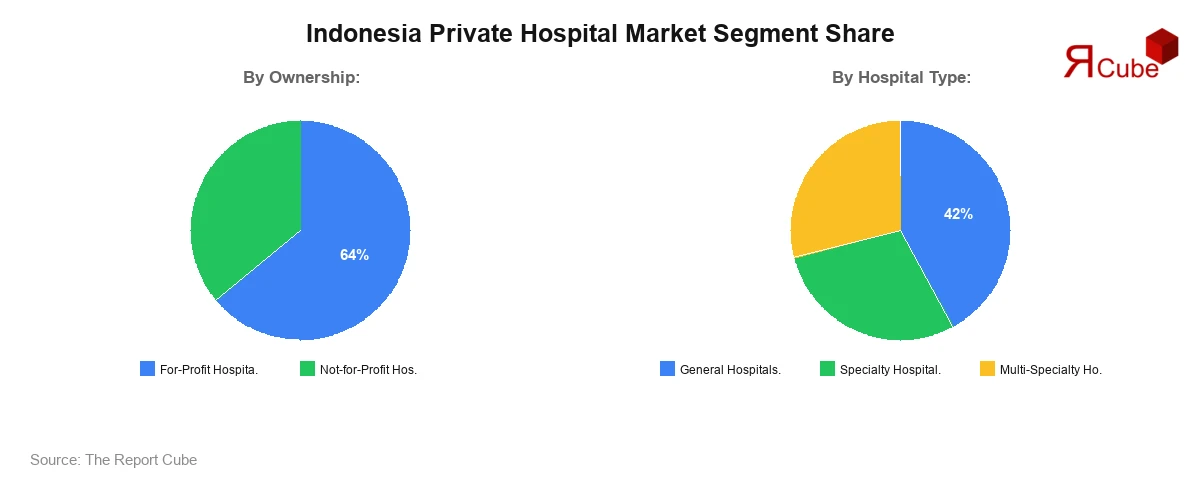
By Ownership:
For-Profit Hospitals segment leads the market, with around 64% market share.
By Hospital Type:
General Hospitals segment dominates the market, accounting for nearly 42% of total revenue.
Regional Outlook:
Java region dominates the Indonesia private hospital market, with around 56% market share.
Indonesia Private Hospital Market Insights & Analysis
The Indonesia Private Hospital Market is anticipated to register a CAGR of 8.3% during 2026-2034. The market size was valued at USD 21.8 billion in 2025 and is projected to reach USD 44.68 billion by 2034. Indonesia’s healthcare system has been undergoing significant transformation driven by population growth, rising income levels, and increasing demand for high-quality medical services. Private hospitals play a crucial role in addressing capacity gaps within the public healthcare system while also providing specialized and premium medical services for middle- and high-income populations.
Indonesia’s population exceeded 280 million in 2025, creating substantial demand for accessible and modern healthcare infrastructure. Public hospitals often face resource constraints, long waiting times, and uneven distribution across provinces. Private healthcare providers have stepped in to fill these gaps by expanding hospital networks, introducing specialized treatment centers, and investing in advanced diagnostic equipment. Private hospitals currently account for more than 55% of Indonesia’s hospital facilities, highlighting their growing importance in the national healthcare ecosystem.
Investment activity in the sector has increased rapidly as both domestic conglomerates and international healthcare organizations recognize the strong long-term growth potential. Major hospital groups are expanding through new facility development, acquisitions, and partnerships with international medical institutions. For example, collaborations with global healthcare providers are enabling Indonesian hospitals to introduce advanced clinical capabilities such as robotic surgery, precision oncology, and telemedicine platforms. These developments are strengthening the competitiveness of private hospitals and positioning Indonesia as an emerging destination for regional medical tourism.
Government healthcare reforms are also contributing to market growth. Indonesia’s universal healthcare program, BPJS Kesehatan, continues to expand coverage and increase patient inflow to hospitals. Although reimbursement rates differ from private insurance payments, participation in BPJS programs provides consistent patient volumes for hospitals. In addition, healthcare infrastructure investment programs have encouraged private hospital development in underserved regions. As Indonesia continues to urbanize and healthcare awareness improves, private hospitals are expected to experience sustained demand for specialized services and modern healthcare facilities.
Indonesia Private Hospital Market Impact Analysis
| Factor | Type | Specific Impact on Market | Magnitude | Business Implication |
|---|---|---|---|---|
| JKN Universal Health Coverage | Regulatory | Government insurance expands patient volumes at scale | High | Partner with JKN; optimize volume-driven care models |
| Rising Middle-Class Income | Consumer | Higher disposable income lifts private healthcare spending | High | Target premium services and specialty care in urban hubs |
| Foreign Investment Liberalization | Regulatory | 100% foreign ownership permits international expansion | High | Attract FDI for network expansion and tech upgrades |
| Medical Tourism Retention | Market | Advanced care reduces USD 4B outbound patient leakage | Medium | Develop centers of excellence in oncology and cardiac |
| Technology and Digital Health | Technological | AI, IoT, telemedicine enhance delivery and efficiency | High | Invest in smart hospital systems and digital platforms |
| Market Fragmentation | Competitive | Top 10-15 groups hold only 10% of private bed supply | Medium | Pursue M&A to consolidate fragmented single-site assets |
| Public-Private Partnerships | Market | PPP models expand infrastructure and facility capacity | Medium | Engage in government PPP projects for rapid scaling |
| Supply Chain Delays | Market | 68% of facilities report delivery delays impacting care | Medium | Standardize logistics and adopt predictive analytics |
| Regulatory Certification Complexity | Regulatory | Lengthy compliance processes slow market entry and scale | Low | Streamline internal compliance and certification teams |
| Private Insurance Penetration | Consumer | Growing private coverage expands premium service demand | Medium | Design bundled packages for insured corporate segments |
Indonesia Private Hospital Market Dynamics
Key Driver: Rising Healthcare Demand and Expanding Middle-Class Population
The rapid expansion of Indonesia’s middle-class population is one of the most influential drivers supporting the growth of the private hospital market. Rising household incomes and improved health awareness have increased consumer willingness to spend on higher-quality medical services. According to national economic estimates, Indonesia’s middle class represented nearly 52 million people in 2025 and is projected to grow steadily throughout the next decade. This demographic shift is fueling demand for private healthcare services that offer shorter waiting times, advanced treatment options, and improved patient experiences compared to many public hospitals.
Chronic disease prevalence has also increased across Indonesia, creating demand for specialized medical care. Cardiovascular disease, diabetes, and cancer cases are rising due to urban lifestyles and aging populations. Private hospitals are investing heavily in specialized departments such as cardiology, oncology, and neurology to address these healthcare needs. Many hospitals are also developing integrated medical centers that combine diagnostics, surgical care, and rehabilitation services within a single facility.
Private healthcare providers are further enhancing patient engagement through digital technologies. Online appointment booking systems, teleconsultation services, and electronic medical records are improving operational efficiency and patient convenience. These innovations help hospitals manage high patient volumes while maintaining service quality. As a result, private hospitals continue to attract both insured and self-pay patients seeking reliable and efficient healthcare solutions.
Book your FREE 30-minute expert consultation today
Contact UsIndustry Trends: Expansion of Specialized Medical Centers and Medical Tourism
The Indonesia private hospital industry is experiencing a notable shift toward specialized medical centers and integrated healthcare campuses. Hospitals are expanding beyond general care services to develop dedicated treatment centers for cardiology, oncology, orthopedics, and neurology. These specialty facilities enable hospitals to attract complex medical cases and offer advanced treatment procedures that were previously available only in overseas hospitals.
Medical tourism is emerging as an important growth opportunity for Indonesian private hospitals. Historically, many Indonesian patients traveled to neighboring countries such as Singapore, Malaysia, and Thailand for advanced medical treatment. However, local hospital groups are now investing heavily in modern equipment, international partnerships, and world-class medical specialists to reduce this outbound medical travel.
Strategic collaborations with international healthcare organizations are accelerating technology transfer and clinical expertise development. Hospitals are adopting robotic surgery systems, AI-enabled diagnostics, and advanced imaging technologies to enhance treatment accuracy and patient outcomes. These improvements are helping Indonesian private hospitals compete with leading regional healthcare providers.
Hospital networks are also expanding geographically to capture underserved markets. New facilities are being developed in secondary cities across Sumatra, Kalimantan, and Sulawesi to improve healthcare access outside major urban centers. This geographic expansion strategy allows hospital groups to reach growing populations while diversifying their revenue sources.
Major Challenge: Uneven Healthcare Infrastructure and Regulatory Complexity
One of the major challenges affecting Indonesia’s private hospital market is the uneven distribution of healthcare infrastructure across regions. Large metropolitan areas such as Jakarta and Surabaya have relatively advanced healthcare facilities, while many rural and remote areas continue to experience limited access to quality hospital services. Developing hospital infrastructure in remote regions requires significant capital investment and logistical planning.
Healthcare regulations and licensing requirements can also influence the pace of hospital expansion. Private healthcare providers must comply with multiple regulatory frameworks related to hospital accreditation, staffing requirements, and healthcare quality standards. Navigating these regulatory processes can increase development timelines for new hospital projects.
Another challenge relates to reimbursement structures under the national health insurance system. Hospitals treating BPJS patients often receive lower reimbursement rates compared to private insurance payments. While BPJS participation increases patient volumes, hospitals must balance operational efficiency and service quality to maintain financial sustainability.
Opportunity: Digital Health Integration and Hospital Network Expansion
Digital health integration presents significant opportunities for Indonesia’s private hospital market. Telemedicine platforms, AI-enabled diagnostic tools, and remote patient monitoring technologies are transforming healthcare delivery models. Hospitals adopting digital health solutions can improve patient engagement, reduce operational costs, and expand services to remote communities.
Hospital networks are also expanding through strategic acquisitions and partnerships. Large healthcare groups are consolidating smaller hospitals to strengthen regional coverage and operational capabilities. This consolidation trend allows hospital groups to achieve economies of scale while maintaining consistent clinical standards across their networks.
Indonesia’s rapidly developing medical tourism sector also presents substantial growth potential. Government support for international hospital projects and medical tourism infrastructure is encouraging private hospital investment in world-class facilities. Hospitals located in medical tourism zones such as Batam and Bali are expected to attract international patients seeking high-quality yet cost-effective medical treatments.
Indonesia Private Hospital Market Segment-wise Analysis
By Ownership:
- For-Profit Hospitals
- Not-for-Profit Hospitals
The for-profit hospitals segment dominates the Indonesia private hospital market with approximately 64% market share in 2025. Large hospital groups such as Siloam Hospitals, Mitra Keluarga, and Hermina Hospitals operate extensive networks of for-profit facilities across major Indonesian cities. These hospitals focus on delivering high-quality medical services, advanced diagnostic capabilities, and specialized treatment centers designed to attract both insured and self-pay patients.
For-profit hospital operators have been aggressively expanding through new facility development and strategic acquisitions. Many hospital groups are investing in modern medical equipment including robotic surgical systems, advanced imaging technologies, and integrated electronic medical records. These investments improve treatment accuracy and patient outcomes while enhancing hospital reputation. For-profit hospitals also benefit from diversified revenue streams, including private insurance partnerships, corporate healthcare contracts, and international patient services. Their strong financial resources enable continuous infrastructure upgrades and network expansion, making them the dominant ownership model in Indonesia’s private healthcare sector.
By Hospital Type:
- General Hospitals
- Specialty Hospitals
- Multi-Specialty Hospitals
The general hospitals segment holds the largest share of Indonesia’s private hospital market, accounting for nearly 42% of total revenue in 2025. General hospitals provide a comprehensive range of medical services including emergency care, surgical procedures, maternity services, and diagnostic testing. Their ability to treat a wide range of medical conditions makes them the primary healthcare destination for many patients.
Private general hospitals have significantly upgraded their service capabilities in recent years. Many facilities now incorporate specialized departments such as cardiology, oncology, orthopedics, and neurology within general hospital frameworks. This integrated care model enables hospitals to manage complex cases while maintaining operational efficiency. Furthermore, private general hospitals often partner with insurance providers and corporate clients, ensuring consistent patient volumes and stable revenue streams. Their strategic positioning as comprehensive healthcare providers continues to drive strong demand across Indonesia’s growing urban population.
Regional Projection of Indonesia Private Hospital Industry
- Sumatra
- Java
- Kalimantan
- Sulawesi
- Nusa Tenggara
- Maluku
- Papua
The Java region dominates Indonesia’s private hospital market, accounting for nearly 56% of total healthcare revenue. Java is home to the country’s largest cities including Jakarta, Surabaya, and Bandung, where population density and healthcare demand are significantly higher than other regions. These urban centers host many of Indonesia’s leading hospital networks, including Siloam Hospitals, Mitra Keluarga, and Mayapada Healthcare.
High economic activity and strong healthcare infrastructure have encouraged continuous investment in private hospitals across the region. Many hospitals in Java offer advanced medical treatments such as cardiac surgery, oncology therapies, and minimally invasive procedures. Additionally, the region benefits from well-developed transportation networks and access to skilled medical professionals, enabling hospitals to deliver high-quality healthcare services.
Java also serves as Indonesia’s primary medical tourism hub. International partnerships and modern hospital facilities attract patients from neighboring countries seeking specialized treatments. As hospital networks continue expanding into secondary cities, the region is expected to maintain its leadership position within Indonesia’s private healthcare industry.
Need insights for a specific region within this market?
Request Regional DataIndonesia Private Hospital Market Regional Analysis
The Indonesia private hospital market varies significantly across regions due to diverse economic development, population density, and healthcare infrastructure.
| Region | Demand Level | Key Areas | System Dominance | Core Demand Logic | Growth Nature |
|---|---|---|---|---|---|
| Java | Extremely High | Jakarta, Surabaya, Bandung | Multi-specialty tertiary hospitals | High density, affluent population & tourism | Market leader with 56% share |
| Sumatra | Medium to High | Medan, Palembang, Pekanbaru | General & specialty hospitals | Urban centers with plantation economy | Steady urban expansion |
| Kalimantan | High (Emerging) | Balikpapan, IKN Nusantara | New capital infrastructure projects | New capital development & resource sector | Fastest infrastructure growth |
| Sulawesi | Medium | Makassar, Manado | Regional specialty centers | Regional hub serving Eastern Indonesia | Regional consolidation |
| Nusa Tenggara | Low to Medium | Denpasar (Bali), Mataram | Medical tourism facilities (Bali) | Bali tourism drives private investment | Tourism-driven growth |
| Maluku | Low | Ambon, scattered islands | Limited general hospitals | Geographic isolation & low population | Minimal private presence |
| Papua | Very Low | Jayapura, scattered remote areas | Basic healthcare facilities | Infrastructure gaps & accessibility issues | Government-dependent sector |
Government Initiatives & Policies
- Indonesia Health Transformation Program (2022–2027): The Ministry of Health launched a national healthcare transformation strategy focusing on hospital infrastructure modernization, improved referral systems, and investment in advanced medical equipment to strengthen healthcare delivery across Indonesia.
- Special Economic Zones for Medical Tourism Initiative: The Indonesian government is promoting medical tourism through dedicated economic zones such as Batam and Bali, encouraging private hospital investments and international partnerships to attract foreign patients and boost healthcare infrastructure development.
Indonesia Private Hospital Market Recent Developments
- 2025: Siloam Hospitals entered a strategic partnership with Marubeni Corporation to strengthen collaboration in Indonesia’s healthcare sector. The partnership focuses on joint initiatives such as outsourced laboratory services and specialized hospital development, supporting Siloam’s long-term expansion strategy and healthcare infrastructure growth.
- 2025: Mitra Keluarga announced plans to expand its hospital network by opening two new hospitals with a combined capacity of approximately 110 beds. The company allocated capital expenditure between IDR 800 billion and IDR 1 trillion to support this expansion and drive double-digit revenue growth.
- 2025: Mayapada Healthcare began developing an international hospital in Batam in partnership with Apollo Hospitals India. The 250-bed facility will include advanced oncology, cardiovascular, orthopedics, gastroenterology, and neurology centers to support Indonesia’s medical tourism initiatives.
- 2025: Pondok Indah Hospital was recognized by Newsweek and Statista as the only Indonesian hospital featured in three categories of the Best Specialized Hospitals Asia Pacific ranking, strengthening its reputation as a leading referral center for complex medical treatments.
Why Choose This Report?
- Provides a comprehensive overview of the overall market analysis, encompassing key trends, consumer behavior analysis, and risk assessment to support strategic decision-making.
- Provides accurate, up-to-date insights into market size, segmentation, and emerging opportunities, helping to minimize risk & capitalizing on growth.
- Gives deep understanding of target audience preferences, investment habits, and communication channels for enhanced product development & marketing effectiveness.
- Delivers competitive analysis & benchmarking, uncovering the strengths & weaknesses of market competitors to guide strategies.
- Consolidate comprehensive market intelligence, reducing reasoning & streamlining research efforts.
- Facilitates customized market segmentation & risk mitigation strategies, fine-tuned to the business objectives.
- Aids in identifying both market challenges & untapped opportunities within the industry to drive long-term business growth.
- Provides valuable information based on actual customer data & search trends.
Table of Contents
- Introduction
- Objective of the Study
- Product and Category Definition
- Market Segmentation
- Study Variables
- Research Methodology
- Secondary Data Points
- Breakdown of Secondary Sources
- Primary Data Points
- Breakdown of Primary Interviews
- Secondary Data Points
- Executive Summary
- Market Dynamics
- Drivers
- Challenges
- Opportunity Assessment
- Recent Trends and Developments
- Regulatory and Policy Landscape
- Indonesia Private Hospital Market Overview (2021-2034)
- Market Size, By Value (USD Billion)
- Market Share, By Ownership
- For‑Profit Hospitals
- Not‑for‑Profit Hospitals
- Market Share, By Hospital Type
- General Hospitals
- Specialty Hospitals
- Multi‑Specialty Hospitals
- Market Share, By Service Type
- Inpatient Services
- Outpatient Services
- Emergency Services
- Daycare Services
- Market Share, By Clinical Specialty
- Cardiology
- Oncology
- Orthopedics
- Obstetrics and Gynecology
- Pediatrics and Neonatology
- Neurology and Neurosurgery
- Gastroenterology
- Others
- Market Share, By Bed Capacity
- Up to 100 Beds
- 101-300 Beds
- 301-500 Beds
- Above 500 Beds
- Market Share, By Payer
- BPJS Patients
- Private Insurance
- Self‑Pay Patients
- Corporate Contracts
- Market Share, By Region
- Sumatra
- Java
- Kalimantan
- Sulawesi
- Nusa Tenggara
- Maluku
- Papua
- Market Share, By Company
- Revenue Shares and Analysis
- Competitive Landscape
- Sumatra Indonesia Private Hospital Market
- Market Size, By Value (USD Billion/Million)
- Market Share, By Ownership
- Market Share, By Hospital Type
- Market Share, By Service Type
- Market Share, By Clinical Specialty
- Market Share, By Bed Capacity
- Market Share, By Payer
- Java Indonesia Private Hospital Market
- Market Size, By Value (USD Billion/Million)
- Market Share, By Ownership
- Market Share, By Hospital Type
- Market Share, By Service Type
- Market Share, By Clinical Specialty
- Market Share, By Bed Capacity
- Market Share, By Payer
- Kalimantan Indonesia Private Hospital Market
- Market Size, By Value (USD Billion/Million)
- Market Share, By Ownership
- Market Share, By Hospital Type
- Market Share, By Service Type
- Market Share, By Clinical Specialty
- Market Share, By Bed Capacity
- Market Share, By Payer
- Sulawesi Indonesia Private Hospital Market
- Market Size, By Value (USD Billion/Million)
- Market Share, By Ownership
- Market Share, By Hospital Type
- Market Share, By Service Type
- Market Share, By Clinical Specialty
- Market Share, By Bed Capacity
- Market Share, By Payer
- Nusa Tenggara Indonesia Private Hospital Market
- Market Size, By Value (USD Billion/Million)
- Market Share, By Ownership
- Market Share, By Hospital Type
- Market Share, By Service Type
- Market Share, By Clinical Specialty
- Market Share, By Bed Capacity
- Market Share, By Payer
- Maluku Indonesia Private Hospital Market
- Market Size, By Value (USD Billion/Million)
- Market Share, By Ownership
- Market Share, By Hospital Type
- Market Share, By Service Type
- Market Share, By Clinical Specialty
- Market Share, By Bed Capacity
- Market Share, By Payer
- Papua Indonesia Private Hospital Market
- Market Size, By Value (USD Billion/Million)
- Market Share, By Ownership
- Market Share, By Hospital Type
- Market Share, By Service Type
- Market Share, By Clinical Specialty
- Market Share, By Bed Capacity
- Market Share, By Payer
- Competitive Outlook and Company Profiles
- Siloam Hospitals
- Company Overview
- Service Portfolio
- Strategic Alliances and Partnerships
- Recent Developments
- Mitra Keluarga
- Company Overview
- Service Portfolio
- Strategic Alliances and Partnerships
- Recent Developments
- Hermina Hospitals
- Company Overview
- Service Portfolio
- Strategic Alliances and Partnerships
- Recent Developments
- Mayapada Healthcare
- Company Overview
- Service Portfolio
- Strategic Alliances and Partnerships
- Recent Developments
- Primaya Hospital
- Company Overview
- Service Portfolio
- Strategic Alliances and Partnerships
- Recent Developments
- Pondok Indah Hospital
- Company Overview
- Service Portfolio
- Strategic Alliances and Partnerships
- Recent Developments
- EMC Healthcare
- Company Overview
- Service Portfolio
- Strategic Alliances and Partnerships
- Recent Developments
- Eka Hospital
- Company Overview
- Service Portfolio
- Strategic Alliances and Partnerships
- Recent Developments
- Ciputra Hospital
- Company Overview
- Service Portfolio
- Strategic Alliances and Partnerships
- Recent Developments
- Brawijaya Hospital
- Company Overview
- Service Portfolio
- Strategic Alliances and Partnerships
- Recent Developments
- Awal Bros Hospital
- Company Overview
- Service Portfolio
- Strategic Alliances and Partnerships
- Recent Developments
- Bunda Hospital (BMHS)
- Company Overview
- Service Portfolio
- Strategic Alliances and Partnerships
- Recent Developments
- Bethsaida Hospital
- Company Overview
- Service Portfolio
- Strategic Alliances and Partnerships
- Recent Developments
- Pantai Indah Kapuk (PIK)
- Company Overview
- Service Portfolio
- Strategic Alliances and Partnerships
- Recent Developments
- Santosa Hospital
- Company Overview
- Service Portfolio
- Strategic Alliances and Partnerships
- Recent Developments
- Medistra Hospital
- Company Overview
- Service Portfolio
- Strategic Alliances and Partnerships
- Recent Developments
- National Hospital
- Company Overview
- Service Portfolio
- Strategic Alliances and Partnerships
- Recent Developments
- Others
- Siloam Hospitals
- Contact Us and Disclaimer
Top Key Players & Market Share Outlook
- Siloam Hospitals
- Mitra Keluarga
- Hermina Hospitals
- Mayapada Healthcare
- Primaya Hospital
- Pondok Indah Hospital
- EMC Healthcare
- Eka Hospital
- Ciputra Hospital
- Brawijaya Hospital
- Awal Bros Hospital
- Bunda Hospital (BMHS)
- Bethsaida Hospital
- Pantai Indah Kapuk (PIK)
- Santosa Hospital
- Medistra Hospital
- National Hospital
Frequently Asked Questions






