



Build Your Custom Market Intelligence Report
Customize Your ReportU.S. Probiotic Dietary Supplement Market Key Takeaways
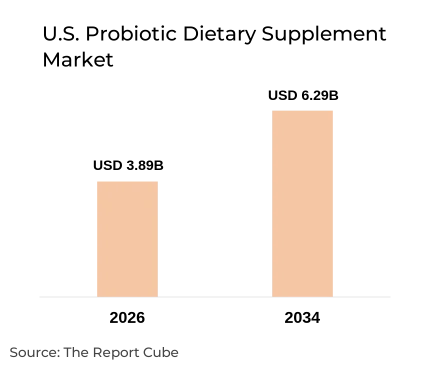
- Market valued at USD 3.89 billion in 2026, reflecting strong consumer wellness investment.
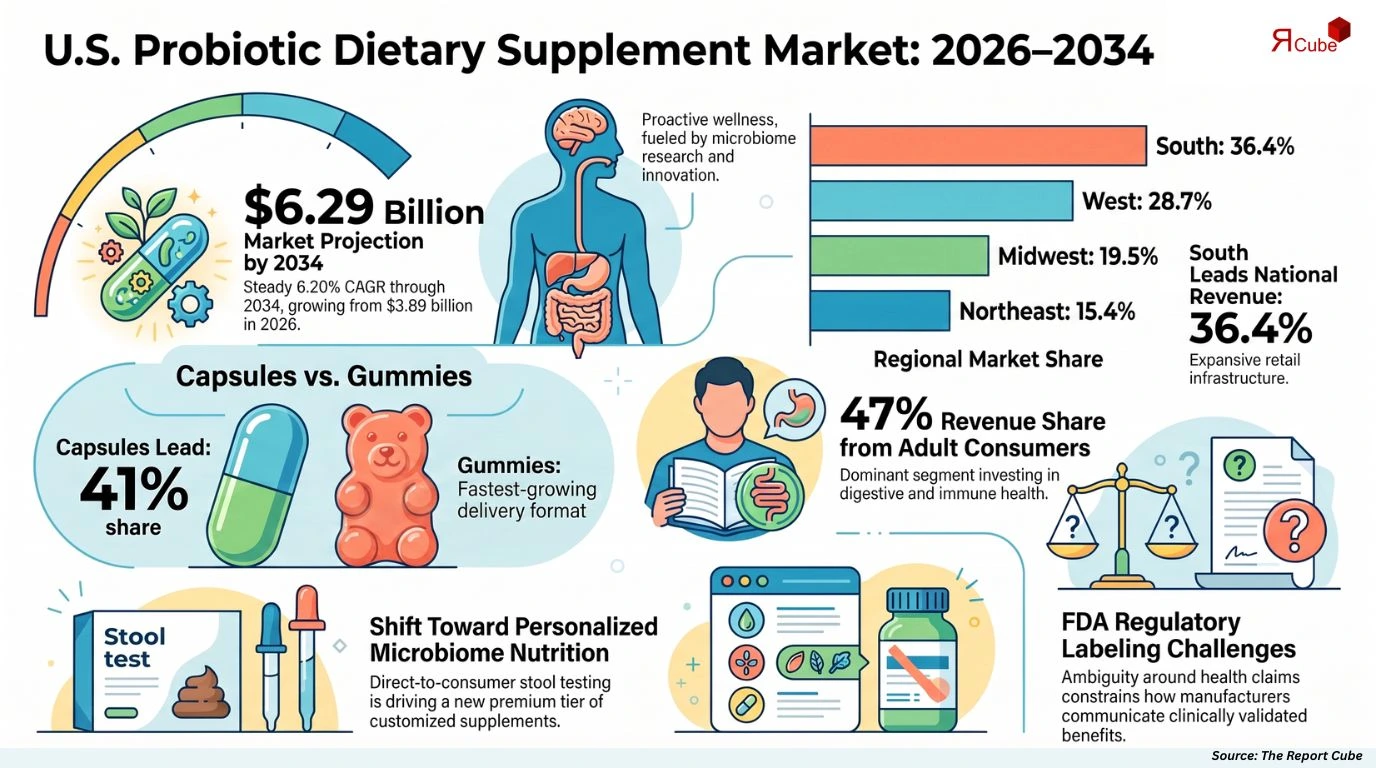
- Industry projected to reach USD 6.29 billion by 2034, expanding at 6.20% CAGR.
- Adults dominate the end-use segment, accounting for the largest consumer revenue share.
- Capsules remain the leading form segment owing to high bioavailability and consumer convenience.
- The South region leads U.S. revenue generation through expansive retail and health infrastructure.
- Chewables and gummies emerge as the fastest-growing form driven by pediatric demand.
- Leading companies include BioGaia AB, Bayer AG, BASF SE, GSK PLC, and DuPont de Nemours.
- Rising preventive healthcare awareness and microbiome research continue accelerating probiotic supplement adoption.
U.S. Probiotic Dietary Supplement Market Insights & Analysis
The U.S. Probiotic Dietary Supplement Market is anticipated to register a 6.20% CAGR during 2026–2034. The market size was valued at USD 3.89 billion in 2026 and is projected to reach USD 6.29 billion by 2034. The industry is benefiting from growing consumer interest in preventive nutrition, a scientifically validated understanding of the gut-brain axis, and expanding clinical evidence linking probiotic supplementation to immune modulation, metabolic health, and gastrointestinal function. Federal initiatives supporting dietary supplement safety and the NIH Human Microbiome Project have further amplified mainstream awareness across diverse consumer demographics throughout the U.S.
Manufacturers are responding to demand acceleration by investing in strain-specific formulation science, precision fermentation technologies, and delivery innovations that improve probiotic viability during shelf life. Strategic funding rounds have supported microbiome-focused startups while established players such as BASF SE and DuPont de Nemours continue advancing proprietary probiotic strain development and fermentation technology pipelines. Retail channel expansion across e-commerce, pharmacy chains, and specialty health food stores is further intensifying competition and broadening consumer access to functional supplement portfolios nationwide.
U.S. Probiotic Dietary Supplement Market Dynamics
The U.S. probiotic dietary supplement sector continues advancing as consumer health priorities shift from reactive medical treatment toward proactive nutritional intervention. Surging clinical publications on gut microbiome function, expanding retail availability, and aggressive product innovation across gummy, capsule, and powder formats are collectively reinforcing sustainable market momentum. Regulatory engagement from the FDA and FTC around structure-function claims also continues shaping formulation and marketing strategies for supplement manufacturers.
|
Factor |
Type |
Specific Impact on Market |
Magnitude |
|---|---|---|---|
|
Preventive healthcare awareness |
Driver |
Accelerates adult and geriatric probiotic supplement adoption |
Very High |
|
Pediatric nutrition demand |
Opportunity |
Expands gummies and chewables product development pipelines |
High |
|
Microbiome research investment |
Driver |
Stimulates strain-specific product differentiation and premiumization |
High |
|
FDA structure-function labeling rules |
Challenge |
Constrains permissible health claims on probiotic packaging |
Moderate |
|
Personalized nutrition technology |
Trend |
Drives customized probiotic formulation and direct-to-consumer growth |
High |
Key Market Driver: Gut Health Awareness Fueling Consumer Demand
Growing scientific consensus connecting gut microbiota balance to immunity, mental health, metabolic function, and chronic disease prevention has positioned probiotic supplementation as a cornerstone of preventive wellness strategies. A 2024 International Probiotics Association survey indicated that over 68% of U.S. supplement users actively seek products containing clinically validated bacterial strains such as Lactobacillus acidophilus and Bifidobacterium longum. This evidence-led consumer behavior is compelling manufacturers to invest in high-CFU formulations, refrigeration-stable delivery systems, and transparent strain-level labeling that builds trust among health-conscious adult and geriatric demographics.
Major Industry Challenge: Regulatory Ambiguity Around Health Claims
The FDA's existing framework for dietary supplement structure-function claims creates significant compliance complexity for probiotic manufacturers seeking to differentiate products through clinically meaningful benefit statements. Companies may not reference specific diseases on packaging without submitting a new drug application, limiting the ability to communicate validated outcomes such as irritable bowel syndrome relief or antibiotic-associated diarrhea prevention. This regulatory ambiguity increases marketing expenditure, narrows permissible communication channels, and creates an uneven competitive environment where scientifically advanced products cannot always demonstrate their full clinical value to end consumers.
Emerging Trend Shaping Outlook: Personalized Microbiome-Based Supplementation
Direct-to-consumer microbiome testing platforms are enabling personalized probiotic recommendations based on individual gut composition data, fundamentally shifting the supplement purchasing model from generalized wellness products toward precision nutrition solutions. Companies integrating at-home stool testing with subscription-based personalized probiotic supplement delivery services are achieving superior consumer retention rates compared to traditional retail channels. This trend is expected to generate a measurable premium pricing tier within the U.S. market through 2034, attracting investment from both established supplement conglomerates and venture-backed microbiome technology firms.
Need Specific Data, Let’s Customize the Report for You
Request CustomizationU.S. Probiotic Dietary Supplement Market Segment-wise Analysis
The U.S. probiotic dietary supplement sector demonstrates broad segmentation across delivery formats and consumer age cohorts, with each sub-segment presenting distinct formulation requirements, channel preferences, and clinical positioning strategies that manufacturers must address to capture available revenue opportunities.
By Form
- Chewables & Gummies
- Capsules
- Powders
- Tablets & Softgels
- Others
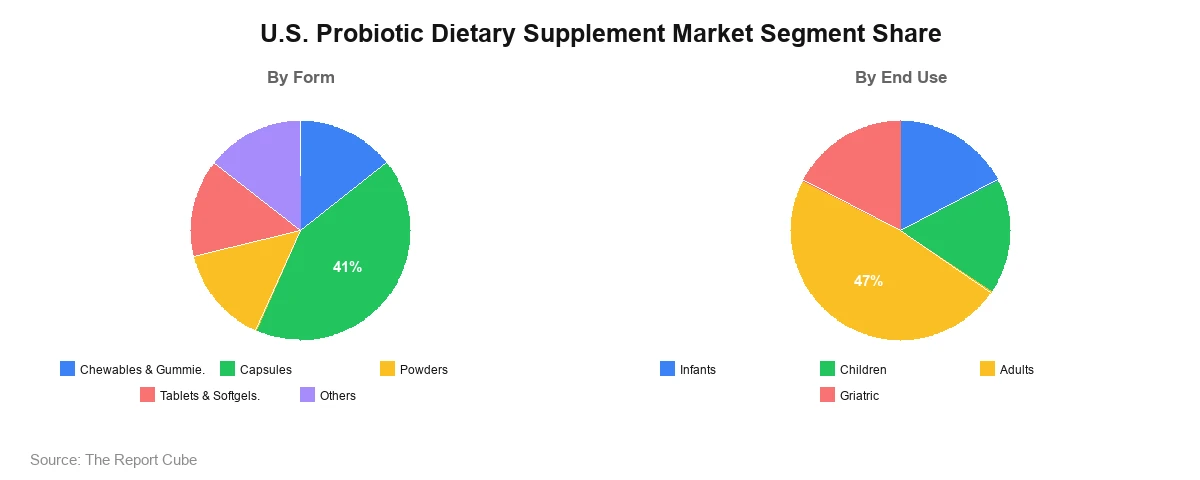
Capsules dominate the By Form segment with an estimated 41% revenue share, reflecting strong consumer preference for precise CFU dosing, superior probiotic strain protection through enteric coating, and established clinical trial precedent using capsule delivery. Healthcare practitioner endorsement of capsule formats continues reinforcing purchase behavior among adult and geriatric demographics seeking therapeutic-grade supplementation for digestive health, immune support, and post-antibiotic microbiome restoration. Manufacturers including DuPont de Nemours and BASF SE continue investing in advanced encapsulation technologies that extend probiotic viability at ambient temperatures across pharmacy and e-commerce distribution channels.
Chewables and gummies represent the fastest-growing form sub-segment, driven by pediatric demand, flavor innovation, and the broader gummy supplement category expansion that has reshaped U.S. retail shelving over the past three years. Powders maintain meaningful penetration among sports nutrition and infant nutrition consumers, where probiotic powder blending into functional food matrices offers flexible dosing convenience. Tablets and softgels serve cost-sensitive adult buyers seeking economy-tier supplementation, while the Others category encompasses liquid shots and sachets gaining traction in condition-specific clinical nutrition segments.
By End Use
- Infants
- Children
- Adults
- Geriatric
Adults account for the dominant share across the By End Use segment, representing an estimated 47% of total U.S. probiotic dietary supplement revenue in 2026. This dominance reflects the adult consumer cohort's established supplement purchasing behavior, strong awareness of digestive and immune health benefits, and growing openness to probiotic supplementation for mental wellness applications linked to the gut-brain axis. Bayer AG, GSK PLC, and Glanbia PLC continue targeting adult wellness positioning through pharmacy-channel distribution, sports nutrition retail integration, and subscription-based direct-to-consumer platforms that support long-term consumer retention.
The geriatric segment is demonstrating accelerating growth as aging U.S. consumers increasingly adopt probiotic supplementation to address age-related gut dysbiosis, antibiotic-associated digestive disruption, and immune decline. Infants and children together represent a strategically significant and fast-growing combined cohort where pediatricians' endorsement of BioGaia AB's Lactobacillus reuteri drops and Archer-Daniels-Midland's infant nutrition ingredients underpins category credibility. The pediatric end-use segment also benefits from the broader children's dietary supplement consumption trends shift toward palatable gummy and liquid formats that support household adoption.
Regional Projection of U.S. Probiotic Dietary Supplement Market
The U.S. probiotic dietary supplement market demonstrates measurable regional variation influenced by population demographics, healthcare infrastructure density, retail channel maturity, and consumer health awareness levels, with distinct revenue concentration patterns across the four primary U.S. census regions.
|
Region |
Estimated Market Share |
Key Growth Factors |
Consumer Trends |
|---|---|---|---|
|
South |
36.4% |
Large population base, expanding pharmacy and health retail chains |
High capsule and adult supplement adoption |
|
West |
28.7% |
Health-conscious urban consumers, premium supplement culture |
Strong demand for personalized and organic probiotics |
|
Midwest |
19.5% |
Growing preventive health awareness, increasing rural health retail |
Rising gummy and chewable format adoption |
|
Northeast |
15.4% |
High income levels, dense healthcare practitioner networks |
Premium clinical-grade probiotic supplement preference |
- South: The South leads U.S. regional revenue with approximately 36.4% market share, supported by a large and demographically diverse population, broad pharmacy chain footprint, and rising chronic disease prevalence driving preventive supplement adoption across adult and geriatric consumer segments.
- West: The West captures approximately 28.7% share, anchored by health-conscious urban consumer bases in California and the Pacific Northwest who demonstrate above-average willingness to pay for premium probiotic formulations, organic-certified strains, and microbiome-tested personalized supplement products.
- Midwest: The Midwest holds approximately 19.5% share with accelerating growth momentum as preventive healthcare awareness expands into suburban and rural markets and pharmacy-led supplement retail continues improving regional product accessibility.
- Northeast: The Northeast accounts for approximately 15.4% share, driven by high household income levels, dense healthcare practitioner networks, and urban consumer preference for clinically validated, high-CFU probiotic formulations distributed through specialty health retailers and online channels.
U.S. Probiotic Dietary Supplement Market: Recent Development (2025)
- BioGaia AB expanded its pediatric Lactobacillus reuteri probiotic drop range across U.S. pharmacy retail.
- Bayer AG launched a new high-CFU adult probiotic capsule line targeting immune and digestive wellness.
- GSK PLC entered a strategic partnership with a U.S. microbiome firm to advance precision probiotic formulations.
- DuPont de Nemours advanced proprietary HOWARU probiotic strain portfolio through a new U.S. distribution agreement.
U.S. Probiotic Dietary Supplement Market Future Outlook (2034)
The U.S. Probiotic Dietary Supplement Market is projected to expand at a steady 6.20% CAGR, reaching approximately USD 6.29 billion by 2034. Continued advances in precision fermentation, strain genomics, and microbiome diagnostics will enable manufacturers to develop increasingly targeted probiotic formulations addressing condition-specific health outcomes across immunity, mental health, metabolic function, and women's health. Rising consumer sophistication, growing healthcare practitioner recommendation rates, and expanding insurance-adjacent wellness benefit programs will collectively sustain broad-based demand growth across all U.S. regions and consumer demographics through the forecast horizon.
Technology-led transformation will remain a defining force as artificial intelligence-assisted microbiome analysis platforms, smart packaging with viability-tracking capabilities, and direct-to-consumer subscription models reshape product development and distribution strategies. Long-term market expansion will also be shaped by end-of-life probiotic manufacturing sustainability and green fermentation practices as environmental compliance increasingly influences procurement decisions among major supplement brands. Strategic mergers, acquisitions, and licensing agreements among companies such as Symrise AG, Archer-Daniels-Midland Co, and BASF SE are expected to further consolidate the competitive landscape while accelerating ingredient innovation and market reach.
U.S. Probiotic Dietary Supplement Market Report Coverage
|
Report Attribute |
Details |
|---|---|
|
Market Name |
U.S. Probiotic Dietary Supplement Market |
|
Market Size (2026) |
USD 3.89 Billion |
|
Market Size (2034) |
USD 6.29 Billion |
|
Forecast Period |
2026–2034 |
|
CAGR |
6.20% |
|
Base Year |
2026 |
|
Historical Years |
2021–2025 |
|
Forecast Years |
2026–2034 |
|
Segments Covered |
By Form, By End Use, By Application |
|
Regions Covered |
South, West, Midwest, Northeast |
|
Key Companies |
BioGaia AB Class B, Amway Malaysia Holdings, Symrise AG, DuPont de Nemours Inc, Archer-Daniels-Midland Co, Bayer AG, GSK PLC, Glanbia PLC, BASF SE, Others |
|
Report Format |
PDF, Excel, PPT |
|
Customization |
Available as per client requirements |
Why Choose This Report?
- Comprehensive analysis of all probiotic supplement form and end-use segments.
- Accurate market sizing supported by validated 2026–2034 forecast data.
- Detailed U.S. regional breakdown covering South, West, Midwest, and Northeast.
- Competitive profiling of leading global and domestic probiotic supplement companies.
- Insights into personalized nutrition trends shaping direct-to-consumer growth strategies.
- Analysis of FDA regulatory dynamics impacting probiotic health claim communications.
- Coverage of 2025 corporate developments including launches, partnerships, and expansions.
- Strategic intelligence supporting investment, product development, and market entry decisions.
Table of Contents
- Introduction
- Objective of the Study
- Product Definition
- Market Segmentation
- Study Variables
- Research Methodology
- Secondary Data Points
- Companies Interviewed
- Primary Data Points
- Breakdown of Primary Interviews
- Secondary Data Points
- Executive Summary
- Market Dynamics
- Drivers
- Challenges
- Opportunity Assessment
- Recent Trends and Developments
- Policy and Regulatory Landscape
- U.S. Probiotic Dietary Supplement Market Overview and Forecast Analysis (2021-2034)
- Market Size, By Value, By Growth Rate (CAGR/USD Billions)
- Demand – Supply Trends
- Market Share, By Form
- Chewables & Gummies
- Capsules
- Powders
- Tablets & Softgels
- Others
- Market Share, By End Use
- Infants
- Children
- Adults
- Geriatric
- Market Share, By Application
- Sports Fitness
- Energy & Weight Management
- General Health
- Bone & Joint Health
- Gastrointestinal Health
- Immunity
- Others
- Market Share, By Region
- Midwest
- West
- South
- Northeast
- Market Share, By Competitors
- Competition Characteristics
- Revenue Shares
- Chewables & Gummies U.S. Probiotic Dietary Supplement Market Overview, 2021-2034F
- By Value (USD Million)
- By End Use – Market Size & Forecast 2021-2034, USD Million
- Infants
- Children
- Adults
- Geriatric
- Capsules U.S. Probiotic Dietary Supplement Market Overview, 2021-2034F
- By Value (USD Million)
- By End Use – Market Size & Forecast 2021-2034, USD Million
- Infants
- Children
- Adults
- Geriatric
- Powders U.S. Probiotic Dietary Supplement Market Overview, 2021-2034F
- By Value (USD Million)
- By End Use – Market Size & Forecast 2021-2034, USD Million
- Infants
- Children
- Adults
- Geriatric
- Tablets & Softgels U.S. Probiotic Dietary Supplement Market Overview, 2021-2034F
- By Value (USD Million)
- By End Use – Market Size & Forecast 2021-2034, USD Million
- Infants
- Children
- Adults
- Geriatric
- Others U.S. Probiotic Dietary Supplement Market Overview, 2021-2034F
- By Value (USD Million)
- By End Use – Market Size & Forecast 2021-2034, USD Million
- Infants
- Children
- Adults
- Geriatric
- Competitive Outlook (Company Profile – Partial List)
- BioGaia AB Class B
- Company Overview
- Business Segments
- Strategic Alliances/Partnerships
- Recent Developments
- Amway Malaysia Holdings
- Company Overview
- Business Segments
- Strategic Alliances/Partnerships
- Recent Developments
- Symrise AG
- Company Overview
- Business Segments
- Strategic Alliances/Partnerships
- Recent Developments
- DuPont de Nemours Inc
- Company Overview
- Business Segments
- Strategic Alliances/Partnerships
- Recent Developments
- Archer-Daniels Midland Co
- Company Overview
- Business Segments
- Strategic Alliances/Partnerships
- Recent Developments
- Bayer AG
- Company Overview
- Business Segments
- Strategic Alliances/Partnerships
- Recent Developments
- GSK PLC
- Company Overview
- Business Segments
- Strategic Alliances/Partnerships
- Recent Developments
- Glanbia PLC
- Company Overview
- Business Segments
- Strategic Alliances/Partnerships
- Recent Developments
- Basf SE
- Company Overview
- Business Segments
- Strategic Alliances/Partnerships
- Recent Developments
- Others
- BioGaia AB Class B
- Contact Us & Disclaimer
Top Key Players & Market Share Outlook
- BioGaia AB Class B
- Amway Malaysia Holdings
- Symrise AG
- DuPont de Nemours Inc
- Archer-Daniels Midland Co
- Bayer AG
- GSK PLC
- Glanbia PLC
- Basf SE
- Others
Frequently Asked Questions






