



Build Your Custom Market Intelligence Report
Customize Your ReportJapan Process Automation Market Statistics and Insights
Market Insight
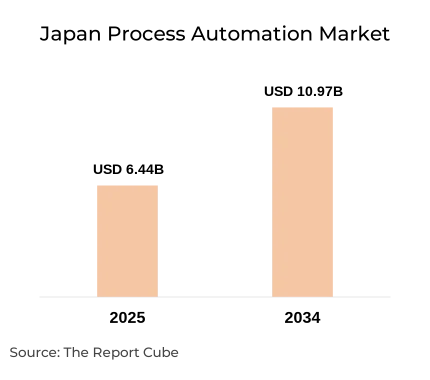
- The Japan Process Automation Market was valued at USD 6.44 billion in 2025.
- The Japan Process Automation Market is projected to reach USD 10.94 billion by 2034.
- The market is anticipated to register a robust CAGR of 6.10% during 2026–2034.
By Communication Protocol
- The Wired Protocol segment leads the market, holding approximately 62% share in 2025.
Competitive Landscape
- More than 10 companies are actively engaged in producing Japan Process Automation Market solutions.
- Top 5 companies acquired around 48% of the market share.
- Mitsubishi Electric Corp, Yaskawa Electric Corp, Yokogawa Electric Corp, Siemens AG, ABB Ltd., and others.
By Application
- The Automotive segment dominates the market, commanding nearly 24% of total application revenue in 2025.
Japan Process Automation Market Insights & Analysis
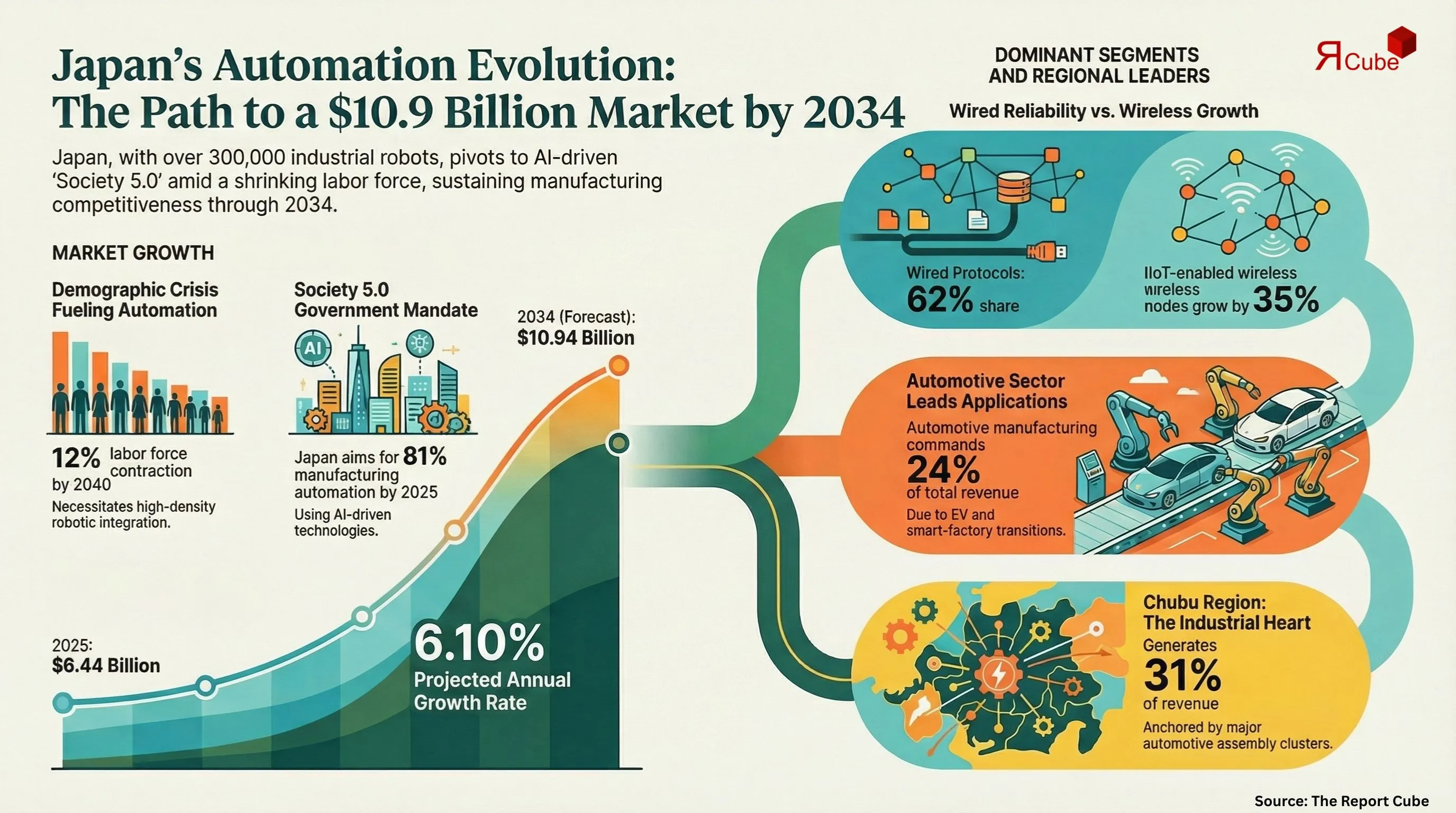
The Japan Process Automation Market is anticipated to register a 6.10% CAGR during 2026–2034. The market size was valued at USD 6.44 billion in 2025 and is projected to reach USD 10.94 billion by 2034. Japan stands as a global leader in industrial automation, hosting the highest density of robots per manufacturing employee worldwide, with over 300,000 industrial robots currently in active operation. This deeply embedded automation culture has created fertile ground for advanced process automation solutions across process-intensive industries.
The Japanese government's Society 5.0 initiative and its commitment to achieving 81% manufacturing automation by 2025 using AI-driven technologies have channeled substantial public and private investments into the sector. Notably, in May 2024, major Japanese conglomerates agreed to increase average monthly wages by 5.58%, intensifying pressure on manufacturers to deploy automation as a long-term workforce cost management strategy. Cross-sector investments in distributed control systems (DCS), programmable logic controllers (PLC), and industrial IoT platforms are accelerating as firms seek to modernize legacy infrastructure while sustaining operational continuity.
Japan Process Automation Market Dynamics
Key Market Driver Aging Workforce Accelerating Industrial Automation Investments
Japan's demographic crisis is one of the most decisive structural drivers reshaping the process automation landscape. The country's labor force is projected to contract by approximately 12% between 2022 and 2040 due to one of the world's fastest-aging populations and persistently low birth rates. This workforce erosion compels manufacturers across oil and gas, chemicals, pharmaceuticals, and automotive sectors to accelerate deployment of automated control systems, SCADA platforms, and smart sensors to maintain output without proportional headcount growth. The Ministry of Economy, Trade and Industry (METI) has identified automation as a national priority, actively subsidizing Industry 4.0 adoption to offset mounting labor costs and sustain Japan's global manufacturing competitiveness.
Major Industry Challenge Legacy Infrastructure Integration Slowing Modernization Timelines
A persistent challenge constraining the Japan Process Automation Market is the complexity of integrating advanced automation technologies with decades-old industrial infrastructure. Many Japanese facilities, particularly in the chemicals, power, and water sectors, operate on proprietary legacy control systems that lack native compatibility with modern digital protocols and IIoT-enabled platforms.
Retrofitting these environments demands substantial engineering customization, lengthy downtime windows, and rigorous safety re-certification processes, all of which extend project timelines and strain capital expenditure budgets. The fragmented nature of industrial communication standards across sectors further complicates interoperability, making seamless integration of wired and wireless protocols an ongoing technical hurdle for systems integrators and end users alike.
Emerging Trend Shaping Outlook IIoT-Enabled Wireless Protocols Transforming Remote Plant Monitoring
The rapid expansion of Industrial Internet of Things (IIoT) connectivity is fundamentally reshaping how Japanese manufacturers monitor and control process automation infrastructure. Wireless protocols such as WirelessHART and ISA100.11a are gaining significant traction across oil and gas, pharma, and power facilities as operators seek to implement real-time remote monitoring without the cost and inflexibility of wired installations.
Yokogawa Electric's OpreX platform and Mitsubishi Electric's e-F@ctory initiative exemplify how leading players are embedding wireless sensor networks and edge computing capabilities into plant ecosystems. By 2028, wireless-enabled automation nodes in Japanese industrial plants are expected to grow by over 35%, driven by predictive maintenance applications, digital twin deployments, and AI-assisted anomaly detection across distributed field devices.
Need Specific Data, Let’s Customize the Report for You
Request CustomizationJapan Process Automation Market Segment-wise Analysis
Japan's process automation market exhibits distinct growth patterns across its two primary segmentation axes, communication protocol and end-use application. Understanding these segment dynamics is essential for stakeholders seeking to allocate resources strategically and identify pockets of above-average demand within Japan's highly sophisticated industrial landscape.
By Communication Protocol
- Wired Protocol
- Wireless Protocol
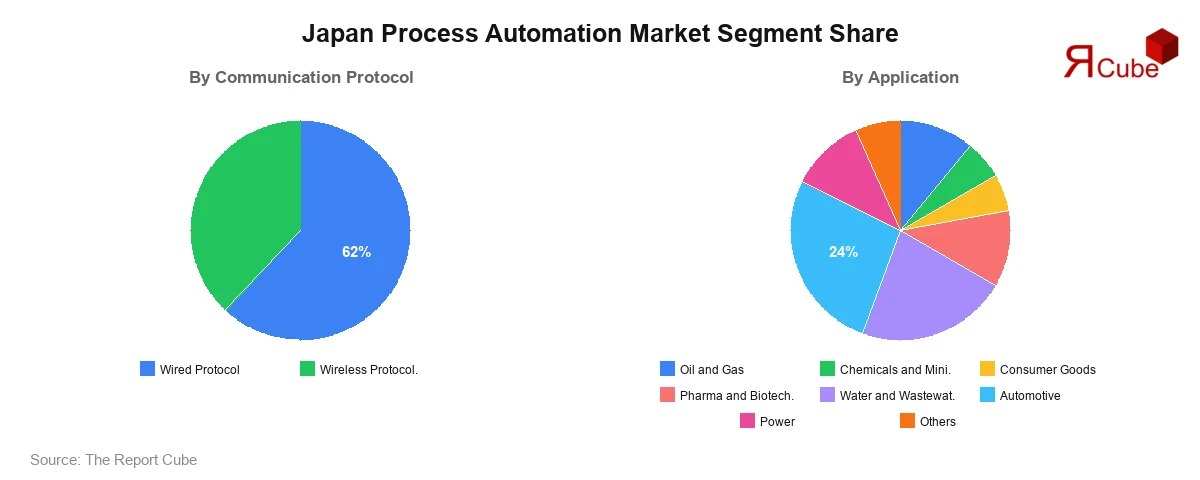
The Wired Protocol segment remains the dominant force within the Japan Process Automation Market by communication protocol, commanding approximately 62% of total revenue in 2025. This dominance is rooted in the long-established reliability, deterministic data transmission, and robust noise immunity that wired systems offer in high-stakes industrial environments such as petroleum refineries, chemical processing plants, and nuclear power facilities. Fieldbus standards including PROFIBUS, Foundation Fieldbus, and HART continue to underpin critical process control loops where signal integrity is non-negotiable.
Wired systems also benefit from Japan's stringent industrial safety regulations, which mandate certified communication channels in hazardous environments. Meanwhile, the Wireless Protocol sub-segment is the faster-growing category, driven by cost-effective installation in greenfield sites and brownfield retrofits, with wireless sensors enabling predictive maintenance and remote condition monitoring across automotive and pharmaceutical plants. Wireless adoption is accelerating in facilities where laying cable infrastructure is physically impractical or economically prohibitive.
By Application
- Oil and Gas
- Chemicals and Mining
- Consumer Goods
- Pharma and Biotech
- Water and Wastewater
- Automotive
- Power
- Others
The Automotive segment is the leading application category, contributing approximately 24% of total market revenue in 2025, underpinned by Japan's globally dominant auto manufacturing ecosystem, anchored by Toyota, Nissan, Honda, and Subaru, which continues to intensify automation investments amid EV platform transitions and smart factory mandates. The Oil and Gas segment ranks as a significant contributor, driven by automation of LNG processing facilities and refinery digitalization programs supported by Japan's energy security policies.
The Pharma and Biotech segment is registering above-average growth as biopharmaceutical manufacturers deploy advanced batch control systems and electronic batch record platforms to meet stringent GMP compliance requirements under the Pharmaceuticals and Medical Devices Act. Water and Wastewater applications are expanding as municipalities invest in SCADA-based remote monitoring to manage aging water infrastructure efficiently, particularly in rural and semi-urban prefectures facing severe population decline.
Regional Projection of Japan Process Automation Market
Japan's process automation market is geographically concentrated, with industrial clusters distributed across several key regions:
- Kanto Region
- Kansai Region
- Chubu Region
- Kyushu Region
- Tohoku Region
The Chubu Region, anchored by Aichi Prefecture and the greater Nagoya industrial belt, commands the leading regional share of approximately 31% of total market revenue, driven by the highest concentration of automotive assembly plants and tier-one supplier facilities in Japan. Toyota City alone accounts for a disproportionate share of PLC and DCS deployments. The Kanto Region ranks second owing to its dense cluster of chemical, pharmaceutical, and energy companies, while Kansai's established heavy chemicals and semiconductor manufacturing base sustains steady automation demand.
Japan Process Automation Market: Recent Development (2025)
- Mitsubishi Electric reported a 7.2% operating margin growth, driven by factory automation segment expansion in Q1 2025.
- Yokogawa Electric secured a multi-year DCS upgrade contract with a leading Japanese LNG terminal operator in early 2025.
- Siemens AG expanded its SIMATIC PCS 7 deployment footprint across three major Japanese chemical refineries in 2025.
- ABB Ltd. announced a USD 120 million investment to scale its industrial automation solutions portfolio across the Asia-Pacific region in 2025, with Japan as a priority market.
Japan Process Automation Market Future Outlook (2034)
The Japan Process Automation Market is projected to reach USD 10.94 billion by 2034, growing at a steady 6.10% CAGR throughout the forecast period. This trajectory will be shaped by Japan's accelerated transition toward smart manufacturing under the Society 5.0 framework, widespread integration of AI-powered predictive analytics into DCS and SCADA platforms, and expansion of wireless IIoT protocols across greenfield industrial developments.
The pharma and biotech and water infrastructure segments offer significant untapped growth potential as regulatory mandates drive digital process compliance. The convergence of digital twin technology with process automation ecosystems will unlock new value creation pathways for solution providers, while government-backed subsidies under METI's carbon-neutral manufacturing roadmap will accelerate deployment timelines for energy-efficient automation systems across Japan's power and chemicals industries.
Why Choose This Report?
- Provides a comprehensive overview of the overall market analysis, encompassing key trends, consumer behavior analysis, and risk assessment to support strategic decision-making.
- Provides accurate, up-to-date insights into market size, segmentation, and emerging opportunities, helping to minimize risk & capitalizing on growth.
- Gives deep understanding of target audience preferences, investment habits, and communication channels for enhanced product development & marketing effectiveness.
- Delivers competitive analysis & benchmarking, uncovering the strengths & weaknesses of market competitors to guide strategies.
- Consolidate comprehensive market intelligence, reducing reasoning & streamlining research efforts.
- Facilitates customized market segmentation & risk mitigation strategies, fine-tuned to the business objectives.
- Aids in identifying both market challenges & untapped opportunities within the industry to drive long-term business growth.
- Provides valuable information based on actual customer data & search trends.
Table of Contents
- Introduction
- Objective of the study
- Product Definition
- Market Segmentation
- Study Variables
- Research Methodology
- Secondary Data Points
- Companies Interviewed
- Primary Data Points
- Breakdown of Primary Interviews
- Secondary Data Points
- Executive Summary
- Market Dynamics
- Drivers
- Challenges
- Opportunity Assessment
- Recent Trends and Developments
- Policy and Regulatory Landscape
- Japan Process Automation Market Overview (2021-2034)
- Market Size, By Value (in USD Billions)
- Market Share, By System Type
- Supervisory Control and Data Acquisition (SCADA)
- Programmable Logic Controller (PLC)
- Distributed Control System (DCS)
- Machine Execution System (MES)
- Valves and Actuators
- Electric Motors
- Human Machine Interface (HMI)
- Process Safety Systems
- Sensors and Transmitters
- Others
- Market Share, By Communication Protocol
- Wired Protocol
- Wireless Protocol
- Market Share, By Application
- Oil and Gas
- Chemicals and Mining
- Consumer Goods
- Pharma and Biotech
- Water and Wastewater
- Automotive
- Power
- Others
- Market Share, By Region
- Kanto Region
- Kansai Region
- Chubu Region
- Kyushu Region
- Tohoku Region
- Market Share, By Competitors
- Competition Characteristics
- Revenue Shares
- Japan Supervisory Control and Data Acquisition (SCADA) Process Automation Market Overview, 2021-2034F
- By Value (USD Million/Billion)
- By Communication Protocol- Market Size & Forecast 2021-2034, USD Million/Billion
- By Application- Market Size & Forecast 2021-2034, USD Million/Billion
- Japan Programmable Logic Controller (PLC) Process Automation Market Overview, 2021-2034F
- By Value (USD Million/Billion)
- By Communication Protocol- Market Size & Forecast 2021-2034, USD Million/Billion
- By Application- Market Size & Forecast 2021-2034, USD Million/Billion
- Japan Distributed Control System (DCS) Process Automation Market Overview, 2021-2034F
- By Value (USD Million/Billion)
- By Communication Protocol- Market Size & Forecast 2021-2034, USD Million/Billion
- By Application- Market Size & Forecast 2021-2034, USD Million/Billion
- Japan Machine Execution System (MES) Process Automation Market Overview, 2021-2034F
- By Value (USD Million/Billion)
- By Communication Protocol- Market Size & Forecast 2021-2034, USD Million/Billion
- By Application- Market Size & Forecast 2021-2034, USD Million/Billion
- Japan Valves and Actuators Process Automation Market Overview, 2021-2034F
- By Value (USD Million/Billion)
- By Communication Protocol- Market Size & Forecast 2021-2034, USD Million/Billion
- By Application- Market Size & Forecast 2021-2034, USD Million/Billion
- Japan Electric Motors Process Automation Market Overview, 2021-2034F
- By Value (USD Million/Billion)
- By Communication Protocol- Market Size & Forecast 2021-2034, USD Million/Billion
- By Application- Market Size & Forecast 2021-2034, USD Million/Billion
- Japan Human Machine Interface (HMI) Process Automation Market Overview, 2021-2034F
- By Value (USD Million/Billion)
- By Communication Protocol- Market Size & Forecast 2021-2034, USD Million/Billion
- By Application- Market Size & Forecast 2021-2034, USD Million/Billion
- Japan Process Safety Systems Process Automation Market Overview, 2021-2034F
- By Value (USD Million/Billion)
- By Communication Protocol- Market Size & Forecast 2021-2034, USD Million/Billion
- By Application- Market Size & Forecast 2021-2034, USD Million/Billion
- Japan Sensors and Transmitters Process Automation Market Overview, 2021-2034F
- By Value (USD Million/Billion)
- By Communication Protocol- Market Size & Forecast 2021-2034, USD Million/Billion
- By Application- Market Size & Forecast 2021-2034, USD Million/Billion
- Japan Others Process Automation Market Overview, 2021-2034F
- By Value (USD Million/Billion)
- By Communication Protocol- Market Size & Forecast 2021-2034, USD Million/Billion
- By Application- Market Size & Forecast 2021-2034, USD Million/Billion
- Competitive Outlook (Company Profile - Partial List)
- Mitsubishi Electric Corp
- Company Overview
- Business Segments
- Strategic Alliances/Partnerships
- Recent Developments
- Yaskawa Electric Corp
- Company Overview
- Business Segments
- Strategic Alliances/Partnerships
- Recent Developments
- Yokogawa Electric Corp
- Company Overview
- Business Segments
- Strategic Alliances/Partnerships
- Recent Developments
- Eaton Corporation Plc
- Company Overview
- Business Segments
- Strategic Alliances/Partnerships
- Recent Developments
- Siemens AG
- Company Overview
- Business Segments
- Strategic Alliances/Partnerships
- Recent Developments
- Schneider Electric SE
- Company Overview
- Business Segments
- Strategic Alliances/Partnerships
- Recent Developments
- ABB Ltd.
- Company Overview
- Business Segments
- Strategic Alliances/Partnerships
- Recent Developments
- Delta Electronics, Inc
- Company Overview
- Business Segments
- Strategic Alliances/Partnerships
- Recent Developments
- Fuji Electric Co. Ltd
- Company Overview
- Business Segments
- Strategic Alliances/Partnerships
- Recent Developments
- Others
- Mitsubishi Electric Corp
- Contact Us & Disclaimer
Top Key Players & Market Share Outlook
- Mitsubishi Electric Corp
- Yaskawa Electric Corp
- Yokogawa Electric Corp
- Eaton Corporation Plc
- Siemens AG
- Schneider Electric SE
- ABB Ltd.
- Delta Electronics, Inc
- Fuji Electric Co. Ltd
- Others
Frequently Asked Questions






