



Build Your Custom Market Intelligence Report
Customize Your ReportKey Takeaways
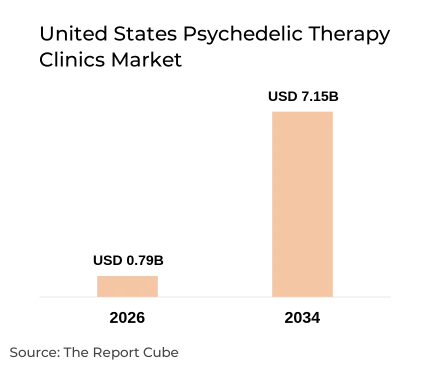
- United States Psychedelic Therapy Clinics Market valued at USD 0.79 billion in 2026, reflecting rapid sector expansion.
- Market projected to reach USD 7.15 billion by 2034 at a 31.70% CAGR through the forecast period.
- Specialty mental health clinics dominate end-user procurement, driven by rising treatment-resistant depression caseloads.
- Oral route of administration leads due to broad clinical adoption of ketamine and psilocybin protocols.
- Hospitals represent the fastest-growing end-user segment as institutional psychedelic programs gain regulatory traction.
- Stella Mental Health, Mindbloom, and Journey Clinical are among the leading clinic networks operating nationally.
- Decriminalization progress and expanded FDA Breakthrough Therapy designations are accelerating clinical deployment.
- Integration of telehealth preparation and integration sessions is reshaping delivery models across all clinic types.
Market Overview
A United States Psychedelic Therapy Clinics Market analysis shows the sector was valued at USD 0.79 billion in 2026 and is projected to reach USD 7.15 billion by 2034 at a 31.70% CAGR. Surging rates of treatment-resistant depression, PTSD, and anxiety disorders are driving institutional and private demand for ketamine, esketamine, and emerging psilocybin-assisted therapies. State-level decriminalization measures and federal legislative activity are collectively broadening the legal operating environment for licensed psychedelic therapy providers across major urban and suburban markets.
Growing clinical evidence from Johns Hopkins, NYU, and MAPS-sponsored trials has accelerated professional acceptance and patient referrals toward psychedelic-assisted mental health treatment. Telehealth-integrated preparation and integration models pioneered by platforms including Mindbloom and Journey Clinical are expanding patient access beyond traditional clinic infrastructure. Investor interest has intensified substantially, with venture capital deployment into clinic networks, compounding pharmacies, and therapist training programs supporting the sector's rapid structural build-out through 2034.
Market Size & Forecast
|
Metric |
Details |
|---|---|
|
Market Size (2026) |
USD 0.79 Billion |
|
Market Size (2034) |
USD 7.15 Billion |
|
CAGR (2026–2034) |
31.70% |
|
Base Year |
2026 |
|
Historical Years |
2021–2025 |
|
Forecast Years |
2026–2034 |
The United States Psychedelic Therapy Clinics Market size stood at USD 0.79 billion in 2026 and is forecast to reach USD 7.15 billion by 2034, expanding at a 31.70% CAGR. This growth substantially outpaces conventional behavioral health sector averages, driven by increasing ketamine infusion clinic density, FDA Breakthrough Therapy designations for psilocybin, and expanding insurance reimbursement conversations across commercial payer networks.
Market Dynamics
The United States Psychedelic Therapy Clinics Market growth trajectory reflects a convergence of clinical evidence accumulation, favorable regulatory signaling, and worsening national mental health burden. Ketamine infusion clinic networks are expanding beyond gateway metropolitan markets into secondary cities, while institutional hospital systems are initiating structured psychedelic therapy pilot programs. Rising therapist workforce development programs and compounding pharmacy partnerships are strengthening supply-side infrastructure.
|
Factor |
Type |
Specific Impact on Market |
Magnitude |
|---|---|---|---|
|
Surging treatment-resistant depression prevalence |
Driver |
Expands addressable patient population seeking ketamine and psilocybin interventions |
High |
|
FDA Breakthrough Therapy designation for psilocybin |
Driver |
Accelerates clinical trial completion and near-term therapy approval pathways |
High |
|
Insurance reimbursement gaps for psychedelic treatments |
Restraint |
Limits patient access to out-of-pocket-capable demographics, constraining volume growth |
Medium |
|
Telehealth-integrated therapy delivery models |
Opportunity |
Enables clinic networks to scale patient preparation and integration sessions efficiently |
High |
|
Therapist training and certification bottlenecks |
Challenge |
Restricts qualified practitioner supply relative to rising clinic demand |
Medium |
- Growth Drivers - Mental Health Crisis and Clinical Evidence Expansion: Treatment-resistant depression affects approximately 30% of the estimated 21 million American adults diagnosed with major depressive disorder. Landmark clinical trials from NYU Langone, Johns Hopkins, and MAPS have generated peer-reviewed efficacy data, compelling psychiatrists and primary care physicians to actively refer patients to licensed ketamine and psychedelic therapy clinic networks.
- Market Restraints - Reimbursement Gaps and Out-of-Pocket Cost Burden: The absence of broad commercial insurance and Medicare reimbursement for ketamine infusion and psilocybin-assisted therapy constrains patient access to higher-income demographics. Treatment courses averaging USD 3,000 to USD 8,000 out of pocket limit market penetration in cost-sensitive patient segments and rural service areas.
- Market Opportunities - Telehealth Integration and Clinic Network Scaling: Digital health platforms integrating remote preparation, dosing-adjacent support, and post-session integration therapy are reducing the per-patient cost of psychedelic treatment delivery. Mindbloom and Journey Clinical have demonstrated scalable telehealth-enhanced ketamine models that enable multi-state expansion without proportional increases in brick-and-mortar infrastructure investment.
- Industry Challenges - Regulatory Complexity and Practitioner Supply Constraints: Psychedelic therapy operates across a fragmented state regulatory landscape, with controlled substance scheduling, clinic licensing, and prescribing protocols varying significantly by jurisdiction. Qualified therapist training pipelines through programs such as MAPS and California Institute of Integral Studies remain insufficient to staff the rate of new clinic openings nationally.
Need Specific Data, Let’s Customize the Report for You
Request CustomizationMarket Trends
- Emerging Trends: United States Psychedelic Therapy Clinics Market trends show clinic networks are transitioning from single-location boutique models to multi-state franchise and licensing structures. Group therapy delivery formats for ketamine treatment are gaining traction as a margin-improving operational model among specialty mental health clinics.
- Technology Trends: AI-driven patient screening tools, biometric monitoring wearables for in-session safety tracking, and electronic health record integrations purpose-built for psychedelic therapy workflows are entering the clinic technology stack. Remote patient monitoring platforms are improving adverse event documentation and regulatory compliance documentation for multi-site operators.
- Consumer / Buyer Trends: Patient demand is expanding beyond early-adopter profiles to include veterans seeking PTSD treatment, chronic pain populations referred through multidisciplinary pain clinics, and corporate wellness programs exploring preventive mental health applications. Patients increasingly research provider credentials, therapy integration quality, and set-and-setting standards before clinic selection.
- Regulatory Trends: Oregon and Colorado have implemented regulated psilocybin therapy frameworks, establishing state-level licensing precedents being monitored by federal regulators. FDA's continued Breakthrough Therapy engagement with COMPASS Pathways and Usona Institute is expected to influence DEA scheduling reviews for psilocybin, with downstream licensing implications for clinic operators nationwide.
United States Psychedelic Therapy Clinics Market Segment Analysis
The United States Psychedelic Therapy Clinics Market serves distinct end-user categories and delivery route classifications, each shaped by regulatory context, clinical protocols, patient demographics, and reimbursement structures. Segment performance diverges substantially across institutional, specialty, and multidisciplinary pain settings.
By End-User
- Specialty Mental Health Clinics
- Hospitals
- Multidisciplinary Pain Clinics
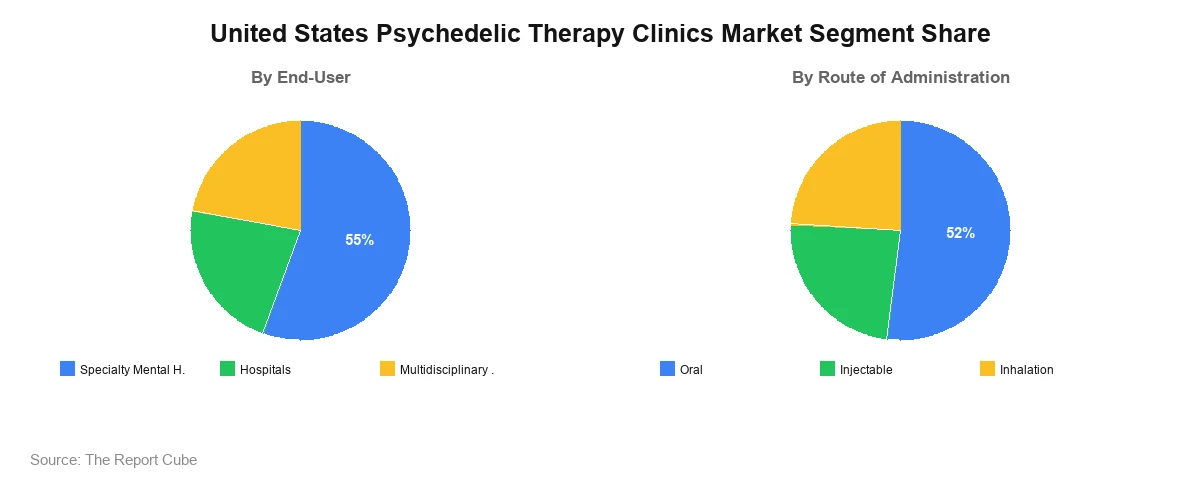
The United States Psychedelic Therapy Clinics Market share by end-user is led by specialty mental health clinics, commanding an estimated 55% of total market revenue in 2026. Clinic networks including Mindbloom, Journey Clinical, and Ketamine Clinics operate dedicated mental health treatment programs serving patients with depression, PTSD, and anxiety disorders. Hospitals represent approximately 28% of end-user demand, with academic medical centers piloting structured ketamine and esketamine programs through psychiatry departments. NY Ketamine Infusions and Stella Mental Health supply protocol frameworks adopted by institutional hospital programs. Multidisciplinary pain clinics account for the remaining 17%, serving chronic pain populations where ketamine infusion therapy is delivered alongside conventional analgesic management.
By Route of Administration
- Oral
- Injectable
- Inhalation
Oral administration leads by route, holding an estimated 52% share in 2026, driven by widespread adoption of oral ketamine lozenges and commercially approved esketamine (Spravato) nasal spray protocols. Mindbloom and Journey Clinical primarily operate oral ketamine-assisted therapy programs. Injectable administration, accounting for approximately 38% of market revenue, dominates hospital-based and specialty clinic ketamine infusion protocols where intravenous delivery ensures precise dosing control. NY Ketamine Infusions and Ketamine Clinics specialize in IV infusion delivery. Inhalation, representing approximately 10%, is an emerging route associated with nitrous oxide-assisted therapy and early clinical inhalation psilocybin research protocols.
Regional Analysis
|
Region |
Estimated Market Share |
Key Growth Factors |
Consumer Trends |
|---|---|---|---|
|
West |
36% |
California, Oregon, Colorado regulatory progress; high clinic density |
Early adoption, tech-industry wellness culture, psilocybin service programs |
|
Northeast |
28% |
Academic medical center partnerships; dense urban patient populations |
High treatment-resistant depression referrals, institutional clinic growth |
|
South |
22% |
Veteran population concentration; growing private clinic networks |
PTSD and military mental health applications; ketamine infusion expansion |
|
Midwest |
14% |
Secondary city clinic expansion; rural telehealth integration |
Mid-market ketamine access; growing psychiatric referral pipelines |
- West - The Western region commands an estimated 36% share, led by California's dense psychedelic clinic concentration across Los Angeles, San Francisco, and San Diego. Oregon's Measure 109 psilocybin service program, operational since 2023, and Colorado's Natural Medicine Health Act have created state-regulated psilocybin therapy markets with growing licensed facilitator and clinic networks.
- Northeast - Accounting for approximately 28% of national market revenue, the Northeast benefits from the highest concentration of academic medical centers conducting psychedelic therapy research. New York institutions including NYU Langone and Columbia University's psychiatry programs are generating referral pipelines for NY Ketamine Infusions and affiliated specialty clinic networks across the region.
- South - The South holds an estimated 22% share, supported by the nation's largest active-duty military and veteran population base. States including Texas, Florida, and Virginia report high PTSD treatment demand, with VA-adjacent private psychedelic therapy clinics gaining referral volume as veteran-focused programs at organizations such as Stella Mental Health expand into Southern markets.
- Midwest - Contributing approximately 14% of market revenue, the Midwest is an emerging growth region as ketamine infusion clinics expand into secondary cities including Chicago, Minneapolis, and Columbus. Telehealth-integrated platforms are enabling Midwest patient access to Journey Clinical-affiliated providers without requiring proximity to coastal urban clinic clusters.
Market Share & Competitive Landscape
The United States Psychedelic Therapy Clinics Market's competitive landscape is defined by a mix of multi-state clinic networks, digital health platforms, and institutional hospital programs competing on clinical protocol quality, therapist training standards, and patient access infrastructure.
|
Company |
Competitive Strength |
Primary Segment Served |
|---|---|---|
|
Stella Mental Health |
Stellate ganglion block protocols; PTSD-focused veteran care |
Specialty mental health clinics, hospital programs |
|
Ketamine Clinics |
Established IV ketamine infusion network; multi-location presence |
Specialty mental health clinics, pain management |
|
NY Ketamine Infusions |
New York City presence; academic referral partnerships |
Specialty mental health, hospital-adjacent programs |
|
Journey Clinical |
Prescriber network + therapist collaboration platform |
Specialty mental health clinics, oral route |
|
Others |
Regional clinics, emerging psilocybin service providers |
All segments |
Key Companies in the United States Psychedelic Therapy Clinics Market
Mindbloom
Mindbloom, headquartered in New York, is one of the United States' largest ketamine-assisted therapy platforms, operating a telehealth-integrated oral ketamine program that pairs remote prescribing with licensed therapist support. In 2024, Mindbloom expanded its provider network across additional states, enabling broader at-home ketamine treatment access. Its scalable digital delivery model and structured therapy integration protocols differentiate it across the United States Psychedelic Therapy Clinics Market.
Stella Mental Health
Stella Mental Health, headquartered in New York, specializes in stellate ganglion block and ketamine-based interventions for PTSD and treatment-resistant depression, with a particularly strong focus on active-duty military and veteran populations. In 2025, Stella expanded its clinical footprint into additional veteran-adjacent markets. Its evidence-based PTSD protocol and strong veteran referral network position it as a differentiated operator in the United States Psychedelic Therapy Clinics Market.
Recent Developments
|
Year |
Company |
Development |
|---|---|---|
|
2025 |
Mindbloom |
Expanded licensed provider network into additional U.S. states, broadening at-home ketamine therapy access |
|
2025 |
Stella Mental Health |
Extended clinical operations into new veteran-focused markets, strengthening PTSD treatment program reach |
Market Future Outlook
The United States Psychedelic Therapy Clinics Market forecast period through 2034 is expected to bring USD 7.15 billion in total market value as institutional hospital adoption, specialty clinic network scaling, and regulatory normalization converge. Specialty mental health clinics will sustain dominant revenue share as depression and PTSD patient volumes grow, while hospital-based programs are expected to increase proportional market contribution as academic medical centers formalize psychedelic therapy departments. Mindbloom, Journey Clinical, and Stella Mental Health are expected to deepen national penetration through provider network expansion and telehealth infrastructure investment.
Technological advancement in biometric patient monitoring, AI-assisted therapy preparation tools, and purpose-built electronic health records for psychedelic treatment documentation will increase operational efficiency across clinic types. Psilocybin therapy is expected to enter broader clinical practice following anticipated FDA review milestones, while state-level regulatory frameworks in Oregon, Colorado, and additional jurisdictions will shape national licensing precedents through 2034.
United States Psychedelic Therapy Clinics Market Report Coverage
This United States Psychedelic Therapy Clinics Market report delivers comprehensive sizing, segmentation, competitive profiling, and regional analysis across the 2026–2034 forecast period.
|
Report Attribute |
Details |
|---|---|
|
Market Name |
United States Psychedelic Therapy Clinics Market |
|
Market Size (2026) |
USD 0.79 Billion |
|
Market Size (2034) |
USD 7.15 Billion |
|
Forecast Period |
2026–2034 |
|
CAGR |
31.70% |
|
Base Year |
2026 |
|
Historical Years |
2021–2025 |
|
Forecast Years |
2026–2034 |
|
Segments Covered |
By End-User (Specialty Mental Health Clinics, Hospitals, Multidisciplinary Pain Clinics); By Route of Administration (Oral, Injectable, Inhalation) |
|
Regions Covered |
West, Northeast, South, Midwest |
|
Key Companies |
Stella Mental Health, Ketamine Clinics, NY Ketamine Infusions, Mindbloom, Journey Clinical, Others |
|
Report Format |
PDF, Excel, PPT |
|
Customization |
Available as per client requirements |
Why Choose This United States Psychedelic Therapy Clinics Market Report?
- Comprehensive coverage of the rapidly expanding U.S. psychedelic therapy clinic ecosystem across all key segments.
- Accurate market sizing from USD 0.79 billion in 2026 through USD 7.15 billion by 2034.
- Detailed segmentation by end-user category and route of administration with share estimates.
- Regional insights covering West, Northeast, South, and Midwest with demand drivers and adoption trends.
- Competitive profiling of leading clinic networks and telehealth-integrated therapy platforms.
- In-depth analysis of regulatory developments in Oregon, Colorado, and federal FDA pathways.
- Forecast data supporting clinic investment, partnership planning, and market entry strategy.
- Coverage aligned with U.S. mental health policy priorities and veteran care program expansion.
Table of Contents
- Introduction
- Objective of the Study
- Product Definition
- Market Segmentation
- Study Variables
- Research Methodology
- Secondary Data Points
- Companies Interviewed
- Primary Data Points
- Breakdown of Primary Interviews
- Secondary Data Points
- Executive Summary
- Market Dynamics
- Drivers
- Challenges
- Opportunity Assessment
- Recent Trends and Developments
- Policy and Regulatory Landscape
- United States Psychedelic Therapy Clinics Market Overview and Forecast Analysis (2021-2034)
- Market Size, By Value, By Growth Rate (CAGR/USD Billions)
- Demand – Supply Trends
- Market Share, By Drug Type
- Ketamine
- Psilocybin
- MDMA-based Therapeutics
- Others
- Market Share, By Target Therapeutic Application
- Treatment-Resistant Depression
- Post-Traumatic Stress Disorder
- Substance Use Disorders
- Anxiety
- Market Share, By End-User
- Specialty Mental Health Clinics
- Hospitals
- Multidisciplinary Pain
- Market Share, By Route of Administration
- Oral
- Injectable
- Inhalation
- Market Share, By Region
- Midwest
- West
- South
- Northeast
- Market Share, By Competitors
- Competition Characteristics
- Revenue Shares
- Ketamine United States Psychedelic Therapy Clinics Market Overview, 2021-2034F
- By Value (USD Million)
- By Target Therapeutic Application – Market Size & Forecast 2021-2034, USD Million
- Treatment-Resistant Depression
- Post-Traumatic Stress Disorder
- Substance Use Disorders
- Anxiety
- Psilocybin United States Psychedelic Therapy Clinics Market Overview, 2021-2034F
- By Value (USD Million)
- By Target Therapeutic Application – Market Size & Forecast 2021-2034, USD Million
- Treatment-Resistant Depression
- Post-Traumatic Stress Disorder
- Substance Use Disorders
- Anxiety
- MDMA-based Therapeutics United States Psychedelic Therapy Clinics Market Overview, 2021-2034F
- By Value (USD Million)
- By Target Therapeutic Application – Market Size & Forecast 2021-2034, USD Million
- Treatment-Resistant Depression
- Post-Traumatic Stress Disorder
- Substance Use Disorders
- Anxiety
- Others United States Psychedelic Therapy Clinics Market Overview, 2021-2034F
- By Value (USD Million)
- By Target Therapeutic Application – Market Size & Forecast 2021-2034, USD Million
- Treatment-Resistant Depression
- Post-Traumatic Stress Disorder
- Substance Use Disorders
- Anxiety
- Competitive Outlook (Company Profile – Partial List)
- Stella Mental Health
- Company Overview
- Business Segments
- Strategic Alliances/Partnerships
- Recent Developments
- Ketamine Clinics Los Angeles
- Company Overview
- Business Segments
- Strategic Alliances/Partnerships
- Recent Developments
- NY Ketamine Infusions
- Company Overview
- Business Segments
- Strategic Alliances/Partnerships
- Recent Developments
- Journey Clinical
- Company Overview
- Business Segments
- Strategic Alliances/Partnerships
- Recent Developments
- Others
- Stella Mental Health
- Contact Us & Disclaimer
Top Key Players & Market Share Outlook
- Stella Mental Health
- Ketamine Clinics Los Angeles
- NY Ketamine Infusions
- Journey Clinical
- Others
Frequently Asked Questions