



Build Your Custom Market Intelligence Report
Customize Your ReportGermany Quick Commerce Grocery Market Key Highlights
By Fulfillment Model:
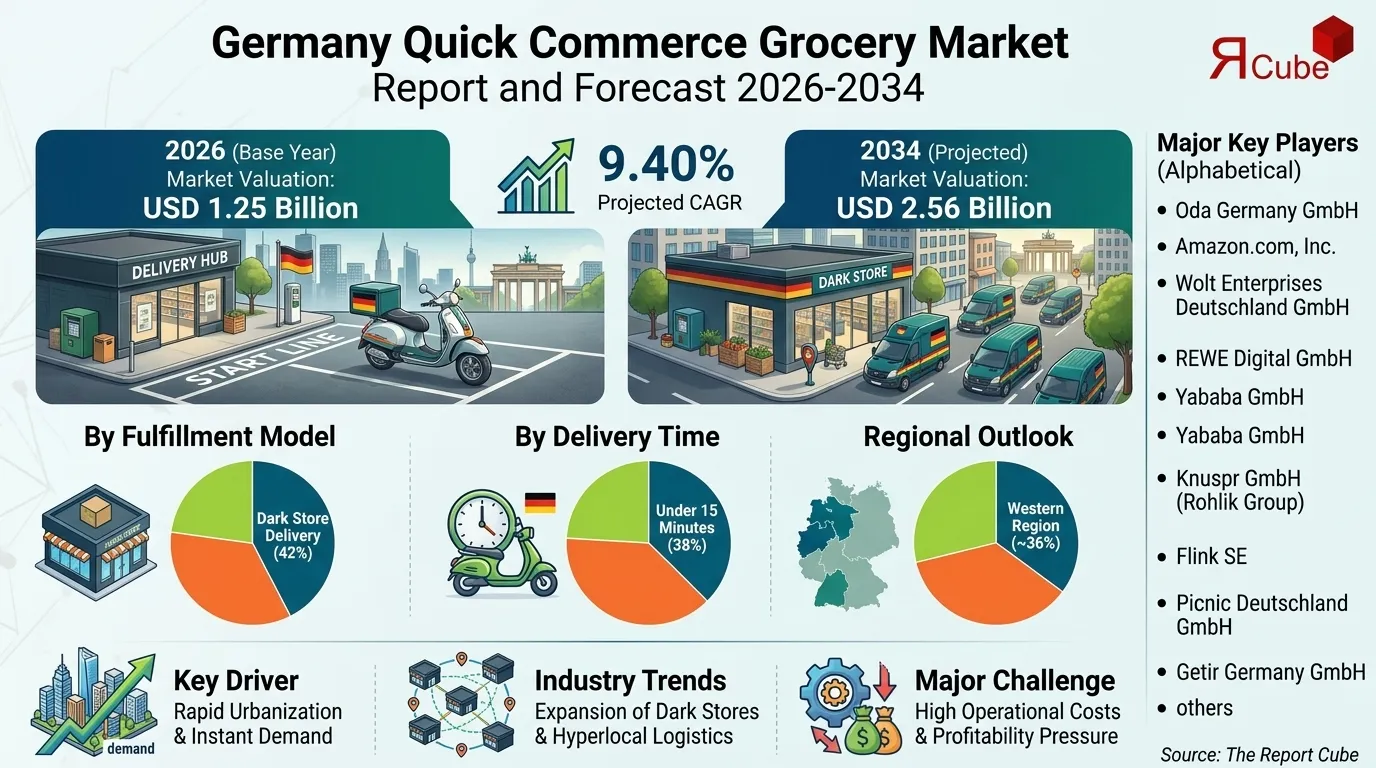
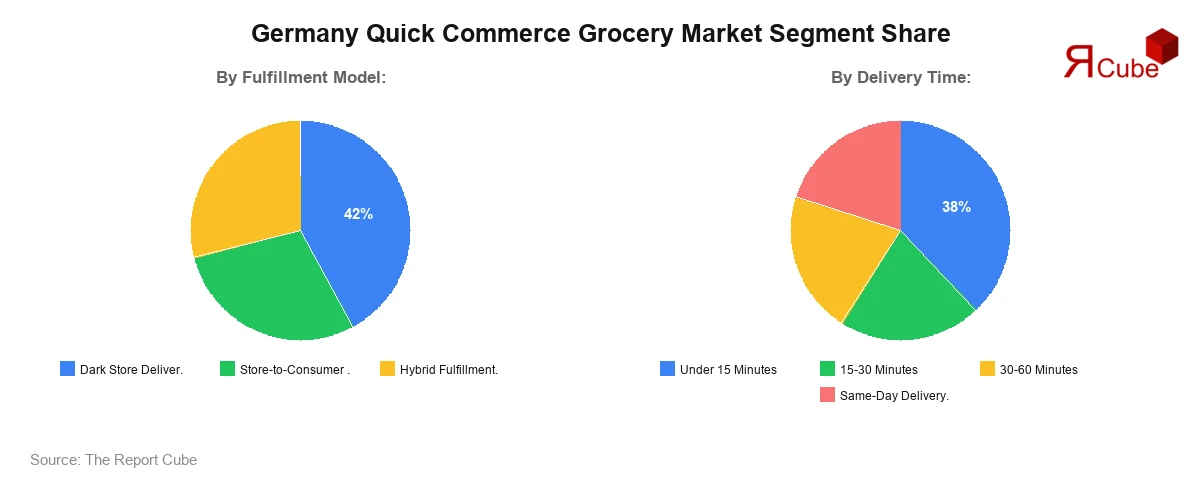
Dark Store Delivery segment leads the market with around 42% share.
By Delivery Time:
Under 15 Minutes segment dominates the market with nearly 38% of revenue.
Regional Outlook:
Western region dominates the Germany Quick Commerce Grocery Market with approximately 36% share.
Germany Quick Commerce Grocery Market Insights & Analysis
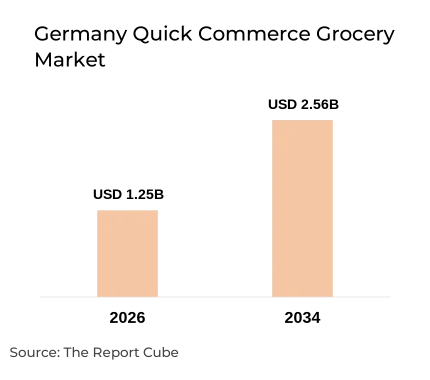
The Germany Quick Commerce Grocery Market is anticipated to register a CAGR of around 9.40% during the forecast period 2026-2034. The market size is valued at USD 1.25 billion in 2026 and is projected to reach USD 2.56 billion by 2034. The Germany quick commerce grocery market size is expanding rapidly as urban consumers shift toward convenience-driven purchasing patterns supported by high smartphone penetration exceeding 85% in 2025. Rising dual-income households and increasing time constraints are encouraging consumers to opt for ultra-fast grocery delivery services, particularly in major cities such as Berlin, Munich, and Hamburg.
Investments in micro-fulfillment centers and dark store infrastructure have significantly accelerated the Germany quick commerce grocery market growth. Companies are investing heavily in AI-powered demand forecasting and route optimization systems, improving delivery efficiency by nearly 25% between 2024 and 2026. Government-backed digitalization strategies and smart city initiatives are also supporting logistics innovation. Moreover, partnerships between retailers and logistics providers are enhancing last-mile delivery capabilities, strengthening the Germany quick commerce grocery market revenue potential while increasing service reliability across both urban and semi-urban regions.
Germany Quick Commerce Grocery Market Dynamics
Key Driver: Rapid Urbanization and Demand for Instant Fulfillment
The primary driver of the Germany quick commerce grocery market is the growing demand for instant fulfillment among urban consumers. Over 77% of Germany’s population resides in urban areas, creating strong demand for rapid delivery services. Consumers increasingly prefer ordering groceries multiple times per week in smaller quantities, which aligns perfectly with the quick commerce model. This behavioral shift is pushing retailers to adopt hyperlocal delivery networks.
Additionally, the rise in digital payment adoption and app-based ordering platforms has simplified the customer journey. Mobile applications account for more than 65% of total quick commerce grocery orders in Germany. This seamless ordering experience, combined with real-time tracking and personalized recommendations, continues to drive market expansion and strengthens overall Germany quick commerce grocery market trends.
Book your FREE 30-minute expert consultation today
Contact UsIndustry Trends: Expansion of Dark Stores and Hyperlocal Logistics
A key trend shaping the Germany quick commerce grocery market is the rapid expansion of dark stores. These facilities are strategically located in dense urban areas to ensure deliveries within 10–20 minutes. By 2026, Germany is expected to host over 1,500 operational dark stores, reflecting a 30% increase from 2024 levels.
Another notable trend is the integration of advanced analytics and automation technologies. Companies are leveraging machine learning algorithms to optimize inventory and reduce stockouts by nearly 20%. This trend is enhancing operational efficiency and improving customer satisfaction, thereby strengthening the Germany quick commerce grocery market share across competitive regions.
Major Challenge: High Operational Costs and Profitability Pressure
The Germany quick commerce grocery market faces significant challenges related to high operational costs. Maintaining ultra-fast delivery requires extensive investments in logistics infrastructure, labor, and technology. Delivery costs per order remain relatively high, often exceeding €5 per delivery, which impacts profitability margins.
Furthermore, rising energy prices and labor costs in Germany are adding additional financial pressure on service providers. Companies must balance speed with cost efficiency, which remains a complex task. These financial constraints are expected to limit smaller players’ expansion and may lead to market consolidation over the forecast period.
Opportunity: Integration of Subscription Models and Private Labels
The introduction of subscription-based delivery models presents a strong opportunity in the Germany quick commerce grocery market. Subscription services offering free deliveries and exclusive discounts are gaining popularity, with adoption rates increasing by nearly 18% annually since 2024.
Additionally, private label product expansion is enabling companies to improve margins while offering competitive pricing. Retailers are increasingly launching their own branded products, which can deliver up to 25% higher margins compared to third-party goods. This trend is expected to drive long-term growth and enhance the Germany quick commerce grocery market value.
Germany Quick Commerce Grocery Market Segment-wise Analysis
By Fulfillment Model:
- Dark Store Delivery
- Store-to-Consumer Delivery
- Hybrid Fulfillment
The dark store delivery segment leads the Germany quick commerce grocery market with approximately 42% share in 2026. This dominance is driven by its ability to support ultra-fast deliveries and maintain optimized inventory management. Dark stores are designed exclusively for online order fulfillment, enabling faster picking and packing processes compared to traditional retail outlets.
Moreover, companies are increasingly investing in automation technologies within dark stores, improving operational efficiency by up to 30%. The scalability of this model makes it highly attractive for expanding urban markets, reinforcing its leading position in the Germany quick commerce grocery market expansion.
By Delivery Time:
- Under 15 Minutes
- 15-30 Minutes
- 30-60 Minutes
- Same-Day Delivery
The under 15 minutes segment dominates the market with nearly 38% revenue share. Consumers are increasingly prioritizing speed, especially for urgent or top-up grocery purchases. This segment has witnessed strong adoption among younger demographics and working professionals.
Companies offering ultra-fast delivery services are gaining a competitive advantage by leveraging dense micro-fulfillment networks. Continuous improvements in route optimization and order batching are further enhancing delivery speed, contributing significantly to Germany quick commerce grocery market trends.
Regional Projection of Germany Quick Commerce Grocery Industry
- Northern
- Western
- Eastern
- Southern
- Others
The Western region holds the largest share of around 36% in the Germany quick commerce grocery market. Cities such as Cologne, Düsseldorf, and Frankfurt are key contributors due to high population density and strong purchasing power. The region benefits from advanced logistics infrastructure and high digital adoption rates.
Additionally, the presence of major market players and early adoption of quick commerce services have accelerated market penetration in Western Germany. Continuous investments in urban logistics and last-mile delivery solutions are expected to further strengthen regional dominance over the forecast period.
Need insights for a specific region within this market?
Request Regional DataGovernment Initiatives & Policies
- Digital Strategy Germany 2025: Supports logistics digitalization and e-commerce innovation.
- Smart City Model Projects Program 2026: Funds urban infrastructure and smart logistics systems enhancing last-mile delivery efficiency.
Germany Quick Commerce Grocery Industry Recent Developments
- 2026: Flink SE secured USD 100 million funding led by Prosus to expand dark store infrastructure and operational capacity across German cities, enhancing delivery coverage and service efficiency.
- 2026: Amazon.com, Inc. expanded its “Amazon Now” quick commerce service into Europe, including Germany, strengthening ultra-fast grocery delivery capabilities and increasing market competition.
Why Choose This Report?
- Provides a comprehensive overview of the overall market analysis, encompassing key trends, consumer behavior analysis, and risk assessment to support strategic decision-making.
- Provides accurate, up-to-date insights into market size, segmentation, and emerging opportunities, helping to minimize risk & capitalizing on growth.
- Gives deep understanding of target audience preferences, investment habits, and communication channels for enhanced product development & marketing effectiveness.
- Delivers competitive analysis & benchmarking, uncovering the strengths & weaknesses of market competitors to guide strategies.
- Consolidate comprehensive market intelligence, reducing reasoning & streamlining research efforts.
- Facilitates customized market segmentation & risk mitigation strategies, fine-tuned to the business objectives.
- Aids in identifying both market challenges & untapped opportunities within the industry to drive long-term business growth.
- Provides valuable information based on actual customer data & search trends.
Table of Contents
- Introduction
- Objective of the Study
- Product and Category Definition
- Market Segmentation
- Study Variables
- Research Methodology
- Secondary Data Points
- Breakdown of Secondary Sources
- Primary Data Points
- Breakdown of Primary Interviews
- Secondary Data Points
- Executive Summary
- Market Dynamics
- Drivers
- Challenges
- Opportunity Assessment
- Recent Trends and Developments
- Regulatory and Policy Landscape
- Germany Quick Commerce Grocery Market Overview (2021-2034)
- Market Size, By Value (USD Billion)
- Market Share, By Fulfillment Model
- Dark Store Delivery
- Store-to-Consumer Delivery
- Hybrid Fulfillment
- Market Share, By Delivery Time
- Under 15 Minutes
- 15-30 Minutes
- 30-60 Minutes
- Same-Day Delivery
- Market Share, By Product
- Fresh Produce
- Dairy and Eggs
- Meat, Fish and Poultry
- Bakery and Confectionery
- Beverages and Alcoholic Drinks
- Pantry Staples and Dry Goods
- Frozen Foods
- Snacks and Convenience Foods
- Personal Care and Household Essentials
- Others
- Market Share, By Order Channel
- Mobile Application
- Website
- Third-Party Aggregator Platforms
- Market Share, By Customer Type
- Household Customers
- Small Business Customers
- Corporate and Office Customers
- Other Customer Types
- Market Share, By Service Type
- Pure Quick Commerce Services
- Online Supermarket Services
- Marketplace and Aggregator Services
- Market Share, By Region
- Northern
- Western
- Eastern
- Southern
- Others
- Market Share, By Company
- Revenue Shares and Analysis
- Competitive Landscape
- Northern Germany Quick Commerce Grocery Market
- Market Size, By Value (USD Billion/Million)
- Market Share, By Fulfillment Model
- Market Share, By Delivery Time
- Market Share, By Product
- Market Share, By Order Channel
- Market Share, By Customer Type
- Market Share, By Service Type
- Western Germany Quick Commerce Grocery Market
- Market Size, By Value (USD Billion/Million)
- Market Share, By Fulfillment Model
- Market Share, By Delivery Time
- Market Share, By Product
- Market Share, By Order Channel
- Market Share, By Customer Type
- Market Share, By Service Type
- Eastern Germany Quick Commerce Grocery Market
- Market Size, By Value (USD Billion/Million)
- Market Share, By Fulfillment Model
- Market Share, By Delivery Time
- Market Share, By Product
- Market Share, By Order Channel
- Market Share, By Customer Type
- Market Share, By Service Type
- Southern Germany Quick Commerce Grocery Market
- Market Size, By Value (USD Billion/Million)
- Market Share, By Fulfillment Model
- Market Share, By Delivery Time
- Market Share, By Product
- Market Share, By Order Channel
- Market Share, By Customer Type
- Market Share, By Service Type
- Competitive Outlook and Company Profiles
- Oda Germany GmbH
- Company Overview
- Product Portfolio
- Strategic Alliances/Partnerships
- Recent Developments
- Amazon.com, Inc.
- Company Overview
- Product Portfolio
- Strategic Alliances/Partnerships
- Recent Developments
- Wolt Enterprises Deutschland GmbH
- Company Overview
- Product Portfolio
- Strategic Alliances/Partnerships
- Recent Developments
- REWE Digital GmbH
- Company Overview
- Product Portfolio
- Strategic Alliances/Partnerships
- Recent Developments
- Yababa GmbH
- Company Overview
- Product Portfolio
- Strategic Alliances/Partnerships
- Recent Developments
- Knuspr GmbH (Rohlik Group)
- Company Overview
- Product Portfolio
- Strategic Alliances/Partnerships
- Recent Developments
- Flink SE
- Company Overview
- Product Portfolio
- Strategic Alliances/Partnerships
- Recent Developments
- Picnic Deutschland GmbH
- Company Overview
- Product Portfolio
- Strategic Alliances/Partnerships
- Recent Developments
- Getir Germany GmbH
- Company Overview
- Product Portfolio
- Strategic Alliances/Partnerships
- Recent Developments
- Flaschenpost SE
- Company Overview
- Product Portfolio
- Strategic Alliances/Partnerships
- Recent Developments
- Bringmeister GmbH
- Company Overview
- Product Portfolio
- Strategic Alliances/Partnerships
- Recent Developments
- Uber Eats Germany GmbH
- Company Overview
- Product Portfolio
- Strategic Alliances/Partnerships
- Recent Developments
- Food.de GmbH
- Company Overview
- Product Portfolio
- Strategic Alliances/Partnerships
- Recent Developments
- Lieferando SE
- Company Overview
- Product Portfolio
- Strategic Alliances/Partnerships
- Recent Developments
- Jokr GmbH
- Company Overview
- Product Portfolio
- Strategic Alliances/Partnerships
- Recent Developments
- Ratz-Fatz GmbH
- Company Overview
- Product Portfolio
- Strategic Alliances/Partnerships
- Recent Developments
- Esento GmbH
- Company Overview
- Product Portfolio
- Strategic Alliances/Partnerships
- Recent Developments
- Edeka Digital GmbH (Bringoo)
- Company Overview
- Product Portfolio
- Strategic Alliances/Partnerships
- Recent Developments
- Urbify GmbH
- Company Overview
- Product Portfolio
- Strategic Alliances/Partnerships
- Recent Developments
- Bünting E-Commerce GmbH (myTime.de)
- Company Overview
- Product Portfolio
- Strategic Alliances/Partnerships
- Recent Developments
- Others
- Oda Germany GmbH
- Contact Us and Disclaimer
Top Key Players & Market Share Outlook
- Oda Germany GmbH
- Amazon.com, Inc.
- Wolt Enterprises Deutschland GmbH
- REWE Digital GmbH
- Yababa GmbH
- Knuspr GmbH (Rohlik Group)
- Flink SE
- Picnic Deutschland GmbH
- Getir Germany GmbH
- Flaschenpost SE
- Bringmeister GmbH
- Uber Eats Germany GmbH
- Food.de GmbH
- Lieferando SE
- Jokr GmbH
- Ratz-Fatz GmbH
- Esento GmbH
- Edeka Digital GmbH (Bringoo)
- Urbify GmbH
- Bünting E-Commerce GmbH (myTime.de)
- Others
Frequently Asked Questions






