



Build Your Custom Market Intelligence Report
Customize Your ReportGermany Private Label FMCG Market Key Highlights
By Product Category:
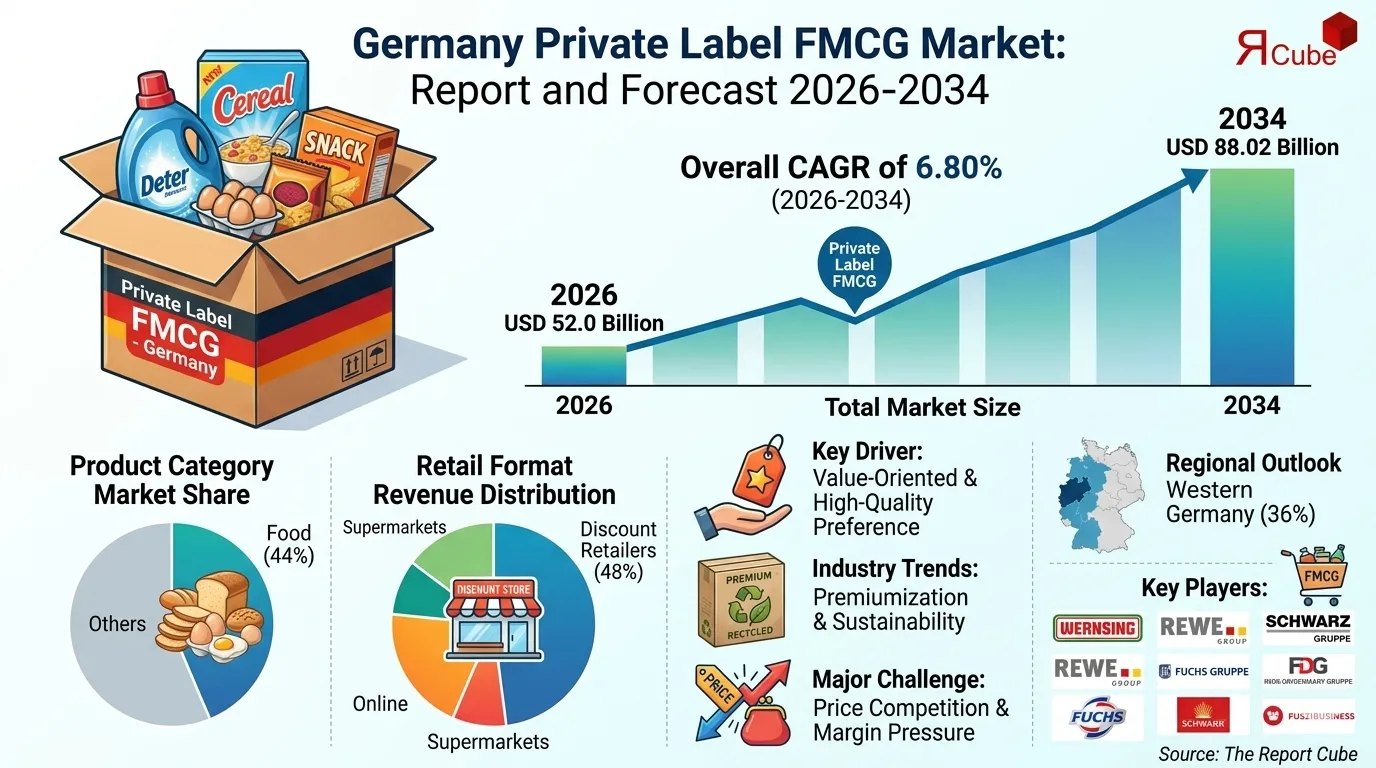
Private Label Food segment leads the market with around 44% market share.
By Retail Format:
Discount Retailers segment dominates the market with nearly 48% of revenue.
Regional Outlook:
Western Germany region dominates the Germany Private Label FMCG Market with approximately 36% share.
Germany Private Label FMCG Market Insights & Analysis
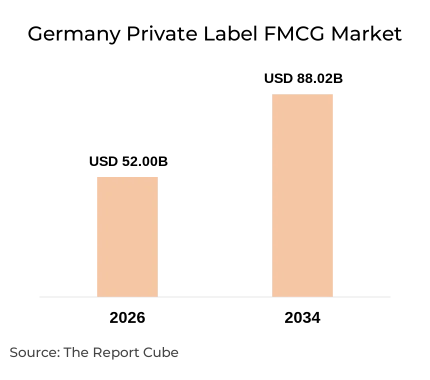
The Germany Private Label FMCG Market is anticipated to register a CAGR of around 6.80% during the forecast period 2026-2034. The market size is valued at USD 52.0 billion in 2026 and is projected to reach USD 88.02 billion by 2034. The Germany Private Label FMCG Market size is expanding steadily as retailers continue to strengthen in-house brands to improve margins and customer loyalty. Private label FMCG growth is strongly supported by evolving consumer preferences toward cost-effective yet quality products, particularly amid economic uncertainty and inflationary pressures across Europe.
Germany remains one of the most mature private label markets globally, with private label penetration exceeding 40% across key FMCG categories. Retail giants such as discount chains and supermarkets are investing heavily in product innovation, packaging improvements, and sustainability. Additionally, the Germany Private Label FMCG Market trends highlight a rising shift toward premium private labels, where retailers offer high-quality alternatives comparable to national brands. This transition is supported by increasing disposable income segments seeking value without compromising quality, further boosting overall Germany Private Label FMCG Market revenue.
Germany Private Label FMCG Market Dynamics
Key Driver: Rising Consumer Preference for Value-Oriented and High-Quality Alternatives
The primary growth driver for the Germany Private Label FMCG Market is the increasing consumer inclination toward affordable yet high-quality alternatives to branded products. Surveys conducted in 2025 indicate that over 62% of German consumers actively choose private label products due to competitive pricing and improved quality standards. Retailers have significantly upgraded product formulations and packaging, aligning them closely with branded equivalents, which enhances trust and repeat purchases.
Moreover, inflationary trends across Europe have reshaped purchasing behavior, encouraging consumers to prioritize value-based consumption. Discount retailers such as Aldi and Lidl have expanded their private label assortments by nearly 15% between 2024 and 2026. This strategic expansion directly contributes to Germany Private Label FMCG Market growth, as consumers increasingly perceive private labels as smart purchasing decisions rather than compromises.
Book your FREE 30-minute expert consultation today
Contact UsIndustry Trends: Premiumization and Sustainable Private Label Expansion
One of the most notable Germany Private Label FMCG Market trends is the rapid premiumization of private label offerings. Retailers are launching organic, vegan, and specialty product lines that cater to health-conscious consumers. In 2025, premium private label products accounted for approximately 28% of total private label sales, reflecting a strong upward trajectory in higher-margin segments.
Another emerging trend is sustainability integration. Retailers are adopting eco-friendly packaging, ethical sourcing, and transparent labeling practices. Private label brands are increasingly used as vehicles for sustainability commitments, helping retailers meet environmental goals while enhancing brand perception. This trend strengthens Germany Private Label FMCG Market value by attracting environmentally conscious consumers.
Major Challenge: Intense Price Competition and Margin Pressure
The Germany Private Label FMCG Market faces significant challenges from intense price competition among retailers. As multiple retail chains aggressively expand their private label portfolios, pricing wars have become more frequent, putting pressure on profit margins. Maintaining competitive pricing while ensuring product quality requires efficient supply chain management and cost optimization strategies.
Additionally, fluctuations in raw material costs and logistics disruptions continue to impact production expenses. Private label manufacturers must balance cost efficiency with innovation, which can be challenging in a highly competitive environment. These factors collectively limit profitability and may hinder the overall Germany Private Label FMCG Market growth in certain segments.
Opportunity: Expansion of Digital Retail and Premium Product Segments
The growth of online retail platforms presents a significant opportunity for the Germany Private Label FMCG Market. E-commerce channels have witnessed a 20% increase in private label FMCG sales between 2024 and 2026, driven by convenience and competitive pricing. Retailers are leveraging digital platforms to promote exclusive private label products, enhancing visibility and customer engagement.
Furthermore, premium private label segments offer strong growth potential. Consumers are increasingly willing to pay a premium for products that combine quality, sustainability, and innovation. This shift enables retailers to improve margins while expanding their product portfolios. As a result, the Germany Private Label FMCG Market revenue is expected to benefit from both digital expansion and premiumization strategies.
Germany Private Label FMCG Market Segment-wise Analysis
By Product Category:
- Private Label Food
- Private Label Household Care
- Private Label Personal Care
- Private Label Baby and Child Care
- Others
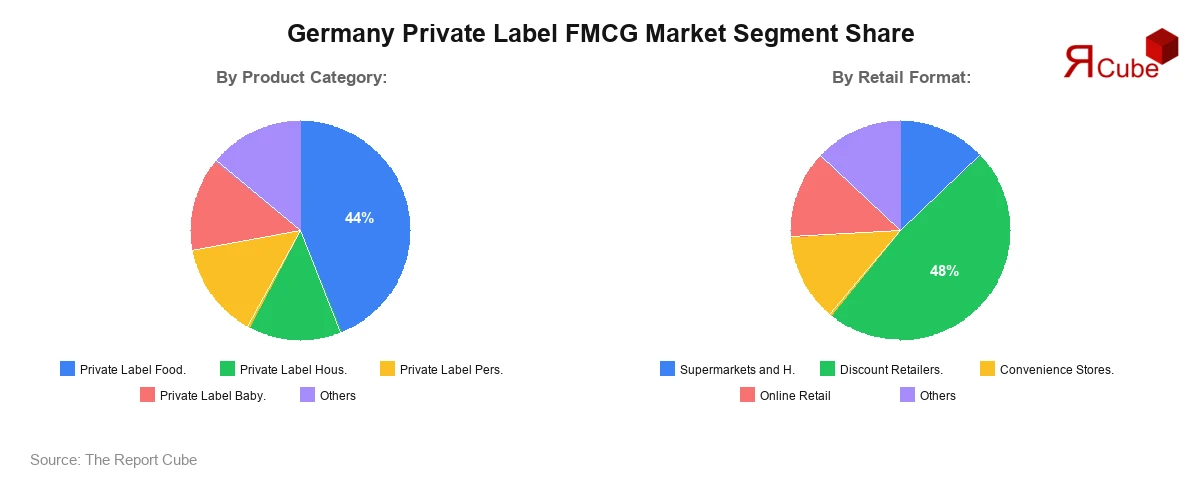
The Private Label Food segment dominates the Germany Private Label FMCG Market share, accounting for approximately 44% in 2026. This dominance is driven by high consumption frequency and strong retailer focus on expanding food assortments. Categories such as dairy products, bakery items, and ready-to-eat meals have experienced consistent demand, supported by changing lifestyles and convenience preferences. Retailers are continuously introducing innovative food products, including organic and plant-based options, to cater to evolving consumer tastes.
Additionally, private label food products benefit from shorter supply chains and better cost control, allowing retailers to offer competitive pricing. The segment has also seen increased investment in packaging and branding, enhancing consumer appeal. As a result, Private Label Food continues to play a central role in boosting Germany Private Label FMCG Market growth and maintaining high market penetration levels.
By Retail Format:
- Supermarkets and Hypermarkets
- Discount Retailers
- Convenience Stores
- Online Retail
- Others
Discount Retailers lead the Germany Private Label FMCG Market with an estimated 48% revenue share. Chains such as Aldi and Lidl have built their business models around private label offerings, providing high-quality products at lower prices. These retailers maintain strong supplier relationships and efficient logistics systems, enabling them to sustain competitive pricing strategies.
Moreover, discount retailers are expanding their premium private label ranges, attracting a broader consumer base. Their ability to quickly adapt to market trends and introduce new products strengthens their market position. This dominance significantly contributes to overall Germany Private Label FMCG Market size expansion.
Regional Projection of Germany Private Label FMCG Industry
- Northern Germany
- Western Germany
- Eastern Germany
- Southern Germany
- Others
Western Germany dominates the Germany Private Label FMCG Market with around 36% share, driven by higher population density, strong retail infrastructure, and higher disposable income levels. Cities such as Cologne, Düsseldorf, and Frankfurt serve as key consumption hubs, where consumers show strong acceptance of private label products across multiple categories.
The region also benefits from the presence of major retail chains and distribution networks, ensuring product availability and accessibility. Additionally, Western Germany has witnessed higher adoption of premium private label products, contributing to increased market value. This regional dominance is expected to continue, supported by ongoing retail expansion and consumer demand trends.
Need insights for a specific region within this market?
Request Regional DataGovernment Initiatives & Policies
- German Supply Chain Due Diligence Act (2026 Update): Strengthens compliance requirements for ethical sourcing and transparency in private label supply chains.
- EU Green Deal Packaging Regulations (2025-2026): Encourages recyclable packaging and waste reduction across FMCG private label products.
Germany Private Label FMCG Industry Recent Developments
- 2026: Schwarz Gruppe (Lidl/Kaufland) expanded Lidl’s private-label brands such as Crivit and Silvercrest into Kaufland stores, strengthening cross-format portfolio reach and increasing private label penetration.
- 2026: Theo Müller Group acquired Elinas and Lünebest dairy brands along with the Lüneburg production site, enhancing its private label supply capabilities in Germany’s dairy segment.
- 2025-2026: EDEKA advanced its sustainable private label strategy through initiatives like “EDEKA Herzstücke,” supported by WWF collaboration, reinforcing eco-friendly product positioning.
Why Choose This Report?
- Provides a comprehensive overview of the overall market analysis, encompassing key trends, consumer behavior analysis, and risk assessment to support strategic decision-making.
- Provides accurate, up-to-date insights into market size, segmentation, and emerging opportunities, helping to minimize risk & capitalizing on growth.
- Gives deep understanding of target audience preferences, investment habits, and communication channels for enhanced product development & marketing effectiveness.
- Delivers competitive analysis & benchmarking, uncovering the strengths & weaknesses of market competitors to guide strategies.
- Consolidate comprehensive market intelligence, reducing reasoning & streamlining research efforts.
- Facilitates customized market segmentation & risk mitigation strategies, fine-tuned to the business objectives.
- Aids in identifying both market challenges & untapped opportunities within the industry to drive long-term business growth.
- Provides valuable information based on actual customer data & search trends.
Table of Contents
- Introduction
- Objective of the Study
- Product and Category Definition
- Market Segmentation
- Study Variables
- Research Methodology
- Secondary Data Points
- Breakdown of Secondary Sources
- Primary Data Points
- Breakdown of Primary Interviews
- Secondary Data Points
- Executive Summary
- Market Dynamics
- Drivers
- Challenges
- Opportunity Assessment
- Recent Trends and Developments
- Regulatory and Policy Landscape
- Germany Private Label FMCG Market Overview (2021-2034)
- Market Size, By Value (USD Billion)
- Market Share, By Product Category
- Private Label Food
- Chilled and Frozen Food
- Dairy Products
- Bakery and Confectionery
- Sauces, Dressings, and Condiments
- Beverages
- Snacks and Savory Products
- Others
- Private Label Household Care
- Laundry Care
- Home Cleaning Products
- Dishwashing Products
- Air Fresheners and Deodorizers
- Others
- Private Label Personal Care
- Skin Care
- Hair Care
- Oral Care
- Bath and Shower Products
- Deodorants and Fragrances
- Others
- Private Label Baby and Child Care
- Baby Food
- Baby Hygiene Products
- Others
- Others
- Private Label Food
- Market Share, By Retail Format
- Supermarkets and Hypermarkets
- Discount Retailers
- Convenience Stores
- Online Retail
- Others
- Market Share, By Price Tier
- Value Private Label
- Standard Private Label
- Premium Private Label
- Market Share, By Region
- Northern
- Western
- Eastern
- Southern
- Others
- Market Share, By Company
- Revenue Shares and Analysis
- Competitive Landscape
- Northern Region Private Label FMCG Market
- Market Size, By Value (USD Billion/Million)
- Market Share, By Product Category
- Market Share, By Retail Format
- Market Share, By Price Tier
- Western Region Private Label FMCG Market
- Market Size, By Value (USD Billion/Million)
- Market Share, By Product Category
- Market Share, By Retail Format
- Market Share, By Price Tier
- Eastern Region Private Label FMCG Market
- Market Size, By Value (USD Billion/Million)
- Market Share, By Product Category
- Market Share, By Retail Format
- Market Share, By Price Tier
- Southern Region Private Label FMCG Market
- Market Size, By Value (USD Billion/Million)
- Market Share, By Product Category
- Market Share, By Retail Format
- Market Share, By Price Tier
- Competitive Outlook and Company Profiles
- Wernsing Food Family
- Company Overview
- Product Portfolio
- Strategic Alliances/Partnerships
- Recent Developments
- Dalli-Werke GmbH & Co. KG
- Company Overview
- Product Portfolio
- Strategic Alliances/Partnerships
- Recent Developments
- REWE Group
- Company Overview
- Product Portfolio
- Strategic Alliances/Partnerships
- Recent Developments
- Fuchs Gruppe
- Company Overview
- Product Portfolio
- Strategic Alliances/Partnerships
- Recent Developments
- Zentis GmbH & Co. KG
- Company Overview
- Product Portfolio
- Strategic Alliances/Partnerships
- Recent Developments
- Laurens Spethmann Holding
- Company Overview
- Product Portfolio
- Strategic Alliances/Partnerships
- Recent Developments
- Schwarz Gruppe (Lidl/Kaufland)
- Company Overview
- Product Portfolio
- Strategic Alliances/Partnerships
- Recent Developments
- Hochwald Foods GmbH
- Company Overview
- Product Portfolio
- Strategic Alliances/Partnerships
- Recent Developments
- Krüger Group
- Company Overview
- Product Portfolio
- Strategic Alliances/Partnerships
- Recent Developments
- Stern-Wywiol Gruppe
- Company Overview
- Product Portfolio
- Strategic Alliances/Partnerships
- Recent Developments
- Theo Müller Group
- Company Overview
- Product Portfolio
- Strategic Alliances/Partnerships
- Recent Developments
- EDEKA Zentrale Stiftung & Co. KG
- Company Overview
- Product Portfolio
- Strategic Alliances/Partnerships
- Recent Developments
- Develey Senf & Feinkost
- Company Overview
- Product Portfolio
- Strategic Alliances/Partnerships
- Recent Developments
- Aldi Einkauf SE & Co. oHG
- Company Overview
- Product Portfolio
- Strategic Alliances/Partnerships
- Recent Developments
- Others
- Wernsing Food Family
- Contact Us and Disclaimer
Top Key Players & Market Share Outlook
- Wernsing Food Family
- Dalli-Werke GmbH & Co. KG
- REWE Group
- Fuchs Gruppe
- Zentis GmbH & Co. KG
- Laurens Spethmann Holding
- Schwarz Gruppe (Lidl/Kaufland)
- Hochwald Foods GmbH
- Krüger Group
- Stern-Wywiol Gruppe
- Theo Müller Group
- EDEKA Zentrale Stiftung & Co. KG
- Develey Senf & Feinkost
- Aldi Einkauf SE & Co. oHG
- Others
Frequently Asked Questions






