



Build Your Custom Market Intelligence Report
Customize Your ReportUK Quantum Computing Market Insights & Analysis
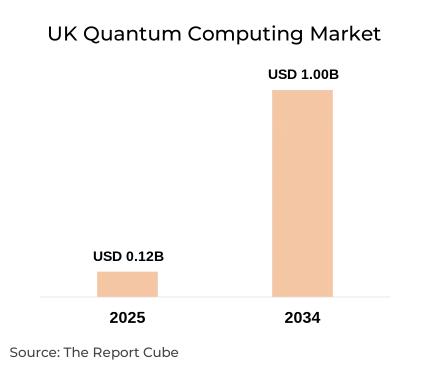
The UK Quantum Computing Market is anticipated to register a CAGR of 26.40% during 2026-2034. The market size was valued at USD 0.122 billion in 2025 and is projected to reach USD 1.00481 billion by 2034. The UK has emerged as one of the most advanced quantum ecosystems globally, supported by sustained government funding, strong academic infrastructure, and early-stage enterprise adoption.
The country’s long-term public investments in quantum technologies have accelerated research commercialization, positioning the UK as a leading hub for quantum hardware and software development. Universities and research institutes play a critical role in talent development, while private enterprises focus on building scalable quantum solutions. By 2025, more than half of national quantum funding was directed toward processor scalability, error mitigation, and quantum algorithm development.
Growing interest from BFSI, healthcare, and government sectors is accelerating pilot deployments. Cloud-based quantum access models are further reducing entry barriers, enabling startups and SMEs to explore real-world applications. As a result, the UK Quantum Computing Market is transitioning from a research-centric phase to a commercialization-driven growth cycle through 2034.
UK Quantum Computing Market Recent Developments
- 2025: IBM expanded enterprise quantum cloud services in the UK for financial optimization pilots.
- 2025: Oxford Quantum Circuits launched advanced superconducting quantum processors for commercial testing.
Government Initiatives & Policies
- National Quantum Technologies Programme: A UK government initiative committing over GBP 2.5 billion to accelerate quantum commercialization.
- UK Quantum Strategy: A long-term national roadmap focusing on quantum computing, sensing, and secure communications.
UK Quantum Computing Market Dynamics
Key Driver: Sustained Government Funding and Academic–Industry Collaboration
The primary growth driver of the UK Quantum Computing Market is consistent government investment combined with strong collaboration between academia and industry. Public funding has accounted for nearly 45% of total quantum R&D expenditure since 2020, significantly reducing financial risk for early-stage innovation. Universities act as research engines, while private enterprises focus on commercialization and system integration.
Financial services, defense, and cybersecurity sectors are increasingly investing in quantum capabilities to maintain strategic advantages. By 2025, approximately 35% of large UK financial institutions had initiated quantum proof-of-concept projects, reinforcing market demand.
Book your FREE 30-minute expert consultation today
Contact UsIndustry Trends: Rapid Adoption of Cloud-Based Quantum Platforms
Cloud-based quantum computing has emerged as a defining trend in the UK market. Enterprises prefer cloud access over on-premise deployment due to lower capital requirements and faster scalability. Hybrid classical–quantum workflows are gaining traction, allowing businesses to integrate quantum algorithms into existing IT infrastructures.
By 2025, cloud-based deployments accounted for nearly 62% of market revenue, driven by increased availability of quantum development kits, simulators, and managed services.
Major Challenge: Technical Complexity and Error Correction Constraints
Despite technological progress, quantum systems remain highly sensitive to noise and decoherence, limiting their commercial reliability. Error correction requires significant hardware overhead, increasing development costs and timelines.
Additionally, the shortage of experienced quantum engineers and software developers poses a challenge, slowing the pace of enterprise-scale implementation.
Opportunity: Optimization and Post-Quantum Cryptography Applications
Quantum computing offers strong opportunities in optimization problems and post-quantum cryptography. Logistics, BFSI, and energy sectors are actively exploring quantum algorithms for route optimization, portfolio modeling, and risk assessment.
Growing concerns over future quantum-enabled cyber threats are driving investments in quantum-safe encryption, positioning the UK market for sustained long-term demand.
UK Quantum Computing Market Segment-wise Analysis
By Component:
- Hardware
- Software
- Services
Hardware dominated the UK Quantum Computing Market in 2025, accounting for approximately 48% of total revenue, driven by investments in superconducting and photonic processors. However, services represent the fastest-growing segment, supported by cloud-based access, consulting, and system integration offerings.
By Technology:
- Superconducting Qubits
- Trapped Ions
- Photonic Systems
- Topological Qubits
Superconducting qubits held nearly 41% market share in 2025 due to faster gate speeds and commercial maturity. Photonic systems are gaining traction in the UK owing to scalability advantages and room-temperature operation.
Need insights for a specific region within this market?
Request Regional DataRegional Projection of UK Quantum Computing Industry
- England
- Scotland
- Wales
- Northern Ireland
England leads the UK Quantum Computing Market with an estimated 68% market share in 2025. The region benefits from dense research clusters in Oxford, Cambridge, and London, alongside strong venture capital participation. Scotland follows with strengths in photonics research, while Wales and Northern Ireland are emerging through publicly supported innovation hubs.
Why Choose This Report?
- Provides a comprehensive overview of market trends, consumer behavior, and risk assessment to support strategic decisions.
- Delivers accurate insights into market size, segmentation, and growth opportunities.
- Offers deep understanding of target audiences, investment patterns, and technology adoption.
- Includes competitive benchmarking to evaluate strengths and weaknesses of key players.
- Consolidates market intelligence to streamline research and planning efforts.
- Supports customized segmentation and risk mitigation strategies.
- Identifies market challenges and untapped opportunities for long-term growth.
- Leverages real customer data and search trends for actionable insights.
Table of Contents
- Introduction
- Objective of the Study
- Quantum Computing Definition
- Market Segmentation
- Study Variables
- Research Methodology
- Secondary Data Points
- Breakdown of Secondary Sources
- Primary Data Points
- Breakdown of Primary Interviews
- Secondary Data Points
- Executive Summary
- Market Dynamics
- Drivers
- Challenges
- Opportunity Assessment
- Recent Trends and Developments
- Regulatory and Policy Landscape
- UK Quantum Computing Market Overview (2020–2034)
- Market Size, By Value (USD Billion)
- Market Share, By Component
- Hardware
- Software
- Services
- Market Share, By Technology
- Superconducting Qubits
- Trapped Ions
- Photonic Systems
- Topological Qubits
- Other Technologies
- Market Share, By Deployment
- Cloud-Based
- On-Premise
- Market Share, By End User
- IT & Telecom
- Banking, Financial Services & Insurance (BFSI)
- Healthcare & Life Sciences
- Manufacturing
- Government & Defense
- Market Share, By Application
- Optimization Problems
- Cryptography & Security
- Drug Discovery
- Material Science
- Machine Learning & AI
- Market Share, By Company
- Competition Characteristics
- Revenue Shares & Analysis
- Market Share, By Region
- England Quantum Computing Market
- Market Size, By Value
- Market Share, By Component
- Market Share, By End User
- Scotland Quantum Computing Market
- Market Size, By Value
- Market Share, By Component
- Market Share, By End User
- Wales Quantum Computing Market
- Market Size, By Value
- Market Share, By Component
- Market Share, By End User
- Northern Ireland Quantum Computing Market
- Market Size, By Value
- Market Share, By Component
- Market Share, By End User
- England Quantum Computing Market
- Competitive Outlook and Company Profiles
- IBM
- Company Overview
- Quantum Computing Portfolio
- Strategic Alliances/Partnerships
- Recent Developments
- Google Quantum AI
- Company Overview
- Quantum Computing Portfolio
- Strategic Alliances/Partnerships
- Recent Developments
- Rigetti Computing
- Company Overview
- Quantum Computing Portfolio
- Strategic Alliances/Partnerships
- Recent Developments
- Oxford Quantum Circuits
- Company Overview
- Quantum Computing Portfolio
- Strategic Alliances/Partnerships
- Recent Developments
- Cambridge Quantum
- Company Overview
- Quantum Software & Tools Portfolio
- Strategic Alliances/Partnerships
- Recent Developments
- Others
- Company Overview
- Business Segments
- Strategic Alliances/Partnerships
- Recent Developments
- IBM
- Contact Us / Disclaimer
Top Key Players & Market Share Outlook
- IBM
- Google Quantum AI
- Rigetti Computing
- Oxford Quantum Circuits
- Cambridge Quantum
- Others
Frequently Asked Questions






