




Build Your Custom Market Intelligence Report
Customize Your ReportPhilippines Quick Service Restaurant Market Key Highlights
By Food Type:
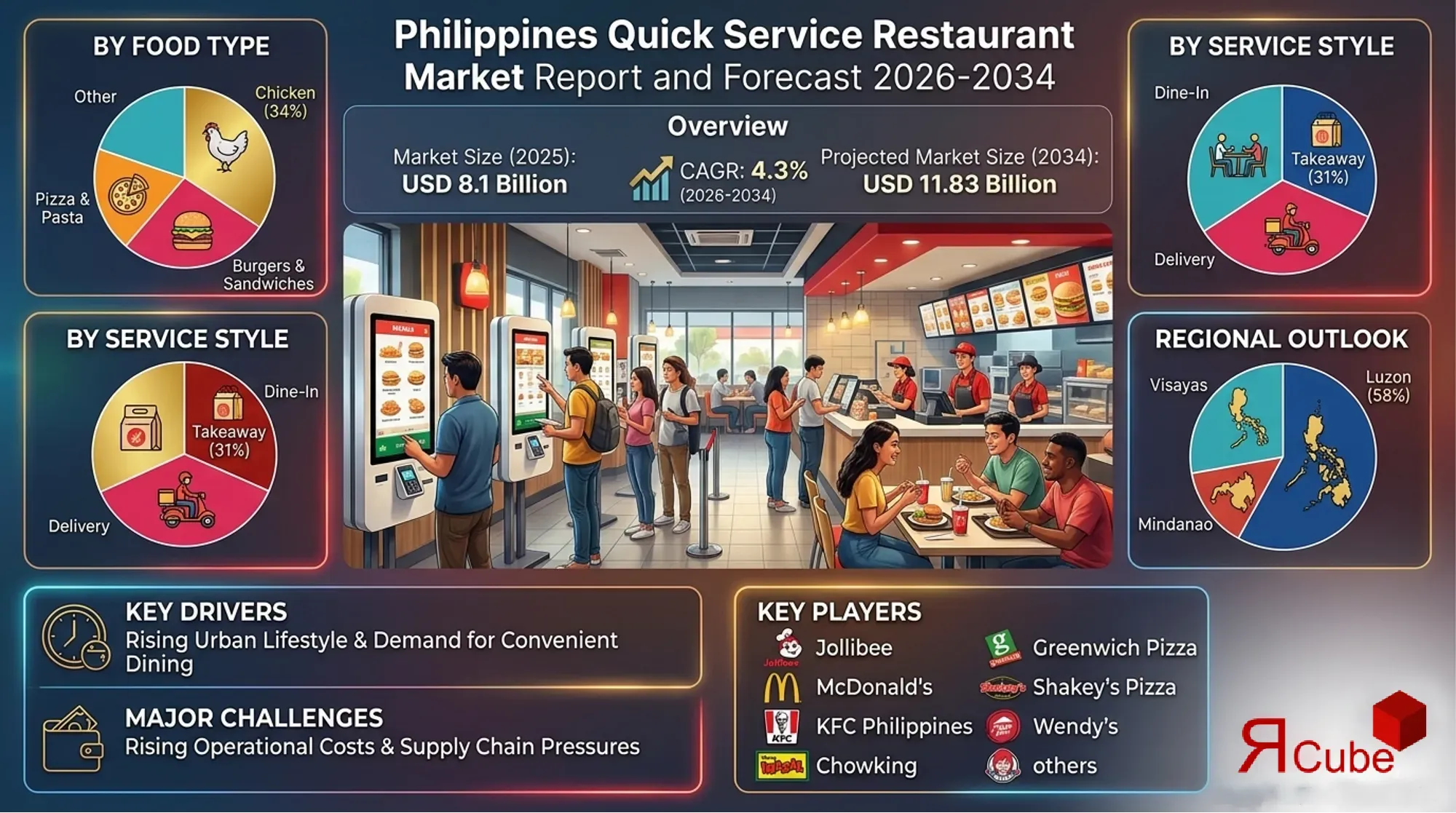
Chicken segment leads the market, with around 34% share.
By Service Style:
Takeaway segment dominates the market, accounting for nearly 31% of total revenue.
Regional Outlook:
Luzon region dominates the Philippines quick service restaurant market, with around 58% share.
Government Initiatives & Policies
- Philippine Food Service Industry Recovery Program (DTI 2025): The Department of Trade and Industry launched initiatives supporting restaurant digitalization, franchising expansion, and SME foodservice modernization to strengthen the post-pandemic restaurant sector.
- Philippine Tourism Development Plan 2023-2028 Implementation (2025 Update): The Department of Tourism expanded food tourism promotion programs encouraging QSR chains and local food brands to scale operations across tourism hubs.
Philippines Quick Service Restaurant Market Insights & Analysis
The Philippines Quick Service Restaurant Market is anticipated to register a 4.3% during 2026-2034. The market size was valued at USD 8.1 billion in 2025 and is projected to reach USD 11.83 billion by 2034.
The Philippines quick service restaurant market has evolved into one of Southeast Asia’s most vibrant foodservice sectors, supported by rapid urbanization, strong consumer spending on convenient dining, and a thriving franchising ecosystem. Quick service restaurants have become deeply embedded in everyday Filipino culture, where affordable meals, fast service, and recognizable brands play a key role in daily dining habits. The country’s young population and increasing workforce participation are further driving demand for accessible food options across urban centers and secondary cities.
Investment activity in the sector continues to expand as both domestic and international brands scale their presence. Major operators such as Jollibee, McDonald’s Philippines, and Mang Inasal continue to accelerate outlet expansion through franchise partnerships and strategic real estate development. By 2025, the Philippines hosts more than 25,000 quick service restaurant outlets, with a growing concentration in urban areas such as Metro Manila, Cebu, and Davao. The country’s strong franchising culture enables brands to expand rapidly while maintaining operational efficiency and consistent brand experience.
Technology integration is also transforming the industry. Online ordering platforms, mobile apps, and delivery aggregators have become core distribution channels for QSR operators. Digital ordering penetration increased significantly after 2023, with nearly 40% of urban consumers using mobile applications or third-party delivery services for restaurant purchases. Restaurants are increasingly adopting data analytics and customer loyalty systems to personalize promotions and improve customer retention.
Government initiatives encouraging tourism, digital entrepreneurship, and small business growth also contribute to sector expansion. The Philippines’ tourism strategy emphasizes food experiences as part of the national travel offering, benefiting both international chains and local QSR brands. As disposable income rises and consumer lifestyles shift toward convenience dining, the quick service restaurant market is expected to maintain steady growth throughout the forecast period.
Philippines Quick Service Restaurant Market Dynamics
Key Driver: Rising Urban Lifestyle and Demand for Convenient Dining
One of the primary growth drivers of the Philippines quick service restaurant market is the increasing demand for convenient and affordable dining options among urban consumers. The Philippines has experienced strong urban population growth over the past decade, with more than 48% of the population now living in cities. This shift has significantly changed dining patterns, as working professionals and students seek quick meal solutions that fit busy schedules. Quick service restaurants provide standardized menus, rapid service, and consistent pricing, making them highly attractive to consumers who prioritize speed and convenience.
Changing family dynamics also contribute to the growth of the sector. With more dual-income households and longer commuting times in metropolitan areas, families increasingly rely on quick service restaurants for daily meals and take-home food options. Industry estimates suggest that Filipino consumers dine at quick service restaurants an average of 3 to 4 times per week, particularly in major cities. Brands such as Jollibee, McDonald’s, and KFC Philippines have capitalized on this demand by offering localized menu items that align with Filipino taste preferences, including rice-based meals and family-sized combo packages.
Book your FREE 30-minute expert consultation today
Contact UsIndustry Trends: Digital Ordering and Delivery Ecosystem Expansion
The Philippines quick service restaurant market is undergoing a major digital transformation as restaurants integrate online ordering platforms and mobile applications into their service models. Digital ordering channels expanded rapidly between 2022 and 2025, driven by growing smartphone penetration and the popularity of delivery platforms such as GrabFood and Foodpanda. By 2025, nearly 45% of urban restaurant orders were processed through digital channels, reflecting a structural shift in consumer purchasing behavior.
Quick service restaurant operators are investing heavily in technology to enhance the customer experience. Mobile applications now offer features such as personalized deals, digital loyalty programs, and real-time order tracking. Many brands have also introduced self-service kiosks and AI-driven recommendation systems inside stores to reduce waiting times and improve operational efficiency. The integration of delivery services with restaurant inventory systems has enabled faster order fulfillment and improved order accuracy.
Another emerging trend is the growth of drive-thru formats and smaller express outlets designed for high-traffic locations. These formats allow restaurants to serve large customer volumes while minimizing operational costs. As digital adoption continues to expand across the Philippines, technology will remain a central factor shaping the future of the quick service restaurant industry.
Major Challenge: Rising Operational Costs and Supply Chain Pressures
Rising operational expenses present a significant challenge for the Philippines quick service restaurant market. The foodservice industry relies heavily on raw materials such as poultry, grains, cooking oil, and imported ingredients, many of which have experienced price volatility in recent years. Global supply chain disruptions and fluctuations in agricultural commodity prices have increased procurement costs for restaurant operators. For example, poultry prices in Southeast Asia increased by more than 12% between 2023 and 2025, directly affecting menu pricing for chicken-based quick service restaurants.
Labor costs also represent a growing concern. As the Philippines government continues to adjust minimum wage standards across regions, restaurant operators must balance labor expenses with competitive pricing strategies. Staffing challenges, including employee retention and training costs, further increase operational complexity for restaurant chains operating large networks of outlets.
Another pressure point involves real estate expenses in prime commercial locations. High rental costs in major cities such as Manila and Cebu can significantly impact restaurant profitability. Quick service restaurant companies are responding by adopting flexible store formats, optimizing supply chains, and expanding into provincial areas where operational costs are lower.
Opportunity: Provincial Expansion and Franchising Growth
The expansion of quick service restaurants into provincial cities represents a major opportunity for market growth. While Metro Manila remains the largest concentration of QSR outlets, rapid economic development in regional cities has created new consumer markets across Luzon, Visayas, and Mindanao. Rising incomes, improved infrastructure, and growing retail developments in provincial areas are encouraging restaurant brands to expand beyond major metropolitan centers.
Franchising plays a critical role in this expansion strategy. The Philippines has one of the most developed franchise ecosystems in Southeast Asia, allowing quick service restaurant brands to scale quickly while maintaining operational standards. Local entrepreneurs often partner with established restaurant brands to open new outlets in emerging cities, accelerating geographic market penetration.
Tourism development also supports expansion opportunities. Popular destinations such as Cebu, Boracay, and Palawan attract millions of visitors annually, creating strong demand for fast dining options. Quick service restaurant operators are increasingly targeting these tourism hubs with new outlets, drive-thru locations, and airport restaurant formats. As infrastructure investments continue across the country, regional expansion is expected to become a major driver of market growth over the next decade.
Philippines Quick Service Restaurant Market Segment-wise Analysis
By Food Type:
- Burgers and Sandwiches
- Chicken
- Pizza and Pasta
- Seafood
- Desserts and Bakery
- Snacks and Sides
- Beverages
The chicken segment leads the Philippines quick service restaurant market, accounting for approximately 34% of total revenue in 2025. Chicken-based meals are deeply integrated into Filipino dining culture, making them one of the most popular quick service restaurant offerings nationwide. Major brands such as Jollibee, Mang Inasal, and KFC Philippines have built their core menu strategies around fried and grilled chicken products that appeal to local taste preferences.
The popularity of rice-based meal combinations paired with fried chicken significantly strengthens this segment’s dominance. Unlike Western markets where burgers dominate QSR menus, Filipino consumers often prefer meals that include rice and savory dishes. As a result, quick service restaurants have developed specialized menu offerings such as chicken rice meals, grilled chicken plates, and family sharing buckets designed specifically for local dining habits.
Continuous menu innovation also supports segment growth. Restaurants frequently introduce limited-time flavors, spicy variants, and promotional combo meals to maintain consumer interest. With strong consumer demand and widespread menu versatility, chicken-based offerings are expected to remain the leading food category in the Philippines quick service restaurant market throughout the forecast period.
By Service Style:
- Dine-in
- Takeaway
- Delivery
- Drive-thru
The takeaway segment dominates the Philippines quick service restaurant market, representing around 31% of total transactions. Takeaway services allow customers to quickly purchase meals without spending extended time inside restaurants, making them particularly popular among commuters and office workers. In densely populated urban areas such as Metro Manila, takeaway counters help restaurants manage large volumes of customers during peak hours.
Takeaway services are often integrated with digital ordering platforms, allowing customers to place orders through mobile apps and pick them up at designated counters. This hybrid approach reduces waiting times and improves customer convenience. Many quick service restaurants have redesigned store layouts to accommodate separate pickup counters for online orders and takeaway customers.
Restaurants are also introducing express outlets in high-traffic areas such as shopping malls, transportation hubs, and office complexes. These compact locations prioritize takeaway operations while minimizing seating capacity. As urban populations continue to grow and consumers prioritize convenience, takeaway services will remain a central pillar of quick service restaurant operations in the Philippines.
Regional Projection of Philippines Quick Service Restaurant Industry
- Luzon
- Visayas
- Mindanao
Luzon holds the largest share of the Philippines quick service restaurant market, accounting for approximately 58% of total industry revenue. The region includes Metro Manila, the country’s economic and population center, where the highest concentration of restaurants and consumer spending occurs. Major commercial districts, shopping malls, and business hubs drive significant foot traffic for quick service restaurant outlets across the region.
Metro Manila alone hosts thousands of quick service restaurant locations, ranging from international chains to local brands. High population density, strong purchasing power, and an active nightlife culture contribute to strong demand for fast dining options throughout the day. In addition to the capital region, rapidly developing cities in Luzon such as Clark, Baguio, and Laguna are attracting new restaurant investments.
Infrastructure development projects across Luzon are further expanding the quick service restaurant market. New transportation hubs, expressways, and shopping complexes are creating additional high-traffic locations suitable for restaurant expansion. With strong consumer demand and continuous urban development, Luzon is expected to remain the leading regional market for quick service restaurants in the Philippines.
Philippines Quick Service Restaurant Market Recent Developments
- 2025: Jollibee announced that its global restaurant network is expected to surpass 10,000 outlets in 2025 as the company accelerates franchising expansion across the Philippines and international markets, strengthening its leadership within the quick service restaurant sector.
- 2025: McDonald's Philippines revealed plans to open its 800th store during 2025, with a significant portion of new outlets located in provincial cities to capture rising demand outside Metro Manila.
- 2025: Chowking, part of the Jollibee Group, was recognized among the top ASEAN restaurant brands in the Restaurants 25 2025 report, highlighting the brand’s strong regional presence in the quick service restaurant industry.
- 2025: Jollibee Group announced plans to add around 800 new stores globally by the end of 2025, with several brands in the Philippines contributing to the growth of the quick service restaurant sector.
Why Choose This Report?
- Provides a comprehensive overview of the overall market analysis, encompassing key trends, consumer behavior analysis, and risk assessment to support strategic decision-making.
- Provides accurate, up-to-date insights into market size, segmentation, and emerging opportunities, helping to minimize risk & capitalizing on growth.
- Gives deep understanding of target audience preferences, investment habits, and communication channels for enhanced product development & marketing effectiveness.
- Delivers competitive analysis & benchmarking, uncovering the strengths & weaknesses of market competitors to guide strategies.
- Consolidate comprehensive market intelligence, reducing reasoning & streamlining research efforts.
- Facilitates customized market segmentation & risk mitigation strategies, fine-tuned to the business objectives.
- Aids in identifying both market challenges & untapped opportunities within the industry to drive long-term business growth.
- Provides valuable information based on actual customer data & search trends.
Table of Contents
- Introduction
- Objective of the Study
- Product and Category Definition
- Market Segmentation
- Study Variables
- Research Methodology
- Secondary Data Points
- Breakdown of Secondary Sources
- Primary Data Points
- Breakdown of Primary Interviews
- Secondary Data Points
- Executive Summary
- Market Dynamics
- Drivers
- Challenges
- Opportunity Assessment
- Recent Trends and Developments
- Regulatory and Policy Landscape
- Philippines Quick Service Restaurant Market Overview (2021-2034)
- Market Size, By Value (USD Billion)
- Market Share, By Food Type
- Burgers and Sandwiches
- Chicken
- Pizza and Pasta
- Seafood
- Desserts and Bakery
- Snacks and Sides
- Beverages
- Market Share, By Service Style
- Dine-in
- Takeaway
- Delivery
- Drive-thru
- Market Share, By Ownership
- Franchised
- Company-owned
- Market Share, By Ordering Mode
- In-store Ordering
- Online Platforms
- Mobile Apps
- Call Center Ordering
- Market Share, By Region
- Luzon
- Visayas
- Mindanao
- Market Share, By Company
- Revenue Shares and Analysis
- Competitive Landscape
- Luzon Quick Service Restaurant Market
- Market Size, By Value (USD Billion/Million)
- Market Share, By Food Type
- Market Share, By Service Style
- Market Share, By Ownership
- Market Share, By Ordering Mode
- Visayas Quick Service Restaurant Market
- Market Size, By Value (USD Billion/Million)
- Market Share, By Food Type
- Market Share, By Service Style
- Market Share, By Ownership
- Market Share, By Ordering Mode
- Mindanao Quick Service Restaurant Market
- Market Size, By Value (USD Billion/Million)
- Market Share, By Food Type
- Market Share, By Service Style
- Market Share, By Ownership
- Market Share, By Ordering Mode
- Competitive Outlook and Company Profiles
- Jollibee
- Company Overview
- Product Portfolio
- Strategic Alliances/Partnerships
- Recent Developments
- McDonald's
- Company Overview
- Product Portfolio
- Strategic Alliances/Partnerships
- Recent Developments
- KFC Philippines
- Company Overview
- Product Portfolio
- Strategic Alliances/Partnerships
- Recent Developments
- Chowking
- Company Overview
- Product Portfolio
- Strategic Alliances/Partnerships
- Recent Developments
- Mang Inasal
- Company Overview
- Product Portfolio
- Strategic Alliances/Partnerships
- Recent Developments
- Greenwich Pizza
- Company Overview
- Product Portfolio
- Strategic Alliances/Partnerships
- Recent Developments
- Shakey's Pizza
- Company Overview
- Product Portfolio
- Strategic Alliances/Partnerships
- Recent Developments
- Pizza Hut
- Company Overview
- Product Portfolio
- Strategic Alliances/Partnerships
- Recent Developments
- Wendy's
- Company Overview
- Product Portfolio
- Strategic Alliances/Partnerships
- Recent Developments
- Red Ribbon
- Company Overview
- Product Portfolio
- Strategic Alliances/Partnerships
- Recent Developments
- Goldilocks
- Company Overview
- Product Portfolio
- Strategic Alliances/Partnerships
- Recent Developments
- Pancake House
- Company Overview
- Product Portfolio
- Strategic Alliances/Partnerships
- Recent Developments
- BonChon Chicken
- Company Overview
- Product Portfolio
- Strategic Alliances/Partnerships
- Recent Developments
- Turks Shawarma
- Company Overview
- Product Portfolio
- Strategic Alliances/Partnerships
- Recent Developments
- Angel's Burger
- Company Overview
- Product Portfolio
- Strategic Alliances/Partnerships
- Recent Developments
- Potato Corner
- Company Overview
- Product Portfolio
- Strategic Alliances/Partnerships
- Recent Developments
- Dunkin'
- Company Overview
- Product Portfolio
- Strategic Alliances/Partnerships
- Recent Developments
- Burger King
- Company Overview
- Product Portfolio
- Strategic Alliances/Partnerships
- Recent Developments
- Others
- Jollibee
- Contact Us and Disclaimer
Top Key Players & Market Share Outlook
- Jollibee
- McDonald's
- KFC Philippines
- Chowking
- Mang Inasal
- Greenwich Pizza
- Shakey's Pizza
- Pizza Hut
- Wendy's
- Red Ribbon
- Goldilocks
- Pancake House
- BonChon Chicken
- Turks Shawarma
- Angel's Burger
- Potato Corner
- Dunkin'
- Burger King
Frequently Asked Questions






