




Build Your Custom Market Intelligence Report
Customize Your ReportEurope Real Estate Market Insights & Analysis
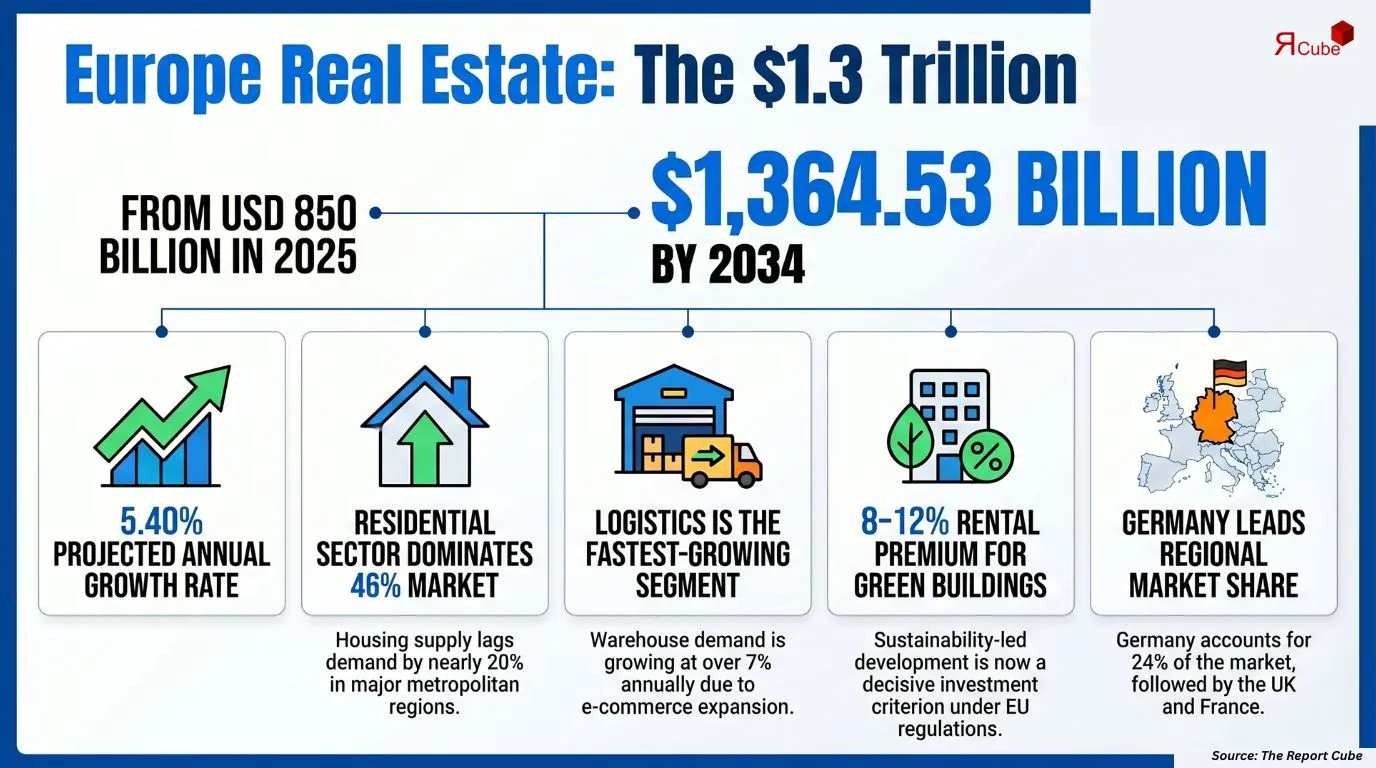
The Europe Real Estate Market is anticipated to register a CAGR of 5.40% during 2026-2034. The market size was valued at USD 850 billion in 2025 and is projected to reach USD 1,364.53 billion by 2034. The market is undergoing a gradual yet structurally strong recovery, supported by stabilizing interest rates, renewed institutional investments, and long-term urbanization trends across major European economies.
Real estate continues to play a central role in Europe’s economic framework, acting as both a wealth preservation asset and a critical infrastructure component. Residential demand remains resilient due to housing shortages in metropolitan areas, while commercial and industrial properties are being reshaped by hybrid work models and supply-chain reconfiguration. At the same time, sustainability-led development and energy-efficient buildings are becoming decisive investment criteria, particularly under stricter European environmental regulations.
Additionally, cross-border investments are regaining momentum as macroeconomic visibility improves. International investors are increasingly targeting stable markets such as Germany, the United Kingdom, and France, while Southern European countries attract capital due to comparatively higher yields. These interconnected dynamics collectively reinforce long-term confidence in the Europe Real Estate Market through 2034.
Europe Real Estate Market Recent Developments
- 2025: CBRE Group expanded its pan-European digital valuation platform to enhance transaction transparency.
- 2025: Vonovia announced large-scale energy-efficiency retrofitting across its German residential portfolio.
Government Initiatives & Policies
- EU Green Deal for Buildings: Policy framework promoting energy-efficient and low-emission real estate development.
- National Housing Acceleration Programs: Country-level initiatives to increase affordable housing supply across Europe.
Europe Real Estate Market Dynamics
Key Driver: Persistent Housing Demand and Urban Population Growth
One of the primary drivers of the Europe Real Estate Market is sustained housing demand driven by urban population growth and demographic shifts. Major cities across Europe continue to experience housing shortages, with residential supply lagging demand by nearly 20% in some metropolitan regions. Rising household formation, migration flows, and longer life expectancy are reinforcing the need for new housing developments. Governments are encouraging private-sector participation through zoning reforms and public-private partnerships, further stimulating construction activity. This persistent demand provides long-term stability for residential real estate investments despite short-term market volatility.
Book your FREE 30-minute expert consultation today
Contact UsIndustry Trends: Sustainability and Mixed-Use Developments Gaining Momentum
Sustainability has emerged as a defining trend across the European real estate sector. Investors and occupiers increasingly prioritize green-certified buildings, driven by regulatory requirements and cost efficiencies. Energy-efficient properties command rental premiums of 8-12% in leading cities. Additionally, mixed-use developments integrating residential, commercial, and leisure spaces are gaining traction as cities aim to optimize land use. These projects enhance asset resilience by diversifying income streams while aligning with evolving urban lifestyles, making them attractive to long-term investors.
Major Challenge: High Construction Costs and Financing Constraints
Escalating construction costs remain a major challenge for the Europe Real Estate Market. Material prices have risen by over 25% since 2021, while skilled labor shortages persist across several countries. Coupled with tighter lending conditions, these factors have delayed project timelines and reduced development margins. Smaller developers are particularly impacted, leading to consolidation within the sector. Although costs are stabilizing gradually, financing constraints continue to weigh on new project launches, especially in speculative commercial developments.
Opportunity: Growth in Logistics and Industrial Real Estate
The expansion of e-commerce and nearshoring strategies presents a strong opportunity for industrial and logistics real estate. Demand for modern warehouses and distribution centers is growing at an annual rate exceeding 7% across Europe. Strategic locations near transport hubs and urban centers are attracting institutional capital, particularly in Germany, France, and Spain. This segment offers stable cash flows and long-term lease structures, positioning it as a high-growth pillar within the broader real estate market.
Europe Real Estate Market Segment-wise Analysis
By Property:
- Residential
- Commercial
- Industrial
- Mixed-Use
Residential real estate dominates the Europe Real Estate Market, accounting for approximately 46% of total market value in 2025. Chronic housing shortages and affordability pressures continue to support demand across rental and ownership segments. Commercial properties follow, with office assets undergoing structural transformation due to hybrid working models. Industrial properties, while smaller in share, are the fastest-growing segment, benefiting from logistics expansion and supply-chain reorganization across Europe.
By Transaction:
- Sales
- Rental
- Lease
Rental and lease transactions collectively account for nearly 58% of market activity, reflecting shifting preferences toward flexible occupancy models. Rising mortgage rates have increased rental demand, particularly in urban centers. Long-term leasing remains dominant in commercial and industrial assets, providing predictable income streams for investors. Sales transactions are gradually recovering as interest rates stabilize, supporting renewed buyer confidence.
Regional Projection of Europe Real Estate Industry
- Germany
- UK
- France
- Italy
- Spain
Germany leads the Europe Real Estate Market, contributing approximately 24% of total regional market value in 2025. Its stable economy, strong rental culture, and robust regulatory framework attract consistent domestic and international investment. The United Kingdom follows closely, driven by London’s global financial hub status and diversified commercial assets, despite post-Brexit adjustments.
France remains a core market supported by strong residential demand and expanding logistics infrastructure. Paris continues to attract institutional capital, while regional cities benefit from decentralization trends. Italy’s real estate market is characterized by selective growth, with strong interest in residential and hospitality assets in major cities and tourist regions. Spain is emerging as a high-growth market, driven by logistics expansion, tourism recovery, and competitive yields. Madrid and Barcelona are witnessing increased investment activity, positioning Spain as a strategic destination for cross-border real estate capital within Europe.
Need insights for a specific region within this market?
Request Regional DataWhy Choose This Report?
- Provides a comprehensive overview of the overall market analysis, encompassing key trends, consumer behavior analysis, and risk assessment to support strategic decision-making.
- Provides accurate, up-to-date insights into market size, segmentation, and emerging opportunities, helping to minimize risk & capitalizing on growth.
- Gives deep understanding of target audience preferences, investment habits, and communication channels for enhanced product development & marketing effectiveness.
- Delivers competitive analysis & benchmarking, uncovering the strengths & weaknesses of market competitors to guide strategies.
- Consolidate comprehensive market intelligence, reducing reasoning & streamlining research efforts.
- Facilitates customized market segmentation & risk mitigation strategies, fine-tuned to the business objectives.
- Aids in identifying both market challenges & untapped opportunities within the industry to drive long-term business growth.
- Provides valuable information based on actual customer data & search trends.
Table of Contents
- Introduction
- Objective of the Study
- Product and Category Definition
- Market Segmentation
- Study Variables
- Research Methodology
- Secondary Data Points
- Breakdown of Secondary Sources
- Primary Data Points
- Breakdown of Primary Interviews
- Secondary Data Points
- Executive Summary
- Market Dynamics
- Drivers
- Challenges
- Opportunity Assessment
- Recent Trends and Developments
- Regulatory and Policy Landscape
- Europe Real Estate Market Overview (2021-2034)
- Market Size, By Value (USD Billion)
- Market Share, By Segment
- Residential
- Commercial
- Industrial
- Land
- Mixed‑Use
- Market Share, By Transaction
- Sales
- Rental
- Lease
- Market Share, By Channel
- Offline
- Online
- Market Share, By Investor
- Institutional
- Private
- Public
- Cross‑Border
- Market Share, By Country
- Germany
- United Kingdom
- France
- Italy
- Spain
- Market Share, By Company
- Market Share, By Company
- Competition Characteristics
- Revenue Shares & Analysis
- Germany Real Estate Market
- Market Size, By Value (USD Billion)
- Market Share, By Segment
- Market Share, By Transaction
- Market Share, By Channel
- Market Share, By Investor
- United Kingdom Real Estate Market
- Market Size, By Value (USD Billion)
- Market Share, By Segment
- Market Share, By Transaction
- Market Share, By Channel
- Market Share, By Investor
- France Real Estate Market
- Market Size, By Value (USD Billion)
- Market Share, By Segment
- Market Share, By Transaction
- Market Share, By Channel
- Market Share, By Investor
- Italy Real Estate Market
- Market Size, By Value (USD Billion)
- Market Share, By Segment
- Market Share, By Transaction
- Market Share, By Channel
- Market Share, By Investor
- Spain Real Estate Market
- Market Size, By Value (USD Billion)
- Market Share, By Segment
- Market Share, By Transaction
- Market Share, By Channel
- Market Share, By Investor
- Competitive Outlook and Company Profiles
- CBRE Group
- Company Overview
- Service Portfolio
- Strategic Alliances/Partnerships
- Recent Developments
- Jones Lang LaSalle
- Company Overview
- Service Portfolio
- Strategic Alliances/Partnerships
- Recent Developments
- Cushman & Wakefield
- Company Overview
- Service Portfolio
- Strategic Alliances/Partnerships
- Recent Developments
- Savills
- Company Overview
- Service Portfolio
- Strategic Alliances/Partnerships
- Recent Developments
- Colliers
- Company Overview
- Service Portfolio
- Strategic Alliances/Partnerships
- Recent Developments
- BNP Paribas Real Estate
- Company Overview
- Service Portfolio
- Strategic Alliances/Partnerships
- Recent Developments
- Unibail‑Rodamco‑Westfield
- Company Overview
- Asset Portfolio
- Strategic Alliances/Partnerships
- Recent Developments
- Vonovia
- Company Overview
- Asset Portfolio
- Strategic Alliances/Partnerships
- Recent Developments
- SEGRO
- Company Overview
- Asset Portfolio
- Strategic Alliances/Partnerships
- Recent Developments
- Gecina
- Company Overview
- Asset Portfolio
- Strategic Alliances/Partnerships
- Recent Developments
- Others
- CBRE Group
- Contact Us and Disclaimer
Top Key Players & Market Share Outlook
- CBRE Group
- Jones Lang LaSalle
- Cushman & Wakefield
- Savills
- Colliers
- BNP Paribas Real Estate
- Unibail‑Rodamco‑Westfield
- Vonovia
- SEGRO
- Gecina
- Others
Frequently Asked Questions






