




Build Your Custom Market Intelligence Report
Customize Your ReportGlobal Ride Gear Market Key Highlights
By Product Type:
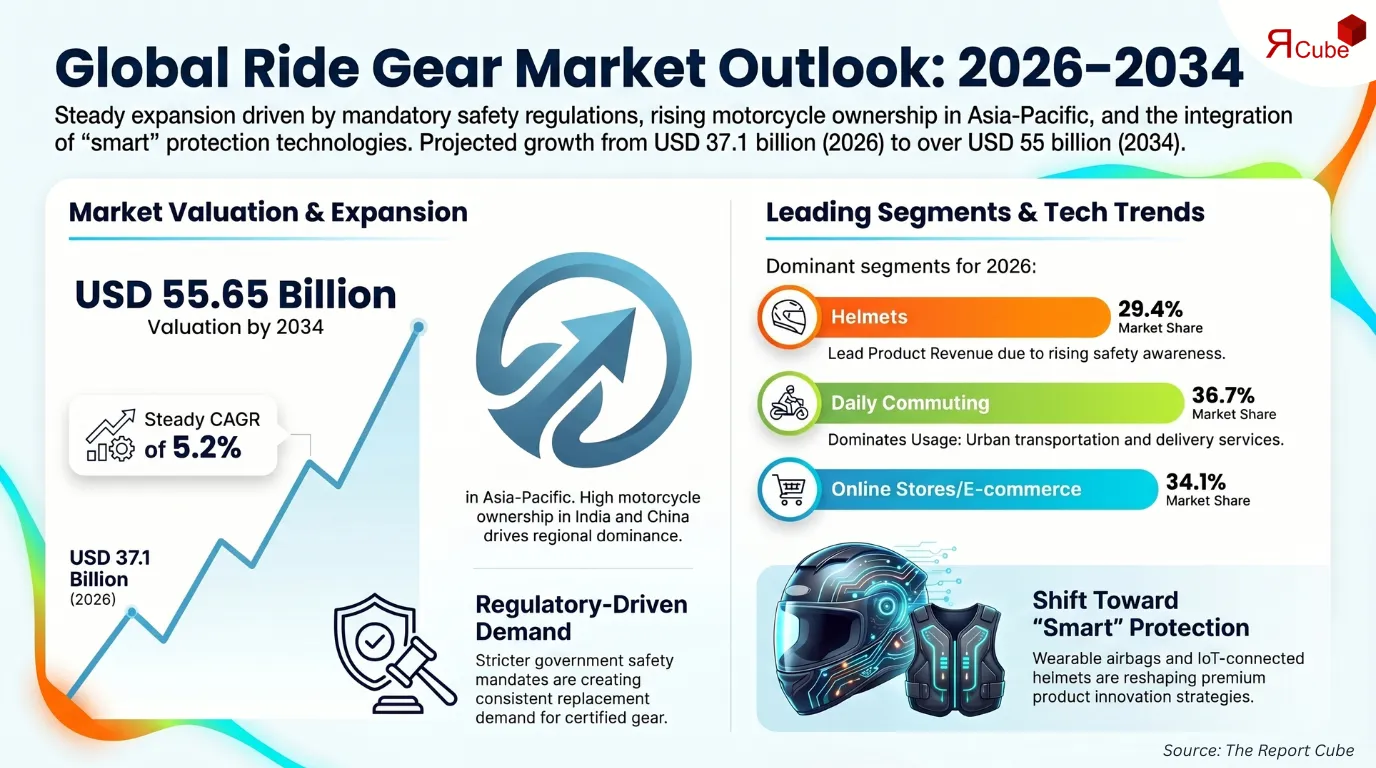
Helmets segment leads the market with nearly 29.4% share.
By Distribution Channel:
Online Stores/E-commerce segment dominates the market with around 34.1% of revenue.
Regional Outlook:
Asia-Pacific region dominates the Global Ride Gear Market with approximately 41.8% share.
Global Ride Gear Market Insights & Analysis
The Global Ride Gear Market is anticipated to register a CAGR of around 5.2% during the forecast period 2026-2034. The market size is valued at USD 37.1 billion in 2026 and is projected to reach USD 55.65 billion by 2034. Growth across the ride gear industry is being supported by rising participation in recreational riding, adventure motorcycling, bicycle touring, motorsports activities, and off-road vehicle usage. Increasing consumer preference for safety-certified helmets, impact-resistant jackets, riding gloves, and intelligent protective systems continues to reshape product innovation strategies across global riding apparel manufacturers. Governments in several countries have also intensified enforcement of rider safety regulations, creating steady replacement demand for certified riding equipment and protective accessories.
Manufacturers across the ride gear industry are actively investing in lightweight materials, aerodynamic helmet structures, moisture-resistant fabrics, and integrated safety technologies to strengthen product performance and rider comfort. The market is also benefiting from growing participation in motorsports, recreational touring, endurance riding events, and organized biking communities. In regions such as Asia-Pacific and Europe, premium riding apparel sales are expanding rapidly due to increasing disposable income and stronger acceptance of performance-oriented riding lifestyles. Product innovation, safety regulation enforcement, and expansion of organized retail channels are expected to remain key contributors supporting long-term ride gear market growth.
Global Ride Gear Market Impact Analysis
| Factor | Type | Specific Impact on Market | Magnitude | Business Implication |
|---|---|---|---|---|
| Rising Road Safety Awareness | Consumer | Fatality rates drive protective gear adoption globally | High | Focus messaging on injury prevention and certification |
| Mandatory Helmet and Gear Laws | Regulatory | Government mandates increase compliance-driven demand | High | Ensure products meet regional safety standards and labels |
| Growing Motorcycle Ownership | Market | Expanding two-wheeler fleets in Asia-Pacific fuel gear sales | High | Strengthen distribution in India, Southeast Asia, and China |
| Smart Gear and Airbag Technology | Technological | Airbag jackets and connected helmets attract premium buyers | Medium–High | Invest in R&D for IoT-enabled and crash-detection products |
| E-Commerce Platform Expansion | Market | Online channels improve product accessibility and choice | Medium | Build direct-to-consumer digital storefronts and marketplaces |
| Premium and Lifestyle Positioning | Consumer | Adventure tourism and brand appeal lift high-end gear demand | Medium | Launch branded collections targeting touring and sport riders |
| Price Sensitivity in Emerging Markets | Market | Cost-conscious consumers limit adoption of advanced gear | Medium | Offer entry-level certified products with financing options |
| Sustainable Materials Demand | Environmental | Eco-friendly production appeals to environmentally aware riders | Low–Medium | Develop recycled-material lines and highlight sustainability |
| Advanced Protective Materials | Technological | Lightweight, breathable fabrics improve comfort and adoption | Medium | Partner with material innovators for next-gen composites |
| Regional Safety Standard Variability | Regulatory | Differing certifications complicate multi-market launches | Medium | Streamline compliance processes and regional product variants |
Global Ride Gear Market Dynamics
Key Driver: Expanding Motorcycle Population and Safety Compliance Supporting Product Demand
The growing number of motorcycles and scooters worldwide continues to create substantial demand for advanced riding protection equipment. Urban transportation challenges, rising fuel costs, and increasing preference for affordable mobility solutions have significantly increased two-wheeler ownership across countries including India, Indonesia, Brazil, Thailand, and Vietnam. As road accident rates remain a major concern, governments and transportation authorities are strengthening helmet mandates and rider protection regulations. This has accelerated demand for safety-certified helmets, riding gloves, jackets, protective suits, and reinforced footwear across commuter and recreational riding segments.
Riders are also becoming more conscious about protective equipment quality and durability, particularly for highway touring and sports riding applications. Premium motorcycles with larger engine capacities are witnessing higher adoption among younger consumers and touring enthusiasts, which directly supports sales of technologically advanced riding gear products. Organized motorcycle communities, endurance riding clubs, and adventure travel groups are encouraging broader use of complete protective riding systems rather than standalone safety accessories. These developments continue to strengthen long-term demand across the global ride gear market.
Book your FREE 30-minute expert consultation today
Contact UsIndustry Trends: Smart Protection Systems and Performance Materials Reshaping Product Innovation
The global ride gear market trends are increasingly centered around intelligent rider protection technologies and lightweight high-performance materials. Manufacturers are introducing wearable airbag systems, integrated communication helmets, anti-fog visor technologies, ventilation-controlled riding jackets, and impact-absorbing armor systems designed for enhanced rider safety. Carbon fiber, Kevlar-reinforced textiles, and advanced synthetic fabrics are becoming widely preferred due to their ability to improve comfort without compromising durability or protection performance during long-distance riding conditions.
Premium riding gear brands are also focusing on rider ergonomics, climate adaptability, and aerodynamic efficiency as consumers demand products suitable for varied weather and terrain conditions. Smart helmets equipped with navigation support, Bluetooth connectivity, and crash-detection functions are gaining visibility within sports and touring categories. Sustainable production practices are gradually becoming important across Europe and North America, where manufacturers are exploring eco-friendly textile alternatives and recycled protective materials. These innovations are helping companies differentiate their product portfolios within an increasingly competitive ride gear industry landscape.
Major Challenge: Availability of Low-Cost Counterfeit Products Affecting Brand Revenue
The increasing circulation of low-quality counterfeit riding gear products remains a major challenge for established manufacturers operating within the global ride gear market. In several price-sensitive economies, uncertified helmets, jackets, gloves, and riding accessories are widely sold through informal retail channels at significantly lower prices than branded alternatives. Many of these products fail to meet international safety certification standards, creating serious concerns regarding rider protection and accident-related injury risks. The presence of counterfeit goods also reduces revenue opportunities for premium manufacturers investing heavily in research, testing, and regulatory compliance.
Another challenge impacting market expansion is the relatively high cost associated with advanced riding safety technologies. Intelligent wearable airbags, carbon fiber helmets, reinforced riding suits, and integrated communication systems remain expensive for entry-level riders in developing regions. Raw material price fluctuations linked to leather, technical textiles, and composite materials have further increased production costs since 2025. Limited awareness regarding long-term product quality benefits continues to influence purchasing decisions among budget-focused consumers, particularly across emerging motorcycle markets.
Opportunity: Adventure Touring Expansion Creating Demand for Premium Protective Equipment
The rapid growth of adventure touring and recreational motorcycling is creating strong opportunities for companies operating within the global ride gear market forecast period. Riders participating in cross-country expeditions, mountain touring, off-road exploration, and endurance travel increasingly require weather-resistant jackets, reinforced riding boots, hydration-compatible apparel, and high-impact protective systems. Tourism-focused motorcycle routes across Europe, North America, India, and Southeast Asia are encouraging consumers to invest in durable premium riding equipment designed for extended riding comfort and safety.
Growing interest in intelligent rider protection technologies is also opening new growth avenues for global manufacturers. Smart airbags, connected helmets, biometric monitoring systems, and adaptive protective apparel are gradually becoming part of premium product portfolios. Female rider participation and youth involvement in motorsports are expanding steadily, encouraging brands to develop rider-specific designs with improved comfort, fit, and lightweight protection features. Expansion of branded retail stores and online distribution networks across developing economies is expected to further strengthen accessibility of certified premium ride gear products through 2034.
Global Ride Gear Market Segment-wise Analysis
By Product Type:
- Gloves
- Rain Gear
- Helmets
- Body Armor & Protection Gear
- Boots & Footwear
- Riding Suits/Apparel
- Knee & Elbow Guards
- Jackets
- Others
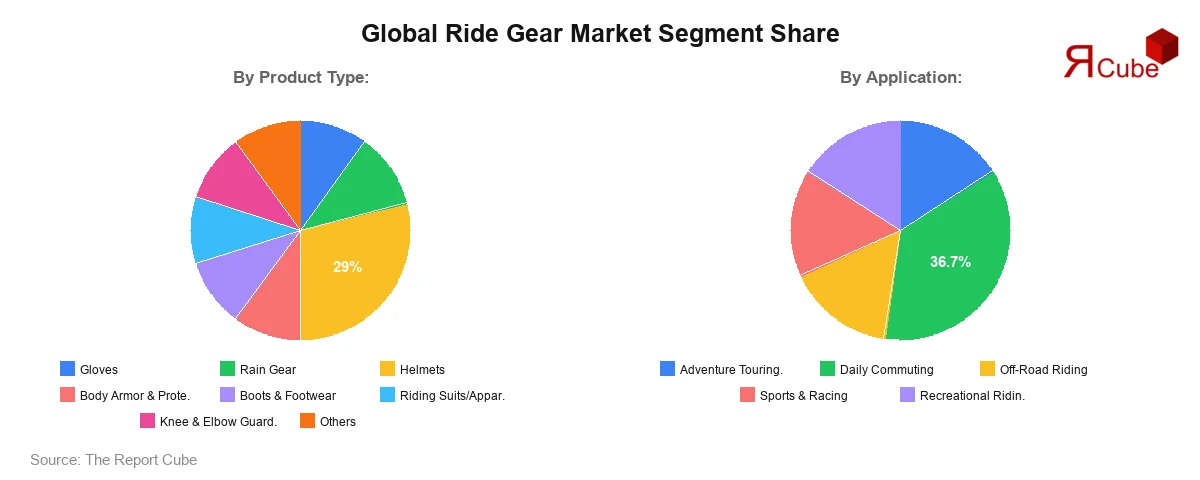
Helmets account for the leading share within the global ride gear market due to rising enforcement of rider safety regulations and increasing awareness regarding head injury prevention. The segment represented approximately 29% of overall revenue in 2026. Demand for full-face helmets, modular helmets, and smart integrated helmet systems has increased significantly among sports riders, urban commuters, and touring enthusiasts. Manufacturers are actively introducing lightweight carbon fiber shells, aerodynamic ventilation systems, anti-scratch visors, and Bluetooth-enabled communication features to strengthen rider convenience and comfort.
Replacement demand remains particularly strong across Asia-Pacific where governments continue to strengthen road safety compliance requirements for motorcyclists. Rising adoption of premium motorcycles and adventure touring bikes has also accelerated demand for high-performance certified helmets capable of supporting long-distance travel and off-road riding conditions. Continuous innovation surrounding impact absorption technologies and lightweight protective materials is expected to support sustained segment growth throughout the forecast period.
By Application:
- Adventure Touring
- Daily Commuting
- Off-Road Riding
- Sports & Racing
- Recreational Riding
Daily commuting continues to dominate the application landscape within the global ride gear market, accounting for nearly 36.7% of total revenue in 2026. Rising traffic congestion, fuel efficiency concerns, and growing dependence on motorcycles and scooters for urban transportation are supporting strong demand for commuter-focused riding protection equipment. Lightweight helmets, breathable jackets, waterproof gloves, and visibility-enhancing riding apparel are increasingly preferred among urban riders seeking comfort during regular travel.
The rapid growth of app-based delivery services and commercial two-wheeler transportation has further increased adoption of affordable protective riding equipment across metropolitan areas. Manufacturers are responding by developing ergonomic riding gear solutions designed specifically for extended commuting durations and varying weather conditions. Electric scooter and electric motorcycle expansion is also encouraging brands to launch compact and stylish urban riding protection products suitable for younger consumers and city-based mobility users.
Regional Projection of Global Ride Gear Industry
- North America
- Europe
- Asia-Pacific
- Middle East & Africa
- South America
Asia-Pacific holds the dominant position in the global ride gear market with an estimated revenue share of nearly 41.8% in 2026. Strong motorcycle ownership across India, China, Indonesia, Vietnam, and Thailand continues to support large-scale demand for helmets, riding jackets, gloves, and protective accessories. Rapid urbanization, expanding middle-class populations, and improving road infrastructure are encouraging wider adoption of motorcycles for both commuting and recreational activities. Governments across several Asian countries have strengthened helmet enforcement policies and safety awareness campaigns, which continue to support replacement demand for certified riding equipment.
India remains one of the fastest-growing regional markets due to rising premium motorcycle sales and increasing participation in long-distance touring culture. International riding gear manufacturers are strengthening regional distribution through dealership collaborations, localized production facilities, and organized retail expansion. Growth in motorsports participation, adventure travel communities, and performance motorcycle ownership is further driving demand for advanced riding protection technologies across the Asia-Pacific region.
Need insights for a specific region within this market?
Request Regional DataGlobal Ride Gear Industry Regional Analysis
The global ride gear market varies significantly across regions due to motorcycle ownership rates, safety regulations, and economic development.
| Region | Demand Level | Key Markets | System Dominance | Core Demand Logic | Growth Nature |
|---|---|---|---|---|---|
| North America | High | USA, Canada, Mexico | Premium protective gear | Recreational & touring riding culture | Premiumization growth |
| Europe | Very High | Germany, UK, France, Italy | CE-certified safety gear | Stringent safety regulations compliance | Regulation-driven demand |
| Asia-Pacific | Extremely High | China, India, Japan, Indonesia | Split & budget gear | Mass two-wheeler commuter penetration | Fastest-growing segment |
| Middle East & Africa | Low to Medium | UAE, Saudi Arabia, South Africa | Adventure & touring gear | Emerging adventure tourism interest | Tourism-driven expansion |
| South America | Medium to High | Brazil, Argentina, Colombia | All-weather protective gear | Booming motorcycle sales & urbanization | Volume-driven growth |
Government Initiatives & Policies
- India Road Safety Amendment Enforcement 2025: The Indian government strengthened helmet compliance and rider safety enforcement under updated Motor Vehicles Act implementation, increasing penalties for non-certified helmet usage and supporting adoption of BIS-certified protective riding gear products.
- European Union Motorcycle Safety Regulation 2026: The European Commission expanded rider safety standards for protective motorcycle apparel and helmets under updated PPE certification frameworks, encouraging manufacturers to adopt advanced impact protection and sustainability-focused production standards.
Global Ride Gear Industry Recent Developments
- April 2026: ReiseMoto became the authorized pan-India distributor for MT Helmets while launching the Stinger 2 helmet series across India. The expansion strengthened nationwide accessibility of ECE-certified premium helmets and supported increasing demand for technologically advanced riding protection equipment within the rapidly growing two-wheeler industry.
- November 2025: NeoKavach introduced India’s first intelligent wearable airbag system for motorcyclists designed to protect the chest, neck, and spine during accidents. The launch highlighted increasing market focus on active rider protection technologies and accelerated interest in smart safety solutions across emerging motorcycle markets.
Why Choose This Report?
- Provides a comprehensive overview of the overall market analysis, encompassing key trends, consumer behavior analysis, and risk assessment to support strategic decision-making.
- Provides accurate, up-to-date insights into market size, segmentation, and emerging opportunities, helping to minimize risk & capitalizing on growth.
- Gives deep understanding of target audience preferences, investment habits, and communication channels for enhanced product development & marketing effectiveness.
- Delivers competitive analysis & benchmarking, uncovering the strengths & weaknesses of market competitors to guide strategies.
- Consolidate comprehensive market intelligence, reducing reasoning & streamlining research efforts.
- Facilitates customized market segmentation & risk mitigation strategies, fine-tuned to the business objectives.
- Aids in identifying both market challenges & untapped opportunities within the industry to drive long-term business growth.
- Provides valuable information based on actual customer data & search trends.
Table of Contents
- Introduction
- Objective of the Study
- Product and Category Definition
- Market Segmentation
- Study Variables
- Research Methodology
- Secondary Data Points
- Breakdown of Secondary Sources
- Primary Data Points
- Breakdown of Primary Interviews
- Secondary Data Points
- Executive Summary
- Market Dynamics
- Emerging Opportunities
- Adoption Trends
- Demand Drivers
- Disruption Analysis (Challenges)
- Industry Analysis & Strategic Insights
- Supply/Value Chain Analysis
- Pricing Analysis
- Go-To-Market (GTM) Strategy
- BCG Matrix
- Recent Trends and Developments
- Import and Export Analysis
- Regulatory and Policy Landscape
- Region-wise Policies
- Government Initiatives
- Global Ride Gear Market Overview and Forecast Analysis (2021-2034)
- Market Size, By Value, By Growth Rate (CAGR/USD Billion)
- Market Share, By Product Type
- Gloves
- Rain Gear
- Helmets
- Body Armor & Protection Gear
- Boots & Footwear
- Riding Suits/Apparel
- Knee & Elbow Guards
- Jackets
- Others
- Market Share, By Material Type
- Carbon Fiber
- Mesh Fabric
- Kevlar & Reinforced Materials
- Leather
- Synthetic/Textile
- Others
- Market Share, By Vehicle Type
- Bicycle Riding Gear
- Equestrian Riding Gear
- Motorcycle Riding Gear
- Off-Road/ATV Riding Gear
- Others
- Market Share, By End User
- Women
- Kids
- Men
- Market Share, By Distribution Channel
- Specialty Stores
- Brand Outlets
- Supermarkets/Hypermarkets
- Online Stores/E-commerce
- Others
- Market Share, By Application
- Adventure Touring
- Daily Commuting
- Off-Road Riding
- Sports & Racing
- Recreational Riding
- Market Share, By Region
- North America
- Europe
- Asia-Pacific
- Middle East & Africa
- South America
- Market Share, By Company
- Revenue Shares & Analysis
- Competitive Landscape
- North America Ride Gear Market Overview and Forecast Analysis (2021-2034)
- Market Size, By Value, By Growth Rate (CAGR/USD Billion/Million)
- Market Share, By Product Type
- Market Share, By Material Type
- Market Share, By Vehicle Type
- Market Share, By End User
- Market Share, By Distribution Channel
- Market Share, By Application
- Market Share, By Country
- United States
- Canada
- Mexico
- Europe Ride Gear Market Overview and Forecast Analysis (2021-2034)
- Market Size, By Value, By Growth Rate (CAGR/USD Billion/Million)
- Market Share, By Product Type
- Market Share, By Material Type
- Market Share, By Vehicle Type
- Market Share, By End User
- Market Share, By Distribution Channel
- Market Share, By Application
- Market Share, By Country
- Germany
- United Kingdom
- France
- Italy
- Spain
- Netherlands
- Russia
- Poland
- Belgium
- Sweden
- Rest of Europe
- Asia-Pacific Ride Gear Market Overview and Forecast Analysis (2021-2034)
- Market Size, By Value, By Growth Rate (CAGR/USD Billion/Million)
- Market Share, By Product Type
- Market Share, By Material Type
- Market Share, By Vehicle Type
- Market Share, By End User
- Market Share, By Distribution Channel
- Market Share, By Application
- Market Share, By Country
- China
- India
- Japan
- South Korea
- Australia
- Indonesia
- Thailand
- Malaysia
- Vietnam
- Philippines
- Singapore
- New Zealand
- Rest of Asia-Pacific
- Middle East & Africa Ride Gear Market Overview and Forecast Analysis (2021-2034)
- Market Size, By Value, By Growth Rate (CAGR/USD Billion/Million)
- Market Share, By Product Type
- Market Share, By Material Type
- Market Share, By Vehicle Type
- Market Share, By End User
- Market Share, By Distribution Channel
- Market Share, By Application
- Market Share, By Country
- Saudi Arabia
- United Arab Emirates
- South Africa
- Egypt
- Nigeria
- Morocco
- Turkey
- Rest of Middle East & Africa
- South America Ride Gear Market Overview and Forecast Analysis (2021-2034)
- Market Size, By Value, By Growth Rate (CAGR/USD Billion/Million)
- Market Share, By Product Type
- Market Share, By Material Type
- Market Share, By Vehicle Type
- Market Share, By End User
- Market Share, By Distribution Channel
- Market Share, By Application
- Market Share, By Country
- Brazil
- Argentina
- Chile
- Colombia
- Peru
- Rest of South America
- Competitive Analysis, 2026
- Market Share of Key Players
- Competitive Mapping for Each Segment and Companies Operating Regionally
- North America Ride Gear Companies Share & Competitive Analysis, 2026
- Europe Ride Gear Companies Share & Competitive Analysis, 2026
- Asia-Pacific Ride Gear Companies Share & Competitive Analysis, 2026
- Middle East & Africa Ride Gear Companies Share & Competitive Analysis, 2026
- South America Ride Gear Companies Share & Competitive Analysis, 2026
- Company Profile (Partial List)
- Leatt Corporation
- Company Overview
- Product Portfolio
- Strategic Alliances/Partnerships
- Recent Developments
- Fly Racing
- Company Overview
- Product Portfolio
- Strategic Alliances/Partnerships
- Recent Developments
- Bell Helmets
- Company Overview
- Product Portfolio
- Strategic Alliances/Partnerships
- Recent Developments
- Steelbird Hi-Tech India
- Company Overview
- Product Portfolio
- Strategic Alliances/Partnerships
- Recent Developments
- Dainese
- Company Overview
- Product Portfolio
- Strategic Alliances/Partnerships
- Recent Developments
- Fox Racing
- Company Overview
- Product Portfolio
- Strategic Alliances/Partnerships
- Recent Developments
- Royal Enfield
- Company Overview
- Product Portfolio
- Strategic Alliances/Partnerships
- Recent Developments
- Alpinestars
- Company Overview
- Product Portfolio
- Strategic Alliances/Partnerships
- Recent Developments
- REV'IT!
- Company Overview
- Product Portfolio
- Strategic Alliances/Partnerships
- Recent Developments
- THOR
- Company Overview
- Product Portfolio
- Strategic Alliances/Partnerships
- Recent Developments
- Shoei
- Company Overview
- Product Portfolio
- Strategic Alliances/Partnerships
- Recent Developments
- RS Taichi
- Company Overview
- Product Portfolio
- Strategic Alliances/Partnerships
- Recent Developments
- Klim
- Company Overview
- Product Portfolio
- Strategic Alliances/Partnerships
- Recent Developments
- Arai Helmet
- Company Overview
- Product Portfolio
- Strategic Alliances/Partnerships
- Recent Developments
- HJC Helmets
- Company Overview
- Product Portfolio
- Strategic Alliances/Partnerships
- Recent Developments
- Others (Partial List)
- Leatt Corporation
- Contact Us and Disclaimer
Top Key Players & Market Share Outlook
- Leatt Corporation
- Fly Racing
- Bell Helmets
- Steelbird Hi-Tech India
- Dainese
- Fox Racing
- Royal Enfield
- Alpinestars
- REV'IT!
- THOR
- Shoei
- RS Taichi
- Klim
- Arai Helmet
- HJC Helmets
- Others
Frequently Asked Questions






