



Build Your Custom Market Intelligence Report
Customize Your ReportJapan E-Bike Market Key Highlights
By Propulsion Type:
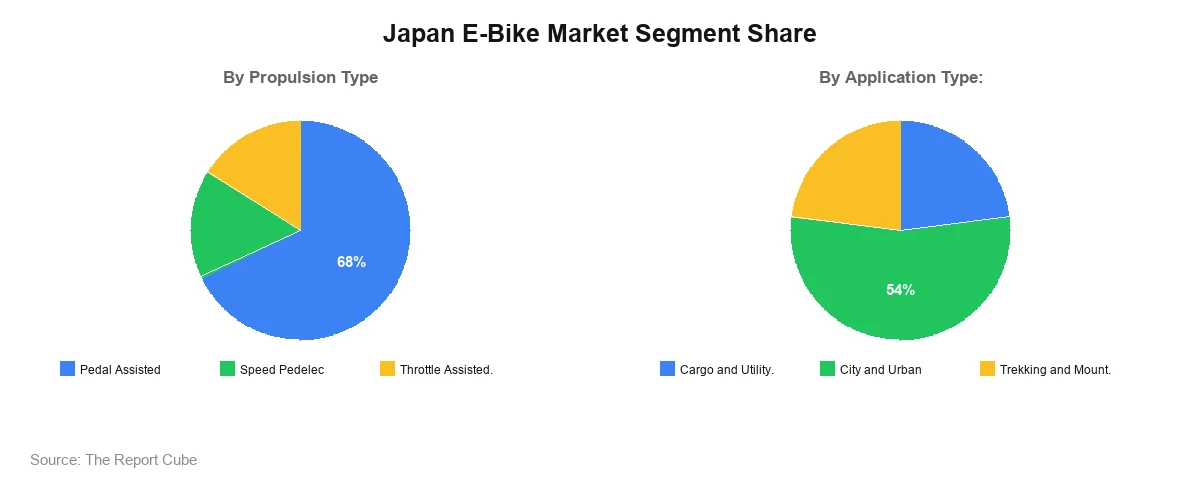
Pedal Assisted segment leads the market with nearly 68% share.
By Application Type:
City and Urban segment dominates the market with around 54% of revenue.
Regional Outlook:
Kanto region dominates the Japan E-Bike market with approximately 36% share.
Japan E-Bike Market Insights & Analysis
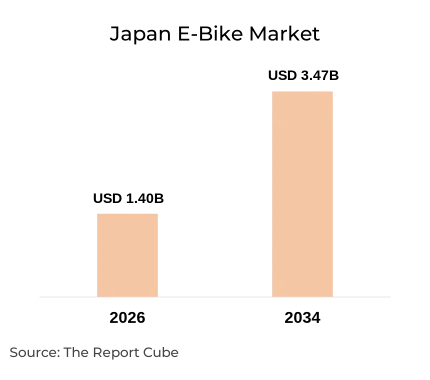
The Japan E-Bike Market is anticipated to register a CAGR of around 12.0% during the forecast period 2026-2034. The market size is valued at USD 1.4 billion in 2026 and is projected to reach USD 3.47 billion by 2034. Japan’s urban mobility ecosystem is evolving rapidly, driven by an aging population, rising fuel prices, and increasing focus on sustainable transport alternatives. E-bikes are becoming a preferred mobility option for short-distance commuting, particularly in dense urban regions such as Tokyo and Osaka.
Investments from major manufacturers like Panasonic and Yamaha are reshaping the technological landscape with lightweight lithium-ion batteries and high-efficiency motors. In 2025, Japan recorded a notable rise in e-bike adoption across last-mile delivery services, supported by growing e-commerce demand. Government-backed sustainability targets and infrastructure development, including dedicated cycling lanes, are further accelerating adoption. Additionally, technological integration such as IoT-enabled tracking and smart battery management systems is strengthening product appeal among both commercial users and individual consumers.
Japan E-Bike Market Dynamics
Key Driver: Rising Demand for Sustainable Urban Mobility Solutions
Japan’s push toward reducing carbon emissions has significantly influenced the demand for e-bikes as an eco-friendly transport option. With urban congestion increasing by nearly 18% in major cities between 2022 and 2025, consumers are actively shifting toward compact mobility solutions. E-bikes provide an efficient alternative to cars and public transport for short-distance travel, reducing both travel time and environmental impact.
Additionally, Japan’s aging population is playing a critical role in driving adoption. Nearly 29% of the population is aged 65 and above, and e-bikes offer assisted mobility that reduces physical strain. This demographic shift is encouraging manufacturers to design ergonomic and user-friendly e-bikes, further boosting market penetration.
Book your FREE 30-minute expert consultation today
Contact UsIndustry Trends: Integration of Smart Technologies and Advanced Battery Systems
The Japan e-bike market is witnessing a strong shift toward smart and connected mobility solutions. Manufacturers are integrating GPS tracking, mobile app connectivity, and performance analytics into e-bikes, enhancing user experience. These features are particularly attractive for urban commuters and delivery service providers seeking operational efficiency.
Battery innovation is another major trend shaping the market. Lithium-ion batteries now account for over 82% of new e-bike sales due to their higher energy density and longer lifespan. Companies are focusing on fast-charging capabilities and extended range, enabling users to travel up to 120 kilometers on a single charge, which significantly improves product usability.
Major Challenge: High Initial Cost and Limited Charging Infrastructure
The relatively high upfront cost of e-bikes remains a barrier to widespread adoption in Japan. Premium models equipped with advanced features can cost over USD 3,000, which limits accessibility for price-sensitive consumers. Although operational costs are lower than traditional vehicles, the initial investment can discourage first-time buyers.
Charging infrastructure also presents a challenge, particularly in rural areas. While urban regions have seen improvements in charging facilities, the lack of standardized infrastructure across regions can hinder long-distance usability. This gap restricts market expansion beyond major metropolitan areas.
Opportunity: Expansion of E-Bikes in Commercial Delivery and Shared Mobility
The rapid growth of e-commerce in Japan is creating significant opportunities for e-bike adoption in last-mile delivery. Delivery companies are increasingly using cargo e-bikes to reduce fuel costs and improve delivery efficiency in congested urban environments. This shift is expected to drive commercial demand substantially over the forecast period.
Shared mobility services also present a promising growth avenue. Bike-sharing platforms are integrating e-bikes into their fleets, offering users convenient and affordable transportation options. With government support and increasing urbanization, shared e-bike services are expected to expand rapidly across major cities.
Japan E-Bike Market Segment-wise Analysis
By Propulsion Type:
- Pedal Assisted
- Speed Pedelec
- Throttle Assisted
Pedal-assisted e-bikes dominate the Japan e-bike market, accounting for approximately 68% of total sales in 2025. These models are widely preferred due to regulatory support and user-friendly operation. Japan’s strict speed regulations favor pedal-assist systems, making them the standard choice for daily commuting.
Additionally, these bikes offer better battery efficiency and longer range compared to throttle-based models. Manufacturers are focusing on improving torque sensors and motor responsiveness, enhancing ride quality and energy efficiency.
By Application Type:
- Cargo and Utility
- City and Urban
- Trekking and Mountain
The city and urban segment holds a dominant share of around 54% in the Japan e-bike market. Urban commuters rely heavily on e-bikes for daily travel due to their convenience and cost-effectiveness. With increasing urban density and traffic congestion, e-bikes provide a practical alternative for short-distance travel.
Furthermore, infrastructure developments such as dedicated cycling lanes and parking facilities are supporting the growth of this segment. The rise of compact and foldable e-bikes is also contributing to increased adoption among urban residents.
Regional Projection of Japan E-Bike Industry
- Hokkaido
- Tohoku
- Kanto
- Shikoku
- Others
The Kanto region leads the Japan e-bike market, holding approximately 36% of the total market share. This dominance is driven by high population density, advanced urban infrastructure, and strong consumer purchasing power. Tokyo, being a major metropolitan hub, has witnessed significant growth in e-bike adoption for both personal commuting and commercial delivery services. The region’s well-developed cycling infrastructure and government initiatives supporting sustainable mobility further contribute to market growth.
Furthermore, the presence of leading manufacturers and distributors in the Kanto region enhances product availability and innovation.
Government Initiatives & Policies
- Japan Green Growth Strategy 2025: Promotes low-emission mobility solutions including e-bikes, encouraging urban electrified transport adoption and infrastructure expansion.
- MLIT Smart Mobility Initiative 2025: Supports micro-mobility integration, including e-bikes in urban planning and shared mobility programs to reduce congestion.
Japan E-Bike Industry Recent Developments
- 2025: Panasonic Cycle Technology launched advanced e-bike batteries with longer lifespan and fast charging to support sustainable mobility expansion.
- 2025: Yamaha Motor Co., Ltd. introduced upgraded PWseries ST motors with improved efficiency and torque for urban and hilly terrains.
- 2025: Shimano Inc. released EP5 and E5100 drive units offering enhanced torque and performance for commuting and adventure cycling.
- 2025: BESV Japan launched MAISON BESV premium e-bike series, strengthening its presence in high-end market segments.
- 2025: Giant Group (Japan) expanded its e-bike portfolio with lightweight and long-range models targeting urban and cargo applications.
Need insights for a specific region within this market?
Request Regional DataWhy Choose This Report?
- Provides a comprehensive overview of the overall market analysis, encompassing key trends, consumer behavior analysis, and risk assessment to support strategic decision-making.
- Provides accurate, up-to-date insights into market size, segmentation, and emerging opportunities, helping to minimize risk & capitalizing on growth.
- Gives deep understanding of target audience preferences, investment habits, and communication channels for enhanced product development & marketing effectiveness.
- Delivers competitive analysis & benchmarking, uncovering the strengths & weaknesses of market competitors to guide strategies.
- Consolidate comprehensive market intelligence, reducing reasoning & streamlining research efforts.
- Facilitates customized market segmentation & risk mitigation strategies, fine-tuned to the business objectives.
- Aids in identifying both market challenges & untapped opportunities within the industry to drive long-term business growth.
- Provides valuable information based on actual customer data & search trends.
Table of Contents
- Introduction
- Objective of the Study
- Product and Category Definition
- Market Segmentation
- Study Variables
- Research Methodology
- Secondary Data Points
- Breakdown of Secondary Sources
- Primary Data Points
- Breakdown of Primary Interviews
- Secondary Data Points
- Executive Summary
- Market Dynamics
- Drivers
- Challenges
- Opportunity Assessment
- Recent Trends and Developments
- Regulatory and Policy Landscape
- Japan E-Bike Market Overview (2021-2034)
- Market Size, By Value (USD Billion)
- Market Volume, By Units
- Market Share, By Propulsion Type
- Pedal Assisted
- Speed Pedelec
- Throttle Assisted
- Market Share, By Application Type
- Cargo and Utility
- City and Urban
- Trekking and Mountain
- Market Share, By Battery Type
- Lead Acid Battery
- Lithium-ion Battery
- Other Battery Types
- Market Share, By Motor Placement
- Hub Motor (Front)
- Hub Motor (Rear)
- Mid-Drive Motor
- Market Share, By Drive Systems
- Chain Drive
- Belt Drive
- Market Share, By Motor Power
- Below 250 W
- 251-350 W
- 351-500 W
- 501-600 W
- Above 600 W
- Market Share, By Price Band
- Up to USD 1,000
- USD 1,000-1,499
- USD 1,500-2,499
- USD 2,500-3,499
- USD 3,500-5,999
- Above USD 6,000
- Market Share, By Sales Channel
- Online
- Offline
- Market Share, By End Use
- Commercial Delivery
- Retail and Goods Delivery
- Food and Beverage Delivery
- Service Providers
- Personal and Family Use
- Institutional Users
- Other End Uses
- Commercial Delivery
- Market Share, By Region
- Hokkaido
- Tohoku
- Kanto
- Shikoku
- Others
- Market Share, By Company
- Revenue Shares and Analysis
- Competitive Landscape
- Hokkaido Japan E-Bike Market
- Market Size, By Value (USD Billion/Million)
- Market Volume, By Units
- Market Share, By Propulsion Type
- Market Share, By Application Type
- Market Share, By Battery Type
- Market Share, By Motor Placement
- Market Share, By Drive Systems
- Market Share, By Motor Power
- Market Share, By Price Band
- Market Share, By Sales Channel
- Market Share, By End Use
- Tohoku Japan E-Bike Market
- Market Size, By Value (USD Billion/Million)
- Market Volume, By Units
- Market Share, By Propulsion Type
- Market Share, By Application Type
- Market Share, By Battery Type
- Market Share, By Motor Placement
- Market Share, By Drive Systems
- Market Share, By Motor Power
- Market Share, By Price Band
- Market Share, By Sales Channel
- Market Share, By End Use
- Kanto Japan E-Bike Market
- Market Size, By Value (USD Billion/Million)
- Market Volume, By Units
- Market Share, By Propulsion Type
- Market Share, By Application Type
- Market Share, By Battery Type
- Market Share, By Motor Placement
- Market Share, By Drive Systems
- Market Share, By Motor Power
- Market Share, By Price Band
- Market Share, By Sales Channel
- Market Share, By End Use
- Shikoku Japan E-Bike Market
- Market Size, By Value (USD Billion/Million)
- Market Volume, By Units
- Market Share, By Propulsion Type
- Market Share, By Application Type
- Market Share, By Battery Type
- Market Share, By Motor Placement
- Market Share, By Drive Systems
- Market Share, By Motor Power
- Market Share, By Price Band
- Market Share, By Sales Channel
- Market Share, By End Use
- Competitive Outlook and Company Profiles
- Panasonic Cycle Technology
- Company Overview
- Product Portfolio
- Strategic Alliances/Partnerships
- Recent Developments
- Yamaha Motor Co., Ltd.
- Company Overview
- Product Portfolio
- Strategic Alliances/Partnerships
- Recent Developments
- Bridgestone Cycle Co.
- Company Overview
- Product Portfolio
- Strategic Alliances/Partnerships
- Recent Developments
- BESV Japan
- Company Overview
- Product Portfolio
- Strategic Alliances/Partnerships
- Recent Developments
- GIC Co., Ltd.
- Company Overview
- Product Portfolio
- Strategic Alliances/Partnerships
- Recent Developments
- Miyata Cycle Co., Ltd.
- Company Overview
- Product Portfolio
- Strategic Alliances/Partnerships
- Recent Developments
- Giant Group
- Company Overview
- Product Portfolio
- Strategic Alliances/Partnerships
- Recent Developments
- Trek Bicycle Japan
- Company Overview
- Product Portfolio
- Strategic Alliances/Partnerships
- Recent Developments
- Specialized Japan
- Company Overview
- Product Portfolio
- Strategic Alliances/Partnerships
- Recent Developments
- Honda Motor Co.
- Company Overview
- Product Portfolio
- Strategic Alliances/Partnerships
- Recent Developments
- Shimano Inc.
- Company Overview
- Product Portfolio
- Strategic Alliances/Partnerships
- Recent Developments
- Kyocera Corporation
- Company Overview
- Product Portfolio
- Strategic Alliances/Partnerships
- Recent Developments
- Tsubame BHB (Araya)
- Company Overview
- Product Portfolio
- Strategic Alliances/Partnerships
- Recent Developments
- Tern Bicycles Japan
- Company Overview
- Product Portfolio
- Strategic Alliances/Partnerships
- Recent Developments
- Cannondale Japan
- Company Overview
- Product Portfolio
- Strategic Alliances/Partnerships
- Recent Developments
- Votani (by BESV)
- Company Overview
- Product Portfolio
- Strategic Alliances/Partnerships
- Recent Developments
- Others
- Panasonic Cycle Technology
- Contact Us and Disclaimer
List of Figure
List of Table
Top Key Players & Market Share Outlook
- Panasonic Cycle Technology
- Yamaha Motor Co., Ltd.
- Bridgestone Cycle Co.
- BESV Japan
- GIC Co., Ltd.
- Miyata Cycle Co., Ltd.
- Giant Group (Japan)
- Trek Bicycle Japan
- Specialized Japan
- Honda Motor Co.
- Shimano Inc.
- Kyocera Corporation
- Tsubame BHB (Araya)
- Tern Bicycles Japan
- Cannondale Japan
- Votani (by BESV)
Frequently Asked Questions






