



Build Your Custom Market Intelligence Report
Customize Your ReportUAE Battery Management Systems (BMS) Market Insights & Analysis
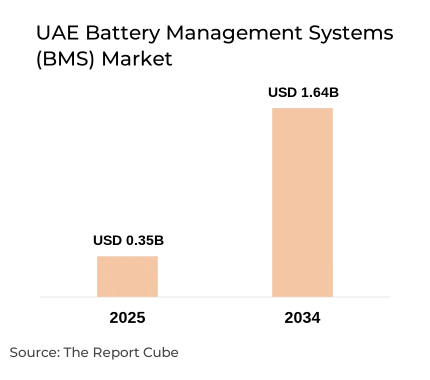
The UAE Battery Management Systems (BMS) Market is anticipated to register a CAGR of 18.70% during 2026-2034. The market size was valued at USD 0.35 billion in 2025 and is projected to reach USD 1.64 billion by 2034. The market is expanding rapidly as the UAE accelerates its transition toward electric mobility, renewable energy integration, and advanced energy storage systems. Battery management systems have become a critical component across electric vehicles, grid-scale energy storage, and industrial applications, ensuring safety, performance optimization, and longer battery life.
This strong growth is closely linked to the country’s clean energy ambitions, including large-scale solar installations and increasing investments in battery-backed power systems. As lithium-ion batteries dominate new deployments, the need for intelligent monitoring, thermal management, and real-time analytics has intensified. BMS solutions are therefore evolving from basic protection units into sophisticated platforms that support predictive maintenance and data-driven decision-making.
Furthermore, the UAE’s position as a regional technology and manufacturing hub is attracting global BMS providers and semiconductor companies. Strategic collaborations with automotive OEMs, energy developers, and smart city initiatives are strengthening the market ecosystem. Together, these factors are creating a robust foundation for sustained BMS adoption across the UAE through 2034.
UAE Battery Management Systems Market Recent Developments
- 2025: A leading EV fleet operator in Dubai deployed advanced BMS platforms to optimize battery performance and lifecycle analytics.
- 2025: An international semiconductor firm expanded its BMS chipset supply to support large-scale energy storage projects in Abu Dhabi.
Government Initiatives & Policies
- UAE Net Zero 2050 Strategy: Supports large-scale battery storage deployment to enhance renewable energy reliability.
- Dubai Clean Energy Strategy 2050: Promotes energy storage systems integrated with solar power projects.
UAE Battery Management Systems (BMS) Market Dynamics
Key Driver: Rapid Growth of Electric Vehicles and Energy Storage Projects
The accelerating adoption of electric vehicles and stationary energy storage systems is the primary driver of the UAE Battery Management Systems Market. EV registrations in the UAE are growing at double-digit rates, supported by charging infrastructure expansion and government incentives. Each EV relies on advanced BMS solutions to manage cell balancing, temperature control, and safety diagnostics. Similarly, utility-scale battery storage projects supporting solar power plants require highly reliable BMS platforms to ensure grid stability and operational efficiency. As battery capacities increase, system complexity rises, making intelligent BMS solutions indispensable for both mobility and energy applications.

Book your FREE 30-minute expert consultation today
Contact UsIndustry Trends: Shift Toward Software-Driven and Smart BMS Solutions
A key trend shaping the market is the shift from hardware-centric BMS architectures toward software-driven, intelligent platforms. Modern BMS solutions increasingly incorporate cloud connectivity, advanced algorithms, and data analytics to enable predictive maintenance and performance optimization. In the UAE, smart city initiatives and digital transformation strategies are accelerating the adoption of connected energy systems. Approximately 40% of newly deployed BMS solutions in 2025 featured remote monitoring and AI-enabled diagnostics. This trend is enhancing battery reliability while reducing operational costs for fleet operators and energy providers.
Major Challenge: High System Costs and Integration Complexity
Despite strong growth prospects, high system costs and integration challenges remain key obstacles. Advanced BMS solutions require sophisticated sensors, semiconductors, and software platforms, increasing upfront investment. Integrating BMS with diverse battery chemistries and legacy energy systems can also be technically complex, particularly for large-scale projects. Smaller developers and fleet operators may face budget constraints, slowing adoption. Additionally, the need for skilled technical expertise to manage and maintain advanced BMS platforms adds to operational challenges across the UAE market.
Opportunity: Expansion of Renewable Energy Storage and Grid Modernization
The UAE’s rapid expansion of renewable energy capacity presents a major opportunity for the BMS market. Large solar projects increasingly require battery storage to manage intermittency and peak demand. Advanced BMS solutions play a critical role in ensuring safe, efficient, and long-lasting battery operation within these systems. As grid modernization efforts accelerate, demand for scalable and interoperable BMS platforms is expected to rise. This creates significant opportunities for technology providers offering modular, software-centric, and high-reliability BMS solutions tailored to regional energy needs.
UAE Battery Management Systems Market Segment-wise Analysis
By Battery Type:
- Lithium-ion
- Lead-acid
- Nickel-based
- Flow Batteries
Lithium-ion batteries dominate the UAE BMS market, accounting for nearly 62% of total demand in 2025. Their high energy density, long lifecycle, and suitability for EVs and renewable energy storage make them the preferred choice. Consequently, lithium-ion-focused BMS solutions lead the market, offering advanced thermal management and real-time monitoring. Other chemistries, such as flow batteries, are gaining attention in grid-scale applications, but adoption remains comparatively limited.
By Component:
- Hardware
- Software
Hardware components currently represent the larger share of the market, contributing approximately 58% of total revenue in 2025. This includes sensors, controllers, and communication modules essential for battery protection. However, the software segment is growing faster as end users increasingly value analytics, diagnostics, and system intelligence. Software-driven BMS platforms are expected to gain share steadily through 2034, supported by digital energy management initiatives.
Regional Projection of UAE Battery Management Systems Industry
- Abu Dhabi
- Dubai
- Sharjah
- Northern Emirates
Abu Dhabi leads the UAE BMS market, holding an estimated 38% market share in 2025. The emirate benefits from large-scale renewable energy projects, industrial investments, and strong government backing for energy storage solutions. Dubai follows closely, driven by EV adoption, smart city initiatives, and commercial energy storage deployments. Sharjah and the Northern Emirates are emerging markets, supported by infrastructure development and increasing focus on sustainable energy systems.
Need insights for a specific region within this market?
Request Regional DataWhy Choose This Report?
- Provides a comprehensive overview of the overall market analysis, encompassing key trends, consumer behavior analysis, and risk assessment to support strategic decision-making.
- Provides accurate, up-to-date insights into market size, segmentation, and emerging opportunities, helping to minimize risk & capitalizing on growth.
- Gives deep understanding of target audience preferences, investment habits, and communication channels for enhanced product development & marketing effectiveness.
- Delivers competitive analysis & benchmarking, uncovering the strengths & weaknesses of market competitors to guide strategies.
- Consolidate comprehensive market intelligence, reducing reasoning & streamlining research efforts.
- Facilitates customized market segmentation & risk mitigation strategies, fine-tuned to the business objectives.
- Aids in identifying both market challenges & untapped opportunities within the industry to drive long-term business growth.
- Provides valuable information based on actual customer data & search trends.
Table of Contents
- Introduction
- Objective of the Study
- Product and Category Definition
- Market Segmentation
- Study Variables
- Research Methodology
- Secondary Data Points
- Breakdown of Secondary Sources
- Primary Data Points
- Breakdown of Primary Interviews
- Secondary Data Points
- Executive Summary
- Market Dynamics
- Drivers
- Challenges
- Opportunity Assessment
- Recent Trends and Developments
- Regulatory and Policy Landscape
- UAE Battery Management Systems (BMS) Market Overview (2020-2034)
- Market Size, By Value (USD Billion)
- Market Share, By Battery Type
- Lithium-ion
- Lead-acid
- Nickel-based
- Flow Batteries
- Other Chemistries
- Market Share, By Component
- Hardware
- Software
- Market Share, By Topology
- Centralized BMS
- Modular BMS
- Distributed BMS
- Market Share, By Application
- Automotive
- Energy Storage
- Industrial
- Consumer Electronics
- Other Applications
- Market Share, By Region
- Abu Dhabi
- Dubai
- Sharjah
- Northern Emirates
- Market Share, By Company
- Competition Characteristics
- Revenue Shares & Analysis
- Abu Dhabi BMS Market
- Market Size, By Value (USD Billion)
- Market Share, By Battery Type
- Market Share, By Component
- Market Share, By Topology
- Market Share, By Application
- Dubai BMS Market
- Market Size, By Value (USD Billion)
- Market Share, By Battery Type
- Market Share, By Component
- Market Share, By Topology
- Market Share, By Application
- Sharjah BMS Market
- Market Size, By Value (USD Billion)
- Market Share, By Battery Type
- Market Share, By Component
- Market Share, By Topology
- Market Share, By Application
- Northern Emirates BMS Market
- Market Size, By Value (USD Billion)
- Market Share, By Battery Type
- Market Share, By Component
- Market Share, By Topology
- Market Share, By Application
- Competitive Outlook and Company Profiles
- LG Energy Solution
- Company Overview
- Product Portfolio
- Strategic Alliances/Partnerships
- Recent Developments
- Samsung SDI
- Company Overview
- Product Portfolio
- Strategic Alliances/Partnerships
- Recent Developments
- Panasonic Holdings
- Company Overview
- Product Portfolio
- Strategic Alliances/Partnerships
- Recent Developments
- BYD Company
- Company Overview
- Product Portfolio
- Strategic Alliances/Partnerships
- Recent Developments
- CATL
- Company Overview
- Product Portfolio
- Strategic Alliances/Partnerships
- Recent Developments
- Analog Devices
- Company Overview
- Product Portfolio
- Strategic Alliances/Partnerships
- Recent Developments
- Texas Instruments
- Company Overview
- Product Portfolio
- Strategic Alliances/Partnerships
- Recent Developments
- NXP Semiconductors
- Company Overview
- Product Portfolio
- Strategic Alliances/Partnerships
- Recent Developments
- Infineon Technologies
- Company Overview
- Product Portfolio
- Strategic Alliances/Partnerships
- Recent Developments
- STMicroelectronics
- Company Overview
- Product Portfolio
- Strategic Alliances/Partnerships
- Recent Developments
- Others
- LG Energy Solution
- Contact Us and Disclaimer
Top Key Players & Market Share Outlook
- LG Energy Solution
- Samsung SDI
- Panasonic Holdings
- BYD Company
- CATL
- Analog Devices
- Texas Instruments
- NXP Semiconductors
- Infineon Technologies
- STMicroelectronics
- Others
Frequently Asked Questions






