



Build Your Custom Market Intelligence Report
Customize Your ReportJapan Electric Vehicle Motor Market Insights & Analysis
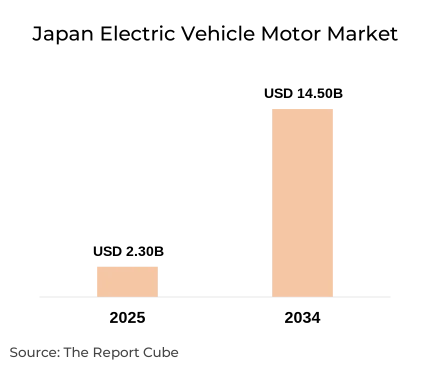
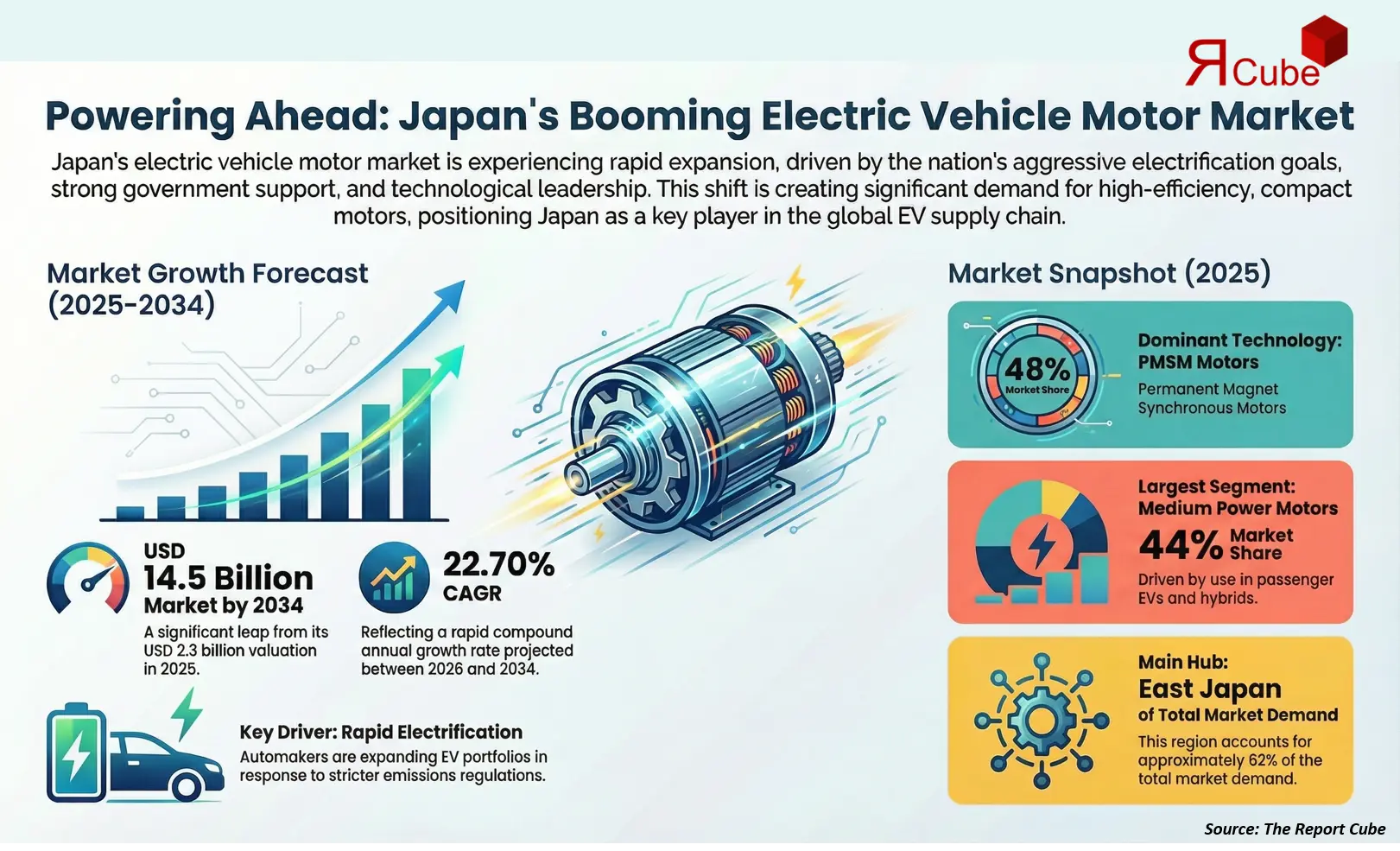
The Japan Electric Vehicle Motor Market is anticipated to register a CAGR of 22.70% during the forecast period 2026-2034. The market size was valued at USD 2.3 billion in 2025 and is projected to reach USD 14.5 billion by 2034. This rapid expansion is strongly linked to Japan’s aggressive electrification targets, rising electric vehicle (EV) adoption, and the country’s leadership in advanced motor and powertrain technologies.
Japan’s automotive industry is undergoing a structural shift as major OEMs accelerate their transition from internal combustion engines to electrified powertrains. Electric motors represent the core component of EV propulsion systems, and their demand is directly tied to vehicle production volumes and technological upgrades. The increasing penetration of battery electric vehicles (BEVs) and hybrid electric vehicles (HEVs) has significantly increased the requirement for high-efficiency, compact, and lightweight motors. Manufacturers are prioritizing motors with higher torque density and lower energy losses to enhance vehicle range and performance.
Additionally, government incentives supporting zero-emission vehicles, combined with strong R&D investments by domestic suppliers, are strengthening the competitive landscape. Japan’s well-established supply chain for electronics, precision components, and automotive manufacturing enables rapid innovation in EV motor design. As a result, the market is expected to witness sustained growth, driven by technological advancements, export opportunities, and the rising global demand for Japanese-engineered electric vehicle components.
Japan Electric Vehicle Motor Market Recent Developments
- 2025: Nidec Corporation expanded high-efficiency EV motor production capacity to support growing domestic and export demand.
- 2025: Mitsubishi Electric introduced next-generation traction motors optimized for compact electric passenger vehicles.
Government Initiatives & Policies
- Green Growth Strategy: Japan’s policy framework promoting electrification and carbon neutrality across the automotive sector.
- Next Generation Vehicle Promotion Program: Incentives supporting EV adoption and advanced component manufacturing.
Japan Electric Vehicle Motor Market Dynamics
Key Driver: Rapid Electrification of the Automotive Industry
The primary driver of the Japan Electric Vehicle Motor Market is the rapid electrification of the automotive industry. Japanese automakers are expanding their EV portfolios in response to stricter emission regulations and changing consumer preferences. Electric motors are essential for delivering smooth acceleration, high efficiency, and reduced maintenance compared to conventional engines. In 2024, electrified vehicles accounted for over 40% of new vehicle sales in Japan, significantly boosting demand for traction motors. Additionally, Japan’s export-oriented automotive sector requires motors that meet global efficiency and reliability standards, further stimulating innovation and production. This sustained push toward electrification ensures long-term demand growth for EV motors across passenger and commercial vehicle segments.
Book your FREE 30-minute expert consultation today
Contact UsIndustry Trends: Shift Toward High-Efficiency and Compact Motor Designs
A key trend shaping the market is the shift toward high-efficiency and compact motor designs. Manufacturers are increasingly adopting permanent magnet synchronous motors (PMSMs) due to their superior power density and efficiency. At the same time, advancements in cooling systems and materials are enabling motors to operate at higher speeds with reduced energy losses. Integration of motor, inverter, and gearbox into unified e-axle systems is also gaining traction, helping automakers reduce vehicle weight and assembly complexity. These trends are closely aligned with Japan’s focus on engineering excellence and precision manufacturing, reinforcing the country’s competitive advantage in EV motor technology.
Major Challenge: High Development and Material Costs
Despite strong growth prospects, high development and material costs pose a significant challenge to the Japan Electric Vehicle Motor Market. Advanced motors often rely on rare earth materials, such as neodymium, which are subject to price volatility and supply risks. Additionally, continuous R&D investment is required to improve efficiency, reduce size, and meet evolving performance standards. These factors increase production costs, placing pressure on profit margins, especially for smaller suppliers. Managing cost competitiveness while maintaining high quality remains a critical hurdle for market participants.
Opportunity: Expansion of High-Power Motors for Commercial and Performance EVs
The growing adoption of electric commercial vehicles and performance-oriented EVs presents a major opportunity for the market. High-power motors are increasingly required for electric buses, trucks, and premium passenger vehicles that demand higher torque and durability. Japan’s expertise in industrial motors and automotive engineering positions domestic manufacturers to capture this emerging demand. Additionally, advancements in motor control software and thermal management systems are enabling the deployment of high-power motors without compromising efficiency. This expanding application scope is expected to create new revenue streams and strengthen long-term market growth.
Japan Electric Vehicle Motor Market Segment-wise Analysis
By Motor Type:
- AC Motor
- DC Motor
- PMSM Motor
- Induction Motor
- Reluctance Motor
PMSM motors dominate the Japan Electric Vehicle Motor Market, accounting for approximately 48% of total market share in 2025. Their high efficiency, compact size, and superior torque characteristics make them ideal for modern EV applications. AC and induction motors follow, benefiting from robustness and lower reliance on rare earth materials. Reluctance motors are gradually gaining attention due to cost advantages and simplified construction. The dominance of PMSM motors reflects the industry’s strong emphasis on performance optimization and energy efficiency.
By Power Range:
- Low Power
- Medium Power
- High Power
The medium power segment leads the market, holding nearly 44% share, driven by its widespread use in passenger electric vehicles and hybrids. Low power motors are commonly deployed in compact EVs and auxiliary systems, while high power motors are experiencing the fastest growth due to rising demand from electric commercial vehicles and performance EVs. This balanced distribution across power ranges highlights the diverse application landscape of EV motors in Japan.
Regional Projection of Japan Electric Vehicle Motor Industry
- East Japan
- West Japan
East Japan leads the Japan Electric Vehicle Motor Market, accounting for approximately 62% of total market demand. The region hosts a high concentration of automotive OEMs, component manufacturers, and R&D centers, particularly around Tokyo and surrounding industrial hubs. Strong infrastructure, skilled workforce availability, and proximity to major export ports further support market dominance. West Japan follows, benefiting from growing EV assembly operations and supplier expansion. East Japan is expected to maintain its leadership throughout the forecast period, supported by continuous innovation and large-scale production capabilities.
Need insights for a specific region within this market?
Request Regional DataWhy Choose This Report?
- Provides a comprehensive overview of the overall market analysis, encompassing key trends, consumer behavior analysis, and risk assessment to support strategic decision-making.
- Provides accurate, up-to-date insights into market size, segmentation, and emerging opportunities, helping to minimize risk & capitalizing on growth.
- Gives deep understanding of target audience preferences, investment habits, and communication channels for enhanced product development & marketing effectiveness.
- Delivers competitive analysis & benchmarking, uncovering the strengths & weaknesses of market competitors to guide strategies.
- Consolidate comprehensive market intelligence, reducing reasoning & streamlining research efforts.
- Facilitates customized market segmentation & risk mitigation strategies, fine-tuned to the business objectives.
- Aids in identifying both market challenges & untapped opportunities within the industry to drive long-term business growth.
- Provides valuable information based on actual customer data & search trends.
Table of Contents
- Introduction
- Objective of the Study
- Product and Category Definition
- Market Segmentation
- Study Variables
- Research Methodology
- Secondary Data Points
- Breakdown of Secondary Sources
- Primary Data Points
- Breakdown of Primary Interviews
- Secondary Data Points
- Executive Summary
- Market Dynamics
- Drivers
- Challenges
- Opportunity Assessment
- Recent Trends and Developments
- Regulatory and Policy Landscape
- Japan Electric Vehicle Motor Market Overview (2020-2034)
- Market Size, By Value (USD Billion)
- Market Share, By Motor Type
- AC Motor
- DC Motor
- PMSM Motor
- Induction Motor
- Reluctance Motor
- Market Share, By Power Range
- Low Power
- Medium Power
- High Power
- Market Share, By Vehicle Type
- Passenger Car
- Light Commercial
- Heavy Commercial
- Two Wheeler
- Market Share, By Application
- Traction Drive
- Auxiliary Systems
- E‑Axle Systems
- Market Share, By Region
- East
- West
- Market Share, By Company
- Revenue Shares
- Competitive Landscape
- East Japan EV Motor Market
- Market Size, By Value (USD Billion)
- Market Share, By Motor Type
- Market Share, By Power Range
- Market Share, By Vehicle Type
- Market Share, By Application
- West Japan EV Motor Market
- Market Size, By Value (USD Billion)
- Market Share, By Motor Type
- Market Share, By Power Range
- Market Share, By Vehicle Type
- Market Share, By Application
- Competitive Outlook and Company Profiles
- Nidec Corporation
- Company Overview
- Product Portfolio
- Strategic Alliances/Partnerships
- Recent Developments
- Mitsubishi Electric
- Company Overview
- Product Portfolio
- Strategic Alliances/Partnerships
- Recent Developments
- Hitachi Astemo
- Company Overview
- Product Portfolio
- Strategic Alliances/Partnerships
- Recent Developments
- Toyota Industries
- Company Overview
- Product Portfolio
- Strategic Alliances/Partnerships
- Recent Developments
- Denso Corporation
- Company Overview
- Product Portfolio
- Strategic Alliances/Partnerships
- Recent Developments
- Aisin Corporation
- Company Overview
- Product Portfolio
- Strategic Alliances/Partnerships
- Recent Developments
- Yamaha Motor
- Company Overview
- Product Portfolio
- Strategic Alliances/Partnerships
- Recent Developments
- NTN Corporation
- Company Overview
- Product Portfolio
- Strategic Alliances/Partnerships
- Recent Developments
- Panasonic Holdings
- Company Overview
- Product Portfolio
- Strategic Alliances/Partnerships
- Recent Developments
- Furukawa Electric
- Company Overview
- Product Portfolio
- Strategic Alliances/Partnerships
- Recent Developments
- Others
- Nidec Corporation
- Contact Us and Disclaimer
Top Key Players & Market Share Outlook
- Nidec Corporation
- Mitsubishi Electric
- Hitachi Astemo
- Toyota Industries
- Denso Corporation
- Aisin Corporation
- Yamaha Motor
- NTN Corporation
- Panasonic Holdings
- Furukawa Electric
- Others
Frequently Asked Questions






