



Build Your Custom Market Intelligence Report
Customize Your ReportJapan Electric Commercial Vehicle Market Insights & Analysis
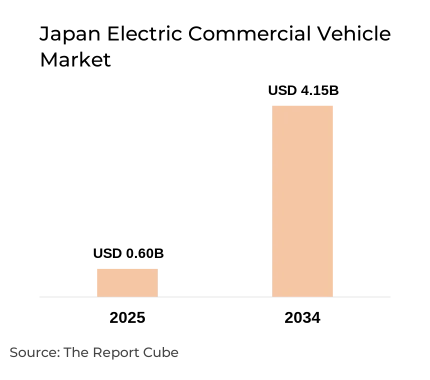
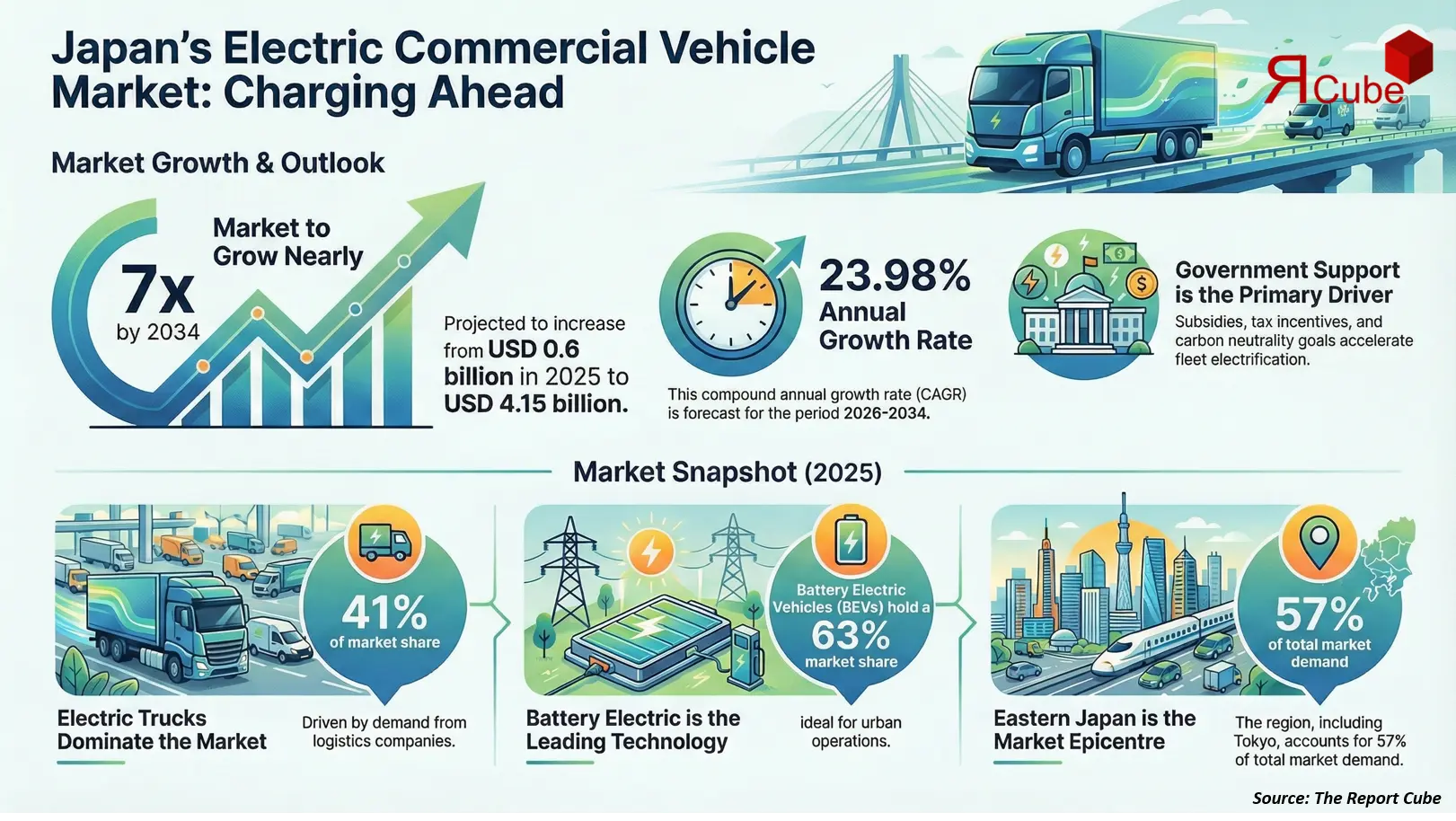
The Japan Electric Commercial Vehicle Market is anticipated to register a CAGR of 23.98% during the forecast period 2026-2034. The market size was valued at USD 0.6 billion in 2025 and is projected to reach USD 4.15 billion by 2034. This exceptional growth trajectory reflects Japan’s aggressive decarbonization targets, strong government backing for electric mobility, and rapid electrification of logistics and public transportation fleets.
Japan’s commercial vehicle ecosystem is undergoing a structural shift as fleet operators increasingly transition from internal combustion engines to electric drivetrains. Rising fuel costs, tightening emission norms, and corporate sustainability commitments are accelerating adoption across buses, trucks, and vans. Electric commercial vehicles (ECVs) are gaining traction due to lower total cost of ownership, reduced maintenance requirements, and expanding charging infrastructure in urban and industrial clusters.
Furthermore, domestic automakers are leveraging Japan’s advanced battery technology and manufacturing capabilities to scale electric commercial vehicle production. Strategic collaborations between vehicle manufacturers, battery suppliers, and logistics companies are improving vehicle range, payload efficiency, and charging turnaround times. As a result, the Japan Electric Commercial Vehicle Market is evolving from pilot deployments to large-scale fleet electrification, positioning the country as a leading hub for next-generation commercial mobility in Asia.
Japan Electric Commercial Vehicle Market Recent Developments
- 2025: Isuzu Motors expanded electric truck production capacity to meet rising demand from urban logistics operators.
- 2025: Mitsubishi Fuso introduced next-generation battery-electric trucks with improved range and fast-charging capability.
Government Initiatives & Policies
- Green Growth Strategy: Promotes zero-emission commercial vehicles and large-scale EV infrastructure deployment.
- Next-Generation Vehicle Promotion Program: Provides subsidies for electric buses and trucks adoption.
Japan Electric Commercial Vehicle Market Dynamics
Key Driver: Strong Government Support for Zero-Emission Commercial Fleets
Government policy support is the most influential driver of the Japan Electric Commercial Vehicle Market. Japan has committed to achieving carbon neutrality by 2050, with the transportation sector identified as a primary focus area. Subsidies covering up to 50% of the incremental cost of electric buses and trucks, combined with tax incentives and preferential financing, have significantly reduced adoption barriers for fleet operators. Municipal governments are mandating electric buses for public transport and waste management fleets, directly stimulating demand. Additionally, national programs supporting charging infrastructure along logistics corridors ensure operational reliability for electric trucks. These coordinated policy measures are accelerating fleet electrification across urban and intercity applications, creating a strong and sustained growth foundation.
Book your FREE 30-minute expert consultation today
Contact UsIndustry Trends: Electrification of Urban Logistics and Public Transport
A key trend shaping the market is the rapid electrification of urban logistics and public transportation. E-commerce growth and same-day delivery expectations have increased demand for electric vans and medium-duty trucks operating in densely populated cities. Electric buses are also being adopted to reduce urban air pollution and noise levels. In 2024, electric buses accounted for over 18% of new municipal bus procurements in major Japanese cities, a figure expected to rise steadily. Fleet operators are favoring battery electric vehicles for predictable urban routes, while fuel cell trucks are gaining interest for longer-haul applications. This trend highlights a diversified propulsion strategy aligned with specific use cases.
Major Challenge: High Upfront Costs and Charging Infrastructure Gaps
Despite strong momentum, high upfront vehicle costs remain a major challenge for the Japan Electric Commercial Vehicle Market. Electric commercial vehicles typically cost 1.5 to 2 times more than diesel equivalents, even after subsidies. Small and mid-sized fleet operators often face financing constraints, slowing adoption outside major cities. Additionally, while urban charging infrastructure is expanding, coverage in rural and regional areas remains limited. Grid capacity constraints and long installation timelines for high-capacity chargers further complicate large fleet deployments. Addressing these cost and infrastructure challenges is critical to achieving nationwide adoption.
Opportunity: Advancements in Battery and Fuel Cell Technologies
Technological advancements present a significant opportunity for market expansion. Improvements in battery energy density, fast-charging technology, and total lifecycle performance are enhancing the commercial viability of electric trucks and buses. Japanese manufacturers are also advancing hydrogen fuel cell technology, positioning fuel cell commercial vehicles as a solution for long-haul and heavy-duty applications. As battery costs decline at an average rate of 7-8% annually, electric commercial vehicles are expected to reach cost parity with diesel models before 2030. These innovations will unlock new use cases and expand adoption beyond urban centers.
Japan Electric Commercial Vehicle Market Segment-wise Analysis
By Vehicle Type:
- Electric Bus
- Electric Truck
- Electric Van
- Electric Pickup
- Other ECVs
Electric Trucks dominate the market, accounting for approximately 41% of total market share in 2025. This dominance is driven by strong demand from logistics and retail distribution companies transitioning urban and regional delivery fleets. Electric Buses follow with nearly 28% share, supported by government-mandated fleet electrification in public transport. Electric Vans are gaining traction among last-mile delivery operators, while Electric Pickups and Other ECVs remain niche but growing segments. The strong performance of electric trucks underscores their central role in Japan’s commercial electrification strategy.
By Propulsion Type:
- Battery Electric
- Plug-in Hybrid
- Hybrid Electric
- Fuel Cell
Battery Electric Vehicles (BEVs) lead the market with an estimated 63% share, reflecting their efficiency, lower operating costs, and suitability for urban operations. Plug-in Hybrid and Hybrid Electric vehicles collectively account for around 22%, offering transitional solutions for operators requiring extended range flexibility. Fuel Cell Electric Vehicles represent approximately 15% of the market and are expected to grow rapidly post-2028 as hydrogen infrastructure expands. This propulsion mix highlights Japan’s balanced approach to commercial vehicle decarbonization.
Regional Projection of Japan Electric Commercial Vehicle Industry
- Eastern Japan
- Western Japan
Eastern Japan leads the Japan Electric Commercial Vehicle Market, accounting for nearly 57% of total demand. The region benefits from dense urban centers such as Tokyo, advanced charging infrastructure, and early adoption by large logistics and public transport operators. Western Japan follows with strong growth driven by industrial activity and port-based logistics hubs. Eastern Japan’s leadership is expected to continue through 2034, supported by ongoing infrastructure investments and stricter urban emission regulations.
Need insights for a specific region within this market?
Request Regional DataWhy Choose This Report?
- Provides a comprehensive overview of the overall market analysis, encompassing key trends, consumer behavior analysis, and risk assessment to support strategic decision-making.
- Provides accurate, up-to-date insights into market size, segmentation, and emerging opportunities, helping to minimize risk & capitalizing on growth.
- Gives deep understanding of target audience preferences, investment habits, and communication channels for enhanced product development & marketing effectiveness.
- Delivers competitive analysis & benchmarking, uncovering the strengths & weaknesses of market competitors to guide strategies.
- Consolidate comprehensive market intelligence, reducing reasoning & streamlining research efforts.
- Facilitates customized market segmentation & risk mitigation strategies, fine-tuned to the business objectives.
- Aids in identifying both market challenges & untapped opportunities within the industry to drive long-term business growth.
- Provides valuable information based on actual customer data & search trends.
Table of Contents
- Introduction
- Objective of the Study
- Product and Category Definition
- Market Segmentation
- Study Variables
- Research Methodology
- Secondary Data Points
- Breakdown of Secondary Sources
- Primary Data Points
- Breakdown of Primary Interviews
- Secondary Data Points
- Executive Summary
- Market Dynamics
- Drivers
- Challenges
- Opportunity Assessment
- Recent Trends and Developments
- Regulatory and Policy Landscape
- Japan Electric Commercial Vehicle Market Overview (2020-2034)
- Market Size, By Value (USD Billion)
- Market Share, By Vehicle Type
- Electric Bus
- Electric Truck
- Electric Van
- Electric Pickup
- Other ECVs
- Market Share, By Propulsion Type
- Battery Electric
- Plug-in Hybrid
- Hybrid Electric
- Fuel Cell
- Market Share, By Application
- Logistics
- Public Transit
- Last-mile Delivery
- Construction
- Others
- Market Share, By Battery Type
- Lithium-ion NMC
- Lithium-ion LFP
- Other Chemistries
- Market Share, By Range
- Up to 200 km
- 200-400 km
- Above 400 km
- Market Share, By Region
- Eastern
- Western
- Market Share, By Company
- Revenue Shares
- Competition Characteristics
- Revenue Shares & Analysis
- Eastern Japan Electric Commercial Vehicle Market
- Market Size, By Value (USD Billion)
- Market Share, By Vehicle Type
- Market Share, By Propulsion Type
- Market Share, By Application
- Market Share, By Battery Type
- Market Share, By Range
- Western Japan Electric Commercial Vehicle Market
- Market Size, By Value (USD Billion)
- Market Share, By Vehicle Type
- Market Share, By Propulsion Type
- Market Share, By Application
- Market Share, By Battery Type
- Market Share, By Range
- Competitive Outlook and Company Profiles
- Mitsubishi Fuso
- Company Overview
- Product Portfolio
- Strategic Alliances/Partnerships
- Recent Developments
- Isuzu Motors
- Company Overview
- Product Portfolio
- Strategic Alliances/Partnerships
- Recent Developments
- Hino Motors
- Company Overview
- Product Portfolio
- Strategic Alliances/Partnerships
- Recent Developments
- Toyota Motor
- Company Overview
- Product Portfolio
- Strategic Alliances/Partnerships
- Recent Developments
- Nissan Motor
- Company Overview
- Product Portfolio
- Strategic Alliances/Partnerships
- Recent Developments
- Mitsubishi Motors
- Company Overview
- Product Portfolio
- Strategic Alliances/Partnerships
- Recent Developments
- BYD Company
- Company Overview
- Product Portfolio
- Strategic Alliances/Partnerships
- Recent Developments
- Daimler Truck
- Company Overview
- Product Portfolio
- Strategic Alliances/Partnerships
- Recent Developments
- Volvo Group
- Company Overview
- Product Portfolio
- Strategic Alliances/Partnerships
- Recent Developments
- Honda Motor
- Company Overview
- Product Portfolio
- Strategic Alliances/Partnerships
- Recent Developments
- Others
- Mitsubishi Fuso
- Contact Us and Disclaimer
Top Key Players & Market Share Outlook
- Mitsubishi Fuso
- Isuzu Motors
- Hino Motors
- Toyota Motor
- Nissan Motor
- Mitsubishi Motors
- BYD Company
- Daimler Truck
- Volvo Group
- Honda Motor
- Others
Frequently Asked Questions






