



Build Your Custom Market Intelligence Report
Customize Your ReportJapan Electric Vehicle (EV) Market Insights & Analysis
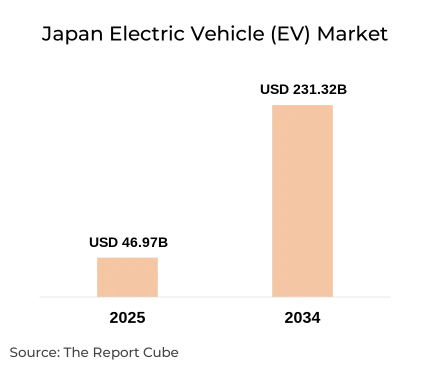
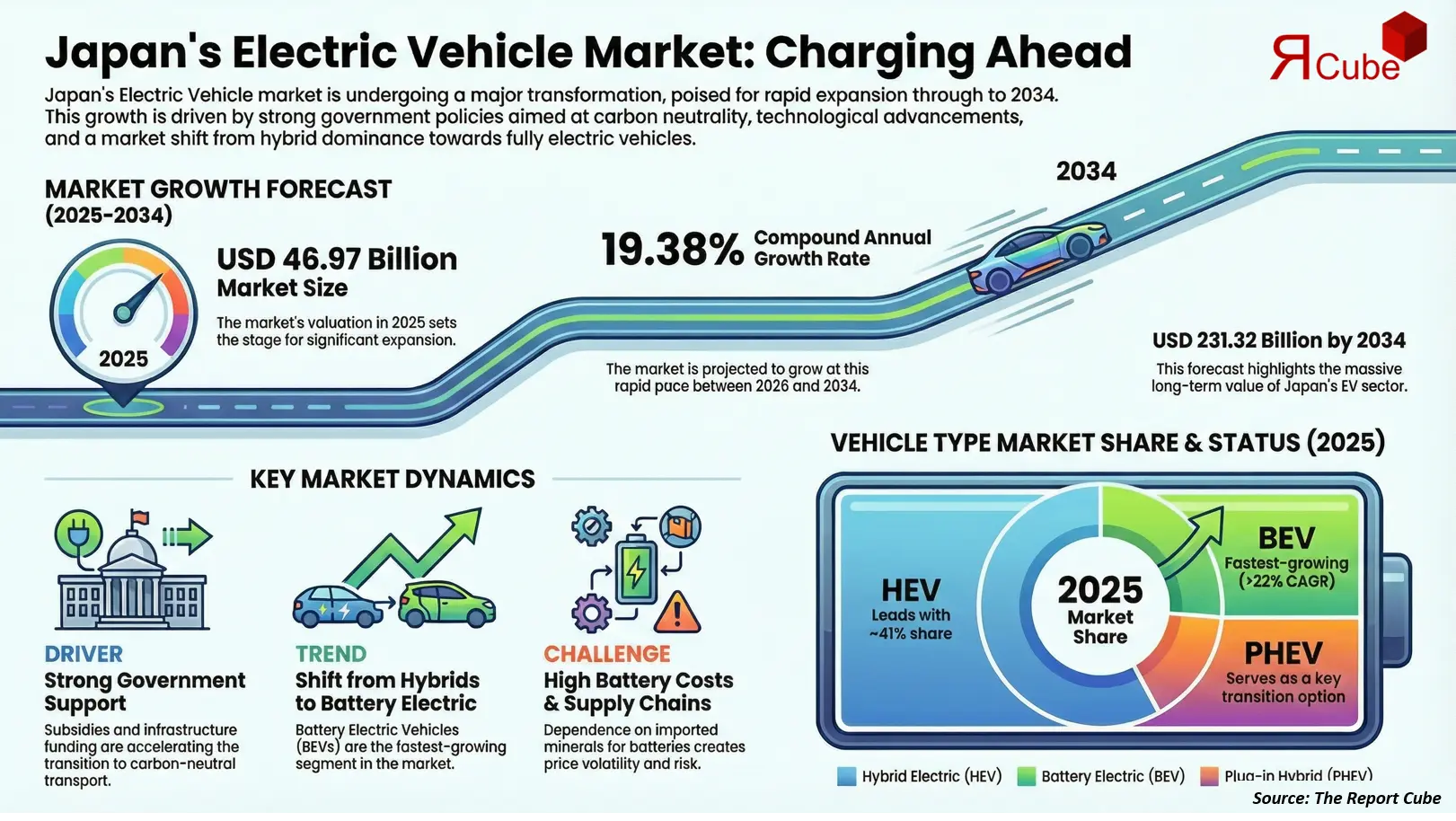
The Japan Electric Vehicle (EV) Market is anticipated to register a CAGR of 19.38% during the forecast period 2026-2034. The market size was valued at USD 46.97 billion in 2025 and is projected to reach USD 231.32 billion by 2034. This rapid expansion reflects Japan’s accelerated transition toward low-emission mobility, driven by stringent carbon neutrality goals, evolving consumer preferences, and sustained technological advancements in electric powertrains.
Japan’s EV ecosystem is uniquely positioned due to its strong automotive manufacturing base, deep expertise in battery technologies, and long-standing leadership in hybrid and fuel cell vehicles. Automakers are increasingly diversifying portfolios beyond hybrid dominance, responding to growing global and domestic demand for battery electric vehicles. Rising fuel prices, urban air quality concerns, and improved charging infrastructure are collectively reshaping vehicle purchasing behavior across passenger and commercial segments.
Furthermore, government-backed incentives, local battery production investments, and collaborations between automakers and energy providers are strengthening market fundamentals. As charging networks expand across urban and regional corridors, range anxiety is gradually diminishing, supporting higher EV adoption rates. These interconnected factors establish the Japan EV Market as one of the fastest-growing automotive segments in the country through 2034.
Japan Electric Vehicle (EV) Market Recent Developments
- 2025: Toyota expanded next-generation battery EV production capacity to support domestic and export demand.
- 2025: Nissan introduced advanced solid-state battery testing programs for future mass-market EV models.
Government Initiatives & Policies
- Green Growth Strategy: National roadmap promoting EV adoption and battery innovation.
- Carbon Neutral Mobility Policy: Incentives for zero-emission vehicles and charging infrastructure deployment.
Japan Electric Vehicle (EV) Market Dynamics
Key Driver: Strong Government Support for Carbon Neutral Transportation
The primary driver of the Japan EV Market is robust government support aimed at achieving carbon neutrality by 2050. Policy frameworks encourage automakers and consumers to transition toward electric mobility through purchase subsidies, tax exemptions, and infrastructure funding. Japan’s national and local governments have committed billions of dollars to charging network expansion, significantly improving accessibility in urban and suburban regions. Additionally, regulatory pressure to reduce fleet-wide emissions has pushed automakers to accelerate EV development timelines. These measures directly influence consumer adoption by reducing upfront costs and enhancing long-term affordability, making government backing a central catalyst for sustained market growth.
Book your FREE 30-minute expert consultation today
Contact UsIndustry Trends: Shift from Hybrid Dominance to Battery Electric Vehicles
A key trend shaping the market is the gradual shift from hybrid electric vehicles toward battery electric vehicles. While hybrids continue to play a transitional role, increasing battery energy density and declining lithium-ion costs are making pure EVs more competitive. Japanese manufacturers are investing heavily in solid-state battery research, targeting faster charging times and extended driving ranges. At the same time, global export requirements are influencing domestic strategies, as international markets increasingly favor zero-emission vehicles. This trend reflects a structural evolution of Japan’s automotive industry, aligning domestic production with global electrification momentum.
Major Challenge: High Battery Costs and Supply Chain Dependence
Despite rapid growth, high battery costs remain a significant challenge for the Japan EV Market. Advanced battery technologies require substantial investment in raw materials, manufacturing facilities, and research infrastructure. Dependence on imported critical minerals such as lithium and nickel exposes manufacturers to price volatility and geopolitical risks. These factors contribute to higher vehicle prices compared to conventional internal combustion models, potentially slowing mass-market adoption. Addressing supply chain resilience and cost optimization remains essential to sustaining long-term growth.
Opportunity: Expansion of Fuel Cell and Next-Generation EV Technologies
The market presents strong opportunities through the expansion of fuel cell EVs and next-generation battery technologies. Japan’s leadership in hydrogen infrastructure positions fuel cell vehicles as a complementary pathway alongside battery EVs. Automakers are also advancing solid-state battery commercialization, which could significantly reduce charging times and improve safety. These innovations offer differentiation opportunities for Japanese manufacturers while supporting national energy diversification goals. As technology matures, next-generation EV solutions are expected to unlock new growth avenues across passenger and commercial vehicle segments.
Japan Electric Vehicle (EV) Market Segment-wise Analysis
By Vehicle Type:
- Battery Electric
- Plug-in Hybrid
- Hybrid Electric
- Fuel Cell EV
- Other EV Types
Hybrid Electric Vehicles currently lead the market, accounting for approximately 41% of total market share in 2025, supported by strong consumer familiarity and established manufacturing capabilities. However, Battery Electric Vehicles are the fastest-growing sub-segment, expanding at a CAGR exceeding 22%, driven by falling battery costs and improved driving ranges. Plug-in hybrids serve as a transition option, while Fuel Cell EVs maintain a niche but strategic role aligned with Japan’s hydrogen roadmap. This diversified mix reflects a balanced transition strategy across multiple electrification pathways.
By Powertrain:
- Front-Wheel Drive
- Rear-Wheel Drive
- All-Wheel Drive
Front-Wheel Drive powertrains dominate the market with an estimated 48% share, favored for compact and mid-size EVs due to efficiency and lower manufacturing costs. All-Wheel Drive is gaining popularity in premium and performance-oriented EVs, particularly in regions with challenging weather conditions. Rear-Wheel Drive remains prominent in high-end electric sedans and SUVs, offering better weight distribution and driving dynamics. Powertrain diversification highlights automakers’ focus on tailoring EV offerings to varied consumer preferences and regional needs.
Regional Projection of Japan Electric Vehicle (EV) Industry
- East Japan
- West Japan
- North Japan
- South Japan
East Japan leads the EV market, holding approximately 44% market share, driven by high population density, advanced infrastructure, and strong purchasing power. Metropolitan areas such as Tokyo and Yokohama account for a significant portion of EV registrations due to supportive local policies and dense charging networks. West Japan follows, supported by industrial clusters and regional incentives. As infrastructure investments expand into North and South Japan, regional adoption gaps are expected to narrow, supporting balanced national growth.
Need insights for a specific region within this market?
Request Regional DataWhy Choose This Report?
- Provides a comprehensive overview of the overall market analysis, encompassing key trends, consumer behavior analysis, and risk assessment to support strategic decision-making.
- Provides accurate, up-to-date insights into market size, segmentation, and emerging opportunities, helping to minimize risk & capitalizing on growth.
- Gives deep understanding of target audience preferences, investment habits, and communication channels for enhanced product development & marketing effectiveness.
- Delivers competitive analysis & benchmarking, uncovering the strengths & weaknesses of market competitors to guide strategies.
- Consolidate comprehensive market intelligence, reducing reasoning & streamlining research efforts.
- Facilitates customized market segmentation & risk mitigation strategies, fine-tuned to the business objectives.
- Aids in identifying both market challenges & untapped opportunities within the industry to drive long-term business growth.
- Provides valuable information based on actual customer data & search trends.
Table of Contents
- Introduction
- Objective of the Study
- Product and Category Definition
- Market Segmentation
- Study Variables
- Research Methodology
- Secondary Data Points
- Breakdown of Secondary Sources
- Primary Data Points
- Breakdown of Primary Interviews
- Secondary Data Points
- Executive Summary
- Market Dynamics
- Drivers
- Challenges
- Opportunity Assessment
- Recent Trends and Developments
- Regulatory and Policy Landscape
- Japan Electric Vehicle (EV) Market Overview (2020-2034)
- Market Size, By Value (USD Billion)
- Market Share, By Vehicle Type
- Battery Electric
- Plug-in Hybrid
- Hybrid Electric
- Fuel Cell EV
- Other EV Types
- Market Share, By Powertrain
- Front-Wheel Drive
- Rear-Wheel Drive
- All-Wheel Drive
- Market Share, By Vehicle Class
- Passenger Cars
- Commercial Vans
- Buses & Coaches
- Two-Wheelers
- Other Vehicles
- Market Share, By Charging
- Slow AC
- Fast DC
- Battery Swap
- Market Share, By End User
- Private Owners
- Fleet Operators
- Government Fleet
- Market Share, By Region
- East
- West
- North
- South
- Market Share, By Company
- Market Share, By Company
- Competition Characteristics
- Revenue Shares & Analysis
- East Japan EV Market
- Market Size, By Value (USD Billion)
- Market Share, By Vehicle Type
- Market Share, By Vehicle Class
- Market Share, By Charging
- Market Share, By End User
- Market Share, By Prefecture Group
- Market Share, By Key Prefectures
- Tokyo
- Kanagawa
- Chiba
- Saitama
- West Japan EV Market
- Market Size, By Value (USD Billion)
- Market Share, By Vehicle Type
- Market Share, By Vehicle Class
- Market Share, By Charging
- Market Share, By End User
- Market Share, By Prefecture Group
- Market Share, By Key Prefectures
- Osaka
- Aichi
- Hyogo
- Fukuoka
- North Japan EV Market
- Market Size, By Value (USD Billion)
- Market Share, By Vehicle Type
- Market Share, By Vehicle Class
- Market Share, By Charging
- Market Share, By End User
- Market Share, By Prefecture Group
- Market Share, By Key Prefectures
- Hokkaido
- Miyagi
- Fukushima
- South Japan EV Market
- Market Size, By Value (USD Billion)
- Market Share, By Vehicle Type
- Market Share, By Vehicle Class
- Market Share, By Charging
- Market Share, By End User
- Market Share, By Prefecture Group
- Market Share, By Key Prefectures
- Hiroshima
- Kumamoto
- Okinawa
- Competitive Outlook and Company Profiles
- Toyota Motor Corporation
- Company Overview
- Product Portfolio
- Strategic Alliances/Partnerships
- Recent Developments
- Nissan Motor Corporation
- Company Overview
- Product Portfolio
- Strategic Alliances/Partnerships
- Recent Developments
- Honda Motor Co., Ltd.
- Company Overview
- Product Portfolio
- Strategic Alliances/Partnerships
- Recent Developments
- Mitsubishi Motors Corporation
- Company Overview
- Product Portfolio
- Strategic Alliances/Partnerships
- Recent Developments
- Mazda Motor Corporation
- Company Overview
- Product Portfolio
- Strategic Alliances/Partnerships
- Recent Developments
- Suzuki Motor Corporation
- Company Overview
- Product Portfolio
- Strategic Alliances/Partnerships
- Recent Developments
- Daihatsu Motor Co., Ltd.
- Company Overview
- Product Portfolio
- Strategic Alliances/Partnerships
- Recent Developments
- BYD Co., Ltd.
- Company Overview
- Product Portfolio
- Strategic Alliances/Partnerships
- Recent Developments
- Tesla Inc.
- Company Overview
- Product Portfolio
- Strategic Alliances/Partnerships
- Recent Developments
- Mercedes-Benz Group AG
- Company Overview
- Product Portfolio
- Strategic Alliances/Partnerships
- Recent Developments
- Others
- Toyota Motor Corporation
- Contact Us and Disclaimer
Top Key Players & Market Share Outlook
- Toyota Motor Corporation
- Nissan Motor Corporation
- Honda Motor Co., Ltd.
- Mitsubishi Motors Corporation
- Mazda Motor Corporation
- Suzuki Motor Corporation
- Daihatsu Motor Co., Ltd.
- BYD Co., Ltd.
- Tesla Inc.
- Mercedes-Benz Group AG
- Others
Frequently Asked Questions






