



Build Your Custom Market Intelligence Report
Customize Your ReportGlobal Saffron Market Insights & Analysis
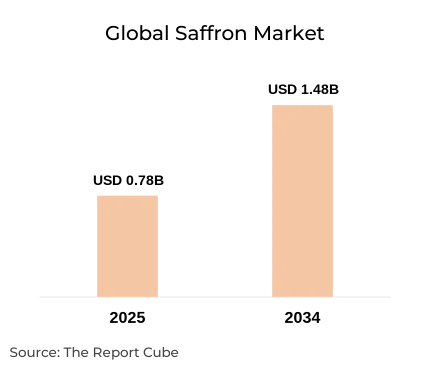
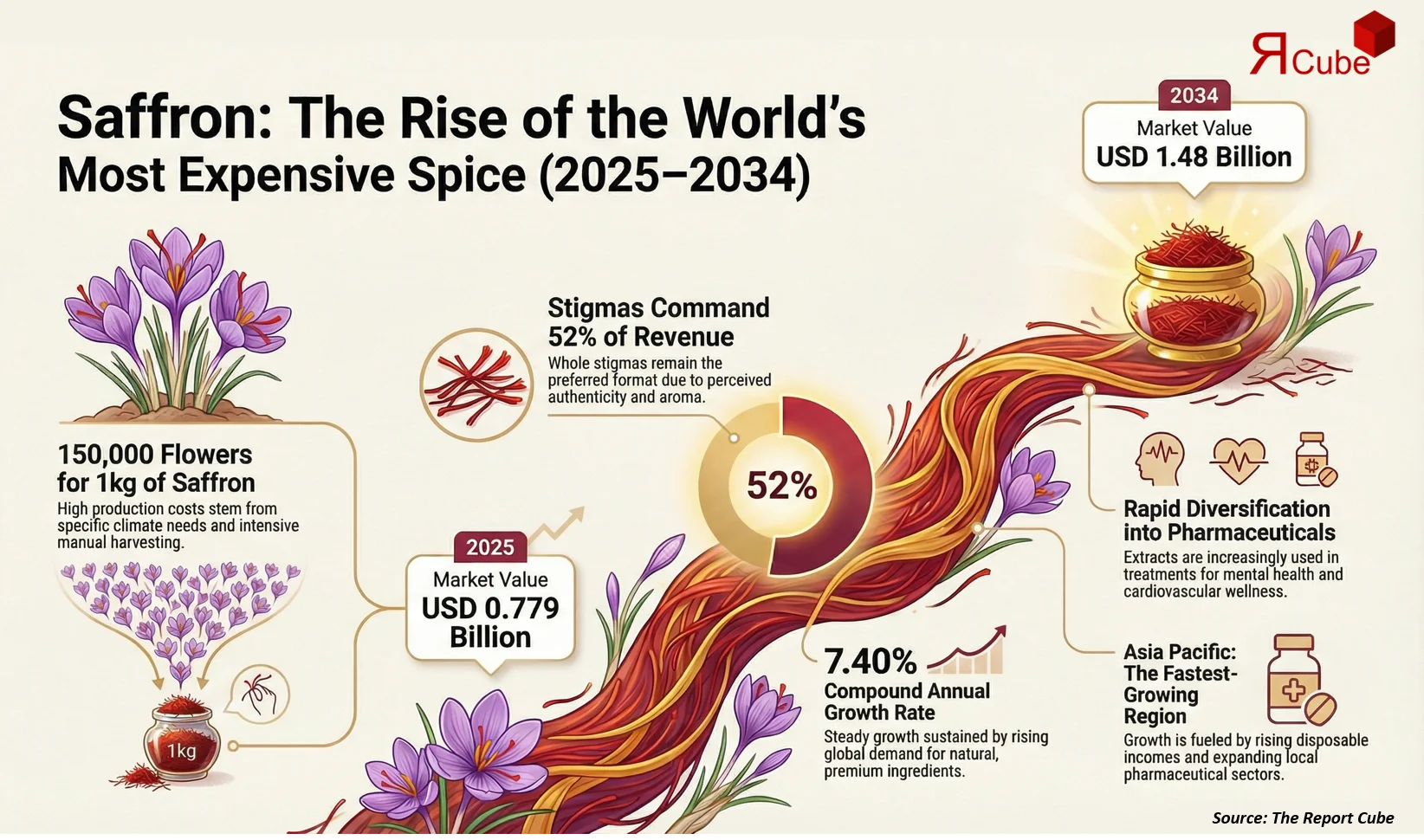
The Global Saffron Market is anticipated to register a CAGR of 7.40% during 2020–2034. The market size was valued at USD 0.779 billion in 2025 and is projected to reach USD 1.48 billion by 2034. Saffron, often referred to as the world’s most expensive spice, continues to witness steady demand growth due to its extensive use across food, beverages, pharmaceuticals, and cosmetic applications.
Rising consumer awareness regarding the health benefits of saffron, including antioxidant, anti-inflammatory, and mood-enhancing properties, is significantly contributing to market expansion. Additionally, saffron’s premium positioning and cultural significance in traditional cuisines and medicinal systems are strengthening its demand across both developed and emerging markets.
Despite limited cultivation regions and labor-intensive harvesting processes, technological advancements in processing, improved supply chain transparency, and expanding online retail channels are supporting broader market accessibility. These factors collectively position the Global Saffron Market for sustained growth through 2034.
Global Saffron Market Recent Developments
- 2025: Iran Saffron Company expanded premium-grade saffron exports to North America and Europe.
- 2025: Gohar Saffron introduced certified organic saffron lines targeting health-conscious consumers.
Government Initiatives & Policies
- Iran Agricultural Export Support Program: Government-backed initiatives promoting saffron exports and quality standardization.
- EU Quality Schemes Regulation: Framework supporting geographical indications and authenticity of premium agricultural products.
Global Saffron Market Dynamics
Key Driver: Growing Demand for Natural, Functional, and Premium Ingredients
The primary driver of the Global Saffron Market is the increasing global demand for natural, plant-based, and functional ingredients. Consumers are progressively shifting away from synthetic additives toward natural spices and botanicals with proven health benefits. Saffron is widely recognized for its antioxidant, antidepressant, and anti-inflammatory properties, making it highly desirable in functional foods, herbal supplements, and nutraceutical formulations.
In addition, saffron’s premium status and cultural importance in traditional cuisines—particularly in Middle Eastern, South Asian, and Mediterranean regions—continue to sustain demand. Growing disposable incomes and rising preference for gourmet and luxury food experiences are further reinforcing saffron consumption in both household and foodservice sectors.
Book your FREE 30-minute expert consultation today
Contact UsIndustry Trends: Expansion into Pharmaceuticals, Cosmetics, and Value-Added Formats
A major trend shaping the market is the diversification of saffron applications beyond culinary uses. Pharmaceutical companies are increasingly incorporating saffron extracts into formulations targeting mental health, eye health, and cardiovascular wellness. Scientific studies highlighting saffron’s therapeutic benefits are accelerating its adoption in evidence-based healthcare products.
Another key trend is the growing use of saffron in cosmetics and personal care products. Saffron’s skin-brightening, anti-aging, and antioxidant properties are driving its inclusion in premium skincare formulations. Additionally, value-added formats such as powders, extracts, and concentrates are gaining popularity due to ease of use, longer shelf life, and consistent quality.
Major Challenge: High Production Costs and Supply Constraints
The Global Saffron Market faces significant challenges related to limited cultivation regions and labor-intensive harvesting processes. Saffron cultivation requires specific climatic conditions and manual harvesting, resulting in high production costs and limited scalability. Approximately 150,000 crocus flowers are required to produce one kilogram of saffron, making supply inherently constrained.
Furthermore, issues such as adulteration, counterfeit products, and price volatility pose challenges to market credibility and consumer trust. Maintaining quality, authenticity, and traceability across global supply chains increases operational complexity and costs for producers and exporters.
Opportunity: Organic Certification, Emerging Markets, and E-Commerce Expansion
Rising demand for organic and sustainably sourced products presents a strong growth opportunity for saffron producers. Certified organic saffron commands premium pricing and appeals to health-conscious and environmentally aware consumers.
Emerging markets in Asia Pacific, Latin America, and parts of Africa offer untapped growth potential due to increasing urbanization, expanding middle-class populations, and growing awareness of saffron’s benefits. Additionally, the rapid expansion of e-commerce platforms enables direct-to-consumer sales, improving margins and enhancing global market reach.
Global Saffron Market Segment-wise Analysis
By Product Type:
- Pistils
- Stigmas
- Powder
- Extracts & Concentrates
Stigmas dominate the market, accounting for approximately 52% of total revenue in 2025. Whole stigmas are preferred due to their superior aroma, color intensity, and authenticity, particularly in premium culinary and pharmaceutical applications.
Saffron powder and extracts are gaining traction due to convenience, standardized potency, and suitability for large-scale food processing and cosmetic formulations. Extracts and concentrates represent the fastest-growing segment, driven by demand from pharmaceutical and personal care industries.
By End User:
- Household Consumption
- Food Processing Industry
- Pharmaceutical Companies
- Cosmetics Manufacturers
Household consumption dominates volume sales, while pharmaceutical and cosmetic manufacturers account for higher value growth due to premium pricing and bulk procurement.
Need insights for a specific region within this market?
Request Regional DataRegional Projection of Global Saffron Industry
- North America
- Europe
- Asia Pacific
- Middle East & Africa
- South America
Middle East and Africa lead global saffron production and exports, with Iran accounting for the majority of global supply. Europe and North America represent high-value consumption markets, while Asia Pacific is emerging as the fastest-growing region due to rising disposable incomes and expanding pharmaceutical applications.
Why Choose This Report?
- Provides comprehensive analysis of global saffron market trends and drivers.
- Delivers accurate market sizing, segmentation, and long-term forecasts.
- Examines supply chain challenges and quality assurance dynamics.
- Offers competitive benchmarking of leading saffron producers.
- Identifies emerging application and regional growth opportunities.
- Supports strategic planning and investment decision-making.
- Analyzes regulatory and authenticity considerations.
- Uses real consumption and trade pattern insights.
Table of Contents
- Introduction
- Objective of the Study
- Saffron Definition
- Market Segmentation
- Study Variables
- Research Methodology
- Secondary Data Points
- Breakdown of Secondary Sources
- Primary Data Points
- Breakdown of Primary Interviews
- Secondary Data Points
- Executive Summary
- Market Dynamics
- Drivers
- Challenges
- Opportunity Assessment
- Recent Trends and Developments
- Regulatory and Policy Landscape
- Global Saffron Market Overview (2020–2034)
- Market Size, By Value (USD Million)
- Market Share, By Product Type
- Pistils
- Stigmas
- Powder
- Extracts & Concentrates
- Market Share, By Application
- Food & Beverages
- Beverages & Infusions
- Pharmaceuticals
- Cosmetics & Personal Care
- Others
- Market Share, By End User
- Household Consumption
- Food Processing Industry
- Pharmaceutical Companies
- Cosmetics Manufacturers
- Market Share, By Distribution Channel
- Modern Trade
- Specialty Stores
- Online Retail
- Traditional Trade
- Market Share, By Pricing Tier
- Premium
- Standard
- Market Share, By Company
- Competition Characteristics
- Revenue Shares & Analysis
- Market Share, By Region
- North America Saffron Market
- Market Size, By Value
- Market Share, By Product Type
- Market Share, By Application
- Europe Saffron Market
- Market Size, By Value
- Market Share, By Product Type
- Market Share, By Application
- Asia Pacific Saffron Market
- Market Size, By Value
- Market Share, By Product Type
- Market Share, By Application
- Middle East and Africa Saffron Market
- Market Size, By Value
- Market Share, By Product Type
- Market Share, By Application
- South America Saffron Market
- Market Size, By Value
- Market Share, By Product Type
- Market Share, By Application
- North America Saffron Market
- Competitive Outlook and Company Profiles
- Iran Saffron Company
- Company Overview
- Saffron Product Portfolio
- Strategic Alliances / Partnerships
- Recent Developments
- Gohar Saffron
- Company Overview
- Saffron Product Portfolio
- Strategic Alliances / Partnerships
- Recent Developments
- Rowhani Saffron
- Company Overview
- Saffron Product Portfolio
- Strategic Alliances / Partnerships
- Recent Developments
- Royal Saffron Company
- Company Overview
- Saffron Product Portfolio
- Strategic Alliances / Partnerships
- Recent Developments
- Baby Brand Saffron
- Company Overview
- Saffron Product Portfolio
- Strategic Alliances / Partnerships
- Recent Developments
- Others
- Company Overview
- Business Segments
- Strategic Alliances / Partnerships
- Recent Developments
- Iran Saffron Company
- Contact Us / Disclaimer
Top Key Players & Market Share Outlook
- Iran Saffron Company
- Gohar Saffron
- Rowhani Saffron
- Royal Saffron Company
- Baby Brand Saffron
- Others
Frequently Asked Questions






