



Build Your Custom Market Intelligence Report
Customize Your ReportIndia Sericulture Market Statistics and Insights
Market Size Statistics
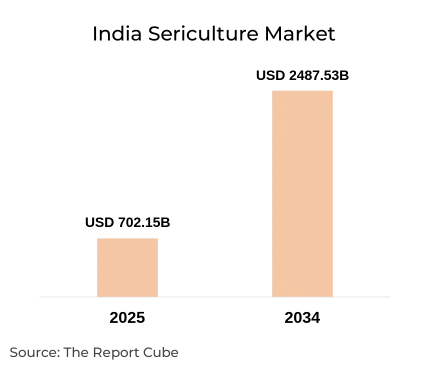
- India sericulture market valued at INR 702.15 billion 2025
- Market expected to reach INR 2487.53 billion by 2034
- Compound annual growth rate projected at 15.09%
By Domestic Production & Imports
- Domestic production accounted for nearly 74% market share
Competitive Landscape
- More than 10 companies are actively engaged in producing India Sericulture Market
- Top 5 companies acquired around 60% of the market share.
- Central Silk Board (CSB), Khadi and Village Industries Commission (KVIC), Karnataka Silk Industries Corporation Limited (KSIC), Fabindia, Raymond Group, and others
By Application
- Silk fabrics and garments held approximately 63% share
India Sericulture Market Insights & Analysis
The India Sericulture Market is anticipated to register a 15.09% CAGR during 2026-2034. The market size was valued at INR 702.15 billion in 2025 and is projected to reach INR 2487.53 billion by 2034. The market is experiencing rapid growth driven by increasing demand for silk products in domestic and international markets. India is one of the largest producers of silk, supported by favorable climatic conditions and a strong base of rural employment. The industry plays a crucial role in supporting livelihoods, particularly in rural and semi-urban areas.
Government initiatives through organizations such as the Central Silk Board are promoting sericulture development, improving productivity, and supporting farmers with training and subsidies. Investments in modern rearing techniques, disease control, and silk processing technologies are enhancing product quality. Additionally, rising exports of silk fabrics and garments, coupled with increasing demand from the fashion industry, are significantly contributing to market expansion.
India Sericulture Market Dynamics
Key Market Driver: Rising Demand for Silk in Fashion Industry
The increasing demand for silk in the fashion and textile industry is a key driver of the India Sericulture Market. Silk is widely preferred for its premium quality, durability, and aesthetic appeal, making it a popular choice in garments and home furnishings.
Growing consumer preference for luxury and traditional clothing is driving demand for silk fabrics. The expansion of the fashion industry and increasing export demand for silk products are further supporting market growth. Additionally, rising disposable income and changing lifestyle trends are contributing to increased consumption of silk-based products across India.
Major Industry Challenge: Disease Management and Raw Material Quality Issues
Disease outbreaks affecting silkworms and inconsistencies in raw material quality present challenges in the India Sericulture Market. Silkworm diseases can significantly impact cocoon production and reduce yield.
Maintaining consistent quality of silk fibers is also a challenge due to variations in rearing conditions and farming practices. Limited access to advanced rearing technologies and training among small-scale farmers further affects productivity. Addressing these challenges is essential to ensure stable production and maintain product quality standards.
Emerging Trend Shaping Outlook: Adoption of Modern Sericulture and Sustainable Practices
The adoption of modern sericulture techniques and sustainable practices is a key trend shaping the India Sericulture Market. Farmers are increasingly adopting improved silkworm rearing methods, disease management practices, and advanced equipment to enhance productivity.
Sustainability initiatives, including eco-friendly silk production and organic sericulture, are gaining traction among environmentally conscious consumers. Additionally, the integration of digital tools and data-driven farming practices is improving efficiency and output quality. This trend is expected to support long-term growth and modernization of the sericulture industry.
Need Specific Data, Let’s Customize the Report for You
Request CustomizationIndia Sericulture Market Segment-wise Analysis
The India Sericulture Market segmentation highlights strong dominance of domestic production supported by government initiatives, while silk fabrics and garments lead applications driven by rising demand from fashion and textile industries.
By Domestic Production & Imports
- Domestic Production
- Imports
The segment is dominated by domestic production, accounting for approximately 74% of total market share. India has a strong base of sericulture activities supported by favorable climatic conditions and government initiatives. Domestic production ensures consistent supply of raw silk for textile industries. Imports play a supplementary role, particularly for specialized silk varieties and quality enhancement. Increasing focus on self-reliance and local production is further strengthening domestic dominance. Investments in sericulture infrastructure and farmer training programs are enhancing productivity and reducing dependency on imports.
By Application
- Natural Silk Yarn
- Fabrics, Made-ups
- Readymade Garments
- Silk Carpets
- Others
The application segment is led by fabrics and readymade garments, holding nearly 63% of the market share. Silk fabrics are widely used in traditional and luxury clothing, driving strong demand across domestic and export markets. Readymade garments are gaining popularity due to increasing fashion trends and consumer preference for premium apparel. Natural silk yarn is also an important segment, supporting textile manufacturing. Silk carpets and other applications contribute moderately, driven by niche demand. The expansion of the textile industry and rising exports are expected to sustain growth across application segments.
Regional Projection of India Sericulture Market
The regional outlook highlights strong growth across major silk-producing regions driven by favorable climate, government support, and established sericulture practices across India.
- North India
- East India
- West India
- South India
South India leads the India Sericulture Market, accounting for approximately 41% of total production and consumption. The dominance is driven by states such as Karnataka, Andhra Pradesh, and Tamil Nadu, which have well-established sericulture infrastructure. East India also contributes significantly due to favorable climatic conditions and increasing adoption of sericulture practices. North and West India are witnessing steady growth supported by government initiatives and rising awareness. Investments in infrastructure and training programs further strengthen regional market expansion.
India Sericulture Market: Recent Develpoment (2025)
- Central Silk Board expanded sericulture development programs improving farmer training and silk production efficiency nationwide
- Karnataka Silk Industries Corporation Limited upgraded silk processing facilities enhancing product quality and export competitiveness
- Khadi and Village Industries Commission promoted rural sericulture initiatives supporting employment and sustainable silk production
- Raymond Group introduced premium silk apparel collections strengthening its presence in luxury textile segment in India
India Sericulture Market Future Outlook (2034)
The India Sericulture Market is projected to grow at a CAGR of 15.09% and reach INR 2487.53 billion by 2034. Growth opportunities are expected from rising demand for silk products, expanding export markets, and increasing adoption of modern sericulture techniques. Technological advancements, including AI-driven farm monitoring and disease control, will enhance productivity and efficiency. Government support and investments in infrastructure will further strengthen the market. As demand for sustainable and premium textiles grows, the sericulture industry is expected to witness significant expansion across India.
Why Choose This Report?
- Provides a comprehensive overview of the overall market analysis, encompassing key trends, consumer behavior analysis, and risk assessment to support strategic decision-making.
- Provides accurate, up-to-date insights into market size, segmentation, and emerging opportunities, helping to minimize risk & capitalizing on growth.
- Gives deep understanding of target audience preferences, investment habits, and communication channels for enhanced product development & marketing effectiveness.
- Delivers competitive analysis & benchmarking, uncovering the strengths & weaknesses of market competitors to guide strategies.
- Consolidate comprehensive market intelligence, reducing reasoning & streamlining research efforts.
- Facilitates customized market segmentation & risk mitigation strategies, fine-tuned to the business objectives.
- Aids in identifying both market challenges & untapped opportunities within the industry to drive long-term business growth.
- Provides valuable information based on actual customer data & search trends.
Table of Contents
- Introduction
- Objective of the study
- Product Definition
- Market Segmentation
- Study Variables
- Research Methodology
- Secondary Data Points
- Companies Interviewed
- Primary Data Points
- Breakdown of Primary Interviews
- Secondary Data Points
- Executive Summary
- Market Dynamics
- Drivers
- Challenges
- Opportunity Assessment
- Recent Trends and Developments
- Policy and Regulatory Landscape
- India Sericulture Market Overview (2021-2034)
- Market Size, By Value (in INR Billions)
- Market Share, By Segment
- Mulberry
- Vanya
- Tasar
- Eri
- Muga
- Market Share, By Domestic Production & Imports
- Domestic Production
- Imports
- Market Share, By Application
- Natural Silk Yarn, Fabrics, Made-ups
- Readymade Garments
- Silk Carpets
- Others
- Market Share, By Region
- North India
- East India
- West India
- South India
- Market Share, By Competitors
- Competition Characteristics
- Revenue Shares
- India Mulberry Sericulture Market Overview, 2021-2034F
- By Value (INR Million/Billion)
- By Domestic Production & Imports- Market Size & Forecast 2021-2034, INR Million/Billion
- By Applicationural Silk Yarn- Market Size & Forecast 2021-2034, INR Million/Billion
- India Vanya (Tasar, Eri, Muga) Sericulture Market Overview, 2021-2034F
- By Value (INR Million/Billion)
- By Domestic Production & Imports- Market Size & Forecast 2021-2034, INR Million/Billion
- By Applicationural Silk Yarn- Market Size & Forecast 2021-2034, INR Million/Billion
- Competitive Outlook (Company Profile - Partial List)
- Central Silk Board (CSB)
- Company Overview
- Business Segments
- Strategic Alliances/Partnerships
- Recent Developments
- Khadi and Village Industries Commission (KVIC)
- Company Overview
- Business Segments
- Strategic Alliances/Partnerships
- Recent Developments
- Karnataka Silk Industries Corporation Limited (KSIC)
- Company Overview
- Business Segments
- Strategic Alliances/Partnerships
- Recent Developments
- Fabindia
- Company Overview
- Business Segments
- Strategic Alliances/Partnerships
- Recent Developments
- Raymond Group
- Company Overview
- Business Segments
- Strategic Alliances/Partnerships
- Recent Developments
- Grasim Industries Ltd.
- Company Overview
- Business Segments
- Strategic Alliances/Partnerships
- Recent Developments
- Kasare Vanya Silk Mill Pvt Ltd
- Company Overview
- Business Segments
- Strategic Alliances/Partnerships
- Recent Developments
- Ajmera Fashion Limited
- Company Overview
- Business Segments
- Strategic Alliances/Partnerships
- Recent Developments
- Others
- Central Silk Board (CSB)
- Contact Us & Disclaimer
Top Key Players & Market Share Outlook
- Central Silk Board (CSB)
- Khadi and Village Industries Commission (KVIC)
- Karnataka Silk Industries Corporation Limited (KSIC)
- Fabindia
- Raymond Group
- Grasim Industries Ltd.
- Kasare Vanya Silk Mill Pvt Ltd
- Ajmera Fashion Limited
- Others
Frequently Asked Questions






