


Build Your Custom Market Intelligence Report
Customize Your ReportKey Takeaways
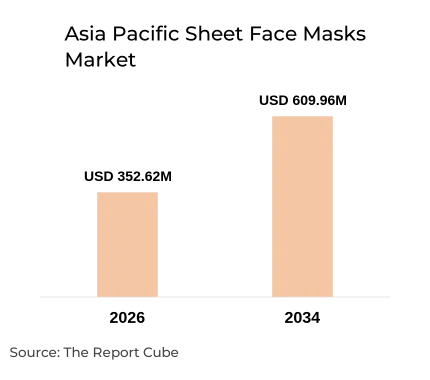
- Asia Pacific Sheet Face Masks Market is valued at USD 352.62 million in 2026.
- The market is projected to reach USD 609.96 million by 2034 at a CAGR of 7.09%.
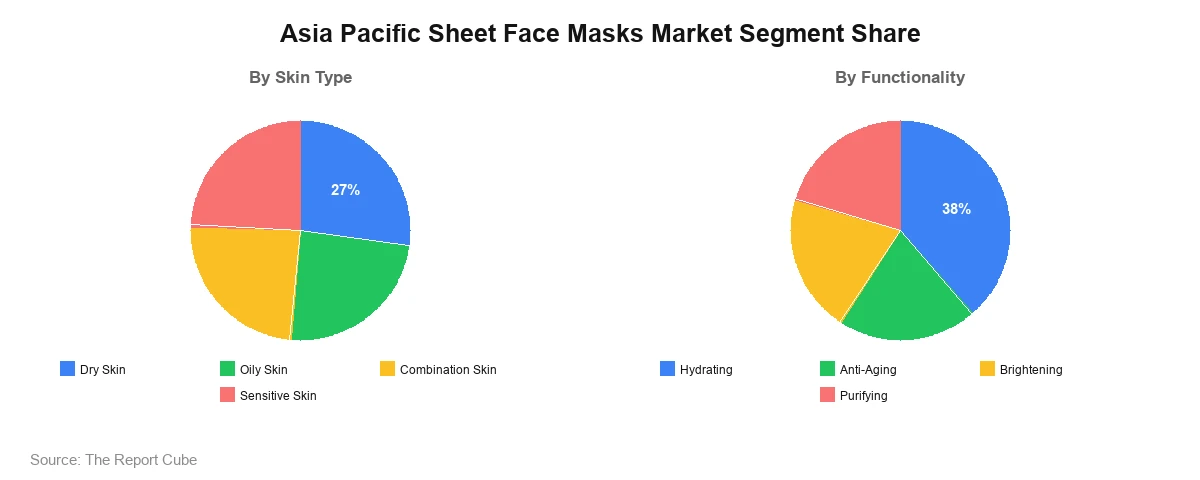
- Dry skin leads the skin type segment with a 27% share in 2026.
- Hydrating products lead the functionality segment with a 38% share in 2026.
- China leads the regional landscape with an estimated 32% share in 2026.
- Amorepacific, Shiseido, L’Oréal, The Estée Lauder Companies and Kracie are among the supplied key players.
- Digital distribution and cosmetic compliance readiness are important themes for market participants.
Market Overview
Sheet face masks are single-use facial treatments made from fabric or fibre sheets soaked in serum or essence, applied for a short period and then removed. They are used for hydration, brightening, purification and anti-aging care, and are sold through online platforms, retail stores, beauty salons and pharmacies. The category spans cotton, non-woven, paper and bio-cellulose materials.
This Asia Pacific Sheet Face Masks Market Analysis covers China, Japan, India, South Korea, Australia and the rest of the region. Exports of facial sheet masks from South Korea increased by 33.4% in the first half of 2025, and the Ministry of Food and Drug Safety reported record 2025 cosmetics exports of USD 11.43 billion. Consumers choose sheet masks for targeted, time-efficient skincare suited to dry, oily, combination and sensitive skin. Hydrating formats lead functionality demand, while online retail and compliance-ready formulations shape current offerings across the region. The market is valued at USD 352.62 million in 2026 and is projected to grow at a CAGR of 7.09% during 2026–2034.
Asia Pacific Sheet Face Masks Market Dynamics
The Asia Pacific sheet face masks market operates within a diverse cosmetics landscape shaped by digital commerce, cosmetic safety requirements and national market-entry rules. Official sources define this commercial and regulatory context but do not measure sheet-mask-specific demand, so impact ratings below are qualitative.
|
Factor |
Type |
Specific Impact on Market |
Magnitude |
|---|---|---|---|
|
Digital commerce expansion |
Driver |
Widens online access to sheet-mask brands across regional markets |
Medium (qualitative) |
|
Korean skincare export momentum |
Driver |
Signals strong outbound demand for Korean skincare, including sheet masks |
Medium–High (qualitative) |
|
Cross-border online distribution |
Opportunity |
Allows brands to reach additional markets where logistics and compliance are manageable |
Medium (qualitative) |
|
Compliance-ready product development |
Opportunity |
Supports structured entry into markets covered by ASEAN cosmetic guidance |
Medium (qualitative) |
|
Differing national regulations |
Challenge |
Requires market-specific registration, labelling and ingredient documentation |
Medium–High (qualitative) |
|
Claim substantiation and safety documentation |
Challenge |
Adds compliance work when formulations or markets differ |
Medium (qualitative) |
|
Growth of digital distribution |
Trend |
Increases the relevance of online channels in regional skincare strategy |
Medium (qualitative) |
|
Emphasis on cosmetic compliance |
Trend |
Raises the importance of documented quality and regulatory readiness |
Medium (qualitative) |
Asia Pacific Sheet Face Masks Market Growth Drivers
Digital commerce widens access to sheet-mask brands across the region. According to UNCTAD, e-commerce has expanded across developing economies, giving businesses additional channels to reach customers in multiple markets. This supports the Asia Pacific Sheet Face Masks Market Growth outlook through online retail, although UNCTAD does not quantify sheet-mask-specific demand or regional sales.
South Korea’s export data indicates strong outbound demand for Korean skincare. The Ministry of Food and Drug Safety reported cosmetics exports of USD 11.43 billion in 2025, with skincare at USD 8.54 billion. Facial sheet mask exports rose 33.4% in the first half of 2025, based on ministry data reported by Korea JoongAng Daily.
Asia Pacific Sheet Face Masks Market Opportunities
UNCTAD identifies digital trade as a route to wider markets while documenting barriers such as logistics, payment systems and regulatory differences. Sheet-mask brands can assess cross-border e-commerce where fulfilment costs and local compliance requirements are manageable, using market-by-market feasibility checks before launch. Infrastructure differences across economies make this a selective rather than uniform opportunity.
ASEAN’s cosmetic guidance provides a framework for product notification, safety assessment, labelling and good manufacturing practices. Companies can strengthen product-information processes and prepare for expansion into participating markets, while checking each country’s applicable rules separately. Documented quality may help manufacturers differentiate formulations, though the guidance does not establish a growth rate for sheet masks.
Asia Pacific Sheet Face Masks Industry Challenges
China’s cosmetics registration and filing system, administered by the National Medical Products Administration, and India’s cosmetics regulations illustrate the need to evaluate each market separately. Businesses may need to coordinate ingredient compliance, labelling, documentation and registration or notification procedures across several jurisdictions, which can lengthen launch timelines and increase administrative workload for brands operating regionally.
ASEAN cosmetic guidance covers safety assessment, product information and labelling requirements. Manufacturers and responsible businesses must ensure that documentation and claims meet applicable rules, which adds compliance work when formulations or markets differ. Smaller brands may face proportionally higher costs, although the guidance sources reviewed do not quantify that burden.
Need Specific Data, Let’s Customize the Report for You
Request CustomizationAsia Pacific Sheet Face Masks Market Trends
Among the Asia Pacific Sheet Face Masks Market Trends, digital distribution is gaining relevance as e-commerce expands. UNCTAD’s work on the digital economy documents this expansion and its effect on business activity, supporting online channels in regional skincare strategy, although it does not directly measure sheet-mask sales or the share held by online retail.
Cosmetic compliance is receiving greater emphasis. ASEAN guidance includes product information, safety assessment, labelling and good manufacturing practices, making documented quality and regulatory readiness important for manufacturers and distributors. In South Korea, the Ministry of Food and Drug Safety plans to roll out a cosmetics safety assessment system in stages between 2028 and 2031.
Asia Pacific Sheet Face Masks Market Segment Analysis
Demand is distributed across skin types, product functions, materials and sales channels, each shaped by distinct consumer needs. The Asia Pacific Sheet Face Masks Market Share is stated only where leading-segment figures were supplied for 2026.
By Skin Type
- Dry Skin
- Oily Skin
- Combination Skin
- Sensitive Skin
Dry skin leads the skin type segment with an estimated 27% share in 2026, reflecting demand for moisture-replenishing formats in regular skincare routines. Oily skin follows, with demand centred on purifying and oil-balancing formulations, while combination skin covers users who select different mask types for different facial zones. Sensitive skin represents consumers seeking gentler formulations, which makes ingredient transparency and documented product safety important considerations. These positions are described qualitatively because no figures were supplied for the remaining skin types, and no skin type has been verified as fastest-growing. Shiseido, Amorepacific and L’Oréal maintain broad skincare portfolios addressing multiple skin concerns, though company-level data by skin type is unavailable.
By Functionality
- Hydrating
- Anti-Aging
- Brightening
- Purifying
Hydrating products lead the functionality segment with an estimated 38% share in 2026, supported by their relevance across skin types and their role in daily moisture-focused routines. Anti-aging masks follow, addressing fine lines and firmness, while brightening formats target uneven tone and dullness. Purifying masks complete the segment, serving oil control and pore-care needs. These descriptions are qualitative, as no figures were supplied for non-leading functions. Amorepacific’s Sulwhasoo brand is associated with ginseng-based rejuvenating skincare, and Laneige, also an Amorepacific brand, is known for hydration-focused lip masks, while Shiseido offers a wide skincare range. Growth momentum by function requires further verification.
Country Analysis
|
Country |
Estimated Market Share |
Key Growth Factors |
Industry Trends |
|---|---|---|---|
|
China |
32% |
Registration and filing system administered by NMPA; shifting export flows from Korea |
Focus on regulatory documentation and ingredient compliance |
|
Japan |
- |
Established domestic skincare companies; USD 1.09 billion of Korean cosmetics imported in 2025 |
Strong presence of domestic and imported skincare brands |
|
India |
- |
Applicable national cosmetics regulations require market-specific evaluation |
Compliance-driven market entry |
|
South Korea |
- |
Record cosmetics exports and 33.4% rise in sheet mask exports in H1 2025 |
Export-oriented skincare and safety assessment reforms planned for 2028–2031 |
|
Australia |
- |
No verified sheet-mask-specific data available |
Requires further verification |
|
Rest of Asia Pacific |
- |
ASEAN cosmetic guidance on notification, safety assessment and labelling |
Growing relevance of digital distribution and compliance |
China is the leading country with an estimated 32% share in 2026. Korean cosmetics shipments to China fell 19.2% to USD 2.01 billion in 2025, according to the Ministry of Food and Drug Safety, while the country’s registration and filing system requires documentation and ingredient compliance. Verified sheet-mask sales data were not available, so the share reflects supplied estimates.
Japan and South Korea represent established skincare markets with strong domestic participants such as Shiseido, Kracie and Amorepacific. Japan imported USD 1.09 billion of Korean cosmetics in 2025, while South Korea’s sheet mask exports rose 33.4% in the first half of 2025. India, Australia and the rest of Asia Pacific were not assigned shares in the supplied data.
Market Share & Competitive Landscape
The Asia Pacific sheet face masks market includes global beauty groups, Korean and Japanese skincare specialists and regional brands. The table summarizes supplied companies by general capability and does not represent numerical market share. Company-level sheet mask sales and distribution data for the region require validation.
|
Company |
Competitive Strength |
Primary Segment Served |
|---|---|---|
|
Tonymoly Co. Ltd. |
Korean cosmetics brand with skincare and sheet mask offerings |
Mass-market sheet masks and skincare |
|
BIO NATURAL INC. (BioRepublic) |
Skincare and sheet mask products; regional activity requires verification |
Sheet masks and skincare |
|
Shiseido Company Limited |
Broad skincare portfolio and strong Japan base |
Premium and mass skincare, including hydration and anti-aging |
|
Amorepacific Corporation |
Multi-brand Korean beauty group with sheet mask innovation through Iope |
Hydrating, anti-aging and premium skincare |
|
Kracie, Ltd |
Japanese consumer products company with beauty and personal care operations |
Sheet masks and skincare |
|
The Estée Lauder Companies Inc. |
Global prestige skincare portfolio |
Premium skincare |
|
Guerlain SA |
Luxury French beauty house with skincare lines |
Premium skincare |
|
L’Oréal S.A. |
Global beauty group with wide skincare coverage |
Mass-market and premium skincare |
|
STARSKIN BV |
Sheet mask and skincare brand |
Sheet masks |
|
Himalaya Global Holdings Ltd. |
Herbal personal care and skincare portfolio |
Natural and herbal skincare |
Key Companies in the Asia Pacific Sheet Face Masks Market
Amorepacific Corporation: Amorepacific is headquartered in Seoul, South Korea, and reported net sales of USD 2.8 billion in 2024, with Asia revenue declining. Its Laneige, Innisfree and Sulwhasoo brands anchor its skincare portfolio, and its Iope brand developed a customized sheet mask system. Strengths include brand breadth and sheet mask technology.
Shiseido Company Limited: Shiseido is headquartered in Tokyo, Japan, and owns brands including Elixir, Nars and Drunk Elephant. Net sales for fiscal 2025 declined 2.1%, with Japan sales rising 9.2% and China weaker, according to company results. Its skincare breadth and large Japan base support relevance in regional facial care.
Recent Developments
|
Year / Month |
Company |
Development |
|---|---|---|
|
January 2026 |
Ministry of Food and Drug Safety (South Korea) |
Released data showing record 2025 cosmetics exports of USD 11.43 billion, with skincare at USD 8.54 billion (completed) |
|
May 2026 |
Shiseido Company Limited |
Reported Q1 2026 net sales of ¥232.0 billion, down 3% like-for-like, and maintained its initial full-year target (completed) |
|
August 2025 |
Shiseido Company Limited |
Reported 1H 2025 net sales of ¥469.8 billion, down 7.6%, with core operating profit up 21.3% (completed) |
|
2025 (H1) |
Ministry of Food and Drug Safety (South Korea) |
Reported a 33.4% rise in facial sheet mask exports in the first half of 2025 (completed) |
|
2025 |
Kolmar Korea |
Completed construction of its second manufacturing facility in the United States (completed) |
Asia Pacific Sheet Face Masks Market Future Outlook
The Asia Pacific Sheet Face Masks Market Forecast indicates growth from USD 352.62 million in 2026 to USD 609.96 million by 2034 at a CAGR of 7.09%, based on supplied estimates. Expansion is expected to depend on hydrating and multifunctional formats, online distribution, and manufacturers’ ability to align formulations and documentation with national cosmetic requirements across China, Japan, India, South Korea, Australia and other markets.
Competition will likely involve global beauty groups and regional brands such as Amorepacific, Shiseido, Kracie and L’Oréal, with material innovation, including bio-cellulose, and compliance readiness shaping product development. Risks include regulatory divergence, shifting regional demand, as seen in changing Korean export destinations, and the absence of sheet-mask-specific official data. Projections are conditional assumptions rather than guaranteed outcomes. Actual results depend on consumer adoption and supplier execution.
Asia Pacific Sheet Face Masks Market Report Coverage
This Asia Pacific Sheet Face Masks Market Report summarizes the supplied valuation, forecast, segmentation, regional framework and competitive ecosystem.
|
Parameter |
Details |
|---|---|
|
Market Name |
Asia Pacific Sheet Face Masks Market |
|
Market Size 2026 |
USD 352.62 million |
|
Market Size 2034 |
USD 609.96 million |
|
Forecast Period |
2026–2034 |
|
CAGR |
7.09% |
|
Base Year |
2026 |
|
Historical Years |
2021-2025 |
|
Forecast Years |
2026–2034 |
|
Segments Covered |
By Skin Type; By Functionality; By Material Type; By Distribution Channel |
|
Regions Covered |
China, Japan, India, South Korea, Australia, Rest of Asia Pacific |
|
Key Companies |
Tonymoly Co. Ltd., BIO NATURAL INC. (BioRepublic), Shiseido Company Limited, Amorepacific Corporation, Kracie, Ltd, The Estée Lauder Companies Inc., Guerlain SA, L’Oréal S.A., STARSKIN BV, Himalaya Global Holdings Ltd. |
|
Customization |
Available as per client requirements |
Why Choose This Asia Pacific Sheet Face Masks Market Report?
- Coverage of sheet face masks across skin type, functionality, material and distribution channel categories.
- Clear presentation of the supplied 2026 valuation, 2034 forecast and 7.09% CAGR, with estimates labelled.
- Segmentation depth across four categories and sixteen sub-segments.
- Country-level framework covering China, Japan, India, South Korea, Australia and the rest of Asia Pacific.
- Competitive profiling of ten supplied global and regional beauty companies.
- Trend and compliance context drawn from UNCTAD, ASEAN guidance and Korean ministry data.
- Forecast insights to support product planning, regulatory preparation and market-entry evaluation.
Table of Contents
- Introduction
- Objective of the Study
- Product Definition
- Market Segmentation
- Study Variables
- Research Methodology
- Secondary Data Points
- Companies Interviewed
- Primary Data Points
- Breakdown of Primary Interviews
- Secondary Data Points
- Executive Summary
- Market Dynamics
- Drivers
- Challenges
- Opportunity Assessment
- Recent Trends and Developments
- Policy and Regulatory Landscape
- Asia Pacific Sheet Face Masks Market Overview and Forecast Analysis (2021-2034)
- Market Size, By Value, By Growth Rate (CAGR/USD Millions)
- Demand – Supply Trends
- Market Share, By Skin Type
- Dry Skin
- Oily Skin
- Combination Skin
- Sensitive Skin
- Market Share, By Functionality
- Hydrating
- Anti-Aging
- Brightening
- Purifying
- Market Share, By Material Type
- Cotton
- Non-Woven Fabric
- Paper
- Bio-Cellulose
- Market Share, By Distribution Channel
- Online Retail
- Offline Retail
- Beauty Salons
- Pharmacies
- Market Share, By Country
- China
- Japan
- India
- South Korea
- Australia
- Rest of Asia Pacific
- Market Share, By Competitors
- Competition Characteristics
- Revenue Shares
- Dry Skin Asia Pacific Sheet Face Masks Market Overview, 2021-2034F
- By Value (USD Million)
- By Functionality – Market Size & Forecast 2021-2034, USD Million
- Hydrating
- Anti-Aging
- Brightening
- Purifying
- Oily Skin Asia Pacific Sheet Face Masks Market Overview, 2021-2034F
- By Value (USD Million)
- By Functionality – Market Size & Forecast 2021-2034, USD Million
- Hydrating
- Anti-Aging
- Brightening
- Purifying
- Combination Skin Asia Pacific Sheet Face Masks Market Overview, 2021-2034F
- By Value (USD Million)
- By Functionality – Market Size & Forecast 2021-2034, USD Million
- Hydrating
- Anti-Aging
- Brightening
- Purifying
- Sensitive Skin Asia Pacific Sheet Face Masks Market Overview, 2021-2034F
- By Value (USD Million)
- By Functionality – Market Size & Forecast 2021-2034, USD Million
- Hydrating
- Anti-Aging
- Brightening
- Purifying
- Competitive Outlook (Company Profile - Partial List)
- Tonymoly Co. Ltd.
- Company Overview
- Business Segments
- Strategic Alliances/Partnerships
- Recent Developments
- BIO NATURAL INC. (BioRepublic)
- Company Overview
- Business Segments
- Strategic Alliances/Partnerships
- Recent Developments
- Shiseido Company Limited
- Company Overview
- Business Segments
- Strategic Alliances/Partnerships
- Recent Developments
- Amorepacific Corporation
- Company Overview
- Business Segments
- Strategic Alliances/Partnerships
- Recent Developments
- Kracie
- Company Overview
- Business Segments
- Strategic Alliances/Partnerships
- Recent Developments
- Ltd
- Company Overview
- Business Segments
- Strategic Alliances/Partnerships
- Recent Developments
- The Estee Lauder Companies Inc.
- Company Overview
- Business Segments
- Strategic Alliances/Partnerships
- Recent Developments
- Guerlain SA
- Company Overview
- Business Segments
- Strategic Alliances/Partnerships
- Recent Developments
- L'Oreal S.A.
- Company Overview
- Business Segments
- Strategic Alliances/Partnerships
- Recent Developments
- STARSKIN BV
- Company Overview
- Business Segments
- Strategic Alliances/Partnerships
- Recent Developments
- Himalaya Global Holdings Ltd.
- Company Overview
- Business Segments
- Strategic Alliances/Partnerships
- Recent Developments
- Tonymoly Co. Ltd.
- Contact Us & Disclaimer
Top Key Players & Market Share Outlook
- Tonymoly Co. Ltd.
- BIO NATURAL INC. (BioRepublic)
- Shiseido Company Limited
- Amorepacific Corporation
- Kracie, Ltd
- The Estee Lauder Companies Inc.
- Guerlain SA
- L'Oreal S.A.
- STARSKIN BV
- Himalaya Global Holdings Ltd.
Frequently Asked Questions