


Build Your Custom Market Intelligence Report
Customize Your ReportKey Takeaways
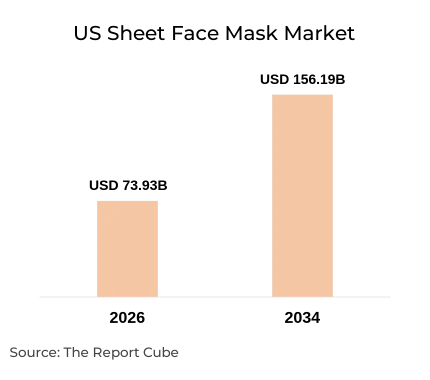
- US sheet face mask market is valued at USD 73.93 billion in 2026.
- The market is projected to reach USD 156.19 billion by 2034 at a CAGR of 9.80%.
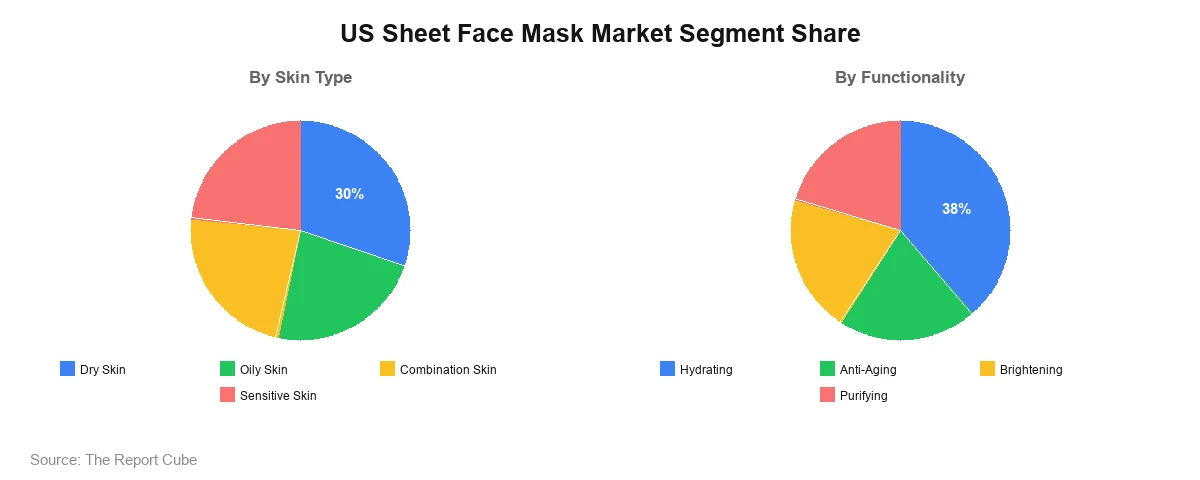
- Hydrating products lead the functionality segment with an estimated 38% share in 2026.
- Dry skin leads the skin type segment with an estimated 30% share in 2026.
- North is the leading region with an estimated 32% share in 2026.
- L’Oréal, Procter & Gamble, Unilever, Estée Lauder, Shiseido, Amorepacific, Beiersdorf and Coty are the supplied key players.
- Online retail development and cosmetic safety documentation under MoCRA are the main market themes.
Market Overview
Sheet face masks are single-use cosmetic sheets saturated with serums or essences and applied to the face for a fixed period. Made from cotton, non-woven fabric, paper or bio-cellulose, they deliver hydration, brightening, purifying and anti-aging ingredients, and are sold for home use and for professional treatments in beauty salons.
The US Sheet Face Mask Market Analysis covers demand shaped by online retail expansion, cosmetic safety regulation and targeted skincare interest. U.S. retail e-commerce reached USD 340.2 billion in the second quarter of 2026, 17.1% of retail sales, according to the U.S. Census Bureau, though not specific to sheet masks. Consumers use sheet masks for hydration, brightening and anti-aging care, while distribution spans online retail, offline retail, beauty salons and pharmacies. Materials include cotton, non-woven fabric, paper and bio-cellulose. The market valued at USD 73.93 billion in 2026 is projected to grow at a CAGR of 9.80% during 2026–2034.
US Sheet Face Mask Market Dynamics
US Sheet Face Mask Market Growth is influenced by cosmetic product safety requirements, online retail development and targeted skincare demand. Official sources cover cosmetics regulation and e-commerce activity, but do not establish sheet-mask-specific demand, segment growth or the supplied market-size estimates. The assessments separate documented evidence from market implications.
|
Factor |
Type |
Specific Impact on Market |
Magnitude |
|---|---|---|---|
|
Expansion of online retail |
Driver |
U.S. retail e-commerce reached USD 340.2 billion in Q2 2026, 17.1% of retail sales; channel-level evidence, not sheet-mask-specific |
Medium–High |
|
MoCRA safety requirements |
Driver |
Safety substantiation, facility registration and product listing encourage documented safety practices and supplier oversight |
Medium |
|
Online-first distribution |
Opportunity |
E-commerce can improve discoverability nationwide; no sheet-mask-specific online sales forecast is verified |
Medium |
|
Documented product safety |
Opportunity |
Transparent ingredient information and substantiated claims can strengthen consumer confidence |
Medium |
|
Regulatory compliance obligations |
Challenge |
Substantiation, registration and listing add workload for businesses with multiple formulations or suppliers |
Medium–High |
|
Adverse-reaction risk |
Challenge |
Brands must assess formulation, ingredient compatibility, quality and complaints rather than rely on marketing claims |
Medium |
|
Digital distribution |
Trend |
Online share of U.S. retail rose from 16.3% to 17.1% between Q2 2025 and Q2 2026 |
Medium |
|
Safety documentation emphasis |
Trend |
MoCRA obligations and renewal cycles make documentation and supplier oversight routine |
Medium |
US Sheet Face Mask Market Growth Drivers
Online retail provides a large and expanding sales channel for skincare products. According to the U.S. Census Bureau, retail e-commerce sales reached USD 340.2 billion in the second quarter of 2026, up 12.2% from a year earlier. The data covers all retail categories, so it indicates channel scale rather than sheet mask demand.
The Modernization of Cosmetics Regulation Act (MoCRA) requires safety substantiation, facility registration and product listing for applicable cosmetics. These obligations encourage brands to maintain documented safety practices and supplier oversight, which can support consumer confidence in categories such as sheet masks. The effect is a qualitative assessment, not a measured demand impact.
US Sheet Face Mask Market Opportunities
Brands can build online-first distribution to improve product discoverability and reach consumers across the United States. Broad e-commerce activity supports this direction, with online sales representing 17.1% of total U.S. retail in the second quarter of 2026. No verified sheet-mask-specific online sales forecast currently supports the opportunity, so it remains a channel-level assessment.
Transparent ingredient information, appropriate substantiation for cosmetic claims and robust quality processes allow brands to differentiate on documented product safety. As FDA registration and listing requirements increase regulatory visibility of products and facilities, companies with organized documentation and supplier controls may strengthen consumer confidence while meeting applicable regulatory expectations across their operations.
US Sheet Face Mask Industry Challenges
Applicable cosmetic manufacturers and responsible persons must meet FDA requirements, including safety substantiation and, where required, facility registration and product listing. These obligations increase compliance workload, particularly for businesses managing multiple formulations or suppliers. Facility registrations also require renewal every two years, and changes to registration details must be reported within 60 days.
Cosmetic products must be adequately substantiated for safety, so brands need to assess formulation, ingredient compatibility, product quality and consumer complaints instead of relying on marketing claims. Sheet masks remain on the face for a set period, which makes adverse-reaction management a practical operating concern. Supplied data do not quantify sheet-mask-specific complaint rates.
Need Specific Data, Let’s Customize the Report for You
Request CustomizationUS Sheet Face Mask Market Trends
US Sheet Face Mask Market Trends reflect a gradual move toward digital distribution. Census Bureau data show online retail rising from 16.3% of total U.S. retail sales in the second quarter of 2025 to 17.1% a year later. This provides channel context for online skincare discovery without isolating sheet masks.
Safety documentation is gaining operational weight as MoCRA obligations mature. Facility registrations must be renewed every two years, making 2026 a renewal year for companies that registered in early 2024, while FDA’s Good Manufacturing Practice rules were still pending in early 2026. Supplier oversight is becoming a routine compliance task.
US Sheet Face Mask Market Segment Analysis
US Sheet Face Mask Market Share is segmented by skin type, functionality, material type and distribution channel. Shares quoted below are supplied 2026 estimates and apply only to the leading segment where one was provided.
By Skin Type
- Dry Skin
- Oily Skin
- Combination Skin
- Sensitive Skin
Dry skin leads the skin type segment with an estimated 30% share in 2026, based on supplied estimates. The leading position is likely supported by the fit between sheet mask formats, which hold serums against the skin, and consumer demand for moisture-focused care. Oily skin, combination skin and sensitive skin follow as additional segments. Oily skin applications center on purifying and balancing formulations, combination skin products address uneven needs across facial zones, and sensitive skin offerings depend on ingredient transparency and documented safety substantiation under U.S. cosmetic regulation. Brands such as Garnier, part of L’Oréal, and Dr. Jart+, part of Estée Lauder, market sheet masks across these needs, although segment-level company shares were not supplied. Segment positions beyond dry skin have not been quantified, and the 30% estimate requires validation before publication.
By Functionality
- Hydrating
- Anti-Aging
- Brightening
- Purifying
Hydrating leads the functionality segment with an estimated 38% share in 2026, based on supplied estimates. The position is likely supported by the broad relevance of moisture delivery across skin types and by the ability of sheet formats to hold ingredients against the skin. Anti-aging, brightening and purifying follow as additional segments, addressing visible aging concerns, skin tone and radiance, and oil or impurity management respectively. SK-II, part of Procter & Gamble, markets facial treatment masks, while Garnier and Dr. Jart+ offer sheet masks within the L’Oréal and Estée Lauder portfolios, although company shares by functionality were not supplied. The hydrating estimate requires validation, and the positions of the remaining segments have not been quantified.
Regional Analysis
The US Sheet Face Mask Market is assessed across West, Southwest, North and Midwest. Only the North share was supplied; regional growth factors and trends are qualitative assessments.
|
Region |
Estimated Market Share |
Key Growth Factors |
Industry Trends |
|---|---|---|---|
|
West |
- |
Metropolitan retail concentration and e-commerce access |
Online and specialty retail discovery |
|
Southwest |
- |
Regional retail expansion and online delivery coverage |
Growing use of digital purchasing channels |
|
North |
32% |
Dense metropolitan retail, e-commerce delivery coverage and specialty beauty channels |
Mix of online, offline and salon-based skincare access |
|
Midwest |
- |
Regional retail networks and pharmacy distribution |
Reliance on mass retail and pharmacy channels |
North is the leading region with an estimated 32% share in 2026, according to supplied estimates. Likely contributors include dense metropolitan retail, extensive e-commerce delivery coverage and access to specialty beauty channels. These factors are qualitative assessments, and the supplied data do not break down North share by state or channel.
The West, Southwest and Midwest collectively account for the remaining 68%, though individual shares were not supplied. Regional differences are expected to reflect population distribution, retail format mix and online adoption. Verified state-level sheet mask sales data would be required before assigning shares, and applicable cosmetic regulation, including FDA requirements, applies nationally across all four regions.
Market Share & Competitive Landscape
The US Sheet Face Mask Market includes global beauty and personal care groups with mass, prestige and Korean skincare portfolios. The table summarizes supplied companies by general capability and does not represent numerical market share. U.S. sheet-mask-specific sales and distribution should be validated.
|
Company |
Competitive Strength |
Primary Segment Served |
|---|---|---|
|
L’Oréal |
Mass and prestige skincare portfolio, including Garnier and L’Oréal Paris |
Hydrating, brightening and anti-aging masks across skin types |
|
Procter & Gamble |
Skincare brands including Olay and SK-II, with large personal care distribution |
Anti-aging and hydrating masks through retail and online channels |
|
Unilever |
Broad personal care portfolio and mass-market distribution |
Mass-market skincare across offline and online retail |
|
Estée Lauder |
Prestige skincare portfolio, including Dr. Jart+, Clinique and Origins |
Premium hydrating and treatment masks |
|
Shiseido |
Prestige skincare and Japanese beauty expertise |
Premium anti-aging and brightening skincare |
|
Amorepacific |
Korean skincare expertise and mask-format experience |
Hydrating and bio-cellulose-oriented skincare |
|
Beiersdorf |
Skincare brands including Nivea and Eucerin, with pharmacy and mass distribution |
Sensitive skin and everyday skincare through pharmacies and retail |
|
Coty |
Mass and prestige beauty portfolio |
Mass and prestige skincare and beauty retail |
Key Companies in the US Sheet Face Mask Market
L’Oréal: L’Oréal is headquartered in Clichy, France, and was founded in 1909. The group markets skincare across mass and prestige brands, including Garnier, which offers sheet masks. Sheet-mask-specific United States activity during 2024–2025 could not be verified, but its brand breadth and retail reach support competitive relevance in hydration and brightening.
The Estée Lauder Companies: The Estée Lauder Companies is headquartered in New York and was founded in 1946. Its portfolio includes Dr. Jart+, known for Dermask sheet masks, alongside Clinique and Origins. Company-specific United States sheet mask developments during 2024–2025 could not be verified, so competitive relevance rests on its prestige skincare positioning.
Recent Developments
|
Year / Month |
Company |
Development |
|---|---|---|
|
January 2026 |
U.S. FDA |
FDA’s system reflected 14,299 active facility registrations and 992,907 active cosmetic product listings as of 6 January |
|
August 2026 |
U.S. Census Bureau |
Second-quarter 2026 report released on 18 August, showing retail e-commerce sales of USD 340.2 billion and a 17.1% share of retail sales |
US Sheet Face Mask Market Future Outlook
US Sheet Face Mask Market Forecast indicates expansion from USD 73.93 billion in 2026 to USD 156.19 billion by 2034 at a CAGR of 9.80%, based on supplied estimates. Growth is expected to depend on skincare demand, online retail development, material innovation and product-safety practices. These projections are supplied assumptions and have not been validated against sheet-mask-specific official statistics or independent sales data.
Compliance activity is likely to remain a feature of the forecast period, as MoCRA registration renewals and Good Manufacturing Practice rules under development influence documentation, supplier oversight and product planning. Competition among global beauty groups and specialty brands may center on formulation, material selection, pricing and channel execution. Risks include regulatory cost, product-safety incidents and the uncertainty surrounding the supplied estimates.
US Sheet Face Mask Market Report Coverage
This US Sheet Face Mask Market Report summarizes the supplied valuation, forecast assumptions, segmentation, regional framework and competitive ecosystem.
|
Parameter |
Details |
|---|---|
|
Market Name |
US Sheet Face Mask Market |
|
Market Size 2026 |
USD 73.93 billion |
|
Market Size 2034 |
USD 156.19 billion |
|
Forecast Period |
2026–2034 |
|
CAGR |
9.80% |
|
Base Year |
2026 |
|
Historical Years |
2021-2025 |
|
Forecast Years |
2026–2034 |
|
Segments Covered |
By Skin Type; By Functionality; By Material Type; By Distribution Channel |
|
Regions Covered |
West, Southwest, North, Midwest |
|
Key Companies |
L’Oréal, Procter & Gamble, Unilever, Estée Lauder, Shiseido, Amorepacific, Beiersdorf, Coty |
|
Customization |
Available as per client requirements |
Why Choose This US Sheet Face Mask Market Report?
- Market coverage of sheet face masks across skin type, functionality, material type and distribution channel segments.
- Clear presentation of the supplied 2026 valuation, 2034 forecast and 9.80% CAGR, with estimates labeled as such.
- Segmentation depth across four classifications covering sixteen segments.
- Regional framework covering West, Southwest, North and Midwest, including the supplied North share.
- Competitive profiling of eight supplied global beauty and personal care companies.
- Trend analysis linking online retail activity and MoCRA safety requirements to market context.
- Forecast insights to support product planning, channel strategy and market-entry evaluation.
Table of Contents
- Introduction
- Objective of the Study
- Product Definition
- Market Segmentation
- Study Variables
- Research Methodology
- Secondary Data Points
- Companies Interviewed
- Primary Data Points
- Breakdown of Primary Interviews
- Secondary Data Points
- Executive Summary
- Market Dynamics
- Drivers
- Challenges
- Opportunity Assessment
- Recent Trends and Developments
- Policy and Regulatory Landscape
- US Sheet Face Mask Market Overview and Forecast Analysis (2021-2034)
- Market Size, By Value, By Growth Rate (CAGR/USD Billions)
- Demand – Supply Trends
- Market Share, By Skin Type
- Dry Skin
- Oily Skin
- Combination Skin
- Sensitive Skin
- Market Share, By Functionality
- Hydrating
- Anti-Aging
- Brightening
- Purifying
- Market Share, By Material Type
- Cotton
- Non-Woven Fabric
- Paper
- Bio-Cellulose
- Market Share, By Distribution Channel
- Online Retail
- Offline Retail
- Beauty Salons
- Pharmacies
- Market Share, By Region
- West
- Southwest
- North
- Midwest
- Market Share, By Competitors
- Competition Characteristics
- Revenue Shares
- Dry Skin US Sheet Face Mask Market Overview, 2021-2034F
- By Value (USD Million)
- By Functionality – Market Size & Forecast 2021-2034, USD Million
- Hydrating
- Anti-Aging
- Brightening
- Purifying
- Oily Skin US Sheet Face Mask Market Overview, 2021-2034F
- By Value (USD Million)
- By Functionality – Market Size & Forecast 2021-2034, USD Million
- Hydrating
- Anti-Aging
- Brightening
- Purifying
- Combination Skin US Sheet Face Mask Market Overview, 2021-2034F
- By Value (USD Million)
- By Functionality – Market Size & Forecast 2021-2034, USD Million
- Hydrating
- Anti-Aging
- Brightening
- Purifying
- Sensitive Skin US Sheet Face Mask Market Overview, 2021-2034F
- By Value (USD Million)
- By Functionality – Market Size & Forecast 2021-2034, USD Million
- Hydrating
- Anti-Aging
- Brightening
- Purifying
- Competitive Outlook (Company Profile – Partial List)
- L'Oreal
- Company Overview
- Business Segments
- Strategic Alliances/Partnerships
- Recent Developments
- Procter & Gamble
- Company Overview
- Business Segments
- Strategic Alliances/Partnerships
- Recent Developments
- Unilever
- Company Overview
- Business Segments
- Strategic Alliances/Partnerships
- Recent Developments
- Estée Lauder
- Company Overview
- Business Segments
- Strategic Alliances/Partnerships
- Recent Developments
- Shiseido
- Company Overview
- Business Segments
- Strategic Alliances/Partnerships
- Recent Developments
- Amorepacific
- Company Overview
- Business Segments
- Strategic Alliances/Partnerships
- Recent Developments
- Beiersdorf
- Company Overview
- Business Segments
- Strategic Alliances/Partnerships
- Recent Developments
- Coty
- Company Overview
- Business Segments
- Strategic Alliances/Partnerships
- Recent Developments
- L'Oreal
- Contact Us & Disclaimer
Top Key Players & Market Share Outlook
- L'Oreal
- Procter & Gamble
- Unilever
- Estée Lauder
- Shiseido
- Amorepacific
- Beiersdorf
- Coty
Frequently Asked Questions