



Build Your Custom Market Intelligence Report
Customize Your ReportIndia Smart Kitchen Appliances Market Statistics and Insights
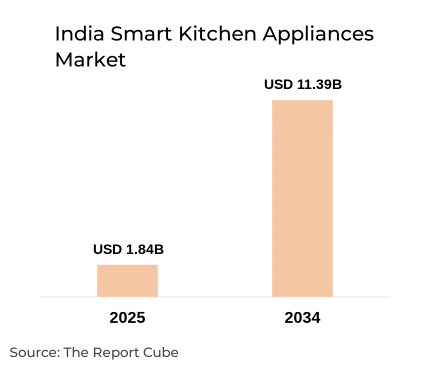
- India Smart Kitchen Appliances Market was valued at USD 1.84 billion in 2025.
- India Smart Kitchen Appliances Market is projected to reach USD 11.39 billion by 2034.
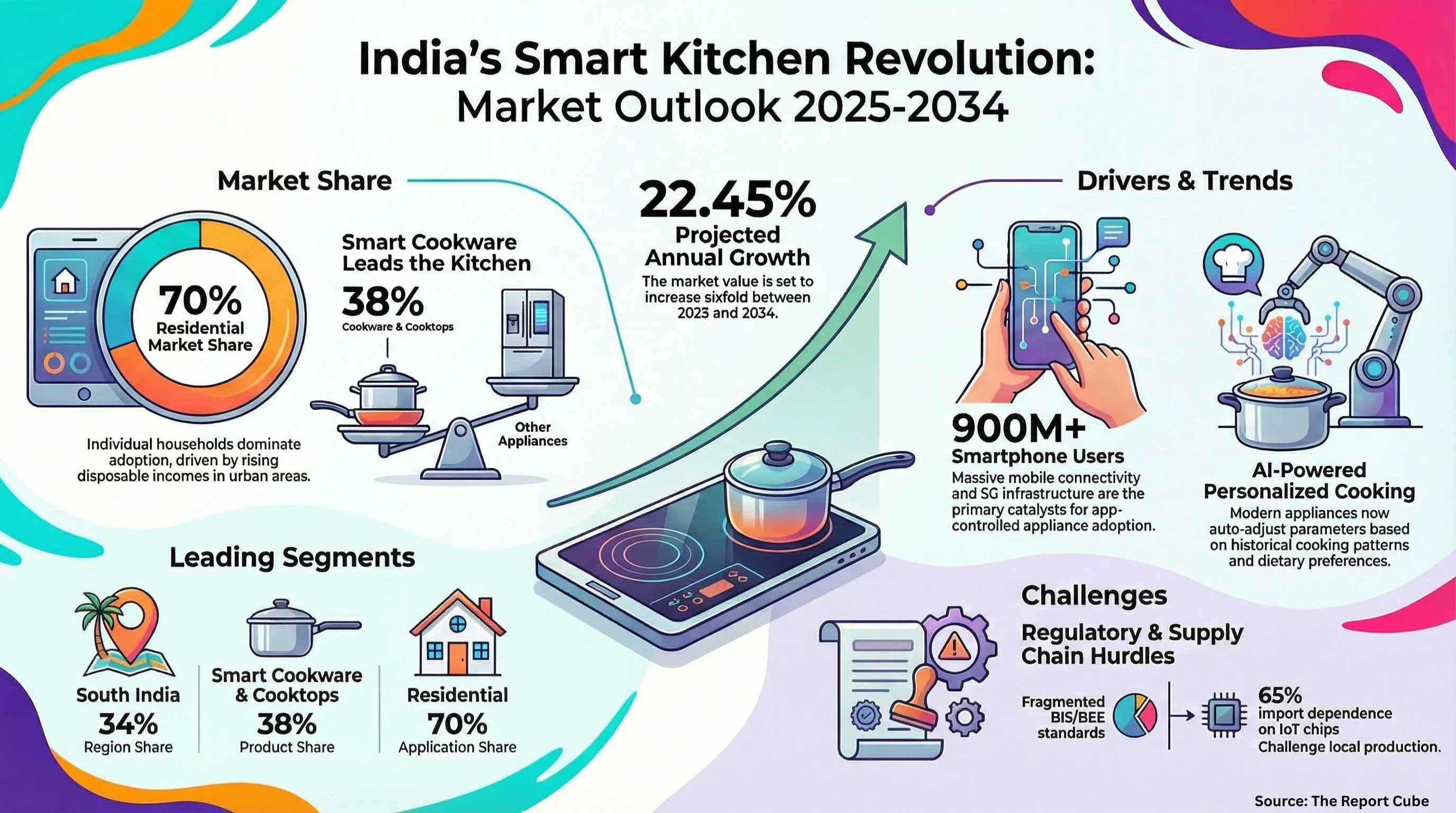
- India Smart Kitchen Appliances Market is anticipated to grow at 22.45% CAGR during 2026–2034.
By Product Smart Cookware & Cooktops leads the By Product segment with approximately 38% market share.
Competitive Landscape
- More than 10 companies are actively engaged in producing India Smart Kitchen Appliances.
- Top 5 companies acquired around 55% of the market share.
- Whirlpool Corp, LG Electronics Inc ADR, Bosch, Haier Smart Home Co Ltd ADR, Electrolux AB ADR, and others.
By Application The Residential segment dominates By Application with around 70% market share in 2025.
India Smart Kitchen Appliances Market Insights & Analysis
The India Smart Kitchen Appliances Market is anticipated to register a 22.45% CAGR during 2026–2034. The market size was valued at USD 1.84 billion in 2025 and is projected to reach USD 11.39 billion by 2034. India's smart kitchen appliances sector is experiencing one of the most rapid transformations across the broader consumer durables landscape. Rising smartphone penetration, estimated at over 900 million users in 2025, combined with expanding 5G infrastructure has made app-controlled kitchen appliances accessible even to middle-income households.
Government initiatives such as the Production Linked Incentive (PLI) scheme have mobilized INR 444.54 crore in manufacturing subsidies specifically targeted at white goods, accelerating domestic production of IoT-enabled refrigerators, smart cooktops, and connected ovens. In May 2025, Samsung Electronics unveiled a new line of AI Inverter Compressor refrigerators for the Indian market, signaling sustained investment in high-technology connected products. Urban household consumption expenditure on consumer durables climbed 18% year-on-year in 2024, underlining the financial capacity of city-dwelling buyers to upgrade to premium smart appliances. E-commerce platforms such as Flipkart and Amazon India have further democratized access, enabling tier-2 and tier-3 city consumers to purchase connected kitchen solutions through zero-cost EMI schemes and doorstep installation services.
India Smart Kitchen Appliances Market Dynamics
Key Market Driver: Smart Home Ecosystem Integration Accelerating Adoption
The convergence of smart kitchen appliances with broader connected home ecosystems is the single most powerful driver reshaping the India Smart Kitchen Appliances Market. As of 2025, India's installed base of smart home devices surpassed 120 million units, with kitchen appliances representing the fastest-growing category within this ecosystem. Wi-Fi-enabled refrigerators, voice-controlled ovens, and app-linked induction cooktops that integrate with platforms such as Google Home and Amazon Alexa are witnessing purchase rates three times higher than standalone connected devices. Manufacturers including Haier, Bosch, and LG have introduced unified mobile applications that allow consumers to manage multiple kitchen appliances simultaneously, creating powerful network effects that raise switching barriers and drive incremental attachment sales.
Major Industry Challenge: Fragmented Regulatory Standards Complicating Market Compliance
Despite strong demand momentum, a fragmented regulatory environment presents a significant operational challenge for participants in the India Smart Kitchen Appliances Market. Smart appliances must simultaneously comply with Bureau of Indian Standards (BIS) certification requirements, Bureau of Energy Efficiency (BEE) star-rating mandates, and evolving data-privacy regulations governing IoT-connected devices.
Differing state-level inspection protocols and certification timelines can add three to six months to product launch cycles, disadvantaging smaller manufacturers and slowing the introduction of next-generation models. Additionally, India's import dependence on specialized semiconductor components, estimated at over 65% for IoT chips used in smart appliances, creates supply chain vulnerabilities that can delay production schedules and inflate product costs, particularly during global chip shortage cycles.
Emerging Trend Shaping Outlook: AI-Powered Personalized Cooking Intelligence Platforms
Artificial intelligence is rapidly transitioning from a marketing differentiator to a core functional architecture within the India Smart Kitchen Appliances Market. Leading manufacturers are now embedding on-device machine learning models in smart ovens and cooktops that analyze a household's historical cooking patterns, ingredient combinations, and dietary preferences to generate personalized recipe suggestions and auto-adjust cooking parameters.
LG's ThinQ AI platform, deployed across its India-specific smart oven lineup from mid-2025, enables real-time food recognition via internal cameras and automatically calibrates temperature and timing. Meanwhile, Bosch's Home Connect ecosystem has integrated with Indian meal-planning applications, allowing smart refrigerators to detect inventory levels and auto-generate grocery orders. This AI-native direction is expected to command a 35% premium price positioning over standard connected appliances by 2027.
India Smart Kitchen Appliances Market Segment-wise Analysis
The India Smart Kitchen Appliances Market is structured across two primary dimensions: By Product and by Application. Understanding segment-level dynamics is essential for stakeholders seeking to identify high-growth pockets, align product development with consumer demand patterns, and prioritize investment across the value chain. Both segments reflect distinct demand characteristics shaped by India's urban-rural divide, rising disposable incomes, and evolving lifestyle preferences.
By Product
- Smart Refrigerators
- Smart Cookware & Cooktops
- Smart Dishwashers
- Smart Ovens
- Other Appliances
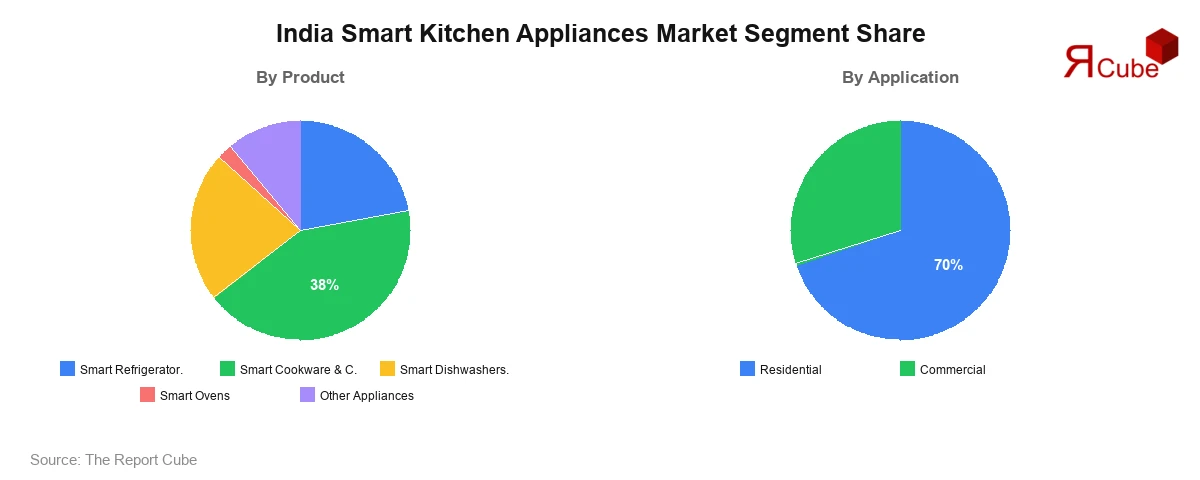
Smart Cookware & Cooktops represents the dominant product category, accounting for approximately 38% of total market revenue in 2025. This leadership is underpinned by the deep cultural centrality of cooking in Indian households, where consumers invest heavily in precision and convenience for daily meal preparation. IoT-enabled induction cooktops with pre-programmed Indian recipes and app-based temperature regulation have proven particularly popular in metro and tier-1 cities. Smart Refrigerators follow closely, holding roughly 32% market share, driven by rising health consciousness and demand for inventory-tracking features that minimize food wastage, a key concern for urban nuclear families.
Smart Ovens represent the fastest-growing sub-segment, with adoption accelerating among millennials and Gen Z consumers drawn to baking and air-frying trends amplified by social media. Smart Dishwashers, although currently limited to premium residential and commercial applications, are expanding at a double-digit CAGR as awareness and water-saving benefits gain traction among environmentally conscious urban consumers.
By Application
- Residential
- Commercial
The Residential segment dominates the India Smart Kitchen Appliances Market, capturing approximately 70% of total market share in 2025. This dominance reflects India's deep-rooted home-cooking culture and the accelerating upgrade cycle among urban and semi-urban households seeking convenience and connectivity in daily kitchen operations. Rising nuclear family formations, dual-income households with constrained time for meal preparation, and the proliferation of smart home platforms have collectively driven premium appliance adoption in the residential space. Samsung's Bespoke AI refrigerator series, introduced at accessible price points starting at INR 36,000, exemplifies the industry's strategy of democratizing smart functionality.
The Commercial segment, while smaller in absolute revenue terms, is projected to grow at a robust CAGR of over 7.5% through 2034, propelled by India's rapidly expanding quick-service restaurant (QSR) industry, cloud kitchen proliferation, and the hospitality sector's post-pandemic modernization drive. Commercial buyers increasingly demand smart appliances with remote diagnostics, energy monitoring, and integration with kitchen management software to optimize throughput and reduce operational costs.
Regional Projection of India Smart Kitchen Appliances Market
The India Smart Kitchen Appliances Market exhibits a distinct regional hierarchy shaped by technology adoption rates, income levels, and urbanization depth.
- South India
- North India
- West India
- East & North-East India
South India leads the regional landscape, commanding approximately 34% of total market revenue in 2025. This dominance is driven by a highly tech-savvy consumer base concentrated in cities such as Bengaluru, Hyderabad, and Chennai, where strong IT sector employment sustains elevated disposable incomes and a strong affinity for connected home ecosystems. The region's robust retail and online distribution networks amplify product accessibility, while growing nuclear family culture accelerates smart appliance replacement cycles.
North and West India collectively represent significant demand centers, particularly in Delhi-NCR and Mumbai, while East & North-East India are emerging as the fastest-growing sub-regional markets, supported by rapid electrification expansion and improving consumer awareness.
India Smart Kitchen Appliances Market: Recent Development (2025)
- Samsung India launched AI Inverter Compressor refrigerators in May 2025, achieving 22% gross margin improvement year-on-year.
- LG Electronics introduced ThinQ AI-enabled smart ovens in India during mid-2025, targeting premium urban millennials.
- Bosch expanded its Home Connect smart appliance ecosystem in India, reporting a 19% revenue increase in connected products.
- Haier Smart Home unveiled IoT-integrated refrigerators with inventory management features across major Indian metro markets in 2025.
India Smart Kitchen Appliances Market Future Outlook (2034)
The India Smart Kitchen Appliances Market is positioned for transformational expansion, with a projected CAGR of 22.45% expected to elevate market value from USD 1.84 billion in 2025 to USD 11.39 billion by 2034. This decade-long trajectory will be shaped by the deepening integration of artificial intelligence into everyday kitchen operations, enabling appliances to function as proactive culinary partners rather than passive tools.
The government's continued PLI incentives and "Make in India" manufacturing push are expected to reduce import dependence on critical components, enhancing supply chain resilience. Rising rural electrification and affordable mid-range smart appliance launches will unlock demand from tier-2 and tier-3 cities, significantly expanding the total addressable market. The commercial segment, driven by India's booming QSR and cloud kitchen industries, will contribute an increasingly meaningful share of overall revenue as operators prioritize smart appliances for operational efficiency and sustainability compliance.
Why Choose This Report?
- Provides a comprehensive overview of the overall market analysis, encompassing key trends, consumer behavior analysis, and risk assessment to support strategic decision-making.
- Provides accurate, up-to-date insights into market size, segmentation, and emerging opportunities, helping to minimize risk & capitalizing on growth.
- Gives deep understanding of target audience preferences, investment habits, and communication channels for enhanced product development & marketing effectiveness.
- Delivers competitive analysis & benchmarking, uncovering the strengths & weaknesses of market competitors to guide strategies.
- Consolidate comprehensive market intelligence, reducing reasoning & streamlining research efforts.
- Facilitates customized market segmentation & risk mitigation strategies, fine-tuned to the business objectives.
- Aids in identifying both market challenges & untapped opportunities within the industry to drive long-term business growth.
- Provides valuable information based on actual customer data & search trends.
Table of Contents
- Introduction
- Objective of the study
- Product Definition
- Market Segmentation
- Study Variables
- Research Methodology
- Secondary Data Points
- Companies Interviewed
- Primary Data Points
- Breakdown of Primary Interviews
- Secondary Data Points
- Executive Summary
- Market Dynamics
- Drivers
- Challenges
- Opportunity Assessment
- Recent Trends and Developments
- Policy and Regulatory Landscape
- India Smart Kitchen Appliances Market Overview (2021-2034)
- Market Size, By Value (in USD Billions)
- Market Share, By Product
- Smart Refrigerators
- Smart Cookware & Cooktops
- Smart Dishwashers
- Smart Ovens
- Other Appliances
- Market Share, By Application
- Residential
- commercial
- Market Share, By Distribution Channel
- Online Retail
- Offline Retail
- Market Share, By Connectivity
- Wi-Fi
- Zigbee
- Others (RFID, NFC)
- Market Share, By Region
- North India
- West and Central India
- South India
- East India
- Market Share, By Competitors
- Competition Characteristics
- Revenue Shares
- India Smart Refrigerators Smart Kitchen Appliances Market Overview, 2021-2034F
- By Value (USD Million)
- By Application- Market Size & Forecast 2021-2034, USD Million
- By Distribution Channel- Market Size & Forecast 2021-2034, USD Million
- By Connectivity- Market Size & Forecast 2021-2034, USD Million
- India Smart Cookware & Cooktops Smart Kitchen Appliances Market Overview, 2021-2034F
- By Value (USD Million)
- By Application- Market Size & Forecast 2021-2034, USD Million
- By Distribution Channel- Market Size & Forecast 2021-2034, USD Million
- By Connectivity- Market Size & Forecast 2021-2034, USD Million
- India Smart Dishwashers Smart Kitchen Appliances Market Overview, 2021-2034F
- By Value (USD Million)
- By Application- Market Size & Forecast 2021-2034, USD Million
- By Distribution Channel- Market Size & Forecast 2021-2034, USD Million
- By Connectivity- Market Size & Forecast 2021-2034, USD Million
- India Smart Ovens Smart Kitchen Appliances Market Overview, 2021-2034F
- By Value (USD Million)
- By Application- Market Size & Forecast 2021-2034, USD Million
- By Distribution Channel- Market Size & Forecast 2021-2034, USD Million
- By Connectivity- Market Size & Forecast 2021-2034, USD Million
- India Other Appliances Smart Kitchen Appliances Market Overview, 2021-2034F
- By Value (USD Million)
- By Application- Market Size & Forecast 2021-2034, USD Million
- By Distribution Channel- Market Size & Forecast 2021-2034, USD Million
- By Connectivity- Market Size & Forecast 2021-2034, USD Million
- Competitive Outlook (Company Profile - Partial List)
- Daewoo International
- Company Overview
- Business Segments
- Strategic Alliances/Partnerships
- Recent Developments
- Miele
- Company Overview
- Business Segments
- Strategic Alliances/Partnerships
- Recent Developments
- Breville Group Ltd
- Company Overview
- Business Segments
- Strategic Alliances/Partnerships
- Recent Developments
- Whirlpool Corp
- Company Overview
- Business Segments
- Strategic Alliances/Partnerships
- Recent Developments
- Haier Smart Home Co Ltd ADR
- Company Overview
- Business Segments
- Strategic Alliances/Partnerships
- Recent Developments
- Bosch
- Company Overview
- Business Segments
- Strategic Alliances/Partnerships
- Recent Developments
- Electrolux AB ADR
- Company Overview
- Business Segments
- Strategic Alliances/Partnerships
- Recent Developments
- LG Electronics Inc ADR
- Company Overview
- Business Segments
- Strategic Alliances/Partnerships
- Recent Developments
- Others
- Daewoo International
- Contact Us & Disclaimer
Top Key Players & Market Share Outlook
- Daewoo International
- Miele
- Breville Group Ltd
- Whirlpool Corp
- Haier Smart Home Co Ltd ADR
- Bosch
- Electrolux AB ADR
- LG Electronics Inc ADR
- Others
Frequently Asked Questions






