

Build Your Custom Market Intelligence Report
Customize Your ReportIndonesia Smart Metering Market Key Highlights
By Meter Type:
Electricity Smart Meters segment lead the market, with around 62% share.
By Application:
Residential Smart Metering segment dominate the market, accounting for nearly 48% of total revenue.
Regional Outlook:
Java region dominates the Indonesia smart metering market, with around 54% share.
Government Initiatives & Policies
- Indonesia Smart Grid Development Program: Indonesia’s Ministry of Energy and Mineral Resources launched a smart grid modernization initiative supporting advanced metering infrastructure deployment across utilities and urban electricity networks.
- PLN Digital Transformation & Smart Meter Rollout Plan: State electricity utility PLN is executing a nationwide digitalization program including millions of smart meters to enhance billing transparency and grid monitoring.
Indonesia Smart Metering Market Insights & Analysis
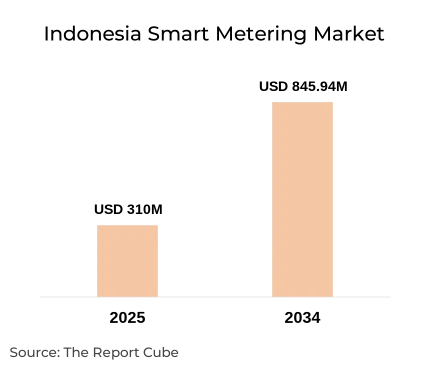
The Indonesia Smart Metering Market is anticipated to register a CAGR of 11.8% during 2026–2034. The market size was valued at USD 310 million in 2025 and is projected to reach USD 845.94 million by 2034. Indonesia’s rapid energy demand growth and national power grid modernization initiatives are driving strong investments in smart metering infrastructure. The market is evolving as utilities transition from conventional mechanical meters toward intelligent digital devices that allow real-time consumption monitoring, remote reading, automated billing, and grid management.
Indonesia is one of Southeast Asia’s fastest-growing electricity markets, with electricity consumption expanding at an annual rate of nearly 6% in recent years. The national electricity provider, PLN, is investing heavily in grid digitalization to improve efficiency and reduce power losses, which historically reached nearly 8–9% of total electricity generation in certain regions. Smart metering technology helps address these challenges by enabling utilities to detect power theft, monitor load demand in real time, and manage distributed energy resources. As a result, advanced metering infrastructure projects are gaining traction across major provinces such as Java, Sumatra, and Kalimantan.
Another important factor shaping the market is Indonesia’s broader energy transition strategy aimed at increasing renewable energy capacity and improving energy efficiency. Smart meters support integration of rooftop solar systems, demand response programs, and time-of-use tariffs, helping utilities balance electricity supply and demand more effectively. The government’s long-term power development plan (RUPTL) outlines significant investments in grid modernization and digital infrastructure, including metering systems that support data-driven energy management.
Private sector participation is also accelerating market growth. International companies and domestic technology firms are collaborating with utilities to deploy communication modules, IoT-enabled meters, and advanced analytics platforms. With rising urbanization and digital transformation initiatives across Southeast Asia, Indonesia’s smart metering ecosystem is expanding beyond electricity meters to include water and gas metering solutions for smart city infrastructure. These developments collectively position Indonesia as one of the most promising smart metering markets in the Asia-Pacific region.
Indonesia Smart Metering Market Dynamics
Key Driver: National Grid Digitalization and Energy Efficiency Programs
The primary factor driving the Indonesia smart metering market is the national push toward grid digitalization and energy efficiency. Indonesia’s electricity demand has been growing steadily due to rapid industrialization, urban expansion, and increasing household electrification. To manage this demand efficiently, the government and national utility PLN are investing heavily in smart grid technologies that enable real-time monitoring and automated electricity distribution. Smart meters play a critical role in this transformation by allowing utilities to collect consumption data remotely and reduce manual meter reading costs.
Historically, manual billing processes and outdated meters have created operational inefficiencies and revenue losses. Studies suggest that electricity theft and inaccurate billing contributed to losses of nearly USD 1 billion annually across several Southeast Asian markets. Smart metering systems address this issue by enabling tamper detection, accurate billing cycles, and dynamic tariff structures. Utilities can also implement demand response strategies, encouraging consumers to reduce electricity usage during peak periods.
Government electrification programs further support market expansion. Indonesia aims to achieve near-universal electricity access while maintaining grid stability. Smart meters allow utilities to monitor power quality in remote areas and optimize distribution networks. As a result, advanced metering infrastructure is becoming an essential component of Indonesia’s energy modernization roadmap.
Book your FREE 30-minute expert consultation today
Contact UsIndustry Trends: Integration of IoT, Data Analytics, and Smart Grid Platforms
One of the most important trends shaping the Indonesia smart metering market is the integration of Internet of Things (IoT) technologies and advanced data analytics into metering infrastructure. Modern smart meters are no longer simple measurement devices; they act as digital sensors connected to utility networks through wireless communication technologies such as cellular networks, radio frequency systems, and Narrowband IoT. These technologies allow utilities to collect granular consumption data at intervals as short as fifteen minutes.
The collected data is analyzed using advanced analytics platforms that help utilities forecast electricity demand and detect grid anomalies. Predictive maintenance systems can identify transformer faults or distribution issues before they escalate into power outages. This capability significantly improves reliability in densely populated regions like Java, where electricity demand peaks during industrial and commercial operations.
Another trend is the growing adoption of multi-utility smart meters capable of measuring electricity, water, and gas consumption simultaneously. These integrated solutions are gaining popularity in smart city initiatives where municipal authorities aim to manage multiple utilities through a single digital platform. With Indonesia expanding its smart city programs across cities such as Jakarta and Surabaya, demand for intelligent metering infrastructure is expected to accelerate during the coming decade.
Major Challenge: High Infrastructure Deployment Costs and System Integration Complexity
Although smart metering offers significant operational benefits, the initial investment required for large-scale deployment remains a major challenge for utilities in Indonesia. Installing advanced metering infrastructure involves substantial costs associated with hardware procurement, communication networks, data management platforms, and integration with existing utility systems. For a large utility like PLN, which serves more than 80 million electricity customers, nationwide deployment requires billions of dollars in infrastructure investments.
In addition to hardware costs, utilities must upgrade their IT systems to process massive volumes of data generated by smart meters. Traditional billing systems are often not designed to handle real-time data streams, making system integration complex and resource intensive. Utilities must invest in secure cloud platforms, data analytics software, and cybersecurity frameworks to protect consumer information and grid operations.
Another challenge is the need for skilled workforce capable of managing smart grid technologies. Engineers and technicians must be trained to install, maintain, and operate advanced metering infrastructure. Without proper technical expertise, utilities may face operational disruptions during system upgrades. Addressing these challenges requires coordinated investments from both government agencies and private technology providers.
Opportunity: Expansion of Smart Cities and Digital Energy Infrastructure
The expansion of smart cities across Indonesia presents a significant opportunity for the smart metering market. Urban centers such as Jakarta, Bandung, and Surabaya are implementing digital infrastructure programs designed to improve urban management and public services. Smart meters are a core component of these initiatives because they enable automated monitoring of electricity, water, and gas consumption across residential and commercial buildings.
Smart metering systems allow city authorities to optimize energy usage, reduce water leakage, and improve billing transparency. For example, intelligent water meters can detect abnormal consumption patterns that indicate pipeline leaks or unauthorized connections. Similarly, electricity smart meters support dynamic pricing models that encourage energy conservation during peak hours.
Another promising opportunity lies in renewable energy integration. Indonesia is expanding solar energy installations, particularly rooftop solar systems in residential and commercial buildings. Smart meters enable bidirectional communication between consumers and utilities, allowing households to feed excess electricity into the grid. This capability supports distributed energy generation and enhances grid flexibility. As Indonesia accelerates its renewable energy transition, smart metering infrastructure will become increasingly essential for managing decentralized power generation.
Indonesia Smart Metering Market Segment-wise Analysis
By Meter Type:
- Electricity Smart Meters
- Gas Smart Meters
- Water Smart Meters
- Heat Smart Meters
Electricity smart meters represent the dominant segment in the Indonesia smart metering market, accounting for nearly 62% of the total market share in 2025. The strong position of this segment is closely tied to the country’s electricity infrastructure modernization programs led by PLN and supported by the Ministry of Energy and Mineral Resources. Electricity meters are being rapidly replaced with digital smart meters capable of remote reading and real-time consumption monitoring.
Electricity smart meters provide several operational advantages for utilities. They eliminate the need for manual meter reading, reduce billing errors, and enable remote connection or disconnection of services. Utilities can also implement time-of-use pricing models that encourage consumers to shift electricity usage to off-peak hours. In industrial zones where energy consumption fluctuates significantly, smart meters help utilities monitor load demand and prevent grid overload.
Moreover, the integration of renewable energy systems such as rooftop solar panels is increasing the importance of electricity smart meters. These devices allow bidirectional energy measurement, enabling households and businesses to export excess electricity to the grid. As Indonesia continues to expand renewable energy capacity, the electricity smart meter segment is expected to maintain its dominant position within the overall market.
By Application:
- Residential Smart Metering
- Commercial Smart Metering
- Industrial Smart Metering
- Public Infrastructure Smart Metering
The residential smart metering segment leads the Indonesia smart metering market, accounting for approximately 48% of total revenue. Indonesia has a large residential electricity customer base exceeding 70 million households, making the residential sector the primary focus of smart meter deployment programs. Utilities are prioritizing residential installations because automated billing and consumption monitoring significantly reduce operational costs.
Smart meters installed in residential buildings enable consumers to track electricity usage through mobile applications and online dashboards. This visibility encourages households to adopt energy-saving practices such as reducing consumption during peak hours or switching to energy-efficient appliances. Several utilities are also introducing prepaid smart meters that allow consumers to manage electricity spending more effectively.
Another reason for the dominance of residential applications is government electrification initiatives aimed at improving energy access in rural areas. Smart meters allow utilities to monitor electricity supply remotely and quickly resolve distribution issues in remote communities. As Indonesia continues to expand electrification coverage and urban housing development, residential smart metering installations are expected to grow rapidly during the forecast period.
Regional Projection of Indonesia Smart Metering Industry
- Sumatra
- Java
- Kalimantan
- Sulawesi
- Nusa Tenggara
- Maluku
- Papua
The Java region dominates the Indonesia smart metering market, accounting for approximately 54% of the national market share. Java is the economic and industrial hub of Indonesia, hosting more than half of the country’s population and the majority of its manufacturing facilities. The region’s high electricity demand has prompted utilities to invest heavily in digital grid infrastructure and smart metering technologies.
Major cities such as Jakarta, Surabaya, and Bandung are implementing smart city programs that include digital energy management systems and advanced metering infrastructure. Industrial zones in West Java and East Java also require precise energy monitoring to manage large-scale manufacturing operations. Smart meters provide utilities with detailed data on electricity consumption patterns, enabling efficient load balancing and grid reliability.
In addition, Java benefits from relatively advanced telecommunications infrastructure, which supports communication technologies such as cellular networks and Narrowband IoT used in smart metering systems. This connectivity advantage makes large-scale deployment more feasible compared with remote regions such as Papua or Maluku. As Indonesia continues to expand digital infrastructure and urban development projects, Java is expected to remain the leading region for smart metering adoption.
Indonesia Smart Metering Market Recent Developments
- 2025: PT Mecoindo (Itron) announced the launch of its Cyble 5 communication module in the Asia-Pacific region, with production scheduled at its Cikarang facility beginning in Q4 2025. The module enables utilities to integrate advanced metering technologies with water conservation and remote monitoring capabilities.
- 2025: Landis+Gyr expanded its advanced metering infrastructure pipeline through a USD 54 million smart meter supply contract with Linyang Energy, strengthening deployment of digital metering systems across Asia and supporting rapid growth in regional utility modernization projects.
- 2025: Huawei Indonesia received the “Best Technology Provider” award at Electricity Connect 2025 in Jakarta and reaffirmed its collaboration with PLN to deliver smart grid solutions, ICT infrastructure, and digital energy platforms supporting smart meter deployment.
- 2025: Schneider Electric announced a strategic partnership with BW Digital during Innovation Day Batam 2025 to develop an AI-ready energy infrastructure platform supporting smart grid and intelligent power management technologies.
Need insights for a specific region within this market?
Request Regional DataWhy Choose This Report?
- Provides a comprehensive overview of the overall market analysis, encompassing key trends, consumer behavior analysis, and risk assessment to support strategic decision-making.
- Provides accurate, up-to-date insights into market size, segmentation, and emerging opportunities, helping to minimize risk & capitalizing on growth.
- Gives deep understanding of target audience preferences, investment habits, and communication channels for enhanced product development & marketing effectiveness.
- Delivers competitive analysis & benchmarking, uncovering the strengths & weaknesses of market competitors to guide strategies.
- Consolidate comprehensive market intelligence, reducing reasoning & streamlining research efforts.
- Facilitates customized market segmentation & risk mitigation strategies, fine-tuned to the business objectives.
- Aids in identifying both market challenges & untapped opportunities within the industry to drive long-term business growth.
- Provides valuable information based on actual customer data & search trends.
Table of Contents
- Introduction
- Objective of the Study
- Product and Category Definition
- Market Segmentation
- Study Variables
- Research Methodology
- Secondary Data Points
- Breakdown of Secondary Sources
- Primary Data Points
- Breakdown of Primary Interviews
- Secondary Data Points
- Executive Summary
- Market Dynamics
- Drivers
- Challenges
- Opportunity Assessment
- Recent Trends and Developments
- Regulatory and Policy Landscape
- Indonesia Smart Metering Market Overview (2021-2034)
- Market Size, By Value (USD Million)
- Market Share, By Meter Type
- Electricity Smart Meters
- Gas Smart Meters
- Water Smart Meters
- Heat Smart Meters
- Market Share, By Communication Technology
- Power Line Communication
- Radio Frequency
- Cellular Communication
- Narrowband IoT
- Market Share, By Component
- Hardware
- Software
- Communication Modules
- Services
- Market Share, By Phase
- Single-Phase Smart Meters
- Three-Phase Smart Meters
- Market Share, By Application
- Residential Smart Metering
- Commercial Smart Metering
- Industrial Smart Metering
- Public Infrastructure Smart Metering
- Market Share, By End User
- Utilities
- Independent Power Producers
- Large Industrial Users
- Government and Municipal Users
- Market Share, By Region
- Sumatra
- Java
- Kalimantan
- Sulawesi
- Nusa Tenggara
- Maluku
- Papua
- Market Share, By Company
- Revenue Shares and Analysis
- Competitive Landscape
- Sumatra Smart Metering Market
- Market Size, By Value (USD Million)
- Market Share, By Meter Type
- Market Share, By Communication Technology
- Market Share, By Component
- Market Share, By Phase
- Market Share, By Application
- Market Share, By End User
- Java Smart Metering Market
- Market Size, By Value (USD Million)
- Market Share, By Meter Type
- Market Share, By Communication Technology
- Market Share, By Component
- Market Share, By Phase
- Market Share, By Application
- Market Share, By End User
- Kalimantan Smart Metering Market
- Market Size, By Value (USD Million)
- Market Share, By Meter Type
- Market Share, By Communication Technology
- Market Share, By Component
- Market Share, By Phase
- Market Share, By Application
- Market Share, By End User
- Sulawesi Smart Metering Market
- Market Size, By Value (USD Million)
- Market Share, By Meter Type
- Market Share, By Communication Technology
- Market Share, By Component
- Market Share, By Phase
- Market Share, By Application
- Market Share, By End User
- Nusa Tenggara Smart Metering Market
- Market Size, By Value (USD Million)
- Market Share, By Meter Type
- Market Share, By Communication Technology
- Market Share, By Component
- Market Share, By Phase
- Market Share, By Application
- Market Share, By End User
- Maluku Smart Metering Market
- Market Size, By Value (USD Million)
- Market Share, By Meter Type
- Market Share, By Communication Technology
- Market Share, By Component
- Market Share, By Phase
- Market Share, By Application
- Market Share, By End User
- Papua Smart Metering Market
- Market Size, By Value (USD Million)
- Market Share, By Meter Type
- Market Share, By Communication Technology
- Market Share, By Component
- Market Share, By Phase
- Market Share, By Application
- Market Share, By End User
- Competitive Outlook and Company Profiles
- PT Smart Meter Indonesia
- Company Overview
- Product Portfolio
- Strategic Alliances/Partnerships
- Recent Developments
- PT Mecoindo (Itron)
- Company Overview
- Product Portfolio
- Strategic Alliances/Partnerships
- Recent Developments
- Landis+Gyr
- Company Overview
- Product Portfolio
- Strategic Alliances/Partnerships
- Recent Developments
- PT Hitachi Sakti Energy
- Company Overview
- Product Portfolio
- Strategic Alliances/Partnerships
- Recent Developments
- PT Schneider Electric
- Company Overview
- Product Portfolio
- Strategic Alliances/Partnerships
- Recent Developments
- CHINT Indonesia
- Company Overview
- Product Portfolio
- Strategic Alliances/Partnerships
- Recent Developments
- XIRKA Silicon Tech
- Company Overview
- Product Portfolio
- Strategic Alliances/Partnerships
- Recent Developments
- PT Solu Filantropi
- Company Overview
- Product Portfolio
- Strategic Alliances/Partnerships
- Recent Developments
- Sindcon (STMicro Partner)
- Company Overview
- Product Portfolio
- Strategic Alliances/Partnerships
- Recent Developments
- Huawei Indonesia
- Company Overview
- Product Portfolio
- Strategic Alliances/Partnerships
- Recent Developments
- EDMI Limited
- Company Overview
- Product Portfolio
- Strategic Alliances/Partnerships
- Recent Developments
- Sensus (Xylem)
- Company Overview
- Product Portfolio
- Strategic Alliances/Partnerships
- Recent Developments
- Comcore Teknologi
- Company Overview
- Product Portfolio
- Strategic Alliances/Partnerships
- Recent Developments
- PT EMS Paramitra
- Company Overview
- Product Portfolio
- Strategic Alliances/Partnerships
- Recent Developments
- PT Tri Mitra Elektrik
- Company Overview
- Product Portfolio
- Strategic Alliances/Partnerships
- Recent Developments
- Honeywell (Elster)
- Company Overview
- Product Portfolio
- Strategic Alliances/Partnerships
- Recent Developments
- Others
- PT Smart Meter Indonesia
- Contact Us and Disclaimer
Top Key Players & Market Share Outlook
- PT Smart Meter Indonesia
- PT Mecoindo (Itron)
- Landis+Gyr
- PT Hitachi Sakti Energy
- PT Schneider Electric
- CHINT Indonesia
- XIRKA Silicon Tech
- PT Solu Filantropi
- Sindcon (STMicro Partner)
- Huawei Indonesia
- EDMI Limited
- Sensus (Xylem)
- Comcore Teknologi
- PT EMS Paramitra
- PT Tri Mitra Elektrik
- Honeywell (Elster)
Frequently Asked Questions