




Build Your Custom Market Intelligence Report
Customize Your ReportU.S. Snacks Market Insights & Analysis
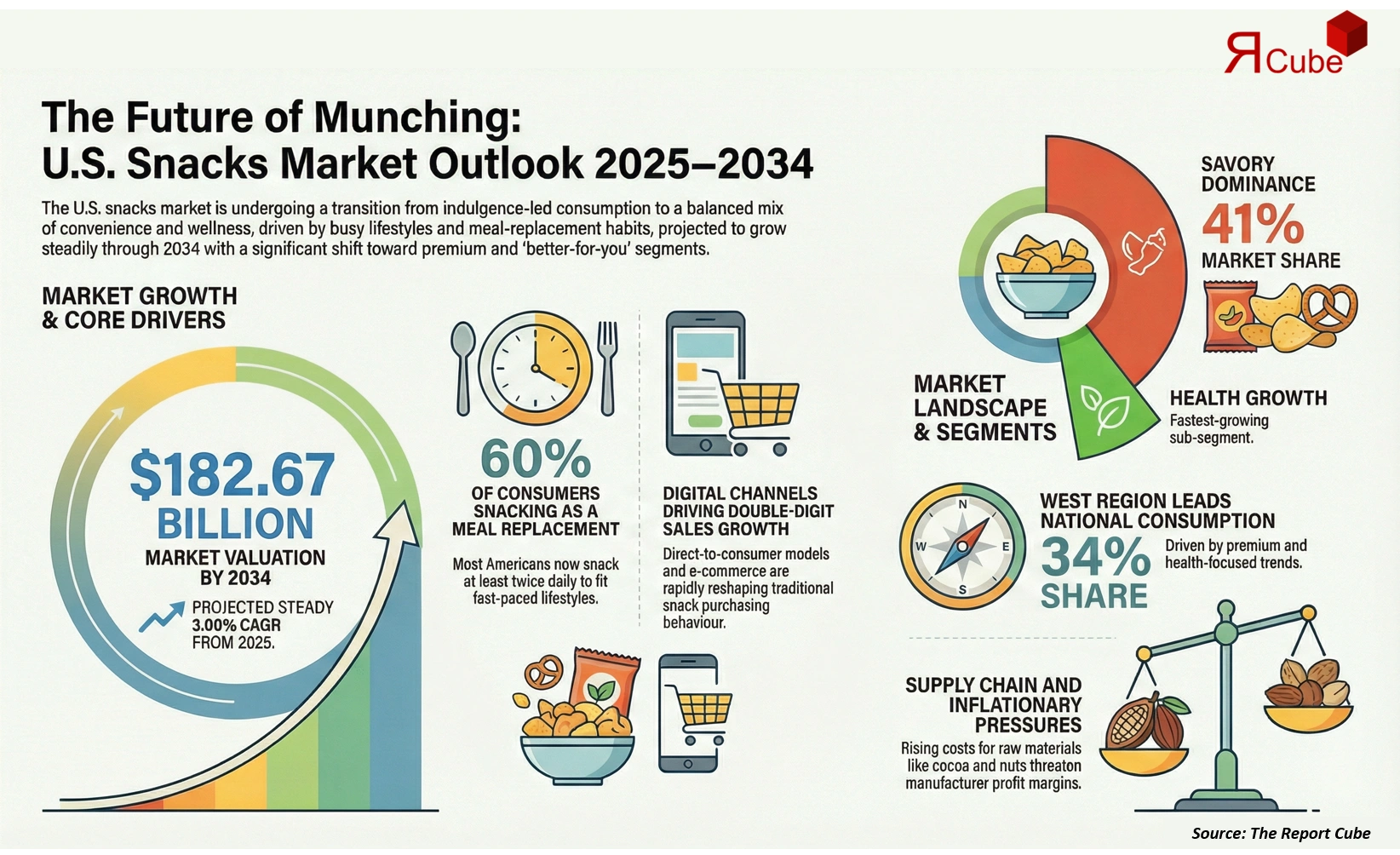
The U.S. Snacks Market is anticipated to register a CAGR of 3.00% during the forecast period 2026-2034. The market size was valued at USD 140 billion in 2025 and is projected to reach USD 182.67 billion by 2034. This growth highlights the deeply embedded role of snacking in American food culture, driven by changing lifestyles, increasing demand for convenience foods, and evolving consumer preferences toward variety and portion control.
The U.S. snacks industry has transitioned from indulgence-led consumption to a balanced mix of taste, convenience, and perceived health benefits. Busy work schedules, rising single-person households, and flexible eating habits have increased the frequency of snacking across all age groups. At the same time, manufacturers are responding with diversified product portfolios that include low-sugar, high-protein, plant-based, and functional snack options. This shift is helping brands retain traditional consumers while attracting health-conscious buyers.
Moreover, strong retail penetration, innovation in packaging, and aggressive brand marketing continue to strengthen market expansion. The integration of digital channels and direct-to-consumer models has also reshaped purchasing behavior, making snacks more accessible across urban and suburban regions. Collectively, these factors position the U.S. Snacks Market for steady and resilient growth throughout the forecast period.
U.S. Snacks Market Recent Developments
- 2025: PepsiCo expanded its better-for-you snack portfolio with new baked and low-sodium product launches.
- 2025: Mondelez International introduced portion-controlled snack packs targeting health-conscious consumers.
Government Initiatives & Policies
- USDA Dietary Guidelines Initiative: Promotes reduced sugar and sodium intake influencing healthier snack formulations.
- FDA Nutrition Labeling Modernization: Strengthens transparency in packaged foods, including snacks.
U.S. Snacks Market Dynamics
Key Driver: Rising Demand for Convenient and On-the-Go Food Options
The primary driver of the U.S. Snacks Market is the growing demand for convenient, ready-to-eat food products that fit fast-paced lifestyles. Consumers increasingly replace traditional meals with multiple snack occasions throughout the day, particularly among working professionals and younger demographics. More than 60% of U.S. consumers report snacking at least twice daily, underscoring its role as a meal substitute. This behavioral shift has encouraged manufacturers to innovate with portable packaging, extended shelf-life, and diverse flavor profiles. Additionally, snacks offer affordability and portion flexibility, making them attractive during periods of economic uncertainty. As convenience remains a core purchasing factor, snack products continue to experience consistent demand across income groups.
Book your FREE 30-minute expert consultation today
Contact UsIndustry Trends: Premiumization and Health-Focused Product Innovation
A key trend shaping the market is premiumization combined with health-oriented innovation. Consumers are increasingly willing to pay more for snacks made with natural ingredients, clean labels, and functional benefits such as protein enrichment or gut health support. Brands are introducing organic, gluten-free, and non-GMO snack options to align with evolving dietary preferences. Plant-based snacks and fruit-and-nut blends are gaining shelf space, reflecting demand for minimally processed foods. At the same time, indulgent categories are being reformulated with reduced sugar and fat content. This dual focus on indulgence and wellness allows brands to address diverse consumer segments while sustaining value growth.
Major Challenge: Rising Raw Material and Supply Chain Costs
Rising costs of raw materials such as grains, cocoa, nuts, and edible oils present a significant challenge for the U.S. Snacks Market. Inflationary pressures and supply chain disruptions have increased production and transportation expenses, squeezing manufacturer margins. Smaller brands face greater difficulty absorbing these costs without raising prices, which may impact demand elasticity. Additionally, fluctuating commodity prices create uncertainty in long-term procurement planning. While large players benefit from economies of scale, sustained cost volatility may limit profitability and slow innovation investments across the industry.
Opportunity: Expansion of Online and Direct-to-Consumer Snack Sales
The rapid expansion of online retail presents a major opportunity for the U.S. Snacks Market. E-commerce platforms and subscription-based snack services are gaining popularity due to convenience and personalized offerings. Online snack sales have grown at a double-digit rate since 2021, supported by improved logistics and digital marketing. Brands are leveraging data analytics to tailor products and promotions to individual preferences, enhancing customer loyalty. Direct-to-consumer channels also allow manufacturers to test new flavors and formats quickly, reducing reliance on traditional retail. This digital shift is expected to unlock incremental growth and strengthen brand-consumer relationships.
U.S. Snacks Market Segment-wise Analysis
By Product Type:
- Savory Snacks
- Sweet Snacks
- Fruit & Nut Snacks
- Health Snacks
- Frozen Snacks
Savory Snacks dominate the U.S. Snacks Market, accounting for approximately 41% market share in 2025. Products such as chips, crackers, and popcorn benefit from strong brand loyalty and frequent consumption. Sweet Snacks follow closely, driven by chocolates, cookies, and bakery items. However, Health Snacks represent the fastest-growing sub-segment, capturing nearly 18% share, supported by rising interest in protein bars, low-calorie options, and functional ingredients. Fruit & Nut Snacks continue to gain traction among health-conscious consumers, while Frozen Snacks cater to indulgent and convenience-driven demand, contributing to portfolio diversification.
By Distribution Channel:
- Supermarkets
- Convenience Stores
- Club Stores
- Online Retail
Supermarkets lead distribution with an estimated 45% market share, owing to wide product availability and frequent consumer visits. Convenience Stores hold a significant share due to impulse purchasing and extended operating hours. Club Stores attract value-seeking households through bulk packaging and competitive pricing. Online Retail, while currently accounting for around 12% market share, is expanding rapidly as consumers embrace digital grocery shopping. The growing importance of omnichannel strategies highlights the need for brands to maintain strong presence across both physical and digital platforms.
Regional Projection of U.S. Snacks Industry
- West
- Southwest
- North
- Midwest
The West region leads the U.S. Snacks Market, holding approximately 34% market share. This dominance is driven by higher adoption of premium and health-focused snack products, supported by strong urbanization and wellness trends. The Midwest follows, benefiting from large-scale snack manufacturing and stable demand for traditional savory products. The Southwest shows rising growth potential due to a younger population and preference for bold flavors, while the North maintains steady consumption across both indulgent and healthy snack categories. Regional diversity in taste and purchasing behavior continues to shape product innovation and marketing strategies nationwide.
Need insights for a specific region within this market?
Request Regional DataWhy Choose This Report?
- Provides a comprehensive overview of the overall market analysis, encompassing key trends, consumer behavior analysis, and risk assessment to support strategic decision-making.
- Provides accurate, up-to-date insights into market size, segmentation, and emerging opportunities, helping to minimize risk & capitalizing on growth.
- Gives deep understanding of target audience preferences, investment habits, and communication channels for enhanced product development & marketing effectiveness.
- Delivers competitive analysis & benchmarking, uncovering the strengths & weaknesses of market competitors to guide strategies.
- Consolidate comprehensive market intelligence, reducing reasoning & streamlining research efforts.
- Facilitates customized market segmentation & risk mitigation strategies, fine-tuned to the business objectives.
- Aids in identifying both market challenges & untapped opportunities within the industry to drive long-term business growth.
- Provides valuable information based on actual customer data & search trends.
Table of Contents
- Introduction
- Objective of the Study
- Product and Category Definition
- Market Segmentation
- Study Variables
- Research Methodology
- Secondary Data Points
- Breakdown of Secondary Sources
- Primary Data Points
- Breakdown of Primary Interviews
- Secondary Data Points
- Executive Summary
- Market Dynamics
- Drivers
- Challenges
- Opportunity Assessment
- Recent Trends and Developments
- Regulatory and Policy Landscape
- United States Snacks Market Overview (2021-2034)
- Market Size, By Value (USD Billion)
- Market Share, By Product Type
- Savory Snacks
- Sweet Snacks
- Fruit & Nut Snacks
- Health Snacks
- Frozen Snacks
- Market Share, By Distribution Channel
- Supermarkets
- Convenience Stores
- Club Stores
- Online Retail
- Market Share, By Consumer Group
- Kids & Teens
- Young Adults
- Families
- Health Seekers
- Market Share, By Region
- West
- Southwest
- North
- Midwest
- Market Share, By Company
- Revenue Shares & Analysis
- Competitive Landscape
- West Snacks Market
- Market Size, By Value (USD Billion)
- Market Share, By Product Segment
- Market Share, By Distribution Channel
- Market Share, By Consumer Group
- Southwest Snacks Market
- Market Size, By Value (USD Billion)
- Market Share, By Product Segment
- Market Share, By Distribution Channel
- Market Share, By Consumer Group
- North Snacks Market
- Market Size, By Value (USD Billion)
- Market Share, By Product Segment
- Market Share, By Distribution Channel
- Market Share, By Consumer Group
- Midwest Snacks Market
- Market Size, By Value (USD Billion)
- Market Share, By Product Segment
- Market Share, By Distribution Channel
- Market Share, By Consumer Group
- Competitive Outlook and Company Profiles
- PepsiCo (Frito-Lay)
- Company Overview
- Product Portfolio
- Strategic Alliances/Partnerships
- Recent Developments
- Mondelez International
- Company Overview
- Product Portfolio
- Strategic Alliances/Partnerships
- Recent Developments
- Kellanova
- Company Overview
- Product Portfolio
- Strategic Alliances/Partnerships
- Recent Developments
- The Hershey Company
- Company Overview
- Product Portfolio
- Strategic Alliances/Partnerships
- Recent Developments
- General Mills
- Company Overview
- Product Portfolio
- Strategic Alliances/Partnerships
- Recent Developments
- Campbell Soup (Snyder's-Lance)
- Company Overview
- Product Portfolio
- Strategic Alliances/Partnerships
- Recent Developments
- Utz Brands
- Company Overview
- Product Portfolio
- Strategic Alliances/Partnerships
- Recent Developments
- JM Smucker (Uncrustables)
- Company Overview
- Product Portfolio
- Strategic Alliances/Partnerships
- Recent Developments
- KIND LLC
- Company Overview
- Product Portfolio
- Strategic Alliances/Partnerships
- Recent Developments
- Quest Nutrition
- Company Overview
- Product Portfolio
- Strategic Alliances/Partnerships
- Recent Developments
- Others
- PepsiCo (Frito-Lay)
- Contact Us and Disclaimer
Top Key Players & Market Share Outlook
- PepsiCo (Frito-Lay)
- Mondelez International
- Kellanova
- The Hershey Company
- General Mills
- Campbell Soup (Snyder's-Lance)
- Utz Brands
- JM Smucker (Uncrustables)
- KIND LLC
- Quest Nutrition
- Others
Frequently Asked Questions






