



Build Your Custom Market Intelligence Report
Customize Your ReportIndia Soil Treatment Market Key Highlights
By Type:
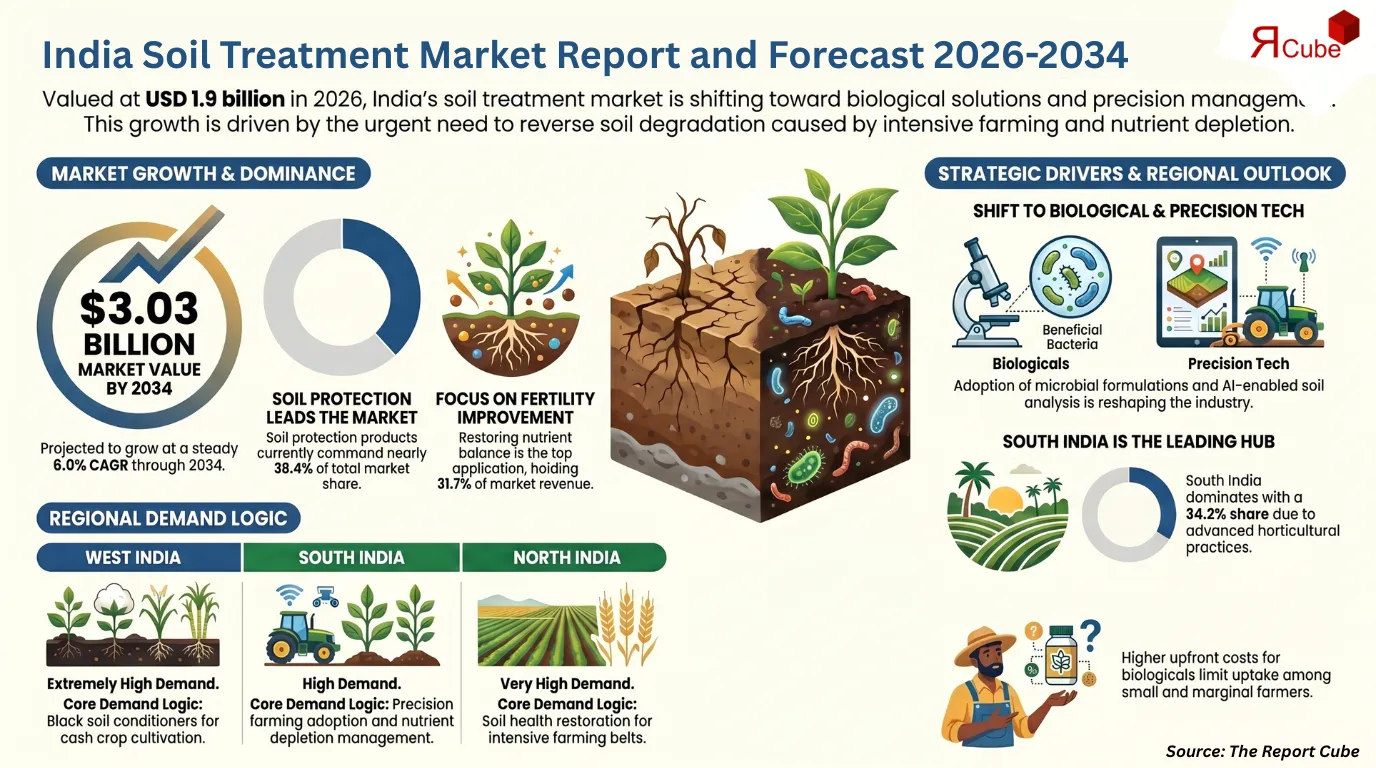
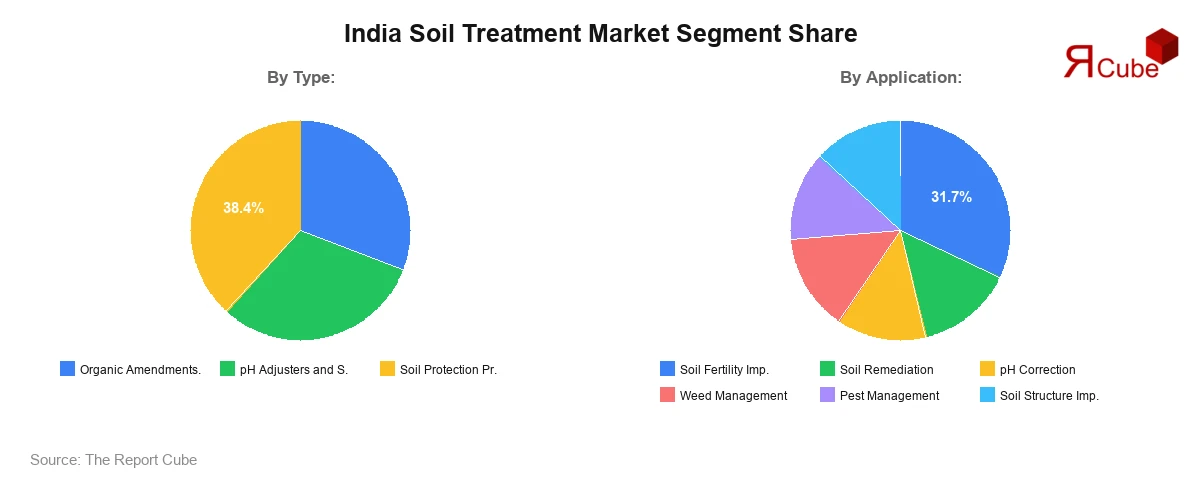
Soil Protection Products segment leads the market with nearly 38.4% share.
By Application:
Soil Fertility Improvement segment dominates the market with around 31.7% of revenue.
Regional Outlook:
South India dominates the India Soil Treatment Market with approximately 34.2% share.
India Soil Treatment Market Insights & Analysis
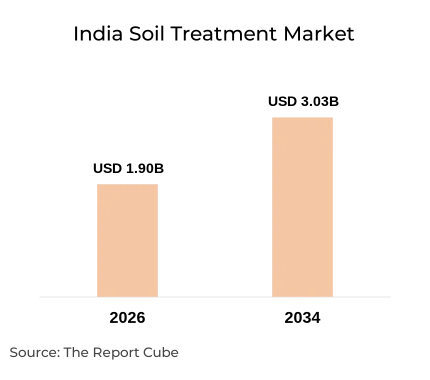
The India Soil Treatment Market is projected to grow steadily as agricultural stakeholders increasingly prioritize long-term soil productivity, nutrient balance, and sustainable crop output. Valued at USD 1.9 billion in 2026 and expected to reach USD 3.03 billion by 2034, the market is expanding at a CAGR of 6.0% during 2026-2034. Soil degradation remains a major agricultural concern across India due to continuous fertilizer-intensive cultivation, shrinking organic carbon levels, and micronutrient depletion in major farming belts. States with intensive crop cycles, including Punjab, Maharashtra, Karnataka, and Andhra Pradesh, are witnessing stronger adoption of soil conditioners, compost-based amendments, and biological treatment products to improve land fertility and water retention.
Indian agricultural input manufacturers are actively strengthening their soil health portfolios through biological formulations, microbial technologies, and precision nutrient management systems. The market is also benefiting from wider access to soil testing programs and digital agronomy support services. Farmers cultivating fruits, vegetables, oilseeds, and plantation crops are increasingly investing in targeted soil remediation and pH correction products to improve crop quality and productivity consistency. The rising focus on residue-free farming practices and regenerative agriculture methods is further supporting the demand for sustainable soil treatment solutions across commercial and small-scale farming operations.
India Soil Treatment Market Impact Analysis
| Factor | Type | Specific Impact on Market | Magnitude | Business Implication |
|---|---|---|---|---|
| Rising Food Demand & Yield Pressure | Market | Higher crop output targets drive use of conditioners and amendments | High | Expands demand for yield enhancing soil treatment solutions nationwide |
| Soil Degradation & Erosion Incidence | Environmental | Loss of fertility and structure increases need for restoration inputs | High | Creates recurring demand for remediation and conservation products |
| Government Schemes & Subsidy Support | Regulatory | Policies promoting soil health cards and balanced input usage | Medium | Supports adoption of certified treatment products in key states |
| Shift Toward Sustainable Farming | Consumer | Preference for residue free produce boosts organic soil solutions | Medium | Encourages portfolio expansion into bio based and organic inputs |
| Awareness and Knowledge Gaps | Market | Limited farmer training slows uptake of advanced soil technologies | Medium | Requires intensive extension, demos, and advisory led selling |
| Technological Advances in Inputs | Technological | New formulations improve nutrient availability and soil biology | Medium | Enables premium positioning and differentiation versus generics |
| Regional Variability in Soil Conditions | Environmental | Diverse pH and fertility profiles need localized treatment mixes | High | Drives region specific product design and segmented go to market |
India Soil Treatment Market Dynamics
Key Driver: Increasing Need to Restore Soil Fertility Across Intensive Farming Regions
India’s agricultural land is facing continuous nutrient stress due to repetitive cropping cycles and prolonged use of synthetic fertilizers. Soil fertility decline has become a critical issue in several high-production states where intensive farming has reduced microbial activity and weakened soil structure. As a result, farmers are increasingly adopting soil treatment products such as compost, gypsum, crop residue solutions, and biological amendments to improve nutrient availability and moisture retention. Rising awareness regarding balanced nutrient management is also supporting the use of customized soil enhancement programs across grain, horticulture, and commercial crop cultivation.
Agricultural cooperatives, agri-input companies, and local agronomy service providers are expanding farmer education initiatives focused on soil restoration practices. Demand for scientific soil treatment methods is particularly rising among growers seeking stable yields and reduced fertilizer dependency. Improved access to soil health diagnostics and farm-level advisory services is helping cultivators adopt data-driven nutrient application methods, contributing to stronger market penetration across rural agricultural regions.
Book your FREE 30-minute expert consultation today
Contact UsIndustry Trends: Growing Adoption of Biological Soil Treatment and Precision Farming Solutions
The India soil treatment industry is witnessing a noticeable shift toward environmentally sustainable treatment technologies and biological crop-support systems. Farmers are increasingly using microbial formulations, biofertilizers, organic carbon enhancers, and residue decomposition products to maintain long-term soil health. This transition is gaining momentum across horticulture, plantation crops, and export-oriented farming segments where soil quality directly impacts productivity and crop value.
Technology integration is also reshaping the industry landscape. Companies are deploying AI-enabled soil analysis tools, mobile-based agronomy platforms, and precision spraying systems to improve treatment efficiency. The growing use of agri-drones for field application and crop monitoring is supporting more accurate deployment of soil protection products and biological inputs. Agricultural technology partnerships and localized advisory services are strengthening farmer access to advanced soil management practices across southern and western India.
Major Challenge: Uneven Adoption Among Small and Marginal Farmers
The adoption of advanced soil treatment solutions remains limited in several rural areas due to affordability concerns and lack of technical understanding among smallholder farmers. Many cultivators continue to prioritize immediate crop protection requirements over long-term investments in soil restoration and fertility management. Specialized biological products and remediation technologies often involve higher upfront costs, creating barriers in price-sensitive agricultural communities.
Infrastructure gaps also continue to affect market growth in remote farming regions. Limited access to certified soil testing facilities and professional agronomy support reduces awareness regarding proper treatment selection and application methods. In addition, inconsistent product quality in unorganized distribution channels can weaken farmer confidence in advanced soil treatment programs. Seasonal income fluctuations and weather-related farming risks further influence purchasing decisions, particularly among rain-fed agricultural households.
Opportunity: Expansion of Sustainable Farming and Climate-Resilient Agriculture
India’s growing focus on sustainable agriculture is creating favorable opportunities for soil treatment manufacturers and agronomy service providers. Increasing awareness regarding regenerative farming practices is encouraging farmers to adopt organic amendments, biological soil enhancers, and residue recycling solutions to improve long-term land productivity. Export-oriented agriculture and premium crop cultivation are also increasing demand for residue-controlled and environmentally safer soil management products.
Government-backed natural farming initiatives and private-sector investments in precision agriculture are accelerating the development of advanced soil health solutions. Companies are expanding customized nutrient advisory platforms and digital farm management services to support region-specific treatment recommendations. Rising interest in carbon-smart farming practices and efficient water management systems is expected to strengthen future demand for biological soil treatment technologies and integrated soil fertility improvement programs across India.
India Soil Treatment Market Segment-wise Analysis
By Type:
- Organic Amendments
- Compost
- Crop Residue
- Animal Manure
- Sewage Sludge and Biosolids
- pH Adjusters and Soil Conditioners
- Gypsum
- Aglime
- Others
- Soil Protection Products
- Herbicides
- Insecticides
- Fungicides
- Nematicides
Soil Protection Products continue to hold a 38.4% share in the India soil treatment market due to the growing need to protect agricultural land from weed infestation, fungal diseases, and soil-borne pests. The segment benefits from increasing cultivation of high-value crops that require consistent soil health management and disease prevention strategies. Herbicides and fungicides are widely used across grain-producing and horticulture-intensive states to improve field productivity and minimize crop loss risks. Manufacturers are also introducing low-residue formulations and biologically integrated treatment solutions to align with sustainable farming practices.
Commercial growers are increasingly combining chemical and biological treatment methods to maintain balanced soil ecosystems while improving crop output. Rising pest resistance and changing climatic conditions are encouraging the adoption of integrated soil protection programs that support long-term agricultural productivity. Expanding agronomy support services and improved product availability through rural retail networks are further strengthening segment growth across major farming regions.
By Application:
- Soil Fertility Improvement
- Soil Remediation
- pH Correction
- Weed Management
- Pest Management
- Soil Structure Improvement
Soil Fertility Improvement remains the leading application segment as Indian farmers increasingly hold approximately 31.7% market share, focus on restoring nutrient balance and improving soil organic content. Continuous cultivation without adequate nutrient replenishment has intensified the demand for compost, micronutrient blends, crop residue management solutions, and biological soil amendments. Farmers growing fruits, vegetables, cereals, and commercial crops are actively investing in fertility-enhancing products to improve yield consistency and nutrient absorption efficiency.
The segment is also benefiting from wider awareness regarding soil microbial activity and moisture retention management. Agricultural advisory programs and digital soil testing services are helping farmers implement targeted nutrient correction strategies based on field-specific requirements. Increasing use of integrated nutrient management systems across intensive farming regions is expected to support long-term demand for soil fertility treatment solutions throughout the forecast period.
Regional Projection of India Soil Treatment Industry
- North India
- East India
- West India
- South India
- Central India
South India maintains a dominant position in the Indian soil treatment market with around 34.2% revenue share in 2026 due to strong adoption of advanced agricultural practices and high cultivation of horticulture and plantation crops. States including Karnataka, Tamil Nadu, Andhra Pradesh, and Telangana are witnessing growing use of biological soil treatments, pH correction products, and precision nutrient management solutions. The region’s diversified crop portfolio and increasing demand for export-quality agricultural produce continue to support market expansion.
Farmers across South India are increasingly adopting micro-irrigation systems, greenhouse farming, and protected cultivation techniques that require improved soil conditioning and nutrient optimization. Agricultural technology providers and input manufacturers have established stronger advisory and distribution networks in the region, improving accessibility to advanced soil treatment products. Rising investment in precision agriculture and sustainable farming infrastructure is expected to reinforce regional market leadership over the coming years.
Need insights for a specific region within this market?
Request Regional DataIndia Soil Treatment Industry Regional Analysis
The India soil treatment industry varies significantly across regions due to diverse soil types, climatic conditions, agricultural intensity, and degradation patterns.
| Region | Demand Level | Key Areas | Treatment Dominance | Core Demand Logic | Growth Nature |
|---|---|---|---|---|---|
| North India | Very High | Punjab, Haryana, UP | pH adjusters & bio-amendments | Intensive farming & soil salinity issues | Soil health restoration |
| East India | Medium | West Bengal, Bihar, Odisha | Organic amendments & drainage | Waterlogged paddy fields & acidity concerns | Organic farming growth |
| West India | Extremely High | Maharashtra, Gujarat | Black soil conditioners & nematicides | Black cotton soil & cash crop cultivation | Fastest-growing segment |
| South India | High | Tamil Nadu, Karnataka, AP | Nutrient supplements & laterite treatment | Weathered soils & nutrient depletion issues | Precision farming adoption |
| Central India | High | Madhya Pradesh, Chhattisgarh | Soil protection & pH adjusters | Black soil management & tribal farming support | Government-driven expansion |
Government Initiatives & Policies
- Soil Health Card Scheme Expansion 2025: The Government of India expanded digital soil health monitoring and micronutrient testing coverage to improve fertilizer efficiency and sustainable farming practices across major agricultural states.
- National Mission on Natural Farming 2026: India increased funding support for biological farming inputs, organic amendments, and residue-management programs to improve long-term soil fertility and climate-resilient agriculture systems.
India Soil Treatment Industry Recent Developments
- 2026: Coromandel International Limited launched the Gromor Gram initiative across 101 villages in 12 Indian states in March 2026. The initiative offers soil and leaf testing, crop advisory services, demonstration farms, and agri-drone spraying support to strengthen scientific soil fertility management practices among farmers.
- 2025: Rallis India Limited introduced NuCode as a science-led soil and plant health platform focused on biological agricultural solutions. The initiative strengthens the company’s sustainable farming portfolio and expands biological treatment offerings for Indian agricultural markets.
Why Choose This Report?
- Provides a comprehensive overview of the overall market analysis, encompassing key trends, consumer behavior analysis, and risk assessment to support strategic decision-making.
- Provides accurate, up-to-date insights into market size, segmentation, and emerging opportunities, helping to minimize risk & capitalizing on growth.
- Gives deep understanding of target audience preferences, investment habits, and communication channels for enhanced product development & marketing effectiveness.
- Delivers competitive analysis & benchmarking, uncovering the strengths & weaknesses of market competitors to guide strategies.
- Consolidate comprehensive market intelligence, reducing reasoning & streamlining research efforts.
- Facilitates customized market segmentation & risk mitigation strategies, fine-tuned to the business objectives.
- Aids in identifying both market challenges & untapped opportunities within the industry to drive long-term business growth.
- Provides valuable information based on actual customer data & search trends.
Table of Contents
- Introduction
- Objective of the Study
- Product and Category Definition
- Market Segmentation
- Study Variables
- Research Methodology
- Secondary Data Points
- Breakdown of Secondary Sources
- Primary Data Points
- Breakdown of Primary Interviews
- Secondary Data Points
- Executive Summary
- Market Dynamics
- Emerging Opportunities
- Adoption Trends
- Demand Drivers
- Disruption Analysis (Challenges)
- Industry Analysis and Strategic Insights
- Supply and Value Chain Analysis
- Pricing Analysis
- Go-to-Market Strategy
- BCG Matrix
- Recent Trends and Developments
- Regulatory and Policy Landscape
- Region-wise Policies
- Government Initiatives
- India Soil Treatment Market Overview and Forecast Analysis (2021-2034)
- Market Size, By Value, By Growth Rate (CAGR/USD Billion)
- Market Share, By Type
- Organic Amendments
- Compost
- Crop Residue
- Animal Manure
- Sewage Sludge and Biosolids
- pH Adjusters and Soil Conditioners
- Gypsum
- Aglime
- Others
- Soil Protection Products
- Herbicides
- Insecticides
- Fungicides
- Nematicides
- Organic Amendments
- Market Share, By Technology
- Physicochemical Treatment
- Biological Treatment
- Thermal Treatment
- Market Share, By Application
- Soil Fertility Improvement
- Soil Remediation
- pH Correction
- Weed Management
- Pest Management
- Soil Structure Improvement
- Market Share, By Crop Type
- Grains and Cereals
- Fruits and Vegetables
- Pulses and Oilseeds
- Commercial Crops
- Turf and Ornamentals
- Market Share, By Region
- North
- East
- West
- South
- Central
- Market Share, By Company
- Revenue Shares and Analysis
- Competitive Landscape
- North India Soil Treatment Market Overview and Forecast Analysis (2021-2034)
- Market Size, By Value, By Growth Rate (CAGR/USD Billion/Million)
- Market Share, By Type
- Market Share, By Technology
- Market Share, By Application
- Market Share, By Crop Type
- East India Soil Treatment Market Overview and Forecast Analysis (2021-2034)
- Market Size, By Value, By Growth Rate (CAGR/USD Billion/Million)
- Market Share, By Type
- Market Share, By Technology
- Market Share, By Application
- Market Share, By Crop Type
- West India Soil Treatment Market Overview and Forecast Analysis (2021-2034)
- Market Size, By Value, By Growth Rate (CAGR/USD Billion/Million)
- Market Share, By Type
- Market Share, By Technology
- Market Share, By Application
- Market Share, By Crop Type
- South India Soil Treatment Market Overview and Forecast Analysis (2021-2034)
- Market Size, By Value, By Growth Rate (CAGR/USD Billion/Million)
- Market Share, By Type
- Market Share, By Technology
- Market Share, By Application
- Market Share, By Crop Type
- Central India Soil Treatment Market Overview and Forecast Analysis (2021-2034)
- Market Size, By Value, By Growth Rate (CAGR/USD Billion/Million)
- Market Share, By Type
- Market Share, By Technology
- Market Share, By Application
- Market Share, By Crop Type
- Competitive Analysis, 2026
- Market Share of Key Players
- Competitive Mapping for Each Segment and Companies Operating Regionally
- North India Soil Treatment Companies Share and Competitive Analysis, 2026
- East India Soil Treatment Companies Share and Competitive Analysis, 2026
- West India Soil Treatment Companies Share and Competitive Analysis, 2026
- South India Soil Treatment Companies Share and Competitive Analysis, 2026
- Central India Soil Treatment Companies Share and Competitive Analysis, 2026
- Company Profile (Partial List)
- Godrej Agrovet Limited
- Company Overview
- Product Portfolio
- Strategic Alliances/Partnerships
- Recent Developments
- Crystal Crop Protection Limited
- Company Overview
- Product Portfolio
- Strategic Alliances/Partnerships
- Recent Developments
- UPL Limited
- Company Overview
- Product Portfolio
- Strategic Alliances/Partnerships
- Recent Developments
- BASF India Limited
- Company Overview
- Product Portfolio
- Strategic Alliances/Partnerships
- Recent Developments
- Dhanuka Agritech Limited
- Company Overview
- Product Portfolio
- Strategic Alliances/Partnerships
- Recent Developments
- Rallis India Limited
- Company Overview
- Product Portfolio
- Strategic Alliances/Partnerships
- Recent Developments
- Bayer CropScience Limited
- Company Overview
- Product Portfolio
- Strategic Alliances/Partnerships
- Recent Developments
- Coromandel International Limited
- Company Overview
- Product Portfolio
- Strategic Alliances/Partnerships
- Recent Developments
- Syngenta India Private Limited
- Company Overview
- Product Portfolio
- Strategic Alliances/Partnerships
- Recent Developments
- Sumitomo Chemical India Limited
- Company Overview
- Product Portfolio
- Strategic Alliances/Partnerships
- Recent Developments
- Others (Partial List)
- Godrej Agrovet Limited
- Contact Us and Disclaimer
Top Key Players & Market Share Outlook
- Godrej Agrovet Limited
- Crystal Crop Protection Limited
- UPL Limited
- BASF India Limited
- Dhanuka Agritech Limited
- Rallis India Limited
- Bayer CropScience Limited
- Coromandel International Limited
- Syngenta India Private Limited
- Sumitomo Chemical India Limited
- Others
Frequently Asked Questions