



Build Your Custom Market Intelligence Report
Customize Your ReportGlobal Sovereign Cloud Market Size, Share, Growth & Forecast 2026-2034
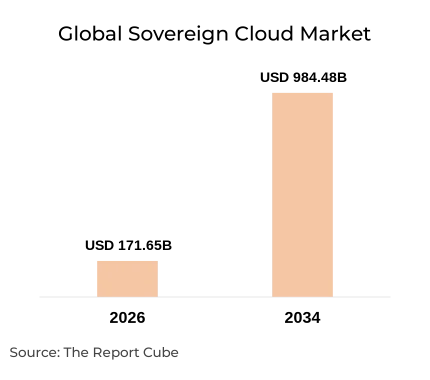
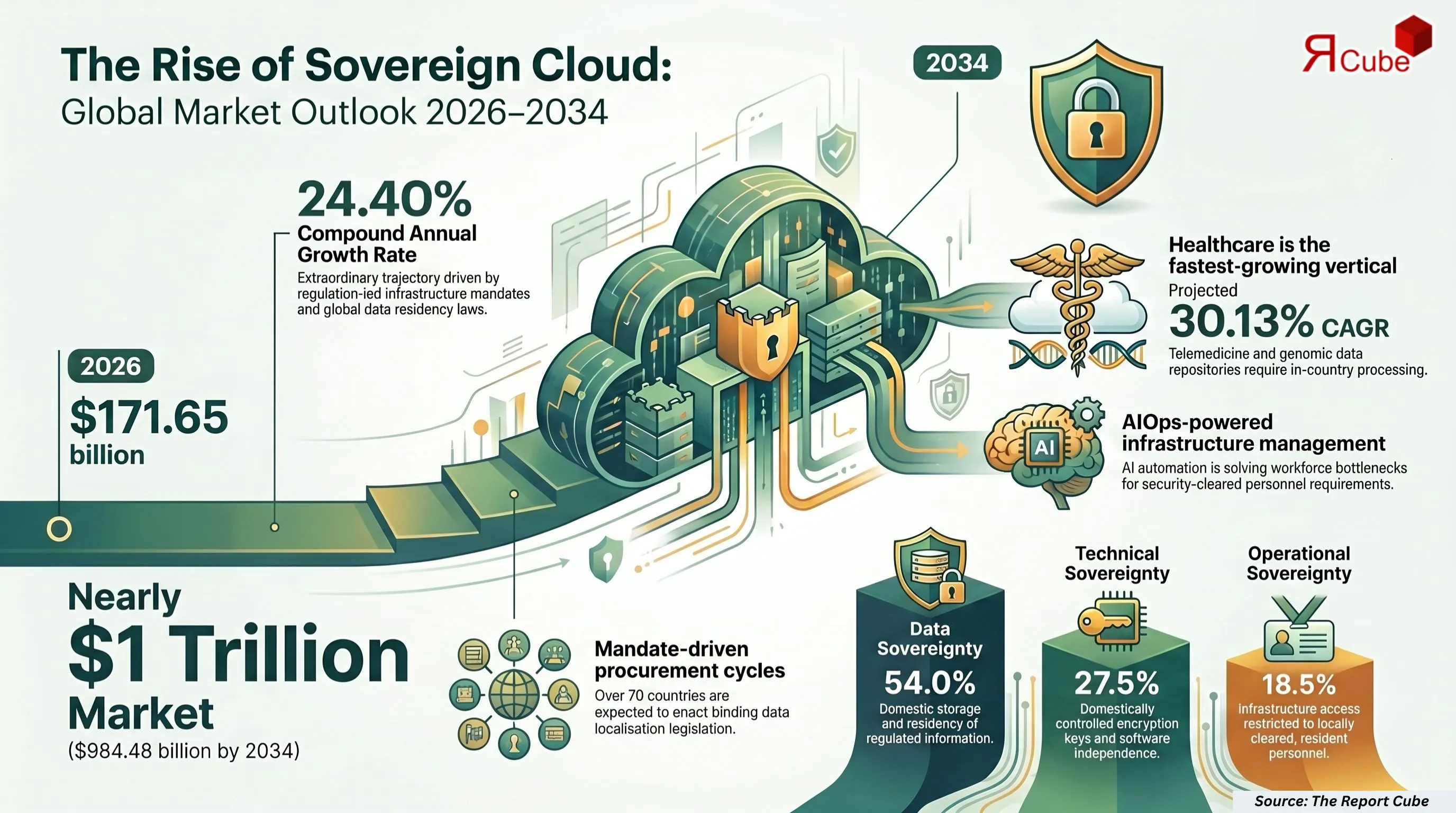
The Global Sovereign Cloud Market is undergoing one of the most structurally significant expansions in the history of cloud computing. Valued at USD 171.65 billion in 2026, the market is on course to reach USD 984.48 billion by 2034, advancing at a compound annual growth rate (CAGR) of 24.40% over the forecast period. This extraordinary trajectory reflects a fundamental shift in how governments, regulated enterprises, and critical infrastructure operators approach data governance, from treating cloud as a technology preference to embedding it within national security frameworks.
Unlike conventional cloud adoption cycles driven by efficiency and scalability, sovereign cloud procurement is increasingly mandate-driven. National laws on data residency, jurisdiction-specific compliance regimes, and geopolitical urgency are converting sovereign cloud from a niche capability to a baseline infrastructure requirement. Regulatory instruments such as the EU's GDPR and NIS2 directive, the US FedRAMP and CMMC frameworks, and emerging data localization laws across Asia and the Middle East are collectively compelling organizations to adopt cloud architectures where data remains under national legal authority, processed by personnel with verified local residency, and encrypted using domestically controlled keys.
Key Takeaways
- Market valued at USD 171.65 billion in 2026, reaching USD 984.48 billion by 2034.
- Strong 24.40% CAGR driven by regulation-led sovereign infrastructure mandates globally.
- Data Sovereignty leads functionality segment, commanding approximately 54% market share.
- Government & Defense dominates end users, holding around 33% share in 2026.
- Healthcare is fastest-growing vertical, projected at 30.13% CAGR through 2034.
- North America leads regionally, accounting for approximately 40–44% market share.
- AWS, Microsoft Azure, IBM, and OVHcloud are key sovereign cloud market leaders.
- AIOps adoption is transforming sovereign cloud management amid workforce shortages.
Global Sovereign Cloud Market: Overview
Sovereign cloud refers to cloud computing infrastructure engineered to guarantee that data is stored, processed, and governed within a specific national or regional jurisdiction. Unlike standard public cloud deployments, sovereign cloud environments are structured to prevent extraterritorial access, particularly from foreign governments, and to ensure that cloud operations comply with host-country laws at every layer, from physical data center location to administrator identity to encryption key custody.
The market encompasses three primary capability pillars: data sovereignty (ensuring data residency within national jurisdictions), technical sovereignty (enabling control over the technology stack including software, hardware, and cryptographic mechanisms), and operational sovereignty (guaranteeing that human access to infrastructure is restricted to locally cleared personnel). As regulatory requirements mature and enterprises seek more granular compliance assurances, the interplay between these three pillars is shaping the design architecture of sovereign cloud platforms globally.
A structural inflection point is the shift of sovereign cloud from a public-sector-only concern to a cross-industry imperative. BFSI regulators now mandate domestic hosting of transaction data, healthcare authorities require in-country processing of patient records, and telecom regulators enforce national-security oversight of metadata. This regulatory spillover is broadening the addressable market well beyond government agencies and into the world's largest regulated industries.
Global Sovereign Cloud Market Dynamics
Key Market Driver: Escalating Data Residency Mandates Compelling Sovereign Infrastructure Investment
The primary catalyst for Global Sovereign Cloud Market growth is the rapid codification of data sovereignty requirements into binding national law. According to Gartner, global sovereign cloud spend is projected to increase 35.6% in 2026 to approximately USD 80 billion as geopolitical tensions drive organizations to retain jurisdictional control over data assets. Over 70 countries are expected to have enacted data localization legislation, with approximately 60% of global enterprises compelled to store data within national borders to avoid regulatory penalties reaching USD 20 million or more.
The European Union leads this trend through an interlocking architecture of regulations. GDPR established the foundational principle of personal data remaining under EU legal authority; NIS2 extended cybersecurity obligations to critical infrastructure operators; and the EU Data Act, effective September 2025, mandates interoperability and switching rights for cloud customers. Simultaneously, the US continues enforcing FedRAMP and CMMC requirements for federal contractors. In Asia, India, Japan, South Korea, Singapore, and Australia have each introduced data residency provisions that structurally disqualify standard hyperscaler deployments for sensitive public data. Sovereign cloud market trends These intersecting frameworks are creating a globally distributed demand for jurisdiction-specific cloud infrastructure that conventional global public clouds cannot satisfy without dedicated sovereign partitions.
Major Industry Challenge: Sovereign Infrastructure Requires Premium Capital Expenditure and Specialized Talent
The primary constraint on Global Sovereign Cloud Market adoption velocity is the substantial cost differential between sovereign and standard cloud deployments. Establishing sovereign cloud infrastructure demands purpose-built data centers within national borders, specialized security protocols such as air-gapped deployments and hardware security modules, and ongoing compliance verification by locally cleared personnel. AWS's European Sovereign Cloud, launched generally available on January 15, 2026 in Brandenburg, Germany, carries a pricing premium of approximately 15% compared to commercial EU regions, with a reduced service catalog of around 90 services versus 240+ available in standard commercial deployments. The Delos Cloud for the German public sector, operated as an SAP subsidiary running Azure, carries a 10–20% cost premium. For small and medium enterprises and entities in developing markets, these cost structures create adoption barriers, moderating the pace of market penetration among lower-budget segments.
Need Specific Data, Let’s Customize the Report for You
Request CustomizationEmerging Trend: AIOps and AI-Powered Automation Reshaping Sovereign Infrastructure Management
AIOps is emerging as a structural trend within the Global Sovereign Cloud Market as governments scale complex cloud infrastructure while facing shortages of security-cleared personnel and rising audit obligations. Sovereign cloud operators face a unique staffing constraint: every administrator must meet residency and background-clearance requirements, creating workforce bottlenecks that AI-powered management tools can partially offset. The US Cybersecurity and Infrastructure Security Agency published an AI Roadmap explicitly encouraging AI adoption across federal infrastructure for monitoring, incident response, and resilience, an institutional signal that AIOps will become embedded in sovereign cloud governance rather than remaining an optional enhancement. Amazon Web Services explicitly positioned Zero Trust, operational autonomy, and AI-controlled access as design principles of its European Sovereign Cloud, establishing a new operational benchmark for the industry.
Global Sovereign Cloud Market Segmentation Analysis
By Functionality
|
Sub-Segment |
Market Share (%) |
Key Driver |
Competitive Intensity |
|---|---|---|---|
|
Data Sovereignty |
54.0% |
National data residency laws mandating domestic storage of regulated information |
High |
|
Technical Sovereignty |
27.5% |
Growing demand for domestically controlled encryption keys and open-source stack independence |
Medium |
|
Operational Sovereignty |
18.5% |
Government procurement requiring locally cleared, nationally resident cloud administrators |
Medium |
Data Sovereignty commands the dominant position within the functionality segmentation because it represents the legally enforceable foundation upon which all other sovereignty layers depend. Governments are no longer treating data location as a secondary consideration, because if regulated data is stored outside national borders, jurisdiction is immediately lost regardless of the technical or operational controls applied. This legal primacy makes data sovereignty the entry-point commitment for nearly every sovereign cloud procurement.
Technical Sovereignty is the fastest-growing sub-segment, expanding as organizations move beyond data location compliance to demand stack-level independence, specifically the ability to use domestically controlled encryption keys, audit-accessible software, and hardware supply chains free from foreign dependency risk. The European Commission's Cloud and AI Development Act, expected in the first half of 2026, is projected to accelerate technical sovereignty investment by codifying stack-independence criteria for highest-assurance cloud certification. Operational Sovereignty, while currently the smallest pillar, is gaining urgency as incidents such as Microsoft's July 2025 appearance before the French Senate, where the company could not confirm it would never hand over EU data to US authorities, exposed the limits of purely technical and contractual sovereignty assurances. This episode is shifting procurement criteria toward requiring operationally sovereign architectures where foreign-government compelled access is structurally impossible, not merely contractually prohibited.
By End Users
|
Sub-Segment |
Market Share (%) |
Key Driver |
Competitive Intensity |
|---|---|---|---|
|
Government & Defense |
33.0% |
Sovereign cloud mandated for classified workloads and national digital infrastructure |
High |
|
BFSI |
22.5% |
Basel Committee resilience standards and GDPR compelling domestic transaction data hosting |
High |
|
Healthcare |
14.0% |
National PHI laws and rising telemedicine requiring in-country patient data processing |
High |
|
Telecommunications |
12.0% |
Regulatory requirements for metadata under national-security jurisdiction |
Medium |
|
Energy & Utilities |
9.5% |
Critical infrastructure protection mandates requiring air-gapped sovereign environments |
Medium |
|
Manufacturing |
6.0% |
Industry 4.0 data generated in sovereign environments per EU Digital Decade Programme |
Low |
|
Others |
3.0% |
Emerging demand from media, education, and public-service adjacent sectors |
Low |
Government & Defense commands the largest end-user share at approximately 33%, because sovereign cloud is not merely a preference for public sector entities, it is a procurement prerequisite. The structural demand driver is the irreversible codification of sovereign cloud into government IT standards, from Germany's Digital Strategy 2025 allocating EUR 3.0 billion for domestic cloud infrastructure to the European Commission's USD 209 million sovereign cloud services procurement tender for EU institutions.
Healthcare is positioned as the fastest-growing end-user vertical, projected to expand at a CAGR of 30.13% through 2034, as national health services confront the simultaneous expansion of telemedicine platforms, AI-powered diagnostics, and genetic data repositories, all classified as sensitive personal health information requiring in-country processing under applicable law. The Indian government's June 2025 initiative integrating 51 cooperative banks into a sovereign cloud-based core banking platform illustrates how healthcare and BFSI sovereign cloud requirements are cascading simultaneously into emerging economies, creating compounding demand well beyond the traditional European and North American markets.
Regional Projection of Global Sovereign Cloud Market
- North America: Holds the largest regional share at approximately 40-44% in 2026, driven by FedRAMP, CMMC, and escalating federal investment in secure cloud infrastructure. The US market is reinforced by the presence of all major global hyperscalers maintaining domestic sovereign partitions, while Canada's Quebec IBM Cloud Multizone Region announcement (April 2024) reflects growing provincial-level sovereign cloud requirements.
- Europe: The most heavily regulated region, accounting for approximately 23% of global market share in 2025, led by Germany (USD 13.21 billion in 2026) and France (USD 9.13 billion). The EU Data Act, GDPR, and NIS2 create layered compliance obligations that make sovereign cloud a regulatory necessity rather than a strategic option.
- Asia Pacific: The fastest-growing region with a CAGR of approximately 24.7%, driven by data sovereignty legislation in India, Japan, South Korea, Singapore, and Australia. AWS's USD 5 billion investment to establish an Asia Pacific region in Taiwan, announced June 2025, reflects hyperscaler recognition of the region's structural demand.
- Rest of World: Expected to reach USD 11.36 billion in 2026, propelled by smart city and e-governance programs across the Middle East, Africa, and Latin America, with Gartner projecting Middle East and Africa as among the highest-growth sovereign cloud geographies in 2026.
Global Sovereign Cloud Market: Recent Development (2025-2026)
- AWS European Sovereign Cloud Launch (January 2026): Amazon Web Services made the European Sovereign Cloud (ESC) generally available on January 15, 2026, with its first region in Brandenburg, Germany. The ESC operates as a structurally isolated partition under German law with EU-resident-only administration, independent IAM and DNS, and achieved BSI C5 and SOC 2 certifications within its first months. The 15% pricing premium and ~90-service catalog at launch represent the cost of genuine operational sovereignty versus contractual assurances.
- IBM Sovereign Core Platform (February 2026): IBM launched Sovereign Core, a purpose-built platform enabling customers to deploy and manage cloud and AI workloads entirely under their own organizational authority, addressing the operational sovereignty gap identified across public and private sector clients seeking administrator-level independence from foreign-jurisdiction compelled access.
- SAP Sovereign Cloud Expansion (September 2025): SAP SE expanded its sovereign cloud portfolio with local infrastructure, on-site cloud, and AI services for European customers requiring strict regulatory compliance, building on the Delos Cloud joint venture and the March 2025 Canadian sovereign cloud capabilities launch. SAP's sovereign cloud revenues from public sector contracts contributed to its full-year 2025 cloud revenue growth of approximately 27% year-on-year.
- OVHcloud Infrastructure Scale-Up (2025): OVHcloud expanded EU-based sovereign data-center capacity across Germany and Italy, backed by a EUR 500 million infrastructure investment, reinforcing its position as Europe's leading independent sovereign cloud provider and targeting government and critical infrastructure workloads that require non-US-CLOUD-Act-exposed infrastructure.
Global Sovereign Cloud Market Future Outlook (2034)
The Global Sovereign Cloud Market is set to reach USD 984.48 billion by 2034, advancing at a CAGR of 24.40% through the forecast period. The long-term growth narrative is anchored in three intersecting forces. First, regulatory expansion will continue to broaden the addressable market as more jurisdictions codify data residency requirements, over 70 countries are anticipated to have enacted data localization legislation before the decade closes. data-sovereignty-regulations-trend Second, AI integration will transform sovereign cloud from a compliance-focused infrastructure layer to an AI-capable platform, as governments require that AI models trained on sovereign data remain under national jurisdiction with domestically controlled training infrastructure.
Third, the expansion of sovereign cloud beyond government and BFSI into healthcare, energy, manufacturing, and telecommunications will create diversified demand streams that reduce concentration risk and sustain market expansion well into the next decade. The European market for sovereign cloud services is projected to grow from approximately EUR 20 billion today to over EUR 100 billion by 2031, while Asia Pacific's CAGR trajectory is expected to position the region as the second-largest sovereign cloud geography globally by 2034.
Global Sovereign Cloud Market Report Coverage
|
Report Features |
Details |
|---|---|
|
Market Size (2026) |
USD 171.65 Billion |
|
Market Size (2034) |
USD 984.48 Billion |
|
CAGR (2026-2034) |
24.40% |
|
Base Year |
2026 |
|
Forecast Period |
2026-2034 |
|
Historical Data |
2021-2025 |
|
Segments Covered |
By Functionality, By Enterprise Size, By End Users, By Deployment |
|
Regions Covered |
North America, Europe, Asia Pacific, Rest of World |
|
Key Players |
Alibaba Cloud, AWS, Clever Cloud, Cloudian, GCP, IBM, Microsoft Azure, OCI, OVHcloud, SAP SE, Tencent Cloud, T-Systems, and Others |
|
Customization |
Available |
|
Delivery Formats |
PDF, PPT & Excel |
Why Choose This Report?
- Provides a comprehensive overview of the overall market analysis, encompassing key trends, consumer behavior analysis, and risk assessment to support strategic decision-making.
- Provides accurate, up-to-date insights into market size, segmentation, and emerging opportunities, helping to minimize risk & capitalizing on growth.
- Gives deep understanding of target audience preferences, investment habits, and communication channels for enhanced product development & marketing effectiveness.
- Delivers competitive analysis & benchmarking, uncovering the strengths & weaknesses of market competitors to guide strategies.
- Consolidate comprehensive market intelligence, reducing reasoning & streamlining research efforts.
- Facilitates customized market segmentation & risk mitigation strategies, fine-tuned to the business objectives.
- Aids in identifying both market challenges & untapped opportunities within the industry to drive long-term business growth.
- Provides valuable information based on actual customer data & search trends.
Table of Contents
- Introduction
- Objective of the study
- Product Definition
- Market Segmentation
- Study Variables
- Research Methodology
- Secondary Data Points
- Companies Interviewed
- Primary Data Points
- Breakdown of Primary Interviews
- Secondary Data Points
- Executive Summary
- Market Dynamics
- Drivers
- Challenges
- Opportunity Assessment
- Recent Trends and Developments
- Policy and Regulatory Landscape
- Global Sovereign Cloud Market Overview and Forecast Analysis (2021-2034)
- Market Size, By Value, By growth rate (CAGR/USD Billions)
- Demand - Supply Trends
- Market Share, By Deployment
- Cloud
- On-Premise
- Market Share, By Functionality
- Data Sovereignty
- Technical Sovereignty
- Operational Sovereignty
- Market Share, By Enterprise Size
- Large Enterprises
- Small and Medium Enterprises
- Market Share, By End Users
- Government & Defense
- Healthcare
- BFSI
- Telecommunications
- Energy & Utilities
- Manufacturing
- Others
- Market Share, By Region
- North America
- Europe
- Asia Pacific
- Rest of World
- Market Share, By Company
- Revenue Shares
- Competition Characteristics
- North America Sovereign Cloud Market Overview (2021-2034)
- Market Size, By Value (in USD Billions)
- Market Share, By Deployment
- Market Share, By Functionality
- Market Share, By Enterprise Size
- Market Share, By End Users
- By Country
- The US
- Canada
- Mexico
- The US Sovereign Cloud Market Overview (2021-2034)
- Market Share, By Deployment
- Market Share, By Functionality
- Market Share, By Enterprise Size
- Market Share, By End Users
- Canada Sovereign Cloud Market Overview (2021-2034)
- Market Share, By Deployment
- Market Share, By Functionality
- Market Share, By Enterprise Size
- Market Share, By End Users
- Mexico Sovereign Cloud Market Overview (2021-2034)
- Market Share, By Deployment
- Market Share, By Functionality
- Market Share, By Enterprise Size
- Market Share, By End Users
- South America Sovereign Cloud Market Overview (2021-2034)
- Market Size, By Value (in USD Billions)
- Market Share, By Deployment
- Market Share, By Functionality
- Market Share, By Enterprise Size
- Market Share, By End Users
- By Country
- Brazil
- Argentina
- Rest of South America
- Brazil Sovereign Cloud Market Overview (2021-2034)
- Market Share, By Deployment
- Market Share, By Functionality
- Market Share, By Enterprise Size
- Market Share, By End Users
- Argentina Sovereign Cloud Market Overview (2021-2034)
- Market Share, By Deployment
- Market Share, By Functionality
- Market Share, By Enterprise Size
- Market Share, By End Users
- Europe Sovereign Cloud Market Overview (2021-2034)
- Market Size, By Value (in USD Billions)
- By Deployment
- By Functionality
- By Enterprise Size
- By End Users
- By Country
- Germany
- The UK
- France
- Spain
- Italy
- Rest of Europe
- Germany Sovereign Cloud Market Overview (2021-2034)
- Market Share, By Deployment
- Market Share, By Functionality
- Market Share, By Enterprise Size
- Market Share, By End Users
- France Sovereign Cloud Market Overview (2021-2034)
- Market Share, By Deployment
- Market Share, By Functionality
- Market Share, By Enterprise Size
- Market Share, By End Users
- The UK Sovereign Cloud Market Overview (2021-2034)
- Market Share, By Deployment
- Market Share, By Functionality
- Market Share, By Enterprise Size
- Market Share, By End Users
- Spain Sovereign Cloud Market Overview (2021-2034)
- Market Share, By Deployment
- Market Share, By Functionality
- Market Share, By Enterprise Size
- Market Share, By End Users
- Italy Sovereign Cloud Market Overview (2021-2034)
- Market Share, By Deployment
- Market Share, By Functionality
- Market Share, By Enterprise Size
- Market Share, By End Users
- The Middle East & Africa Sovereign Cloud Market Overview (2021-2034)
- Market Size, By Value (in USD Billions)
- By Deployment
- By Functionality
- By Enterprise Size
- By End Users
- By Country
- The UAE
- Saudi Arabia
- South Africa
- Rest of the Middle East & Africa
- The UAE Sovereign Cloud Market Overview (2021-2034)
- Market Share, By Deployment
- Market Share, By Functionality
- Market Share, By Enterprise Size
- Market Share, By End Users
- Saudi Arabia Sovereign Cloud Market Overview (2021-2034)
- Market Share, By Deployment
- Market Share, By Functionality
- Market Share, By Enterprise Size
- Market Share, By End Users
- South Africa Sovereign Cloud Market Overview (2021-2034)
- Market Share, By Deployment
- Market Share, By Functionality
- Market Share, By Enterprise Size
- Market Share, By End Users
- Asia-Pacific Sovereign Cloud Market Overview (2021-2034)
- Market Size, By Value (in USD Billions)
- By Deployment
- By Functionality
- By Enterprise Size
- By End Users
- By Country
- China
- India
- Japan
- South Korea
- Australia
- Rest of Asia-Pacific
- China Sovereign Cloud Market Overview (2021-2034)
- Market Share, By Deployment
- Market Share, By Functionality
- Market Share, By Enterprise Size
- Market Share, By End Users
- India Sovereign Cloud Market Overview (2021-2034)
- Market Share, By Deployment
- Market Share, By Functionality
- Market Share, By Enterprise Size
- Market Share, By End Users
- Japan Sovereign Cloud Market Overview (2021-2034)
- Market Share, By Deployment
- Market Share, By Functionality
- Market Share, By Enterprise Size
- Market Share, By End Users
- South Korea Sovereign Cloud Market Overview (2021-2034)
- Market Share, By Deployment
- Market Share, By Functionality
- Market Share, By Enterprise Size
- Market Share, By End Users
- Austraila Sovereign Cloud Market Overview (2021-2034)
- Market Share, By Deployment
- Market Share, By Functionality
- Market Share, By Enterprise Size
- Market Share, By End Users
- Competitive Outlook (Company Profile - Partial List)
- Alibaba Cloud
- Company Overview
- Business Segments
- Strategic Alliances/Partnerships
- Recent Developments
- Amazon Web Services (AWS)
- Company Overview
- Business Segments
- Strategic Alliances/Partnerships
- Recent Developments
- Clever Cloud
- Company Overview
- Business Segments
- Strategic Alliances/Partnerships
- Recent Developments
- Cloudian
- Company Overview
- Business Segments
- Strategic Alliances/Partnerships
- Recent Developments
- Google Cloud Platform (GCP)
- Company Overview
- Business Segments
- Strategic Alliances/Partnerships
- Recent Developments
- IBM Corporation
- Company Overview
- Business Segments
- Strategic Alliances/Partnerships
- Recent Developments
- Microsoft Azure
- Company Overview
- Business Segments
- Strategic Alliances/Partnerships
- Recent Developments
- Oracle Cloud Infrastructure (OCI)
- Company Overview
- Business Segments
- Strategic Alliances/Partnerships
- Recent Developments
- OVHcloud
- Company Overview
- Business Segments
- Strategic Alliances/Partnerships
- Recent Developments
- SAP SE
- Company Overview
- Business Segments
- Strategic Alliances/Partnerships
- Recent Developments
- Tencent Cloud
- Company Overview
- Business Segments
- Strategic Alliances/Partnerships
- Recent Developments
- T-Systems
- Company Overview
- Business Segments
- Strategic Alliances/Partnerships
- Recent Developments
- Others
- Alibaba Cloud
- Disclaimer
Top Key Players & Market Share Outlook
- Alibaba Cloud
- Amazon Web Services (AWS)
- Clever Cloud
- Cloudian
- Google Cloud Platform (GCP)
- IBM Corporation
- Microsoft Azure
- Oracle Cloud Infrastructure (OCI)
- OVHcloud
- SAP SE
- Tencent Cloud
- T-Systems
- Others
Frequently Asked Questions






