




Build Your Custom Market Intelligence Report
Customize Your ReportU.S. Super Fruit Juices Market Key Takeaways
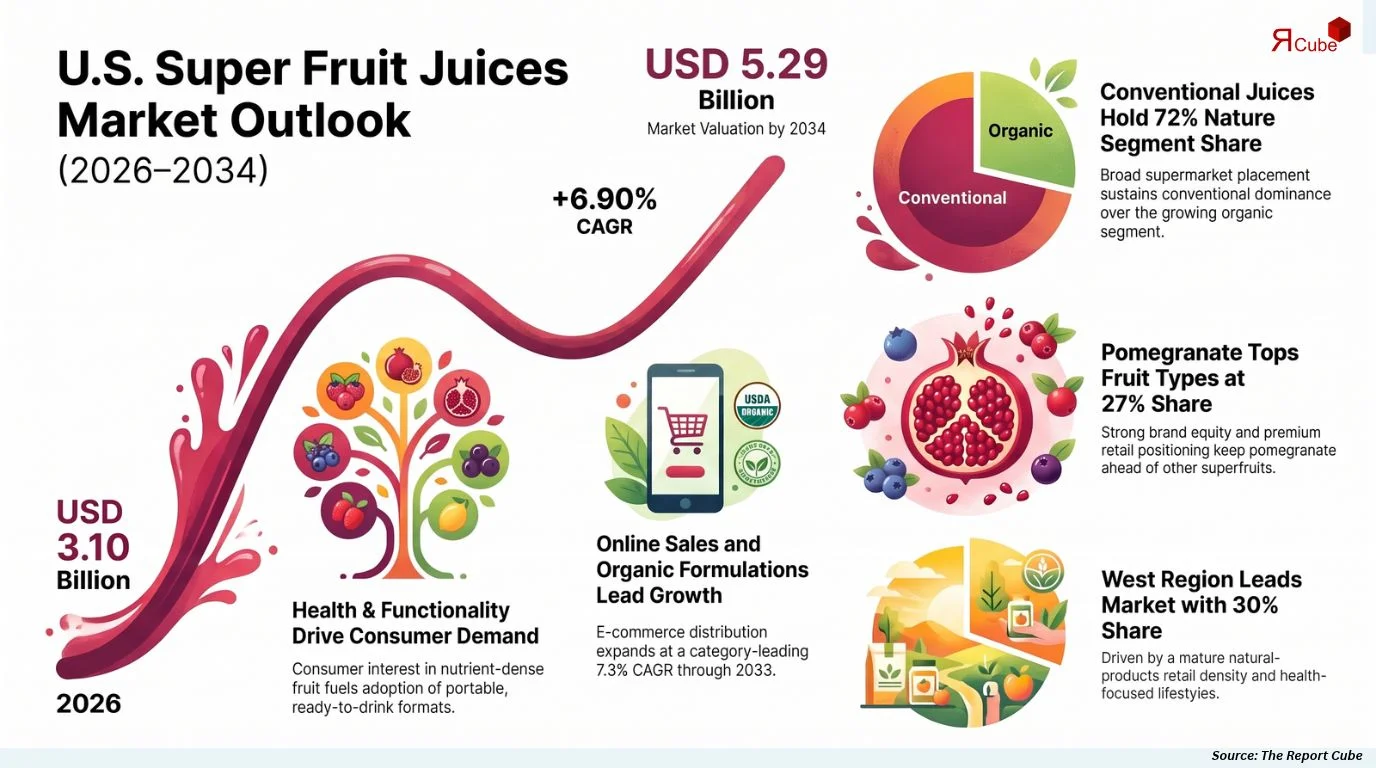
- U.S. market valued at USD 3.10 billion in 2026.
- Market projected to reach USD 5.29 billion by 2034.
- Industry expands at a 6.90% CAGR through 2034.
- Conventional juices hold 72% share, leading the nature segment.
- West leads regionally with 30% share across the country.
- Online distribution is the fastest-growing channel at 7.3% CAGR.
- Key players include POM Wonderful, Ocean Spray, Suja, and Sambazon.
- Clean-label, reduced-sugar formulations are reshaping product development priorities.
U.S. Super Fruit Juices Market Insights & Analysis
The U.S. Super Fruit Juices Market is anticipated to register a 6.90% CAGR during 2026–2034. The market size was valued at USD 3.10 billion in 2026 and is projected to reach USD 5.29 billion by 2034. Demand is anchored in consumer interest in nutrient-dense fruit. USDA Economic Research Service data links fruit to dietary fiber, potassium, and calcium, which supports interest in fruit-based beverages. Manufacturers are responding with açaí, pomegranate, and blueberry formulations positioned around functional nutrition across refrigerated and shelf-stable lines.
Industry investment is concentrating on scale and distribution. In June 2024, Generous Brands, the former Bolthouse Farms beverage business, began producing Sambazon juices at its 500,000-square-foot Bakersfield facility, expanding access across North American supermarkets. Ocean Spray, a cooperative of roughly 700 farm families, continues extending its juice portfolio. Federal dietary guidance adds a counterweight. The Dietary Guidelines for Americans advise that at least half of fruit intake come from whole fruit, encouraging brands to emphasize ingredient transparency and moderate sugar levels through clearer labeling.
U.S. Super Fruit Juices Market Dynamics
Demand in the U.S. super fruit juices market is shaped by a tension between nutritional appeal and shifting beverage habits. Consumers continue to seek antioxidant-rich fruits such as açaí, pomegranate, and blueberry, while brands recalibrate sugar levels, organic credentials, and package formats. Retail expansion across supermarkets, specialty health stores, and online platforms is widening access. Together, these forces are steering manufacturers toward premium, functional, and transparently labeled products.
|
Factor |
Type |
Specific Impact on Market |
Magnitude |
|---|---|---|---|
|
Interest in nutrient-rich fruit |
Driver |
Supports demand for fruit-based, functional beverages |
High |
|
Growth of online distribution |
Opportunity |
Channel projected at 7.3% CAGR during 2026–2033, expanding discovery and subscriptions |
High |
|
Organic and clean-label shift |
Trend |
Organic segment forecast at 6.9% CAGR during 2026–2033 |
Very High |
|
Declining per-capita juice intake |
Challenge |
Intake fell 50% between 2003–2004 and 2017–2018, limiting category volume |
High |
|
Sugar and whole-fruit guidance |
Challenge |
Dietary guidance steers consumers toward whole fruit, pressuring juice positioning |
Medium |
Key Market Driver: Nutrient-Rich Fruit Drives Consumer Demand
Consumer interest in nutrient-rich fruit continues to underpin category demand. USDA Economic Research Service identifies fruit as a source of dietary fiber, potassium, and calcium, reinforcing the perception of fruit-based beverages as a convenient route to nutrition. Convenience amplifies this effect, as ready-to-drink bottles, single-serve formats, and blended superfruit recipes fit time-pressed routines. Grand View Research also identifies functional beverage demand as a commercial factor, favoring portable formats. Brands combining açaí, pomegranate, and blueberry with clear nutritional positioning are therefore gaining shelf visibility across supermarkets, specialty stores, and digital storefronts.
Major Industry Challenge: Declining Per-Capita Juice Consumption Trend
Per-capita fruit-juice intake among Americans aged two and older fell 50%, from 0.46 cup-equivalents daily in 2003–2004 to 0.23 in 2017–2018, according to USDA Economic Research Service. The data covers fruit juice generally rather than super fruit juices specifically, yet it signals a structurally smaller consumption base. Sugar perception compounds the pressure, since Dietary Guidelines for Americans recommend that at least half of fruit intake come from whole fruit. Brands must therefore manage sugar content, serving sizes, and health claims carefully, while justifying premium positioning through measurable nutritional differentiation.
Emerging Trend Shaping Outlook: Organic Clean-Label Reformulation Gains Momentum
Grand View Research identifies organic, natural, clean-label, and reduced-sugar super fruit juices as rising commercial priorities, and projects the organic segment as the fastest-growing nature category at a 6.9% CAGR during 2026–2033. Reformulation is already visible: Sambazon introduced an açaí superfruit juice with 50% less sugar, while Ocean Spray expanded its zero-sugar line. Shorter ingredient lists, certified organic sourcing, and transparent labeling help brands address sugar scrutiny while preserving the nutrient-rich positioning that defines super fruit juices among health-conscious households.
Need Specific Data, Let’s Customize the Report for You
Request CustomizationU.S. Super Fruit Juices Market Segment-wise Analysis
Product choices in the U.S. super fruit juices market vary by sourcing method, fruit profile, and purchase channel. Brands are balancing mainstream conventional volume with organic growth, while expanding exotic fruit blends and digital sales. The segments below show where revenue concentrates today and which categories are positioned to outpace the broader market.
By Nature
- Conventional
- Organic
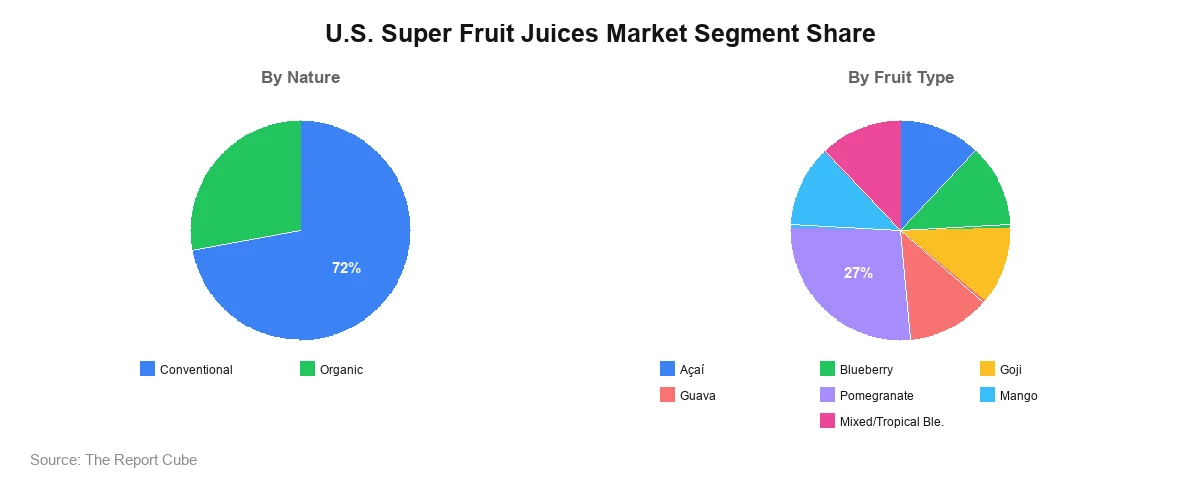
Conventional super fruit juices dominate the nature segment with an estimated 72% market share in 2026. Broad supermarket availability, established refrigerated and shelf-stable supply chains, and familiar flavor profiles keep conventional products at the center of household purchasing. Large brands such as Ocean Spray, Naked Juice, and Bolthouse Farms rely on this base to introduce blended superfruit lines that reach mainstream shoppers. Revenue contribution remains concentrated in multi-serve bottles sold through grocery retail, where promotional visibility supports repeat purchase, especially during seasonal wellness campaigns.
Organic super fruit juices account for the remaining 28% and are expected to be the fastest-growing nature category, with Grand View Research projecting a 6.9% CAGR during 2026–2033. Adoption is driven by demand for certified, clean-label, and reduced-sugar products, particularly among health-focused households. Sambazon, which supplies certified organic and Fair Trade açaí through a vertically integrated supply chain, illustrates how organic beverage certification and clean-label sourcing can support premium positioning. Specialty retailers and online platforms are expected to widen organic availability across the country throughout the forecast period.
By Fruit Type
- Açaí
- Blueberry
- Goji
- Guava
- Pomegranate
- Mango
- Mixed/Tropical Blends
Pomegranate leads the fruit type segment with an estimated 27% market share in 2026. Its position reflects strong pomegranate juice demand and antioxidant positioning, a long-established premium presence, and recognizable brand equity led by POM Wonderful. Pomegranate juice also performs well in both straight and blended formats, giving manufacturers flexibility across pricing tiers and flavor pairings. Retail visibility in refrigerated produce sections continues to reinforce trial and repeat purchase among health-conscious shoppers, which sustains its revenue contribution relative to other fruit types.
Açaí, blueberry, goji, guava, mango, and mixed or tropical blends share the remaining demand. Açaí is gaining visibility through Sambazon, whose Original Açaí, Dragon Fruit, and Energy Açaí juices are produced and distributed by Generous Brands. Mixed and tropical blends are expected to grow quickly because they soften tartness, lower perceived sugar intensity, and introduce exotic fruits to mainstream consumers. Blueberry and guava benefit from antioxidant and vitamin C positioning, while goji remains a niche, specialty-store product. Adoption is driven by flavor innovation and functional claims.
Country Insights of U.S. Super Fruit Juices Market
Consumption patterns in the United States differ by climate, retail density, and health awareness. The West leads revenue, supported by a mature natural-products retail ecosystem, while other regions show distinct preferences for value, convenience, and familiar flavors. Regional expansion strategies increasingly combine grocery distribution with online delivery to widen reach.
|
Region |
Estimated Market Share |
Key Growth Factors |
Consumer Trends |
|---|---|---|---|
|
West |
30% |
Natural-products retail strength, health-focused lifestyles, açaí and pomegranate availability |
Preference for organic, cold-pressed, and functional blends |
|
Southwest |
24% |
Warm climate, hydration demand, expanding specialty retail |
Rising interest in tropical, mango, and guava blends |
|
North |
26% |
Dense grocery networks, seasonal wellness demand |
Growing preference for reduced-sugar, immunity-oriented juices |
|
Midwest |
20% |
Broad supermarket coverage, family household purchasing |
Steady conventional demand with rising online orders |
- West: The West leads with an estimated 30% share in 2026, supported by natural-products retailers, health-focused consumers, and strong demand for açaí, pomegranate, and organic cold-pressed juices.
- Southwest: Warm climate and hydration-focused consumption favor tropical, mango, and guava blends, while growing specialty retail and convenience formats improve access to premium superfruit juices.
- North: Dense grocery networks and seasonal wellness purchasing support steady demand, with shoppers increasingly choosing reduced-sugar, immunity-oriented blends sold through supermarkets and online delivery platforms.
- Midwest: Broad supermarket coverage and family-oriented purchasing sustain demand for conventional blends, while online ordering and subscriptions are gradually extending access to organic and specialty superfruit products.
U.S. Super Fruit Juices Market: Recent Development (2025)
- Ocean Spray launched Zero Sugar Tropical Punch nationwide, its first tropical flavor in the line.
- Ocean Spray and Dyla Brands expanded drink mix sticks into Publix, Giant, Schnucks, and Walmart.com.
- Naked Juice launched Naked Antioxidants Mighty Berry, positioned as an excellent source of immune-supporting antioxidants.
- Sambazon reformulated its flagship Açaí Superfruit Juice with 50% less sugar and 29% fewer calories.
U.S. Super Fruit Juices Market Future Outlook (2034)
The U.S. Super Fruit Juices Market is projected to expand at a 6.90% CAGR, reaching approximately USD 5.29 billion by 2034. Growth will be supported by organic reformulation, online subscriptions, and portable single-serve formats that fit modern routines. Opportunities are strongest in reduced-sugar açaí, pomegranate, and blueberry blends, where transparent labeling can offset the long-term decline in general fruit-juice intake. Brands that pair certified sourcing with clear nutritional positioning are well placed to win shelf space and repeat purchases throughout the forecast period.
Technology will reshape how super fruit juices are developed, sold, and distributed. AI-driven demand forecasting can improve refrigerated inventory planning for perishable products, while machine-learning tools help brands analyze flavor preferences and personalize online recommendations. Advances in cold-pressed juice processing, gentle pasteurization, and traceable sourcing platforms will strengthen quality and organic credibility. As direct-to-consumer channels mature and regional distribution widens, the market is expected to evolve from niche wellness positioning into a broader, more diversified beverage category, supported by premium and functional innovation.
U.S. Super Fruit Juices Market Report Coverage
|
Report Attribute |
Details |
|---|---|
|
Market Name |
U.S. Super Fruit Juices Market |
|
Market Size (2026) |
USD 3.10 Billion |
|
Market Size (2034) |
USD 5.29 Billion |
|
Forecast Period |
2026–2034 |
|
CAGR |
6.90% |
|
Base Year |
2026 |
|
Historical Years |
2021–2025 |
|
Forecast Years |
2026–2034 |
|
Segments Covered |
By Nature, By Fruit Type, By Distribution Channel |
|
Regions Covered |
West, Southwest, North, Midwest |
|
Key Companies |
POM Wonderful LLC, Dynamic Health, Acai Roots, Ocean Spray, Suja Life LLC., Bolthouse Farms Inc., Naked Juice Co., Twisted Alchemy, Sambazon Inc., Lakewood Juice Co. |
|
Report Format |
PDF, Excel, PPT |
|
Customization |
Available as per client requirements |
Why Choose This Report?
- Comprehensive analysis of U.S. super fruit juice demand drivers.
- Reliable market sizing with transparent forecasts through 2034.
- Detailed segmentation by nature, fruit type, and distribution channel.
- Regional insights across West, Southwest, North, and Midwest.
- Competitive profiling of leading juice brands and emerging challengers.
- Evidence drawn from USDA data and verified industry sources.
- Actionable insights on organic, clean-label, and online growth.
- Strategic guidance supporting investment, product, and channel planning.
Table of Contents
- Introduction
- Objective of the Study
- Product Definition
- Market Segmentation
- Study Variables
- Research Methodology
- Secondary Data Points
- Companies Interviewed
- Primary Data Points
- Breakdown of Primary Interviews
- Secondary Data Points
- Executive Summary
- Market Dynamics
- Drivers
- Challenges
- Opportunity Assessment
- Recent Trends and Developments
- Policy and Regulatory Landscape
- U.S. Super Fruit Juices Market Overview and Forecast Analysis (2021-2034)
- Market Size, By Value, By Growth Rate (CAGR/USD Billions)
- Demand – Supply Trends
- Market Share, By Nature
- Conventional
- Organic
- Market Share, By Fruit Type
- Açaí
- Blueberry
- Goji
- Guava
- Pomegranate
- Mango
- Mixed/Tropical blends
- Market Share, By Distribution Channel
- Supermarkets & hypermarkets
- Convenience stores
- Specialty/health stores
- Online
- Market Share, By Region
- West
- Southwest
- North
- Midwest
- Market Share, By Competitors
- Competition Characteristics
- Revenue Shares
- Conventional U.S. Super Fruit Juices Market Overview, 2021-2034F
- By Value (USD Million)
- By Fruit Type – Market Size & Forecast 2021-2034, USD Million
- Açaí
- Blueberry
- Goji
- Guava
- Pomegranate
- Mango
- Mixed/Tropical blends
- Organic U.S. Super Fruit Juices Market Overview, 2021-2034F
- By Value (USD Million)
- By Fruit Type – Market Size & Forecast 2021-2034, USD Million
- Açaí
- Blueberry
- Goji
- Guava
- Pomegranate
- Mango
- Mixed/Tropical blends
- Competitive Outlook (Company Profile – Partial List)
- POM Wonderful LLC
- Company Overview
- Business Segments
- Strategic Alliances/Partnerships
- Recent Developments
- Dynamic Health
- Company Overview
- Business Segments
- Strategic Alliances/Partnerships
- Recent Developments
- Acai Roots
- Company Overview
- Business Segments
- Strategic Alliances/Partnerships
- Recent Developments
- Ocean Spray
- Company Overview
- Business Segments
- Strategic Alliances/Partnerships
- Recent Developments
- Suja Life LLC.
- Company Overview
- Business Segments
- Strategic Alliances/Partnerships
- Recent Developments
- Bolthouse Farms Inc.
- Company Overview
- Business Segments
- Strategic Alliances/Partnerships
- Recent Developments
- Naked Juice Co.
- Company Overview
- Business Segments
- Strategic Alliances/Partnerships
- Recent Developments
- Twisted Alchemy
- Company Overview
- Business Segments
- Strategic Alliances/Partnerships
- Recent Developments
- Sambazon Inc.
- Company Overview
- Business Segments
- Strategic Alliances/Partnerships
- Recent Developments
- Lakewood Juice Co.
- Company Overview
- Business Segments
- Strategic Alliances/Partnerships
- Recent Developments
- POM Wonderful LLC
- Contact Us & Disclaimer
Top Key Players & Market Share Outlook
- POM Wonderful LLC
- Dynamic Health
- Acai Roots
- Ocean Spray
- Suja Life LLC.
- Bolthouse Farms Inc.
- Naked Juice Co.
- Twisted Alchemy
- Sambazon Inc.
- Lakewood Juice Co.
Frequently Asked Questions