



Build Your Custom Market Intelligence Report
Customize Your ReportJapan Telemedicine Market Key Highlights
By Type:
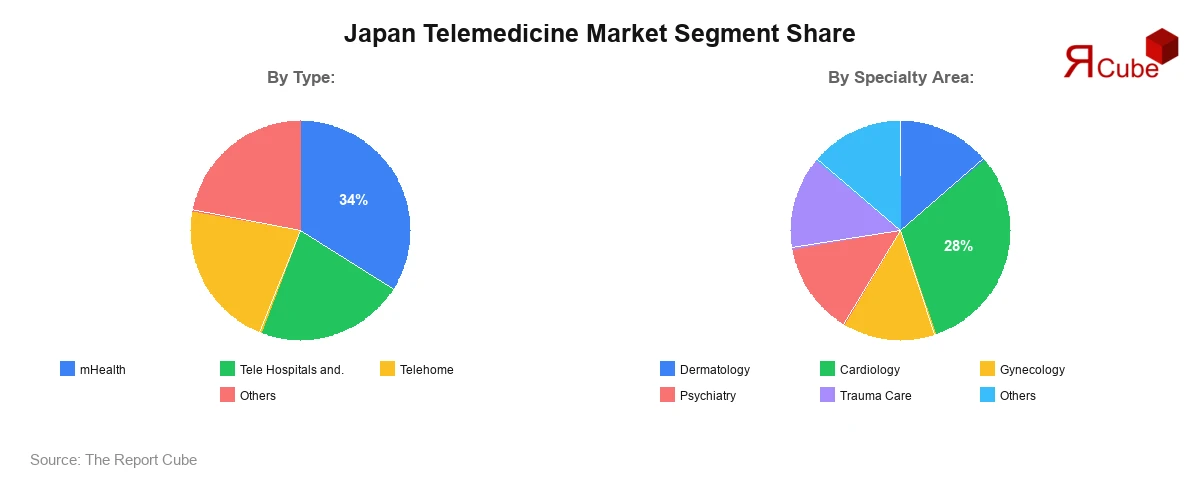
mHealth segment leads the market with nearly 34% share.
By Specialty Area:
Cardiology segment dominates the market with around 28% of revenue.
Regional Outlook:
Honshu region dominates the Japan Telemedicine market with approximately 52% share.
Japan Telemedicine Market Insights & Analysis
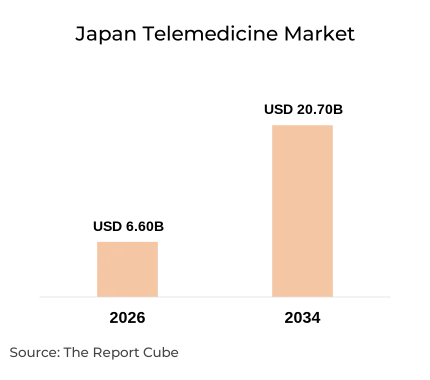
The Japan Telemedicine Market is anticipated to register a CAGR of around 17.8% during the forecast period 2026-2034. The market size is valued at USD 6.6 billion in 2026 and is projected to reach USD 20.7 billion by 2034. The rapid expansion of Japan telemedicine market size is strongly supported by the country’s aging population, where over 29% of citizens are aged above 65 as of 2025. This demographic shift has increased demand for remote healthcare services, especially for chronic disease management and post-acute care monitoring. In addition, Japan’s high internet penetration rate of over 93% and smartphone adoption exceeding 85% are accelerating mHealth adoption, directly influencing Japan telemedicine market growth.
Investment trends across Japan indicate a steady push toward digital healthcare transformation. Government-backed digital health frameworks and private sector innovation are encouraging teleconsultation adoption across hospitals and clinics. Companies are actively investing in AI-powered diagnostics and remote monitoring platforms, which enhance clinical outcomes while reducing hospital burden. Furthermore, Japan’s healthcare system is increasingly integrating telemedicine with electronic health records and insurance reimbursement models. This integration supports long-term sustainability and strengthens Japan telemedicine market revenue streams. The convergence of advanced technology with healthcare delivery is expected to define future Japan telemedicine market trends.
Japan Telemedicine Market Dynamics
Key Driver: Rising Aging Population and Chronic Disease Burden
Japan’s demographic profile is one of the strongest drivers of telemedicine adoption. With a rapidly aging population, healthcare systems are under continuous pressure to provide accessible and efficient care. More than 36 million individuals in Japan are aged 65 and above, leading to a rise in chronic conditions such as cardiovascular diseases and diabetes. Telemedicine solutions allow continuous monitoring and timely interventions without requiring frequent hospital visits, which improves patient outcomes and reduces healthcare costs.
Additionally, remote care solutions are becoming essential for rural and semi-urban areas where healthcare facilities are limited. Teleconsultation platforms and home-based monitoring systems enable patients to receive specialized care without geographic barriers. This shift toward decentralized healthcare delivery significantly contributes to Japan telemedicine market growth and enhances service accessibility across the country.
Book your FREE 30-minute expert consultation today
Contact UsIndustry Trends: Integration of AI and Digital Health Platforms
The Japan telemedicine market is witnessing strong momentum in AI-based healthcare solutions. Advanced technologies such as predictive analytics, AI diagnostics, and machine learning algorithms are being integrated into telemedicine platforms. These tools help healthcare providers detect diseases earlier and provide personalized treatment plans. For instance, AI-enabled imaging systems are improving diagnostic accuracy in cardiology and dermatology.
Another key trend is the expansion of integrated digital ecosystems that combine teleconsultation, electronic health records, and patient engagement tools. Companies are building unified platforms that streamline healthcare workflows and improve patient experience. This digital transformation is shaping new Japan telemedicine market trends, making healthcare more data-driven and efficient.
Major Challenge: Regulatory and Data Privacy Concerns
Data security and regulatory compliance remain significant challenges in the Japan telemedicine market. Handling sensitive patient data requires strict adherence to privacy regulations, and any breach can impact patient trust. Japan has implemented stringent healthcare data protection laws, which sometimes slow down innovation and platform deployment.
Moreover, interoperability between different healthcare systems is still evolving. Many healthcare providers operate on legacy systems, making integration with modern telemedicine platforms complex and costly. These barriers can limit scalability and slow the overall Japan telemedicine market growth, especially for smaller healthcare providers.
Opportunity: Expansion of Home-Based Care and Remote Monitoring
The growing demand for home-based healthcare presents a strong opportunity for market expansion. Remote patient monitoring devices and telehome platforms are gaining popularity among elderly patients who prefer receiving care at home. These solutions reduce hospital admissions and improve quality of life, creating long-term value for healthcare providers.
In addition, increasing awareness about preventive healthcare is encouraging the use of wellness and fitness apps. Integration of wearable devices with telemedicine platforms allows continuous health tracking, enabling early diagnosis and intervention. This shift toward preventive and personalized care is expected to drive Japan telemedicine market revenue and unlock new growth avenues.
Japan Telemedicine Market Segment-wise Analysis
By Type:
- mHealth
- Tele Hospitals and Clinics
- Telehome
- Others
The mHealth segment holds the leading position in the Japan telemedicine market share, accounting for approximately 34% in 2026. This dominance is driven by the widespread adoption of smartphones and mobile health applications across the country. Remote patient monitoring apps and chronic disease management platforms are widely used to track health conditions in real time. These apps enable continuous communication between patients and healthcare providers, improving treatment adherence and outcomes.
Furthermore, wellness and fitness apps are gaining traction among younger demographics, contributing to overall Japan telemedicine market growth. The integration of AI-based features in mobile apps enhances user experience and provides personalized health insights. As digital literacy continues to rise, mHealth is expected to remain a key contributor to market expansion.
By Specialty Area:
- Dermatology
- Cardiology
- Gynecology
- Psychiatry
- Trauma Care
- Others
Cardiology dominates the specialty segment, capturing nearly 28% of the Japan telemedicine market revenue. The high prevalence of cardiovascular diseases in Japan has increased the demand for remote cardiac monitoring and teleconsultation services. Advanced wearable devices and AI-driven diagnostic tools allow continuous monitoring of heart conditions, enabling early detection of abnormalities.
In addition, telecardiology services are widely adopted in hospitals and clinics to manage patient load efficiently. Remote consultations reduce hospital visits while ensuring timely medical intervention. This segment is expected to maintain its leadership due to ongoing technological advancements and increasing awareness about heart health.
Regional Projection of Japan Telemedicine Industry
- Hokkaido
- Honshu
- Shikoku
- Kyushu
Honshu holds the largest share in the Japan telemedicine market, accounting for approximately 52% of total revenue. This dominance is attributed to the presence of major metropolitan areas such as Tokyo and Osaka, where healthcare infrastructure and digital adoption are highly advanced. The region benefits from strong internet connectivity, a high concentration of hospitals, and early adoption of telemedicine technologies.
Moreover, government initiatives and private investments are heavily focused on urban centers within Honshu, further boosting market growth. The increasing use of teleconsultation services in large hospitals and clinics supports efficient healthcare delivery. As digital health ecosystems continue to expand, Honshu is expected to remain the leading contributor to Japan telemedicine market trends.
Government Initiatives & Policies
- Japan Digital Transformation Healthcare Policy 2025: Promotes nationwide telemedicine adoption through digital infrastructure upgrades and reimbursement reforms.
- Online Medical Consultation Expansion Program 2026: Expands teleconsultation coverage under national insurance, encouraging remote care adoption across rural and urban regions.
Japan Telemedicine Industry Recent Developments
- 2025: MEDLEY, INC strengthened its CLINICS telemedicine platform, enabling seamless online consultations, digital prescriptions, and remote care continuity, reinforcing its leadership in Japan’s telemedicine ecosystem.
- 2025: M3, Inc expanded its physician network platform to integrate AI-assisted teleconsultation and chronic care services, connecting nearly 90% of Japan’s doctors for digital healthcare delivery.
Need insights for a specific region within this market?
Request Regional DataWhy Choose This Report?
- Provides a comprehensive overview of the overall market analysis, encompassing key trends, consumer behavior analysis, and risk assessment to support strategic decision-making.
- Provides accurate, up-to-date insights into market size, segmentation, and emerging opportunities, helping to minimize risk & capitalizing on growth.
- Gives deep understanding of target audience preferences, investment habits, and communication channels for enhanced product development & marketing effectiveness.
- Delivers competitive analysis & benchmarking, uncovering the strengths & weaknesses of market competitors to guide strategies.
- Consolidate comprehensive market intelligence, reducing reasoning & streamlining research efforts.
- Facilitates customized market segmentation & risk mitigation strategies, fine-tuned to the business objectives.
- Aids in identifying both market challenges & untapped opportunities within the industry to drive long-term business growth.
- Provides valuable information based on actual customer data & search trends.
Table of Contents
- Introduction
- Objective of the Study
- Product and Category Definition
- Market Segmentation
- Study Variables
- Research Methodology
- Secondary Data Points
- Breakdown of Secondary Sources
- Primary Data Points
- Breakdown of Primary Interviews
- Secondary Data Points
- Executive Summary
- Market Dynamics
- Drivers
- Challenges
- Opportunity Assessment
- Recent Trends and Developments
- Regulatory and Policy Landscape
- Japan Telemedicine Market Overview (2021-2034)
- Market Size, By Value (USD Billion)
- Market Share, By Type
- mHealth
- Remote Patient Monitoring Apps
- Chronic Disease Management Apps
- Wellness and Fitness Apps
- Medication Adherence Apps
- Tele Hospitals and Clinics
- Tele-ICU
- Tele-Consultation
- Tele-Radiology
- Tele-Pathology
- Telehome
- Home-Based Remote Monitoring
- Home Nursing Support Platforms
- Post-Acute Care Monitoring
- Others
- Store-and-Forward Telemedicine
- Telepharmacy
- Virtual Health Kiosks
- mHealth
- Market Share, By Specialty Area
- Dermatology
- Cardiology
- Gynecology
- Psychiatry
- Trauma Care
- Others
- Market Share, By End User
- Hospitals
- Clinics
- Others
- Market Share, By Solution
- Software
- Telemedicine Platforms
- Electronic Health Record Integration Software
- Diagnostic and AI-Based Decision Support Software
- Patient Engagement and Scheduling Software
- Services
- Teleconsultation Services
- Installation and Integration Services
- Training and Support Services
- Managed Telehealth Services
- Devices and Hardware
- Connected Monitoring Devices
- Telemedicine Carts and Stations
- Imaging and Diagnostic Devices
- Software
- Market Share, By Region
- Hokkaido
- Honshu
- Shikoku
- Kyushu
- Market Share, By Company
- Revenue Shares and Analysis
- Competitive Landscape
- Hokkaido Telemedicine Market
- Market Size, By Value (USD Billion/Million)
- Market Share, By Type
- Market Share, By Specialty Area
- Market Share, By End User
- Market Share, By Solution
- Honshu Telemedicine Market
- Market Size, By Value (USD Billion/Million)
- Market Share, By Type
- Market Share, By Specialty Area
- Market Share, By End User
- Market Share, By Solution
- Shikoku Telemedicine Market
- Market Size, By Value (USD Billion/Million)
- Market Share, By Type
- Market Share, By Specialty Area
- Market Share, By End User
- Market Share, By Solution
- Kyushu Telemedicine Market
- Market Size, By Value (USD Billion/Million)
- Market Share, By Type
- Market Share, By Specialty Area
- Market Share, By End User
- Market Share, By Solution
- Competitive Outlook and Company Profiles
- Terumo Corporation
- Company Overview
- Product Portfolio
- Strategic Alliances/Partnerships
- Recent Developments
- Nihon Kohden Corporation
- Company Overview
- Product Portfolio
- Strategic Alliances/Partnerships
- Recent Developments
- NTT Data Inc
- Company Overview
- Product Portfolio
- Strategic Alliances/Partnerships
- Recent Developments
- Sony Corporation
- Company Overview
- Product Portfolio
- Strategic Alliances/Partnerships
- Recent Developments
- MEDLEY, INC
- Company Overview
- Product Portfolio
- Strategic Alliances/Partnerships
- Recent Developments
- M3, Inc
- Company Overview
- Product Portfolio
- Strategic Alliances/Partnerships
- Recent Developments
- Medmain
- Company Overview
- Product Portfolio
- Strategic Alliances/Partnerships
- Recent Developments
- PK Telehealth
- Company Overview
- Product Portfolio
- Strategic Alliances/Partnerships
- Recent Developments
- Others
- Terumo Corporation
- Contact Us and Disclaimer
Top Key Players & Market Share Outlook
- Terumo Corporation
- Nihon Kohden Corporation
- NTT Data Inc
- Sony Corporation
- MEDLEY, INC
- M3, Inc
- Medmain
- PK Telehealth
Frequently Asked Questions






