



Build Your Custom Market Intelligence Report
Customize Your ReportSaudi Arabia Textile Manufacturing Market Insights & Analysis
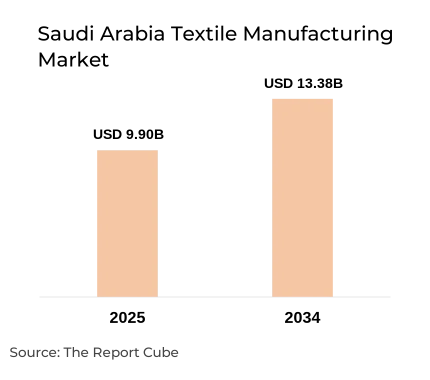
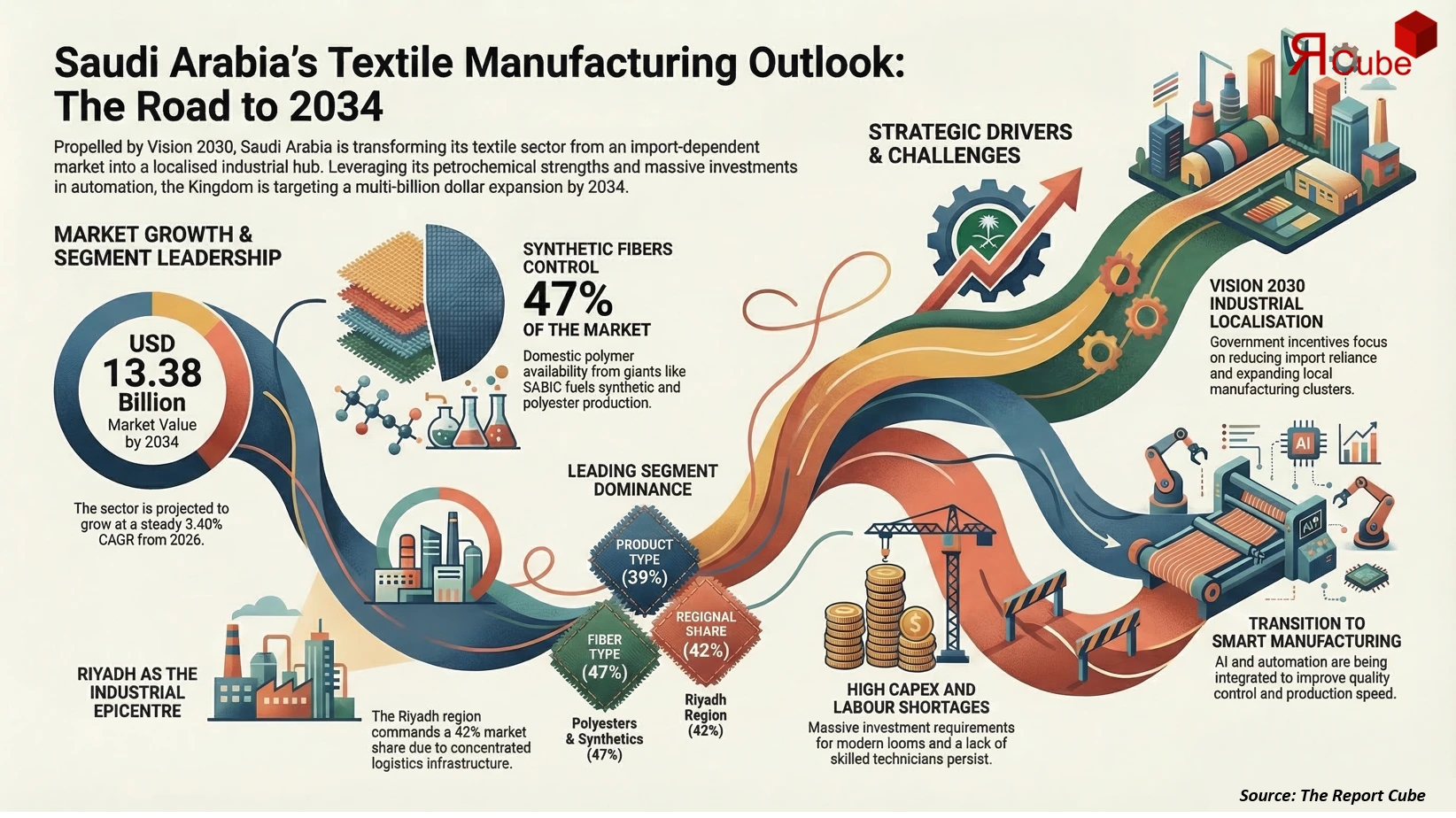
The Saudi Arabia Textile Manufacturing Market is projected to grow at a 3.40% CAGR during 2026-2034. The market stood at USD 9.9 billion in 2025 and is expected to reach USD 13.38 billion by 2034. Growth is supported by national industrial diversification strategies under Vision 2030, rising domestic demand for apparel and home textiles, and significant investments in modern textile machinery and polymer-based fiber production. State-backed logistics initiatives and competitive energy pricing continue to help manufacturers scale operations and develop advanced production capabilities. Increasing participation from local and international players across spinning, weaving, knitting, and non-woven processing is reinforcing Saudi Arabia’s position as a growing textile hub within the GCC.
Technological modernization, including automation in spinning and weaving, digital warp preparation, advanced dyeing systems, and integration of smart quality-control platforms, is reshaping operational efficiency and product consistency. The strong presence of polymer producers such as SABIC supports downstream availability of synthetic fibers and specialty materials essential for technical textiles. Demand for Saudi-made textiles is further stimulated by rapid expansion in real estate, hospitality, healthcare, and automotive sectors—all increasing consumption of uniforms, upholstery, industrial fabrics, and non-woven hygiene materials. As the Kingdom strengthens efforts to localize textile value chains and reduce reliance on imports, the sector is positioned for sustained long-term relevance.
Saudi Arabia Textile Manufacturing Market Recent Developments
- 2025: Several manufacturers advanced automation in spinning and non-woven production lines, targeting higher export compliance and reduced production waste.
- 2025: New investments in technical textile machinery were announced to support filtration, geotextiles, and medical textile product categories.
Government Initiatives & Policies
- Saudi Vision 2030 Industrial Diversification Programs: Targeted incentives for industrial clusters, logistics zones, and textile manufacturing modernization across Riyadh and the Eastern Province.
- Local Manufacturing & Export Promotion (Ministry of Industry & Mineral Resources): Policies encouraging local content, machinery upgrades, and export-linked certifications for globally competitive textile output.
Saudi Arabia Textile Manufacturing Market Dynamics
Driver: Industrial Localisation, Polymer Availability & Vision 2030 Support
Saudi Arabia’s push to localize textile and garment manufacturing under Vision 2030 is a major market growth driver. Government incentives and industrial clusters encourage textile firms to upgrade machinery, expand processing capacity, and adopt sustainable production practices. Ready availability of polyester, specialty polymers, and petrochemical derivatives from domestic chemical giants like SABIC reduces input dependency while supporting development of technical textiles and high-performance fabrics. Retail expansion, rising household income, and increased demand for uniforms and hospitality textiles amplify downstream consumption. Modern logistics infrastructure and proximity to major export markets in the GCC and Africa further support Saudi Arabia’s textile ambitions.
Challenge: Skilled Labor Shortages, High Capex Requirements & Import Competition
The textile sector faces considerable challenges, including shortages of skilled technicians trained in automated weaving, knitting, and advanced finishing systems. High capital expenditure for modern looms, non-woven machinery, and dyeing technologies increases financial pressure on small and mid-sized manufacturers. Import competition from low-cost producers—particularly from Asia—creates pricing pressure, requiring local firms to differentiate through quality, speed, and technical-fabric capabilities. Meanwhile, water-intensive dyeing processes and environmental compliance regulations raise operational complexity, pushing manufacturers to invest in treatment systems and sustainable technologies.
Opportunity: Technical Textiles, Non-Wovens & Domestic Supply Chain Substitution
Significant opportunity exists in technical textiles—including geotextiles, medical fabrics, filtration materials, protective apparel, and automotive textiles—where demand is rising from infrastructure, healthcare, and industrial sectors. Non-wovens for hygiene applications represent another fast-growing category, fueled by population growth and expansion of healthcare manufacturing. Local content programs encourage substitution of imported uniforms, hotel textiles, industrial fabrics, and home furnishing materials with Saudi-made products. Firms that invest in advanced fiber engineering, automated finishing, and high-performance product lines will be positioned to command premium segments and gain export share.
Trend: Automation, Smart Manufacturing & Sustainable Processing
Automation is transforming textile factories through robotic material handling, smart looms, automated quality inspection, and digital dyeing control systems. These technologies help address labor shortages while boosting speed and consistency. Sustainability is also emerging as a major trend—manufacturers are adopting water-efficient coloration systems, waste-recovery solutions, and eco-friendly chemical formulations. Fibers made from recycled polymers and bio-based raw materials are gaining traction as environmental standards strengthen. Digital manufacturing, integration with ERP systems, and predictive maintenance technologies further elevate productivity and reduce downtime, shaping the next stage of competitiveness for Saudi textile manufacturing.
Saudi Arabia Textile Manufacturing Market Segment-wise Analysis
By Product Type:
- Woven Fabrics
- Non-Woven Fabrics
- Knitted Fabrics
- Technical Textiles
- Others
Woven Fabrics hold the largest segment share at around 39%, supported by strong demand from uniforms, home textiles, industrial fabrics, and traditional apparel. Woven fabric production benefits from Saudi Arabia’s investment in automated shuttleless looms, improved spinning capacity, and polymer-based yarn availability. Industrial and hospitality segments increasingly demand durable, high-thread-count woven textiles, while export markets in the GCC consume Saudi-manufactured fabric for downstream garment production. The durability and versatility of woven materials help maintain their leadership role across broad application categories.
By Fiber Type:
- Cotton
- Polyester & Synthetics
- Wool
- Blends & Others
Polyester & Synthetics lead the fiber-type segment with an estimated approximately 47% share. Synthetic fibers benefit from Saudi Arabia’s strong petrochemical base, providing cost-effective raw material supply for polyester yarns, technical-fabric fibers, and specialty polymer blends. These fibers support diverse applications including non-wovens, filtration materials, automotive textiles, medical fabrics, and moisture-resistant apparel. Their durability, ease of processing, and compatibility with high-speed automated machinery make synthetics the preferred choice for industrial-scale production.
Regional Projection of Saudi Arabia Textile Manufacturing Industry
By Region:
- Riyadh Region
- Eastern Province
- Makkah & Madinah Region
- Other Regions
Riyadh Region dominates the market with approximately 42% share, reflecting its concentration of industrial estates, textile factories, logistics centers, and supportive manufacturing infrastructure. Riyadh’s strong labor pool, proximity to government agencies, and cluster-based industrial zones enable rapid scaling of spinning, weaving, and finishing units. The region also hosts key buyers in defense, hospitality, healthcare, and institutional sectors, creating consistent demand for uniforms, bedding, and technical fabrics. Its central location facilitates distribution to national and regional markets.
What Does Our Saudi Arabia Textile Manufacturing Market Research Study Entail?
- Provides comprehensive market sizing and forecasting from 2026–2034, showing growth from USD 9.9 billion to USD 13.38 billion at a 3.40% CAGR with scenario insights across modernization and export expansion.
- Delivers detailed segmentation across Product Types and Fiber Types, highlighting growth in woven fabrics and synthetic fiber applications.
- Offers regional analysis across Riyadh, Eastern Province, Makkah & Madinah, and other regions to prioritise capacity expansion and supply-chain localization.
- Presents competitive profiling of major players including Al-Hokair Group, SGMC, Alfanar Textile, Zamil Industrial (Textiles), SABIC, Tasnee, Al Rajhi Textile Industries, Gulf Textile Manufacturing, Saudi Modern Factory for Textile Spinning, and others.
- Reviews modernization trends, sustainability initiatives, automation strategies, and strategic recommendations for investors, manufacturers, and downstream buyers.
Top Key Players
Al-Hokair Group (Textile Division), Saudi Garment Manufacturing Co. (SGMC), Alfanar Textile Company, Zamil Industrial Investment Co. (Textiles), SABIC (Specialty Polymers for Textiles), National Industrialization Company (Tasnee), Al Rajhi Textile Industries, Gulf Textile Manufacturing Company, Saudi Modern Factory for Textile Spinning, Al Moammar Textile Factory, International Modern Factory for Spinning, and Others.
Table of Contents
- Introduction
- Objective of the Study
- Product/Technology Definition
- Market Segmentation
- Study Variables
- Research Methodology
- Secondary Data Points
- Breakdown of Secondary Sources
- Primary Data Points
- Breakdown of Primary Interviews
- Secondary Data Points
- Executive Summary
- Market Dynamics
- Drivers
- Challenges
- Opportunity Assessment
- Recent Trends and Developments
- Policy and Regulatory Landscape
- Saudi Arabia Textile Manufacturing Market Overview (2020–2034)
- Market Size, By Volume (Million Meters / Tons) & Value (USD Million)
- Market Share, By Product Type
- Woven Fabrics
- Non-Woven Fabrics
- Knitted Fabrics
- Technical Textiles
- Others
- Market Share, By Fiber Type
- Cotton
- Polyester & Synthetics
- Wool
- Blends & Others
- Market Share, By End-Use Industry
- Apparel & Garments
- Home Textiles
- Technical & Industrial Textiles
- Healthcare & Medical Textiles
- Others
- Market Share, By Region
- Riyadh Region
- Eastern Province
- Makkah & Madinah Region
- Other Regions
- Market Share, By Company
- Revenue Shares
- Competitive Landscape
- Segment-wise & Industry-wise Market Forecast (2026–2034)
- By Product Type
- By Fiber Type
- By End-Use Industry
- By Region
- Regional Analysis (2020–2034)
- Riyadh Region Textile Manufacturing Market
- Market Size, By Volume & Value (USD Million)
- Market Share, By Product Type
- Market Share, By Fiber Type
- Market Share, By End-Use Industry
- Eastern Province Textile Manufacturing Market
- Market Size, By Volume & Value (USD Million)
- Market Share, By Product Type
- Market Share, By Fiber Type
- Market Share, By End-Use Industry
- Makkah & Madinah Region Textile Manufacturing Market
- Market Size, By Volume & Value (USD Million)
- Market Share, By Product Type
- Market Share, By Fiber Type
- Market Share, By End-Use Industry
- Other Regions Textile Manufacturing Market
- Market Size, By Volume & Value (USD Million)
- Market Share, By Product Type
- Market Share, By Fiber Type
- Market Share, By End-Use Industry
- Competitive Outlook & Company Profiles
- Al-Hokair Group (Textile Division)
- Company Overview
- Business Segments
- Strategic Alliances/Partnerships
- Recent Developments
- Saudi Garment Manufacturing Co. (SGMC)
- Company Overview
- Business Segments
- Strategic Alliances/Partnerships
- Recent Developments
- Alfanar Textile Company
- Company Overview
- Business Segments
- Strategic Alliances/Partnerships
- Recent Developments
- Zamil Industrial Investment Co. (Textiles)
- Company Overview
- Business Segments
- Strategic Alliances/Partnerships
- Recent Developments
- SABIC (Specialty Polymers for Textiles)
- Company Overview
- Business Segments
- Strategic Alliances/Partnerships
- Recent Developments
- National Industrialization Company (Tasnee)
- Company Overview
- Business Segments
- Strategic Alliances/Partnerships
- Recent Developments
- Al Rajhi Textile Industries
- Company Overview
- Business Segments
- Strategic Alliances/Partnerships
- Recent Developments
- Gulf Textile Manufacturing Company
- Company Overview
- Business Segments
- Strategic Alliances/Partnerships
- Recent Developments
- Saudi Modern Factory for Textile Spinning
- Company Overview
- Business Segments
- Strategic Alliances/Partnerships
- Recent Developments
- Al Moammar Textile Factory
- Company Overview
- Business Segments
- Strategic Alliances/Partnerships
- Recent Developments
- International Modern Factory for Spinning
- Company Overview
- Business Segments
- Strategic Alliances/Partnerships
- Recent Developments
- Other Local & Regional Players
- Company Overview
- Business Segments
- Strategic Alliances/Partnerships
- Recent Developments
- Al-Hokair Group (Textile Division)
- Contact Us / Disclaimer
Top Key Players & Market Share Outlook
-
Al-Hokair Group (Textile Division)
-
Saudi Garment Manufacturing Co. (SGMC)
-
Alfanar Textile Company
-
Zamil Industrial Investment Co. (Textiles)
-
SABIC (Specialty Polymers for Textiles)
-
National Industrialization Company (Tasnee)
-
Al Rajhi Textile Industries
-
Gulf Textile Manufacturing Company
-
Saudi Modern Factory for Textile Spinning
-
Al Moammar Textile Factory
-
International Modern Factory for Spinning
-
Others
Frequently Asked Questions






