



Build Your Custom Market Intelligence Report
Customize Your ReportEurope Ultrafast Charging Market Key Highlights
By Charger Power Output:
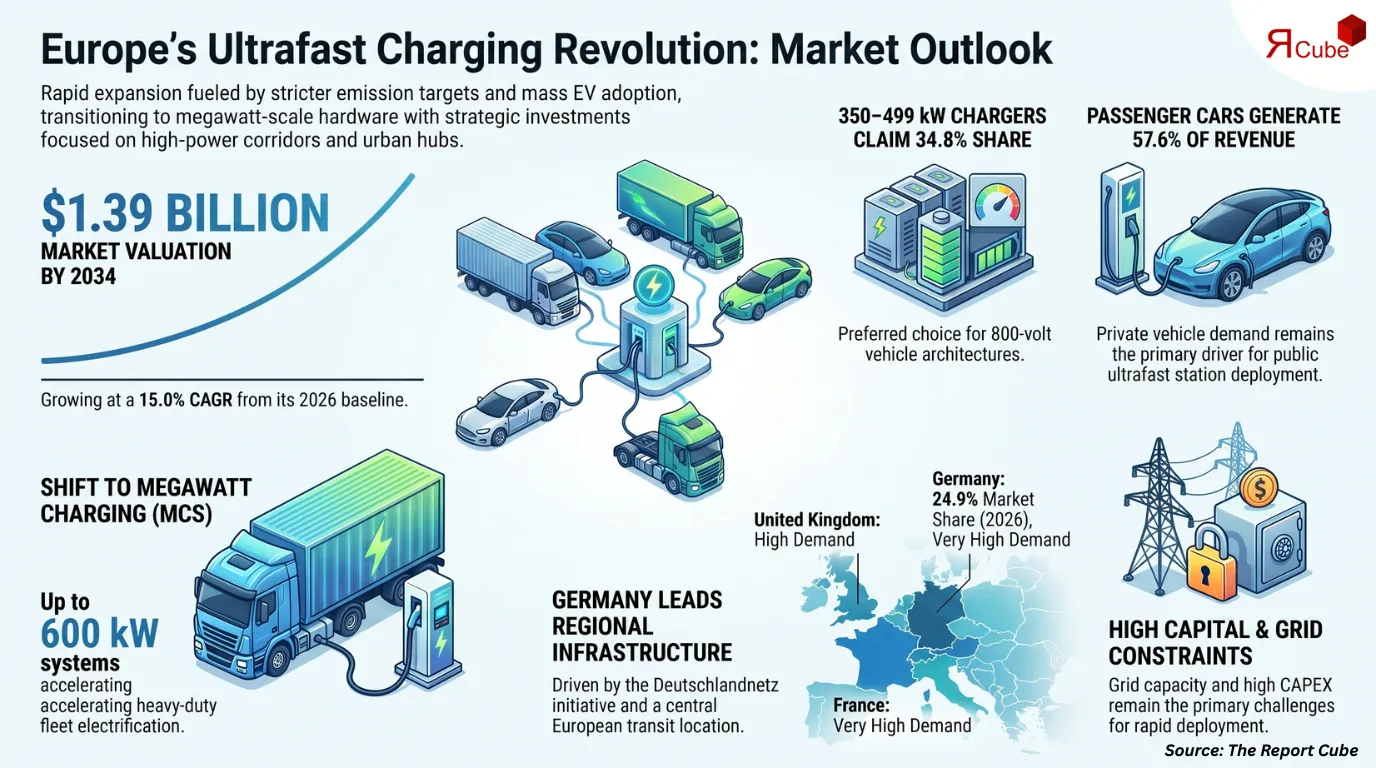
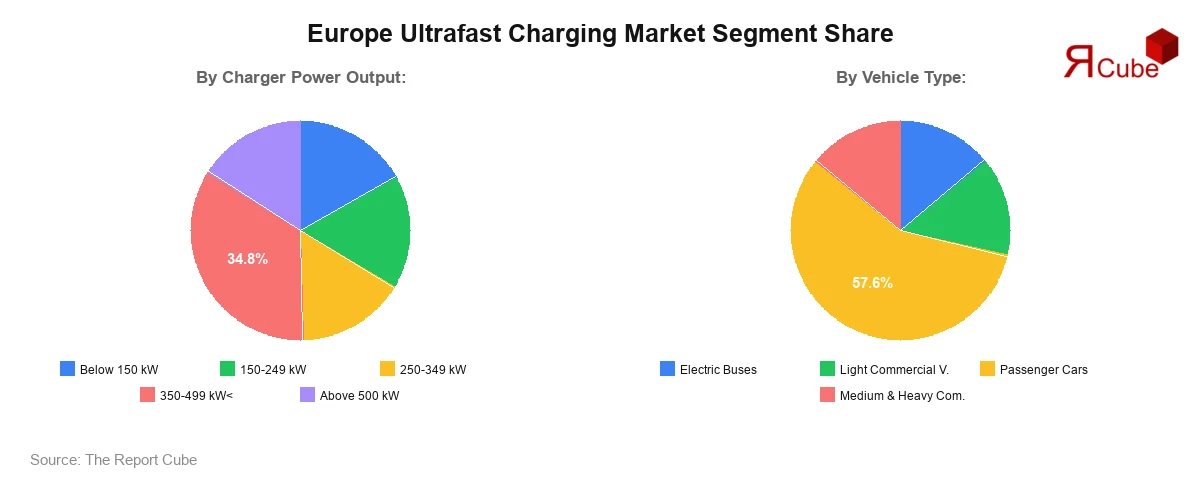
350–499 kW chargers lead the market with approximately 34.8% share.
By Vehicle Type:
Passenger Cars dominate the market with nearly 57.6% of total revenue.
Regional Outlook:
Germany dominates the Europe Ultrafast Charging Market with an estimated 24.9% market share.
Europe Ultrafast Charging Market Insights & Analysis
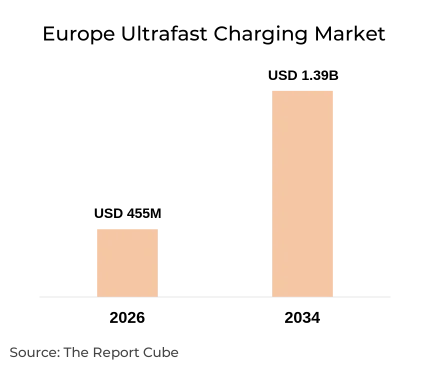
The Europe Ultrafast Charging Market is anticipated to register a CAGR of around 15.0% during the forecast period of 2026-2034. The market size is valued at USD 455 million in 2026 and is projected to reach USD 1,391.86 million by 2034. Market growth is being fueled by the rapid expansion of battery electric vehicle ownership, increasing demand for shorter charging durations, and the development of high-capacity charging corridors connecting major European cities. Governments and private charging operators continue investing in charging infrastructure capable of delivering more than 350 kW to support next-generation electric vehicles equipped with larger battery packs. At the same time, stricter emission reduction targets, fleet electrification programs, and rising consumer confidence in long-distance electric mobility are encouraging the installation of ultrafast charging stations across highways, logistics hubs, urban centers, and commercial destinations. Continuous improvements in charging software, smart energy management, and grid integration are further strengthening the Europe ultrafast charging market size and long-term growth outlook.
Significant investments from utilities, charging network operators, automotive manufacturers, and infrastructure funds continue reshaping the Europe ultrafast charging stations market. Leading charging providers are introducing modular charging platforms with dynamic power allocation, liquid-cooled charging cables, remote diagnostics, and predictive maintenance capabilities to improve station reliability and operational efficiency. Vehicle manufacturers are simultaneously launching electric models capable of accepting charging rates exceeding 300 kW, creating stronger demand for advanced charging infrastructure. Public funding under European transport and climate initiatives continues supporting cross-border charging corridors, while private operators are expanding partnerships with retail centers, fuel station operators, logistics companies, and fleet owners. Increasing renewable energy integration, battery energy storage systems, and intelligent load balancing technologies are also helping reduce grid stress during peak charging periods. These developments collectively support sustained Europe ultrafast charging market growth while improving charging convenience, infrastructure utilization, and customer experience across both passenger and commercial vehicle segments.
Europe Ultrafast Charging Market Impact Analysis
| Factor | Type | Specific Impact on Market | Magnitude | Business Implication |
|---|---|---|---|---|
| Rapid EV Fleet Expansion | Market | More battery vehicles raise need for dense high speed chargers | High | Supports aggressive roll out of highway and corridor sites |
| Government Funding & Targets | Regulatory | Subsidies and EU plans accelerate public ultrafast deployments | High | Improves project returns and attracts infrastructure capital |
| Advances in High Power Hardware | Technological | 350kW and above systems cut charge time for long distance trips | High | Enables premium pricing and differentiates leading networks |
| Grid Capacity & Connection Limits | Environmental | High load sites face delays and added grid upgrade expense | Medium | Requires smart load control and utility partnership models |
| Competitive Network Expansion | Competitive | Multiple operators race to secure prime routes and hubs | Medium | Promotes brand alliances and dynamic tariff strategies |
| Shift to Passenger Car Fast Charging | Consumer | Most public ultrafast sessions come from private car users | High | Guides site design toward convenient short stay amenities |
| Emerging Heavy Duty Charging Demand | Market | Freight decarbonisation creates need for megawatt truck hubs | Medium | Opens new depot and corridor partnership revenue streams |
Europe Ultrafast Charging Market Dynamics
Key Driver: Accelerating Electrification of Passenger and Commercial Transportation
The continued growth of battery electric vehicle adoption across Europe remains the strongest factor supporting demand for ultrafast charging infrastructure. Governments across the region have introduced stricter vehicle emission standards, low-emission zones, and financial incentives that encourage the transition toward zero-emission mobility. At the same time, vehicle manufacturers are expanding their portfolios with electric models featuring larger battery capacities and 800-volt electrical architectures capable of utilizing charging speeds exceeding 350 kW. These technological improvements are increasing demand for charging stations that can minimize charging durations and support long-distance travel without compromising operational efficiency.
The commercial transport sector is adding further momentum to infrastructure deployment. Logistics providers, municipal transit agencies, and fleet operators are investing in electric buses, delivery vans, and heavy commercial vehicles to reduce operating costs and comply with sustainability targets. This transition requires reliable high-power charging facilities capable of supporting intensive daily vehicle operations. Consequently, charging point operators and energy companies continue expanding corridor charging stations, urban charging hubs, and fleet charging facilities, reinforcing long-term demand for ultrafast charging equipment across Europe.
Industry Trends: Expansion of Megawatt Charging Infrastructure and High-Power Charging Corridors
The European charging industry is progressing beyond conventional fast charging toward megawatt-capable infrastructure designed for next-generation passenger and heavy-duty electric vehicles. Charging equipment manufacturers are introducing modular systems that allow operators to increase available charging capacity without replacing complete installations, improving scalability while reducing long-term infrastructure costs. Recent product launches capable of delivering up to 600 kW per vehicle demonstrate the industry's focus on supporting higher-capacity batteries and shorter charging sessions.
Infrastructure deployment is also expanding along major European transport corridors where governments and private operators are strengthening cross-border charging availability. High-power charging hubs equipped with multiple DC chargers are increasingly integrating battery energy storage, renewable electricity generation, and advanced power management technologies to improve network reliability and reduce pressure on local electricity grids. These developments are strengthening Europe's long-distance charging network while supporting the growing electrification of passenger transport and commercial freight operations.
Book your FREE 30-minute expert consultation today
Contact UsMajor Challenge: Grid Modernization Requirements and High Capital Investment
Although infrastructure deployment continues at a rapid pace, electrical grid capacity remains a significant challenge for the Europe Ultrafast Charging Market. High-power charging stations require substantial grid connections, upgraded substations, and advanced power management systems before they can operate at full capacity. In several regions, distribution network limitations and lengthy utility approval processes continue to delay project commissioning, particularly along motorway corridors and remote transport routes where existing electrical infrastructure was not designed for high-power charging applications.
Developing ultrafast charging stations also requires considerable capital expenditure covering power electronics, transformers, cooling systems, civil construction, software integration, and long-term maintenance. Profitability depends heavily on charger utilization, which varies across locations depending on electric vehicle density and traffic volumes. Managing electricity demand charges while maintaining reliable station performance remains an operational priority for charging point operators. Continued investment in grid modernization, energy storage, and renewable power integration will be essential to support the next phase of market expansion.
Opportunity: Heavy-Duty Vehicle Electrification and Cross-Border Charging Network Expansion
The electrification of medium and heavy commercial vehicles is creating new opportunities for high-capacity charging infrastructure across Europe. Freight operators are increasingly investing in battery-electric trucks to meet emission reduction targets and improve fleet sustainability, generating demand for charging systems capable of delivering substantially higher power than conventional passenger vehicle chargers. The commercialization of Megawatt Charging System (MCS) technology is expected to accelerate infrastructure deployment at logistics hubs, industrial parks, ports, and major freight corridors throughout the forecast period.
Cross-border interoperability is also becoming an important growth catalyst as European countries continue harmonizing charging standards under the Alternative Fuels Infrastructure Regulation. Ongoing investments in motorway charging corridors, digital payment interoperability, renewable-powered charging hubs, and intelligent energy management systems are improving infrastructure accessibility across the region. These initiatives are expected to strengthen charging network coverage, support higher electric vehicle utilization, and create long-term growth opportunities for equipment manufacturers, charging network operators, and infrastructure developers operating within the Europe ultrafast charging market.
Europe Ultrafast Charging Market Segment-wise Analysis
By Charger Power Output:
- Below 150 kW
- 150-249 kW
- 250-349 kW
- 350-499 kW
- Above 500 kW
The 350-499 kW segment held the leading position in the Europe Ultrafast Charging Market, accounting for approximately 34.8% of total revenue in 2026. This power range has emerged as the preferred choice for charging point operators because it offers an optimal balance between charging speed, infrastructure cost, and compatibility with the latest battery electric vehicles. Many premium passenger EVs equipped with 800-volt battery architectures are capable of utilizing charging capacities above 300 kW, enabling substantial reductions in charging time. The deployment of these chargers has increased significantly across motorway service areas, logistics hubs, and high-traffic urban charging locations where rapid vehicle turnaround is essential.
The segment is also benefiting from continuous investments by charging network operators seeking to improve corridor charging capacity and reduce waiting times during peak travel periods. Modular charging systems, liquid-cooled charging cables, and advanced power-sharing technologies are enhancing operational flexibility while maximizing charger utilization. As next-generation electric vehicles continue entering the European market with higher charging acceptance rates, the demand for 350-499 kW charging infrastructure is expected to strengthen further, supporting long-distance electric mobility and reinforcing the segment's leadership throughout the forecast period.
By Vehicle Type:
- Electric Buses
- Light Commercial Vehicles
- Passenger Cars
- Medium & Heavy Commercial Vehicles
Passenger Cars accounted for the largest share of the Europe Ultrafast Charging Market, representing nearly 57.6% of overall revenue. The segment continues to benefit from the rapid increase in battery electric vehicle ownership across major European economies, supported by stringent emission regulations, expanding model availability, and ongoing public investment in charging infrastructure. Automakers are introducing new electric vehicles equipped with larger battery packs and high-voltage platforms that support ultrafast DC charging, encouraging charging network operators to expand installations capable of delivering charging capacities above 250 kW. This combination of vehicle innovation and infrastructure expansion continues to stimulate charging demand throughout the region.
Growing long-distance travel by electric vehicles has further accelerated the deployment of ultrafast charging stations along highways, urban centers, retail destinations, and public parking facilities. Passenger vehicles generate the highest charging demand due to their significantly larger fleet size compared with commercial electric vehicles. In addition, continuous improvements in battery technology, charging efficiency, and vehicle range are encouraging greater adoption of battery electric cars across Europe. These factors are expected to sustain the segment's market leadership while contributing significantly to overall Europe ultrafast charging market growth during the forecast period.
Regional Projection of Europe Ultrafast Charging Industry
- The UK
- Germany
- France
- Italy
- Spain
- Benelux
- Rest of Europe
Germany accounted for the largest share of the Europe Ultrafast Charging Market, contributing approximately 24.9% of total revenue in 2026. The country's leadership is supported by one of Europe's highest electric vehicle adoption rates, a well-developed automotive manufacturing ecosystem, and sustained investment in public charging infrastructure. Government-backed initiatives, including the Deutschlandnetz program and implementation of the Alternative Fuels Infrastructure Regulation, continue accelerating the installation of high-power charging stations across highways and urban areas. Germany also serves as a strategic transportation hub connecting several European markets, creating strong demand for reliable ultrafast charging corridors.
Leading charging equipment manufacturers, energy companies, and charging point operators continue expanding high-capacity charging networks throughout the country to support increasing passenger and commercial electric vehicle traffic. Investments in renewable energy integration, battery energy storage systems, and smart grid technologies are improving network reliability while supporting higher charging capacities. The growing electrification of logistics fleets, public transportation, and private mobility is expected to further strengthen infrastructure deployment. Supported by continuous technological innovation and favorable regulatory policies, Germany is projected to maintain its dominant position in the Europe Ultrafast Charging Market over the forecast period.
Need insights for a specific region within this market?
Request Regional DataEurope Ultrafast Charging Market Country Analysis
Europe’s ultrafast charging market is expanding quickly, with strong policy support, rising BEV use, and corridor build-out.
| Country | Demand Level | Key Areas | System Dominance | Core Demand Logic | Growth Nature |
|---|---|---|---|---|---|
| The UK | High | London, M1/M6, retail sites | 150 kW+ rapid hubs | Road-trip use, fleet uptime, urban top-up | Network densification |
| Germany | Very High | Autobahn, Ruhr, Munich, Berlin | HPC hubs, 300 kW+ DC | Large BEV base, highway freight flow | Scale-led expansion |
| France | Very High | Paris, Lyon, Marseille, motorways | High-power motorway chargers | Intercity travel, tourism, corridor charging | Fast corridor build-out |
| Italy | High | Milan, Rome, Turin, A1/A4 corridors | Fast DC on highways | North-led EV demand, long-distance travel | North-centric growth |
| Spain | High | Madrid, Barcelona, AP-7, AP-2 | 150 kW corridor chargers | Tourism, intercity mobility, fleet electrification | Route-led expansion |
| Benelux | Very High | Netherlands, Belgium, Luxembourg | Dense HPC and urban fast charging | Dense cities, strong EV adoption, cross-border use | Mature, upgrade-led |
| Rest of Europe | Medium | CEE, Balkans, Nordics, Baltics | Mixed-speed rollout | Catch-up build, corridor gaps, policy support | Fastest percentage growth |
Government Initiatives & Policies
- Alternative Fuels Infrastructure Regulation (AFIR) Implementation (2025): The European Union continues implementing AFIR requirements to expand high-power public charging infrastructure across the Trans-European Transport Network, ensuring minimum charging capacity and improved accessibility for electric vehicle users throughout member states.
- Germany's Deutschlandnetz Fast Charging Program (2025): Germany continues expanding its nationwide fast-charging network through the Deutschlandnetz initiative, supporting installation of thousands of publicly accessible high-power charging points to strengthen nationwide EV charging coverage and improve long-distance electric mobility.
Europe Ultrafast Charging Industry Recent Developments
- 2025: IONITY announced plans to become the first charging network in Europe to deploy Alpitronic's HYC1000 Megawatt Charging System. The new platform supports charging capacities of up to 600 kW per vehicle, enabling significantly shorter charging sessions for next-generation electric vehicles. The rollout across key European transport corridors is expected to strengthen highway charging infrastructure, improve long-distance EV travel, and accelerate the adoption of ultrafast charging technologies throughout the region.
Why Choose This Report?
- Provides a comprehensive overview of the overall market analysis, encompassing key trends, consumer behavior analysis, and risk assessment to support strategic decision-making.
- Provides accurate, up-to-date insights into market size, segmentation, and emerging opportunities, helping to minimize risk while capitalizing on growth.
- Gives deep understanding of target audience preferences, investment habits, and communication channels for enhanced product development and marketing effectiveness.
- Delivers competitive analysis and benchmarking, uncovering the strengths and weaknesses of market competitors to guide business strategies.
- Consolidates comprehensive market intelligence, reducing research efforts and improving strategic planning.
- Facilitates customized market segmentation and risk mitigation strategies, fine-tuned to business objectives.
- Aids in identifying both market challenges and untapped opportunities within the industry to drive long-term business growth.
- Provides valuable information based on actual customer data, industry developments, and evolving search trends.
Table of Contents
- Introduction
- Objective of the Study
- Product and Category Definition
- Market Segmentation
- Study Variables
- Research Methodology
- Secondary Data Points
- Breakdown of Secondary Sources
- Primary Data Points
- Breakdown of Primary Interviews
- Secondary Data Points
- Executive Summary
- Market Dynamics
- Emerging Opportunities
- Adoption Trends
- Demand Drivers
- Disruption Analysis (Challenges)
- Industry Analysis & Strategic Insights
- Supply/Value Chain Analysis
- Pricing Analysis
- Go-To-Market (GTM) Strategy
- BCG Matrix
- Recent Trends and Developments
- Import and Export Analysis
- Regulatory and Policy Landscape
- Country-wise policies
- Government Initiatives
- Europe Ultrafast Charging Market Overview and Forecast Analysis (2021-2034)
- Market Size, By Value, By Growth Rate (CAGR/USD Million)
- Market Share, By Charger Power Output
- Below 150 kW
- 150-249 kW
- 250-349 kW
- 350-499 kW
- Above 500 kW
- Market Share, By Connector Type
- Megawatt Charging System (MCS)
- North American Charging Standard (NACS/Tesla)
- CHAdeMO
- Combined Charging System (CCS2)
- Others
- Market Share, By Vehicle Type
- Electric Buses
- Light Commercial Vehicles
- Passenger Cars
- Medium & Heavy Commercial Vehicles
- Market Share, By Charging Site Type
- Fleet Depot Charging
- Urban Public Charging
- Highway / Corridor Charging
- Destination Charging
- Market Share, By Component
- Services
- Hardware
- Software
- Market Share, By Country
- The UK
- Germany
- France
- Italy
- Spain
- Benelux
- Rest of Europe
- Market Share, By Company
- Revenue Shares & Analysis
- Competitive Landscape
- The UK Ultrafast Charging Market Overview and Forecast Analysis (2021-2034)
- Market Size, By Value, By Growth Rate (CAGR/USD Million)
- Market Share, By Charger Power Output
- Market Share, By Connector Type
- Market Share, By Vehicle Type
- Market Share, By Charging Site Type
- Market Share, By Component
- Germany Ultrafast Charging Market Overview and Forecast Analysis (2021-2034)
- Market Size, By Value, By Growth Rate (CAGR/USD Million)
- Market Share, By Charger Power Output
- Market Share, By Connector Type
- Market Share, By Vehicle Type
- Market Share, By Charging Site Type
- Market Share, By Component
- France Ultrafast Charging Market Overview and Forecast Analysis (2021-2034)
- Market Size, By Value, By Growth Rate (CAGR/USD Million)
- Market Share, By Charger Power Output
- Market Share, By Connector Type
- Market Share, By Vehicle Type
- Market Share, By Charging Site Type
- Market Share, By Component
- Italy Ultrafast Charging Market Overview and Forecast Analysis (2021-2034)
- Market Size, By Value, By Growth Rate (CAGR/USD Million)
- Market Share, By Charger Power Output
- Market Share, By Connector Type
- Market Share, By Vehicle Type
- Market Share, By Charging Site Type
- Market Share, By Component
- Spain Ultrafast Charging Market Overview and Forecast Analysis (2021-2034)
- Market Size, By Value, By Growth Rate (CAGR/USD Million)
- Market Share, By Charger Power Output
- Market Share, By Connector Type
- Market Share, By Vehicle Type
- Market Share, By Charging Site Type
- Market Share, By Component
- Benelux Ultrafast Charging Market Overview and Forecast Analysis (2021-2034)
- Market Size, By Value, By Growth Rate (CAGR/USD Million)
- Market Share, By Charger Power Output
- Market Share, By Connector Type
- Market Share, By Vehicle Type
- Market Share, By Charging Site Type
- Market Share, By Component
- Competitive Analysis, 2026
- Market Share of Key Players
- Competitive Mapping for Each Segment and Companies Operating by Country
- The UK Ultrafast Charging Companies Share & Competitive Analysis, 2026
- Germany Ultrafast Charging Companies Share & Competitive Analysis, 2026
- France Ultrafast Charging Companies Share & Competitive Analysis, 2026
- Italy Ultrafast Charging Companies Share & Competitive Analysis, 2026
- Spain Ultrafast Charging Companies Share & Competitive Analysis, 2026
- Benelux Ultrafast Charging Companies Share & Competitive Analysis, 2026
- Company Profile (Partial List)
- Schneider Electric SE
- Company Overview
- Product Portfolio
- Strategic Alliances/Partnerships
- Recent Developments
- Wallbox N.V.
- Company Overview
- Product Portfolio
- Strategic Alliances/Partnerships
- Recent Developments
- Delta Electronics, Inc.
- Company Overview
- Product Portfolio
- Strategic Alliances/Partnerships
- Recent Developments
- ABB Ltd.
- Company Overview
- Product Portfolio
- Strategic Alliances/Partnerships
- Recent Developments
- Ekoenergetyka-Polska S.A.
- Company Overview
- Product Portfolio
- Strategic Alliances/Partnerships
- Recent Developments
- Tritium DCFC Limited
- Company Overview
- Product Portfolio
- Strategic Alliances/Partnerships
- Recent Developments
- Alpitronic GmbH
- Company Overview
- Product Portfolio
- Strategic Alliances/Partnerships
- Recent Developments
- EVBox Group B.V.
- Company Overview
- Product Portfolio
- Strategic Alliances/Partnerships
- Recent Developments
- Kempower Oyj
- Company Overview
- Product Portfolio
- Strategic Alliances/Partnerships
- Recent Developments
- Siemens AG
- Company Overview
- Product Portfolio
- Strategic Alliances/Partnerships
- Recent Developments
- ChargePoint Holdings, Inc.
- Company Overview
- Product Portfolio
- Strategic Alliances/Partnerships
- Recent Developments
- Circontrol S.A.
- Company Overview
- Product Portfolio
- Strategic Alliances/Partnerships
- Recent Developments
- Others (Partial List)
- Schneider Electric SE
- Contact Us and Disclaimer
Top Key Players & Market Share Outlook
- Schneider Electric SE
- Wallbox N.V.
- Delta Electronics, Inc.
- ABB Ltd.
- Ekoenergetyka-Polska S.A.
- Tritium DCFC Limited
- Alpitronic GmbH
- EVBox Group B.V.
- Kempower Oyj
- Siemens AG
- ChargePoint Holdings, Inc.
- Circontrol S.A.
- Others
Frequently Asked Questions






