



Build Your Custom Market Intelligence Report
Customize Your ReportEurope Fuel Cell Electric Vehicle Market Insights & Analysis
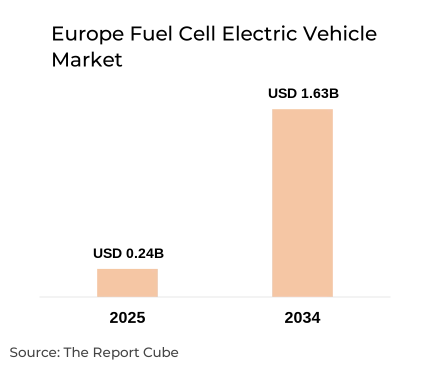
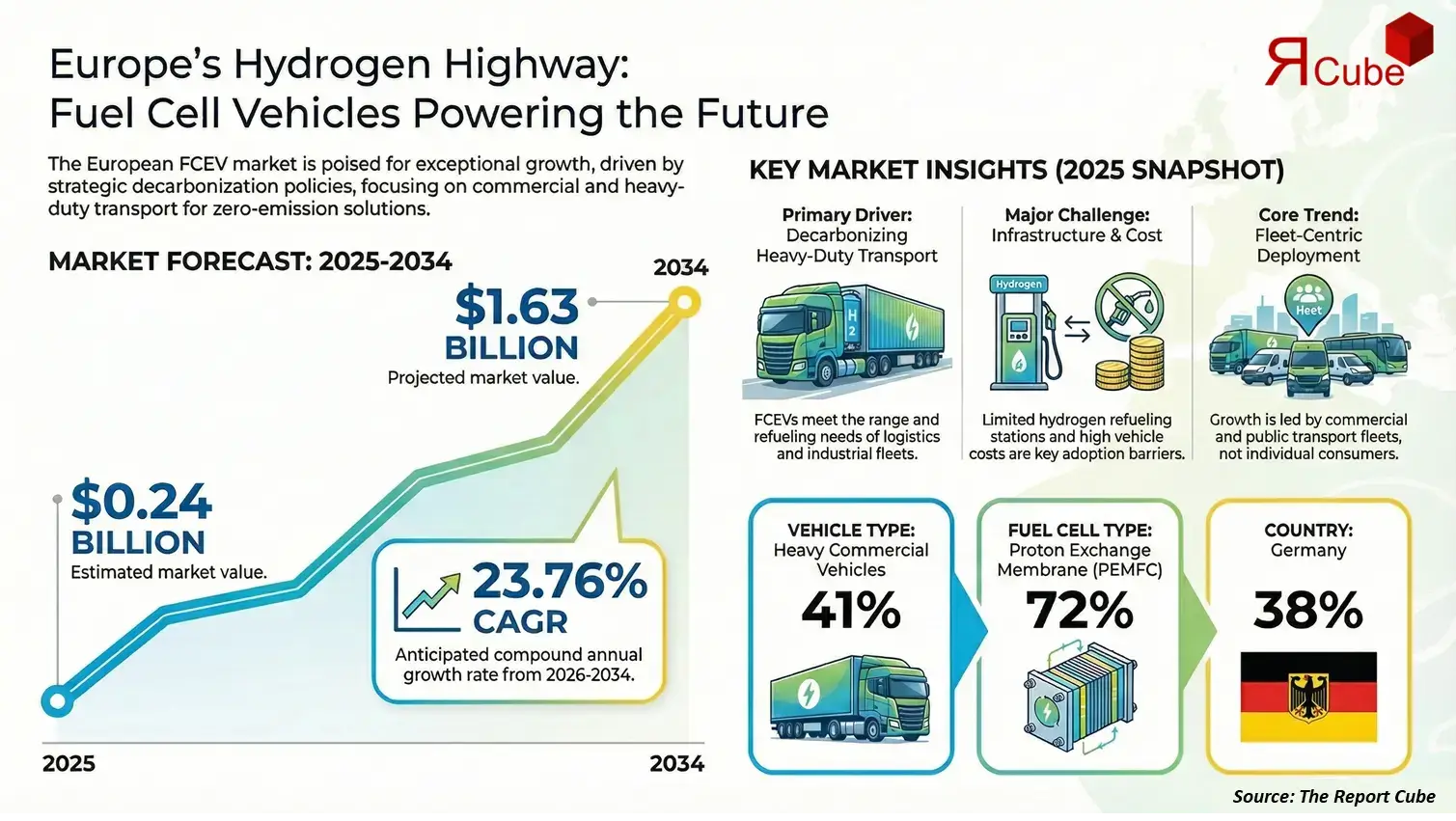
The Europe Fuel Cell Electric Vehicle Market is anticipated to register a CAGR of 23.76% during 2026-2034. The market size was valued at USD 0.24 Billion in 2025 and is projected to reach USD 1.63 Billion by 2034. This exceptional growth trajectory reflects Europe’s strategic focus on deep decarbonization of transport, particularly in segments where battery-electric solutions face limitations. Fuel cell electric vehicles (FCEVs) are increasingly positioned as a complementary zero-emission solution, especially for long-range, high-utilization, and heavy-duty transport applications. Policy alignment with hydrogen strategies, emissions reduction targets, and energy security goals has created a favorable foundation for sustained market expansion rather than short-term pilot adoption.
Europe Fuel Cell Electric Vehicle Market Recent Developments
- 2025: Daimler Truck AG expanded hydrogen fuel cell truck pilots across Germany and neighboring European freight corridors.
- 2025: Hyundai Motor Europe increased deployment of fuel cell buses through public transport partnerships in multiple EU cities.
Government Initiatives & Policies
- EU Hydrogen Strategy: European Union initiative supporting large-scale hydrogen production, infrastructure, and transport-sector adoption.
- Fit for 55 - Transport Decarbonization: EU legislative framework targeting 55% emissions reduction, accelerating zero-emission vehicle adoption.
Market development across Europe is being driven by regulatory certainty, infrastructure planning, and industrial collaboration rather than purely consumer-led demand. The European Union’s Fit for 55 package, national hydrogen roadmaps, and cross-border hydrogen corridor initiatives are collectively accelerating investment in hydrogen production, refueling infrastructure, and vehicle deployment. Unlike early-stage electric mobility markets, the fuel cell vehicle ecosystem is evolving in close coordination with energy providers, fleet operators, and heavy-industry stakeholders. This systems-level approach supports scalable adoption, particularly in commercial fleets and public transport, where total cost of ownership and operational uptime are critical decision factors.
Competitive dynamics within the European FCEV landscape are shaped by a mix of global automotive OEMs, fuel cell technology specialists, and commercial vehicle manufacturers. Companies such as Toyota Motor Europe, Hyundai Motor Europe, Honda Motor Europe, Daimler Truck AG, and Volvo Group are actively advancing fuel cell platforms for both passenger and heavy-duty vehicles. At the same time, technology providers including Ballard Power Systems Europe and Plug Power’s European operations play a central role in stack development, hydrogen integration, and system efficiency improvements. As deployment scales, the market is expected to transition from demonstration projects toward commercially viable fleet-based adoption models.
Europe Fuel Cell Electric Vehicle Market Dynamics
Key Driver: Decarbonization of Heavy-Duty and Long-Haul Transport
The primary growth driver for Europe’s fuel cell electric vehicle market is the urgent need to decarbonize heavy-duty, long-haul, and high-utilization transport segments. Battery-electric solutions face challenges related to range, payload capacity, and charging downtime in these use cases, making fuel cell technology an attractive alternative. Hydrogen-powered vehicles offer fast refueling times and long driving ranges, which align well with logistics, public transport, and industrial fleet requirements. As emissions regulations tighten for commercial vehicles, fleet operators increasingly view fuel cell vehicles as a viable pathway to regulatory compliance without compromising operational efficiency.
Major Challenge: Infrastructure Scale-Up and Cost Competitiveness
Despite strong policy support, infrastructure availability remains a critical challenge for widespread adoption. Hydrogen refueling stations are still limited and unevenly distributed across Europe, creating regional disparities in vehicle deployment. In addition, fuel cell vehicles currently face higher upfront costs compared to battery-electric and conventional alternatives, largely due to stack manufacturing costs and low production volumes. While government subsidies and pilot funding mitigate these barriers, achieving long-term cost competitiveness will depend on economies of scale, standardized platforms, and accelerated hydrogen infrastructure rollout.
Industry Trends: Fleet-Centric Deployment and Industrial Partnerships
A defining trend in the European FCEV market is the shift toward fleet-centric deployment models rather than individual consumer adoption. Public transport authorities, logistics companies, and industrial operators are leading early adoption through controlled fleet rollouts supported by public funding. Strategic partnerships between vehicle OEMs, hydrogen suppliers, and infrastructure developers are becoming increasingly common, enabling integrated solutions that reduce deployment risk. These collaborations are shaping a market structure focused on reliability, uptime, and lifecycle economics rather than retail vehicle sales alone.
Opportunity Ahead: Green Hydrogen Integration and Cross-Border Corridors
The expansion of green hydrogen production and cross-border hydrogen corridors presents a major opportunity for long-term market growth. As renewable hydrogen capacity increases, fuel cell vehicles can deliver truly zero-emission mobility across Europe. Trans-European transport networks integrating hydrogen refueling stations will further support long-distance freight and passenger services. These developments position fuel cell vehicles as a strategic component of Europe’s long-term sustainable mobility framework.
Europe Fuel Cell Electric Vehicle Market Segment-wise Analysis
By Vehicle Type:
- Passenger Cars
- Light Commercial Vehicles
- Heavy Commercial Vehicles
- Buses & Coaches
- Others
Heavy commercial vehicles represent the leading value segment in Europe’s fuel cell electric vehicle market, accounting for an estimated 41% of total market value in 2025. This dominance reflects early adoption by logistics operators, port authorities, and industrial fleets seeking zero-emission solutions for long-haul and high-payload operations. Heavy trucks benefit most from fuel cell advantages such as extended range and rapid refueling, which minimize downtime and productivity loss. While buses and coaches also show strong uptake through public transport programs, heavy commercial vehicles remain the primary driver of revenue due to higher unit costs and fleet-scale procurement.
By Fuel Cell Type:
- Proton Exchange Membrane Fuel Cell
- Solid Oxide Fuel Cell
- Others
Proton Exchange Membrane Fuel Cells (PEMFC) dominate the European market, accounting for approximately 72% of deployed fuel cell systems in vehicles. PEM technology is favored due to its fast start-up times, high power density, and suitability for mobile applications. Most passenger cars, buses, and commercial vehicles currently rely on PEM fuel cells, while solid oxide fuel cells remain largely confined to stationary and auxiliary power applications. Continued investment in PEM efficiency and durability is expected to reinforce this leadership position over the forecast period.
Regional Projection of Europe Fuel Cell Electric Vehicle Industry
- Germany
- France
- United Kingdom
- Italy
- Rest of Europe
Germany leads the European fuel cell electric vehicle market, accounting for an estimated 38% of total regional market value in 2025. This leadership is driven by strong government funding, advanced hydrogen infrastructure planning, and the presence of major automotive and industrial players. Germany’s focus on hydrogen corridors for freight transport and large-scale pilot deployments positions it as the central hub for FCEV adoption in Europe. France and the United Kingdom follow, supported by public transport initiatives and hydrogen mobility programs, while other European countries are gradually scaling pilot projects into commercial deployments.
Why Choose This Report?
- Provides a comprehensive overview of market dynamics, technology evolution, and regulatory drivers.
- Delivers accurate insights into market size, segmentation, and high-growth opportunities.
- Enhances understanding of fleet-based adoption and infrastructure-linked demand.
- Offers competitive benchmarking across OEMs and technology providers.
- Consolidates complex hydrogen mobility data into actionable intelligence.
- Supports strategic planning with data-driven market projections.
- Identifies deployment challenges and scalable growth pathways.
- Incorporates insights aligned with Europe’s long-term decarbonization goals.
Table of Contents
- Introduction
- Objective of the Study
- Product/Category Definition
- Market Segmentation
- Study Variables
- Research Methodology
- Secondary Data Points
- Breakdown of Secondary Sources
- Primary Data Points
- Breakdown of Primary Interviews
- Secondary Data Points
- Executive Summary
- Market Dynamics
- Drivers
- Challenges
- Opportunity Assessment
- Recent Trends and Developments
- Policy and Regulatory Landscape
- Europe Fuel Cell Electric Vehicle Market Overview (2020-2034)
- Market Size, By Volume (Units) & Value (EUR Million / USD Million)
- Market Share, By Vehicle Type
- Passenger Cars
- Light Commercial Vehicles
- Heavy Commercial Vehicles
- Buses & Coaches
- Others
- Market Share, By Fuel Cell Type
- Proton Exchange Membrane Fuel Cell (PEMFC)
- Solid Oxide Fuel Cell (SOFC)
- Others
- Market Share, By Power Output
- Below 100 kW
- 100–200 kW
- Above 200 kW
- Market Share, By End User
- Private Consumers
- Commercial Fleet Operators
- Public Transport Authorities
- Logistics & Industrial Operators
- Market Share, By Country
- Germany
- France
- United Kingdom
- Italy
- Rest of Europe
- Market Share, By Company
- Revenue Shares
- Competitive Landscape
- Segment-wise & Industry-wise Market Forecast (2026-2034)
- By Vehicle Type
- By Fuel Cell Type
- By Power Output
- By End User
- By Country
- Germany Fuel Cell Electric Vehicle Market
- Market Size, By Volume & Value (EUR Million)
- Market Share, By Vehicle Type
- Market Share, By Fuel Cell Type
- Market Share, By End User
- Market Share, By Key Region
- France Fuel Cell Electric Vehicle Market
- Market Size, By Volume & Value (EUR Million)
- Market Share, By Vehicle Type
- Market Share, By Fuel Cell Type
- Market Share, By End User
- Market Share, By Key Region
- UK Fuel Cell Electric Vehicle Market
- Market Size, By Volume & Value (EUR Million)
- Market Share, By Vehicle Type
- Market Share, By Fuel Cell Type
- Market Share, By End User
- Market Share, By Key Region
- Competitive Outlook & Company Profiles
- Toyota Motor Europe
- Company Overview
- Product Portfolio
- Strategic Alliances/Partnerships
- Recent Developments
- Hyundai Motor Europe
- Company Overview
- Product Portfolio
- Strategic Alliances/Partnerships
- Recent Developments
- Honda Motor Europe
- Company Overview
- Product Portfolio
- Strategic Alliances/Partnerships
- Recent Developments
- Ballard Power Systems Europe
- Company Overview
- Product Portfolio
- Strategic Alliances/Partnerships
- Recent Developments
- Plug Power Inc. (Europe Operations)
- Company Overview
- Product Portfolio
- Strategic Alliances/Partnerships
- Recent Developments
- Daimler Truck AG
- Company Overview
- Product Portfolio
- Strategic Alliances/Partnerships
- Recent Developments
- Volvo Group
- Company Overview
- Product Portfolio
- Strategic Alliances/Partnerships
- Recent Developments
- Others
- Toyota Motor Europe
- Contact Us / Disclaimer
Top Key Players & Market Share Outlook
- Toyota Motor Europe
- Hyundai Motor Europe
- Honda Motor Europe
- Ballard Power Systems Europe
- Plug Power Inc. (Europe Operations)
- Daimler Truck AG
- Volvo Group
- Others
Frequently Asked Questions






