



Build Your Custom Market Intelligence Report
Customize Your ReportKey Highlights of the U.S. Collaborative Robots Market
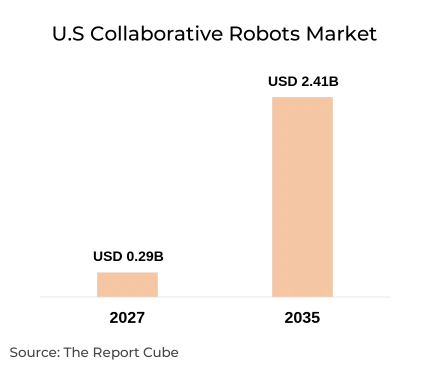
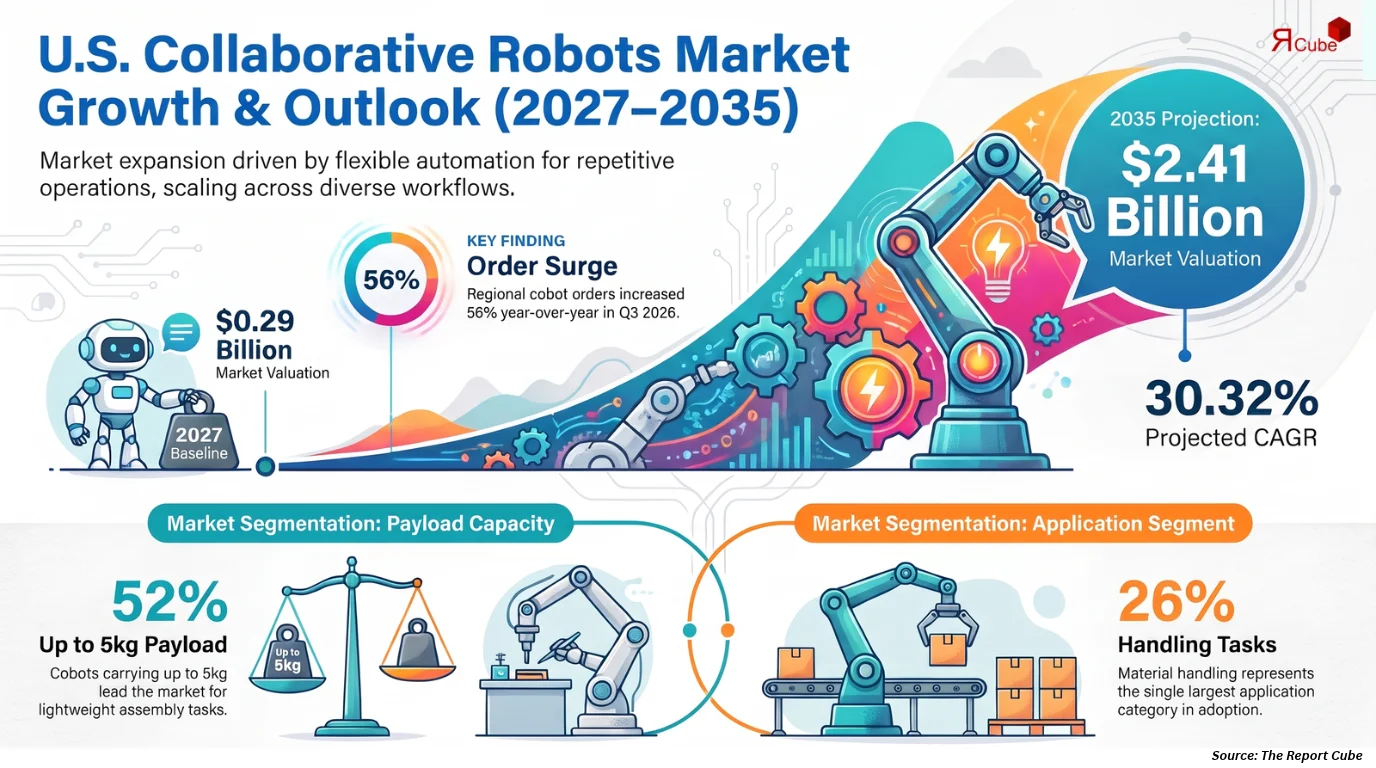
- The U.S. collaborative robots market is projected to increase from USD 0.29 billion in 2027 to USD 2.41 billion by 2035, based on the supplied market estimates.
- The market is expected to register a CAGR of approximately 30.30% during 2027–2035, broadly consistent with the supplied CAGR of 30.32% after rounding.
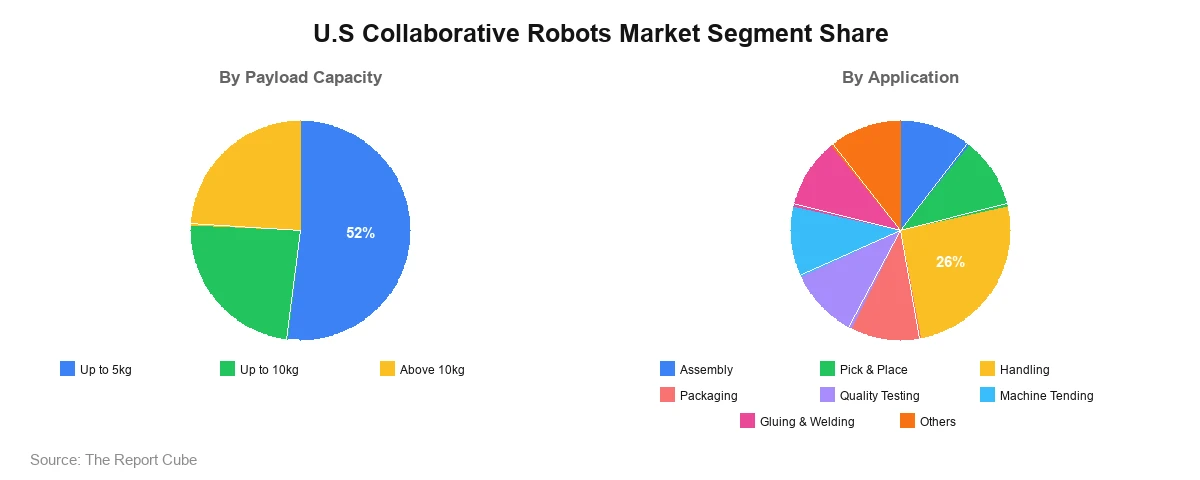
- By payload capacity, the Up to 5kg category is estimated to account for 52% of the market in 2026, according to the supplied segmentation data.
- By application, Handling is estimated to represent 26% of the market in 2026, according to the supplied segmentation data.
- Collaborative robots are increasingly relevant to assembly, machine tending, material handling, packaging, inspection, welding, and other repetitive manufacturing activities.
- North American collaborative robot orders increased approximately 56% year over year in Q3 2026, according to the Association for Advancing Automation (A3). This is regional order data and should not be interpreted as U.S.-only market revenue.
- Manufacturing automation demand across automotive, food and beverage, electronics, metalworking, and pharmaceutical production is supporting the broader industrial robotics ecosystem.
- Robot-system integration, application-specific safety assessments, workforce training, and compatibility with existing production equipment remain important considerations for commercial adoption.
U.S. Collaborative Robots Market Overview
Collaborative robots, commonly known as cobots, are industrial robots designed to operate in applications where human workers and robotic systems share a workspace under defined safety conditions. Unlike conventional industrial automation installations that often rely on physically separated robot cells, collaborative robotic applications can support closer human-robot interaction through features such as force and power limitation, speed and separation monitoring, safety-rated monitored stops, and hand-guiding. The appropriate safety approach depends on the robot, end-effector, workpiece, task, operating environment, and complete integrated application.
The U.S. collaborative robots market is influenced by manufacturers seeking flexible automation for repetitive, ergonomically demanding, and labor-intensive production activities. Cobots can be deployed in applications such as assembly, pick and place, machine tending, packaging, quality inspection, and material handling. Their relatively compact installation options and programming approaches can make them suitable for selected small and medium-sized manufacturing operations, although the total cost of deployment also includes integration, tooling, safety validation, training, and maintenance.
The broader U.S. industrial robotics industry provides an important demand environment for collaborative automation. According to the International Federation of Robotics (IFR), industrial robot installations in the United States reached approximately 38,000 units in 2025, representing an 11% year-over-year increase. The automotive industry remained the largest adopter, while food-industry installations increased by 30%. These figures cover industrial robots as a whole and should not be treated as collaborative robot installations.
U.S. Collaborative Robots Market Size & Forecast
The U.S. collaborative robots market is estimated at USD 0.29 billion in 2027 and is projected to reach USD 2.41 billion by 2035. Based on these supplied values, the market is expected to expand at an approximate CAGR of 30.30% during the forecast period. The calculated CAGR is close to the supplied 30.32%, with the small difference attributable to rounding of the market-size figures.
The forecast reflects the expected expansion of collaborative automation across manufacturing and selected industrial applications. Increased use of robotic systems for repetitive handling, assembly, packaging, machine tending, and inspection may support demand. Nevertheless, the forecast values are treated as supplied market estimates and have not been independently established by the public industry statistics cited in this report.
U.S. Collaborative Robots Market Government Regulations
Collaborative robot installations in the United States must be evaluated under applicable workplace safety requirements and relevant consensus standards. The Occupational Safety and Health Administration (OSHA) identifies requirements related to machine guarding, hazardous energy control, and other general-industry workplace protections, while noting that consensus standards are not themselves OSHA regulations. ISO 10218-1:2025 and ISO 10218-2:2025 establish safety requirements for industrial robots and their integration into robot systems. ISO/TS 15066:2016 provides supplementary guidance for collaborative industrial robot systems and remains current following its 2022 review. Employers and system integrators should assess the complete application, including tooling, workpieces, robot motion, foreseeable contact, surrounding equipment, and operator access. A robot marketed as collaborative does not automatically make every application safe or eliminate the need for guarding, risk assessment, validation, and appropriate protective measures.
U.S. Collaborative Robots Market Dynamics
The U.S. collaborative robots market is shaped by manufacturers' demand for flexible automation, advances in robotic sensing and programming, and the need to integrate automation into existing production environments. Adoption opportunities are supported by a wider range of cobot products and applications, while safety engineering, integration costs, and task-specific performance requirements influence deployment decisions.
| Factor | Type | Specific Impact on Market | Magnitude |
|---|---|---|---|
| Expansion of manufacturing automation | Growth Driver | Manufacturers are investing in robotics to automate repetitive operations, improve production consistency, and increase manufacturing flexibility. | High |
| Growing demand for flexible production systems | Growth Driver | Compact robot systems and adaptable programming can support production environments with changing product mixes and frequent task changes. | High |
| Automation of repetitive and ergonomic tasks | Growth Driver | Cobots can support handling, assembly, machine tending, and other tasks that involve repetitive movement or physically demanding work. | High |
| Advances in robot sensing and application software | Market Opportunity | Improved vision, force sensing, and programming tools can expand the range of tasks suitable for collaborative automation. | High |
| Automation adoption among small and medium-sized manufacturers | Market Opportunity | Modular systems and application-specific packages can create opportunities among manufacturers that cannot justify large, fixed automation projects. | High |
| Safety assessment and integration complexity | Industry Challenge | Risk assessment, safeguarding, tooling selection, and integration engineering can increase deployment time and total project cost. | High |
| Performance limitations for selected high-speed tasks | Industry Challenge | Cycle-time requirements, payload, reach, and operating speed may make conventional industrial robots more suitable for some applications. | Medium |
| Increasing use of collaborative automation in production workflows | Market Trend | Manufacturers are evaluating cobots for machine tending, assembly, packaging, welding, and inspection rather than limiting adoption to simple pick-and-place tasks. | High |
| Integration of vision, force sensing, and easier programming | Market Trend | Sensor technologies and simplified programming interfaces are improving the adaptability of collaborative robotic applications. | High |
Growth Drivers: Increasing Industrial Automation Across U.S. Manufacturing
Manufacturing automation is an important driver of collaborative robot demand as U.S. companies seek to improve production consistency, reduce repetitive manual workloads, and respond to changing manufacturing requirements. According to the International Federation of Robotics, U.S. industrial robot installations reached approximately 38,000 units in 2025, increasing 11% year over year. Automotive remained the largest industrial robotics customer, while food-industry installations grew by 30%. Although these figures include conventional industrial robots, they indicate a broader environment of investment in robotic automation. Cobots can participate in this investment cycle where applications require flexible handling, assembly, machine tending, or human-robot interaction.
Market Opportunities: Expanding Adoption Among Small and Medium-Sized Manufacturers
Small and medium-sized manufacturers represent an opportunity for collaborative robot suppliers and system integrators. Some of these businesses require automation but have limited engineering resources, production space, or capital budgets for complex industrial automation cells. Compact cobots, pre-engineered application packages, intuitive programming interfaces, and modular tooling can reduce selected deployment barriers. Suppliers that provide application assessment, commissioning, operator training, and after-sales support can strengthen their position in this customer segment. However, affordability must be evaluated using total installation and lifecycle costs rather than the robot arm purchase price alone.
Industry Challenges: Safety Compliance and Application-Level Risk Assessment
Safety requirements remain a major consideration in collaborative robot deployment. A collaborative robot's safety features do not automatically establish that the complete production application is safe for human interaction. The integrated system must account for the robot, end-effector, workpiece, speed, force, operating conditions, and potential contact hazards. Manufacturers and integrators must determine suitable protective measures and validate the application under relevant requirements and standards. These engineering and validation activities can increase project complexity, commissioning time, and deployment costs, particularly where production environments contain multiple machines or changing work processes.
Need Specific Data, Let’s Customize the Report for You
Request CustomizationMarket Trends: Expansion of Cobots Across Diverse Manufacturing Applications
Collaborative robot applications are expanding across assembly, machine tending, handling, packaging, welding, and quality inspection. Manufacturers are evaluating cobots for tasks that require a combination of repetitive automation and operator interaction. Product launches also indicate that suppliers are addressing a wider range of payload and application requirements. For example, Comau introduced its MyCo collaborative robot family in 2025 with six models covering payloads from 3 kg to 15 kg. FANUC America introduced the CRX-3iA in April 2026, targeting portable automation for smaller and high-mix tasks. These developments demonstrate product diversification rather than proving a specific U.S. market share shift.
U.S. Collaborative Robots Market Segment Analysis
The U.S. collaborative robots market is segmented by payload capacity, application, industry vertical, and region. Payload capacity determines the weight a robot can handle within specified operating conditions, while application segmentation reflects the production tasks performed by collaborative systems. Industry verticals represent the manufacturing sectors adopting these technologies, and regional segmentation reflects the geographic distribution of industrial activity and automation demand.
By Payload Capacity
- Up to 5kg
- Up to 10kg
- Above 10kg
The Up to 5kg category is estimated to account for 52% of the U.S. collaborative robots market in 2026, based on the supplied market data. Lower-payload collaborative robots are relevant to lightweight assembly, component handling, inspection, laboratory-related operations, and selected packaging tasks. Their compact form factors can support installations in workspaces where floor area and ease of redeployment are important considerations. Robots in higher payload categories can address heavier material handling, machine tending, and palletizing requirements. The supplied payload labels overlap because the Up to 10kg category includes payloads already covered by Up to 5kg. For mutually exclusive market sizing, the categories should be defined as Up to 5kg, Above 5kg to 10kg, and Above 10kg. The original labels have been retained here pending confirmation of the intended methodology.
By Application
- Assembly
- Pick & Place
- Handling
- Packaging
- Quality Testing
- Machine Tending
- Gluing & Welding
- Others
Handling is estimated to represent 26% of the U.S. collaborative robots market in 2026, according to the supplied data. Handling applications include transferring components, loading and unloading workstations, positioning materials, and moving products between production stages. Assembly applications use cobots for repetitive joining, fastening, and component-placement activities, while pick-and-place systems support the movement of individual products or parts. Packaging applications include product placement and selected end-of-line operations. Quality testing can involve inspection support and repeatable positioning, while machine tending automates loading and unloading of manufacturing equipment. Gluing and welding applications require appropriate process equipment, tooling, and application-specific safety measures. Handling and pick-and-place can overlap in practical deployments, so the market methodology should define their boundaries clearly to avoid double counting.
U.S. Collaborative Robots Market Regional Analysis
Regional demand for collaborative robots is associated with the geographic distribution of manufacturing facilities, industrial investment, and the adoption of flexible automation. The Midwest, West, South, and Northeast each contain manufacturing clusters with different application requirements. Automotive and machinery production, food processing, electronics, pharmaceuticals, and advanced manufacturing contribute to the potential adoption environment. Public industrial robot installation statistics provide useful national context, but they do not establish cobot-specific regional revenue or market shares.
| Region | Key Growth Factors | Industry Trends |
|---|---|---|
| Midwest | Automotive manufacturing, industrial machinery, metal fabrication, and established supplier networks. | Automation of machine tending, assembly, welding, material handling, and repetitive production activities. |
| West | Electronics, technology manufacturing, aerospace, advanced manufacturing, and robotics innovation ecosystems. | Demand for precision handling, flexible assembly, inspection, and integration with machine vision and software. |
| South | Automotive and electronics manufacturing investment, food processing, and expansion of industrial production facilities. | Deployment of cobots for packaging, handling, machine tending, and selected assembly operations. |
| Northeast | Pharmaceuticals, medical technology, precision manufacturing, electronics, and industrial equipment production. | Use of collaborative automation for controlled handling, assembly, inspection, and packaging-related tasks. |
U.S. Collaborative Robots Market Competitive Landscape
The competitive landscape includes global industrial robotics manufacturers, dedicated collaborative robot suppliers, and specialist robotics technology and integration companies. Competition is based on payload capacity, reach, repeatability, safety functions, programming experience, application support, software compatibility, and distribution or service networks. The companies listed below do not all compete as equivalent robot-arm manufacturers. Some provide collaborative robot products, while others contribute system integration, robotics software, or adjacent automation technologies.
| Company | Competitive Strength | Primary Segment Served |
|---|---|---|
| ABB Group | Established industrial robotics portfolio with collaborative robot products such as GoFa and SWIFTI, supported by programming and automation software. | Collaborative and industrial robots for assembly, machine tending, welding, handling, and manufacturing automation. |
| AUBO (BEIJING) Robotics Technology Co. Ltd | Dedicated collaborative robot portfolio, including i-Series and iS-Series models, with application packages and ecosystem accessories. | Collaborative automation for handling, assembly, welding, and palletizing. |
| Comau S.p.A | Industrial automation expertise and the MyCo collaborative robot family, with six models covering 3 kg to 15 kg payloads. | Collaborative robotics, manufacturing automation, welding, handling, and assembly. |
| DENSO Corporation | Robotics portfolio includes COBOTTA and COBOTTA PRO collaborative robot products, alongside broader industrial automation capabilities. | Collaborative and industrial robotics for assembly, handling, and inspection. |
| Energid Technologies Corporation | Robotics software, motion-control, and tasking technologies for advanced robotic systems; not classified here as a direct cobot-arm OEM. | Robotics software, motion control, simulation, and system-level technology. |
| Epson America Inc. | Industrial robotics expertise and an expanded collaborative robotics portfolio, including the AX6 collaborative robot announced in September 2026. | Industrial and collaborative robotics for manufacturing and precision automation. |
| Fanuc Corporation | CR and CRX collaborative robot families, supported by a broad industrial automation portfolio and established manufacturing customer base. | Collaborative robotics for handling, assembly, welding, palletizing, and machine tending. |
| KUKA AG | Collaborative robot portfolio includes LBR iiwa and LBR iisy, supported by industrial automation and robot-system integration capabilities. | Human-robot collaboration, assembly, handling, inspection, and manufacturing automation. |
| MRK-SystemS GmbH | Specialist robot-system integrator with expertise in human-robot collaboration, safety engineering, machine vision, and turnkey installations. | Collaborative robot integration, machine tending, handling, and production automation. |
| Precise Automation Inc. | Specialized collaborative robot solutions, including collaborative Cartesian and SCARA-style systems, with integration through distribution and engineering partners. | Compact collaborative automation, assembly, handling, and laboratory or industrial applications. |
- ABB Group: ABB competes through a broad robotics and automation portfolio that includes collaborative robot products such as GoFa. Its collaborative offering supports applications including machine tending, welding, palletizing, assembly, and screwdriving. ABB's product ecosystem, RobotStudio software, and established industrial automation presence are relevant competitive strengths. Its GoFa family includes multiple payload variants, enabling manufacturers to evaluate different combinations of reach, payload, and application requirements.
- FANUC Corporation: FANUC competes in collaborative robotics through its CR and CRX product families. Its portfolio addresses applications such as machine tending, assembly, handling, welding, and palletizing. In April 2026, FANUC America announced the CRX-3iA, a lightweight collaborative robot designed for portable deployment and smaller, high-mix automation tasks. The company also announced additional capabilities across the CRX range, including welding and palletizing enhancements. These developments reinforce FANUC's strategy of extending collaborative automation to a wider set of production requirements.
Recent Developments and Updates
- October 28, 2026: The Association for Advancing Automation reported that North American collaborative robot orders increased approximately 56% year over year in Q3 2026. Cobots represented 16.7% of all robot units ordered during the quarter. The figures cover North America, not the U.S. market alone.
- September 22, 2026: Epson announced its AX6 collaborative six-axis robot, expanding its robotics portfolio with a product designed for worker interaction and no-code programming.
- April 20, 2026: FANUC America announced the CRX-3iA collaborative robot and additional capabilities across the CRX lineup, targeting smaller automation tasks, high-mix production, welding, handling, and palletizing.
U.S. Collaborative Robots Market Report Coverage
The report provides an overview of the U.S. collaborative robots market, including its estimated market size, forecast growth, major demand factors, competitive environment, and segmentation by payload capacity, application, industry vertical, and region. It also examines key industry developments, safety considerations, and the role of manufacturers and integration companies in the adoption of collaborative automation.
| Parameter | Details |
|---|---|
| Market Name | U.S. Collaborative Robots Market |
| Market Size (2027) | USD 0.29 Billion |
| Market Size (2035) | USD 2.41 Billion |
| CAGR | 30.32% |
| Base Year | 2026 |
| Historical Period | 2022–2026 |
| Forecast Period | 2027–2035 |
| Geographic Scope | United States |
| Segmentation | By Payload Capacity, By Application, By Industry Vertical, and By Region |
| Regions Covered | Midwest, West, South, and Northeast |
| Key Companies | ABB Group, AUBO (BEIJING) Robotics Technology Co. Ltd, Comau S.p.A, DENSO Corporation, Energid Technologies Corporation, Epson America Inc., Fanuc Corporation, KUKA AG, MRK-SystemS GmbH, and Precise Automation Inc. |
| Customization | Available based on specific research requirements |
Why Choose This U.S. Collaborative Robots Market Report?
- Provides market size estimates and a forecast overview for the 2027–2035 period.
- Examines key growth drivers, market opportunities, industry challenges, and emerging technology trends.
- Analyzes the market across payload capacity, application, industry vertical, and U.S. regions.
- Reviews major collaborative robot manufacturers, robotics technology providers, and system integrators.
- Includes industry developments and relevant safety-standard considerations for collaborative robot applications.
- Supports business planning, competitive assessment, product strategy, and market-entry research.
- Offers customization options for specific applications, industries, competitors, and geographic requirements.
Table of Contents
- Introduction
- Objective of the Study
- Product Definition
- Market Segmentation
- Study Variables
- Research Methodology
- Secondary Data Points
- Companies Interviewed
- Primary Data Points
- Breakdown of Primary Interviews
- Secondary Data Points
- Executive Summary
- Market Dynamics
- Drivers
- Challenges
- Opportunity Assessment
- Recent Trends and Developments
- Policy and Regulatory Landscape
- U.S Collaborative Robots Market Overview and Forecast Analysis (2022-2035)
- Market Size, By Value, By Growth Rate (CAGR/USD Billions)
- Demand – Supply Trends
- Market Share, By Payload Capacity
- Up to 5kg
- Up to 10kg
- Above 10kg
- Market Share, By Application
- Assembly
- Pick & Place
- Handling
- Packaging
- Quality Testing
- Machine Tending
- Gluing & Welding
- Others
- Market Share, By Industry Vertical
- Automotive
- Food & Beverage
- Furniture & Equipment
- Plastic & Polymers
- Metal & Machinery
- Electronics
- Pharma
- Others
- Market Share, By Region
- Midwest
- West
- South
- Northeast
- Market Share, By Competitors
- Competition Characteristics
- Revenue Shares
- Up to 5kg U.S Collaborative Robots Market Overview, 2022-2035F
- By Value (USD Million)
- By Application – Market Size & Forecast 2022-2035, USD Million
- Assembly
- Pick & Place
- Handling
- Packaging
- Quality Testing
- Machine Tending
- Gluing & Welding
- Others
- Up to 10kg U.S Collaborative Robots Market Overview, 2022-2035F
- By Value (USD Million)
- By Application – Market Size & Forecast 2022-2035, USD Million
- Assembly
- Pick & Place
- Handling
- Packaging
- Quality Testing
- Machine Tending
- Gluing & Welding
- Others
- Above 10kg U.S Collaborative Robots Market Overview, 2022-2035F
- By Value (USD Million)
- By Application – Market Size & Forecast 2022-2035, USD Million
- Assembly
- Pick & Place
- Handling
- Packaging
- Quality Testing
- Machine Tending
- Gluing & Welding
- Others
- Competitive Outlook (Company Profile – Partial List)
- ABB Group
- Company Overview
- Business Segments
- Strategic Alliances/Partnerships
- Recent Developments
- AUBO (BEIJING) Robotics Technology Co. Ltd
- Company Overview
- Business Segments
- Strategic Alliances/Partnerships
- Recent Developments
- Comau S.p.A
- Company Overview
- Business Segments
- Strategic Alliances/Partnerships
- Recent Developments
- DENSO Corporation
- Company Overview
- Business Segments
- Strategic Alliances/Partnerships
- Recent Developments
- Energid Technologies Corporation
- Company Overview
- Business Segments
- Strategic Alliances/Partnerships
- Recent Developments
- Epson America Inc.
- Company Overview
- Business Segments
- Strategic Alliances/Partnerships
- Recent Developments
- Fanuc Corporation
- Company Overview
- Business Segments
- Strategic Alliances/Partnerships
- Recent Developments
- KUKA AG
- Company Overview
- Business Segments
- Strategic Alliances/Partnerships
- Recent Developments
- MRK-SystemS GmbH
- Company Overview
- Business Segments
- Strategic Alliances/Partnerships
- Recent Developments
- Precise Automation Inc.
- Company Overview
- Business Segments
- Strategic Alliances/Partnerships
- Recent Developments
- ABB Group
- Contact Us & Disclaimer
Top Key Players & Market Share Outlook
- ABB Group
- AUBO (BEIJING) Robotics Technology Co. Ltd
- Comau S.p.A
- DENSO Corporation
- Energid Technologies Corporation
- Epson America Inc
- Fanuc Corporation
- KUKA AG
- MRK-SystemS GmbH
- Precise Automation Inc
Frequently Asked Questions