



Build Your Custom Market Intelligence Report
Customize Your ReportKey Highlights of the U.S. Collectibles Market
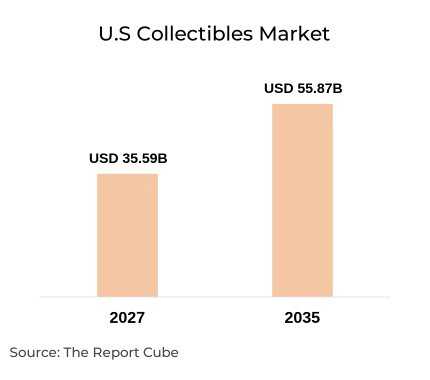
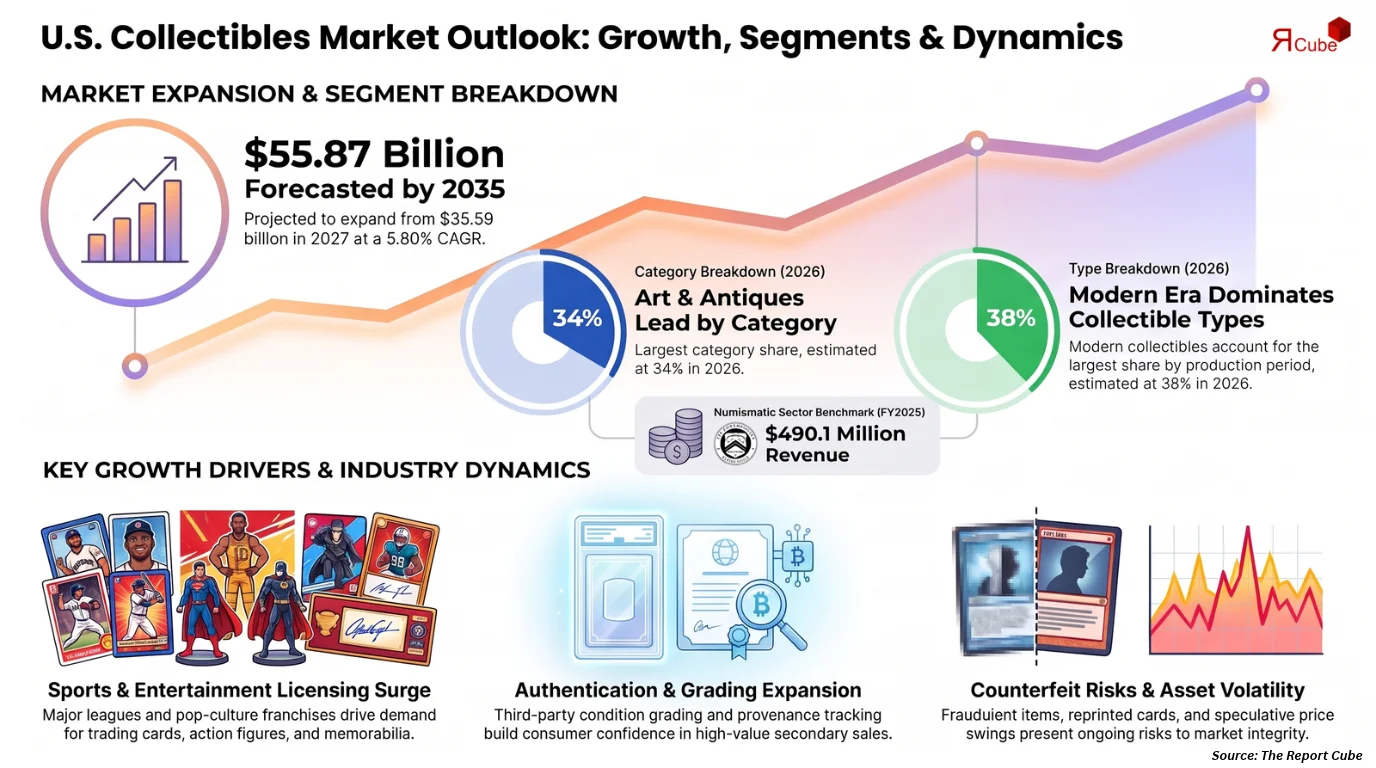
- The U.S. collectibles market is projected to increase from USD 35.59 billion in 2027 to USD 55.87 billion by 2035, based on the supplied market estimates.
- The market is expected to expand at a CAGR of 5.80% during 2027–2035, consistent with the CAGR calculated from the supplied market values.
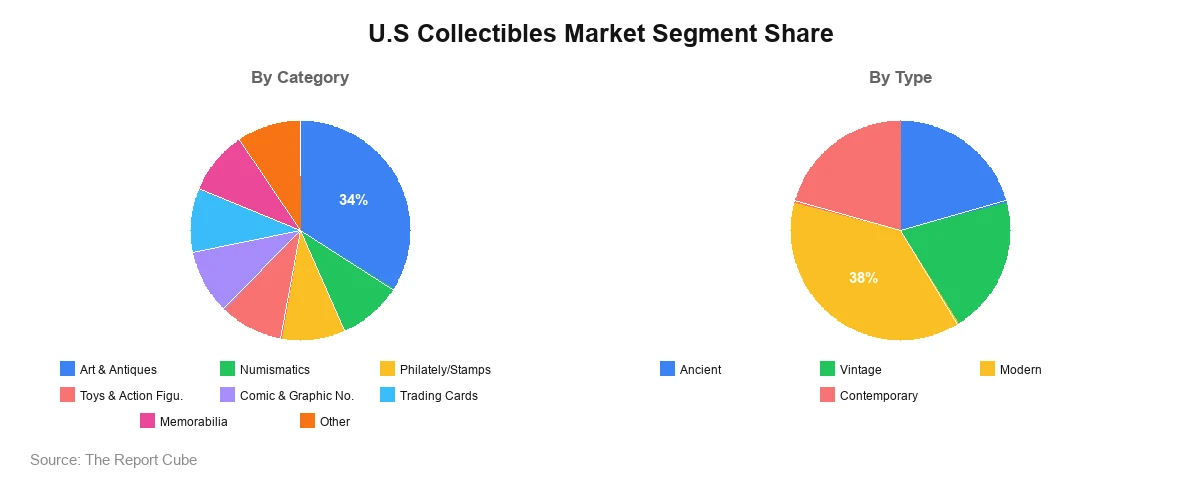
- By category, Art & Antiques is estimated to account for 34% of the market in 2026, according to the supplied market data.
- By type, Modern collectibles are estimated to represent 38% of the market in 2026, according to the supplied market data.
- The market includes art and antiques, coins, stamps, toys, action figures, comics, trading cards, memorabilia, and other collectible products.
- Digital marketplaces, online auctions, authentication services, grading providers, and collector communities are influencing the discovery, valuation, and resale of collectible products.
- Official U.S. Mint data recorded USD 490.1 million in numismatic product revenue during FY2025, demonstrating the commercial activity of the U.S. coin-collecting segment.
- Licensed sports and entertainment properties, limited-edition releases, nostalgia-driven products, and collector-focused experiences are shaping product development and brand competition.
U.S. Collectibles Market Overview
The U.S. collectibles market comprises physical and selected digital products acquired by individuals for their historical, cultural, artistic, entertainment, rarity, or personal significance. Major categories include art and antiques, numismatics, philately, toys and action figures, comic books and graphic novels, trading cards, sports and entertainment memorabilia, and other collectible items. The market includes both newly manufactured collectibles and previously owned objects traded through dealers, auction houses, specialty retailers, conventions, and online resale platforms.
Art and antiques represent an established segment of the market, supported by demand for fine art, historical objects, decorative pieces, rare furniture, and culturally significant artifacts. Numismatics and philately attract collectors interested in coins, currency, medals, stamps, and postal history. Meanwhile, toys, action figures, comics, trading cards, and memorabilia are closely associated with sports, entertainment franchises, gaming, popular culture, and nostalgia. These categories have different buyer profiles, price structures, distribution networks, and valuation practices.
The U.S. Mint provides an official indicator of activity within the numismatic segment. According to its FY2025 Annual Report, the Mint recorded approximately 2.9 million numismatic product units sold and USD 490.1 million in numismatic product revenue. These figures reflect U.S. Mint products rather than the entire secondary coin market or the broader U.S. collectibles industry. The wider market also includes private dealers, auctions, resale transactions, and products from independent manufacturers.
U.S. Collectibles Market Size & Forecast
The U.S. collectibles market is estimated to reach USD 35.59 billion in 2027 and is projected to increase to USD 55.87 billion by 2035. Based on these supplied market values, the market is expected to register a CAGR of approximately 5.80% during the forecast period. The calculated growth rate is consistent with the supplied CAGR after rounding.
The projected expansion reflects demand across several collecting categories, including art and antiques, numismatics, toys and action figures, comics, trading cards, and memorabilia. Online marketplaces, auction platforms, licensed entertainment products, collector-focused retail channels, and authentication services are contributing to the development of the market ecosystem. The forecast figures are supplied market estimates and should not be interpreted as independently verified government statistics.
U.S. Collectibles Market Government Regulations
The U.S. collectibles industry operates under regulatory requirements that vary according to product category, transaction type, and intended consumer. The Internal Revenue Service (IRS) identifies works of art, antiques, coins, stamps, metals, gems, and certain other tangible property as collectibles for specific capital-gains tax provisions. Qualifying net long-term gains from collectibles may be subject to a maximum 28% federal capital-gains rate, depending on the taxpayer's circumstances and applicable tax rules. For toys and action figures designed or intended primarily for children aged 12 or younger, the Consumer Product Safety Commission (CPSC) requires applicable third-party testing and certification under children's product safety regulations, including the incorporated ASTM F963 toy safety standard.
Products containing small parts may also be subject to choking-hazard restrictions and labeling requirements. Online marketplaces are subject to relevant consumer-protection requirements, including provisions under the INFORM Consumers Act that require certain high-volume third-party sellers to provide identifying information and allow consumers to report suspicious activity. Collectibles businesses should also consider applicable intellectual-property, licensing, advertising, import, customs, and state-level consumer-protection requirements. Regulatory obligations differ between adult-oriented display collectibles, children's toys, precious-metal products, and previously owned collectible assets.
U.S. Collectibles Market Dynamics
The U.S. collectibles market is influenced by consumer interest in historical objects, sports and entertainment franchises, limited-edition products, and culturally significant items. Online distribution, licensing arrangements, authentication services, and resale platforms are changing how collectors discover and trade products. At the same time, product safety requirements, counterfeit risks, valuation uncertainty, and changing consumer preferences affect industry participation.
| Factor | Type | Specific Impact on Market | Magnitude |
|---|---|---|---|
| Growing interest in sports and entertainment collectibles | Growth Driver | Sports leagues, entertainment franchises, and licensed intellectual properties support demand for trading cards, action figures, memorabilia, and limited-edition products. | High |
| Expansion of online marketplaces and auction channels | Growth Driver | Digital platforms improve product discovery, expand buyer access, and support primary and secondary-market transactions. | High |
| Growth of authentication and grading services | Market Opportunity | Authentication, condition grading, and provenance services can improve transaction confidence and support specialist services for high-value collectibles. | High |
| Increasing demand for licensed and limited-edition products | Market Opportunity | Exclusive releases, franchise collaborations, and numbered products create opportunities for manufacturers, license holders, and specialist retailers. | High |
| Counterfeit products and uncertain provenance | Industry Challenge | Fake collectibles, altered condition information, and incomplete ownership histories can undermine buyer confidence and increase verification costs. | High |
| Price volatility and speculative resale activity | Industry Challenge | Changes in collector preferences, product supply, rarity perceptions, and resale demand can create unpredictable asset valuations. | High |
| Digital-first collecting and marketplace integration | Market Trend | Online auctions, digital catalogs, marketplace communities, and integrated buying experiences are changing how collectors discover and purchase products. | High |
| Expansion of licensed pop-culture and sports merchandise | Market Trend | Brands are using sports, entertainment, gaming, and nostalgia-related intellectual property to develop new collectible product lines. | High |
Growth Drivers: Increasing Popularity of Sports and Entertainment Collectibles
Growing interest in sports and entertainment franchises is supporting demand for trading cards, autographed memorabilia, action figures, character merchandise, and limited-edition collectibles. Professional sports leagues, athletes, film studios, gaming companies, and entertainment brands provide intellectual property that manufacturers can convert into licensed collectible products. Trading cards are particularly influenced by athlete performance, rookie releases, special editions, autographs, and memorabilia-based inserts. Fanatics Collectibles has expanded its licensed trading-card business through partnerships with major sports organizations, while manufacturers such as Panini and Upper Deck continue to develop sports and entertainment collections. This combination of established fan communities and new product releases supports recurring collector engagement and creates opportunities across manufacturing, distribution, retail, and resale channels.
Market Opportunities: Expansion of Authentication and Collectibles Grading Services
Authentication and grading services represent an important opportunity as collectors increasingly seek reliable information about product originality, condition, and provenance. Rare trading cards, autographed sports memorabilia, vintage toys, coins, and high-value art can require specialist evaluation before purchase or resale. Third-party authentication and grading providers can create value by assessing item condition, verifying signatures or identifying characteristics, assigning standardized grades, and providing protective packaging or certification records. Companies that develop secure verification systems and transparent databases may strengthen their position in the collectibles ecosystem. The opportunity extends beyond grading companies to auction houses, dealers, insurers, and online platforms that integrate authentication into their transaction processes.
Industry Challenges: Counterfeit Collectibles and Authentication Risks
Counterfeit products and uncertain provenance remain important challenges for the collectibles industry. High-value coins, trading cards, autographed memorabilia, luxury collectibles, and rare art can attract fraudulent sellers because buyers may have difficulty independently verifying authenticity. Counterfeit certificates, altered signatures, reprinted cards, misleading condition descriptions, and duplicated digital records can lead to financial losses and reputational damage. Online marketplaces face additional challenges because transactions may involve sellers and buyers who have never interacted directly. Authentication services, verified seller programs, item-level records, secure packaging, and transparent return policies can help reduce these risks. Nevertheless, authentication can be expensive, and no single verification process is equally suitable for every collectibles category.
Need Specific Data, Let’s Customize the Report for You
Request CustomizationMarket Trends: Increasing Adoption of Digital Collectibles Marketplaces
Digital marketplaces are becoming an important part of the collectibles distribution ecosystem. Online platforms allow collectors to browse specialist inventory, participate in auctions, compare prices, and access products from dealers and sellers across the country. Trading-card marketplaces and digital collecting platforms are also combining physical products with online account management, collection tracking, and transaction services. Companies are developing marketplace experiences that support product discovery, live sales, digital catalogs, and collector engagement. Upper Deck's e-Pack platform, for example, connects digital collecting experiences with physical trading-card products. The expansion of online channels is increasing market accessibility, although authentication, transaction security, and seller transparency remain important considerations.
U.S. Collectibles Market Segment Analysis
The U.S. collectibles market is segmented by category, type, and region. Category segmentation covers the primary product groups collected and traded by consumers, including art and antiques, coins, stamps, toys, comics, trading cards, and memorabilia. Type segmentation classifies collectibles according to their historical or production period, while regional segmentation examines demand across the Midwest, West, South, and Northeast. Each segment is influenced by different collector communities, product supply, valuation methods, and distribution channels.
By Category
- Art & Antiques
- Numismatics
- Philately/Stamps
- Toys & Action Figures
- Comic & Graphic Novels
- Trading Cards
- Memorabilia
- Other
Art & Antiques is estimated to account for 34% of the U.S. collectibles market in 2026, based on the supplied market data. This category includes fine art, decorative art, antique furniture, historical objects, rare artifacts, and other items valued for their artistic, cultural, or historical significance. Numismatics covers coins, currency, medals, and related products, supported by collector interest in historical issues, minting variations, precious-metal content, and limited releases. Philately includes postage stamps, postal history, and related collecting materials.
Toys and action figures attract consumers interested in vintage toys, licensed character figures, limited releases, and franchise-based merchandise. Comic books and graphic novels are collected for their historical significance, character popularity, condition, and limited print editions. Trading cards include sports, entertainment, and gaming-related products, with values influenced by player or character popularity, scarcity, condition, and grading. Memorabilia includes signed sports items, historical objects, entertainment artifacts, and other products associated with notable individuals or events. Other includes collectible categories that do not fall directly within the specified segments.
By Type
- Ancient
- Vintage
- Modern
- Contemporary
Modern collectibles are estimated to account for 38% of the U.S. collectibles market in 2026, based on the supplied market data. The Modern category can include collectibles produced during more recent manufacturing and collecting periods, such as contemporary-era coins, toys, trading cards, figures, and memorabilia. Ancient collectibles generally include historical objects from early civilizations and antiquity, while vintage collectibles cover older products valued for their age, rarity, cultural relevance, or historical significance.
Contemporary collectibles include more recent products and releases associated with current entertainment, sports, art, and popular-culture activity. The classification of Modern and Contemporary can vary by product category and research methodology; therefore, consistent production-period definitions are required when calculating segment revenue and market shares.
U.S. Collectibles Market Regional Analysis
The U.S. collectibles market is supported by regional differences in consumer demographics, sports and entertainment interests, antique and art markets, and the concentration of specialist dealers and auction businesses. The Midwest, West, South, and Northeast contain diverse collector communities and distribution networks. Physical retail stores, conventions, auctions, museums, specialist dealers, and digital marketplaces contribute to regional access. Since the supplied dataset does not provide independently verified regional revenue shares, the analysis focuses on regional demand characteristics rather than assigning unsupported market-share percentages.
| Region | Key Growth Factors | Industry Trends |
|---|---|---|
| Midwest | Established sports communities, antique dealers, coin-collecting networks, regional auctions, and specialty retail businesses. | Demand for sports memorabilia, vintage toys, coins, historical objects, and regional collector events. |
| West | Entertainment and gaming industries, technology-driven marketplaces, pop-culture communities, and licensed merchandise businesses. | Growth of character collectibles, limited-edition figures, entertainment trading cards, and digital collector experiences. |
| South | Sports fandom, historical collecting interests, population growth, specialty retail, and regional collector conventions. | Demand for sports memorabilia, coins, antiques, licensed figures, and collectibles connected to popular franchises. |
| Northeast | Established auction houses, art dealers, antique businesses, museums, historical collections, and specialist collector networks. | Continued activity in art and antiques, rare coins, historical memorabilia, stamps, and high-value auction transactions. |
U.S. Collectibles Market Competitive Landscape
The competitive landscape includes manufacturers of licensed figures, toys, trading cards, entertainment merchandise, and coin-related products, as well as companies operating across broader collectibles ecosystems. Competition is influenced by intellectual-property licensing, product design, distribution partnerships, collector engagement, authenticity, limited-edition releases, and brand recognition. The companies listed below have different business models and product specializations. Some are direct manufacturers of collectibles, while others operate across trading cards, games, licensed products, and related merchandise. Their participation should not be interpreted as equal exposure to every category of the U.S. collectibles market.
| Company | Competitive Strength | Primary Segment Served |
|---|---|---|
| Fanatics Inc. | Large sports licensing ecosystem, Topps trading-card brand, and integrated collectibles marketplace and distribution capabilities. | Sports trading cards, sports memorabilia, and licensed collectibles. |
| Funko LLC | Extensive licensed pop-culture product portfolio, recognizable Pop! figures, and direct-to-consumer collector channels. | Toys and action figures, character collectibles, and pop-culture merchandise. |
| Panini Group | International trading-card and sticker expertise, extensive licensing relationships, and established sports and entertainment distribution. | Trading cards, stickers, sports collectibles, and entertainment collectibles. |
| Hasbro Inc. | Established intellectual-property portfolio, global toy and game operations, and licensed consumer-products ecosystem. | Toys, action figures, trading-card games, and franchise-based collectibles. |
| The Upper Deck Company | Sports and entertainment trading cards, authenticated memorabilia, licensing relationships, and collector-focused digital platforms. | Trading cards, sports memorabilia, and entertainment collectibles. |
| Sideshow Inc. | Specialist creator and distributor of premium licensed and original collectible statues, figures, and fine-art products. | Premium action figures, statues, and pop-culture collectibles. |
- Fanatics Inc.: Fanatics has developed a major position in sports collectibles through its Fanatics Collectibles business and the Topps trading-card brand. The company combines licensed trading-card production, sports memorabilia, retail distribution, and online collector experiences. Topps provides an established brand platform across baseball, football, soccer, Formula 1, and entertainment-related products. Fanatics also operates Fanatics Collect, a marketplace connecting buyers and sellers of trading cards and memorabilia. Its licensing relationships with sports leagues and players' associations provide access to official team marks, athlete-related content, and licensed product development. The company's April 2026 agreement involving Topps, the NFL, and NFLPA further supports its position in U.S. football trading cards.
- Funko LLC: Funko competes in the pop-culture collectibles segment through its recognizable Pop! figures and a broad portfolio of licensed products. The company develops collectibles based on film, television, music, gaming, sports, and other entertainment properties. Its product portfolio also includes brands such as Loungefly and Mondo, extending its participation into accessories, art, and other fandom-related merchandise. Funko's direct-to-consumer channels and licensed product range allow it to reach collectors across different price points and fan communities. Its FY2025 reported net sales were USD 908.2 million, compared with USD 1.05 billion in FY2024, demonstrating that company-level performance can fluctuate even within an established collectibles business. In Q3 2026, Funko reported USD 258.3 million in net sales, with Core Collectibles sales increasing 4.8% year over year. These figures relate to Funko's consolidated business and should not be interpreted as total U.S. collectibles market revenue.
Recent Developments and Updates
- November 24, 2026: Panini America announced a trading-card collaboration with Rockstar Games for Grand Theft Auto VI. The partnership expands Panini's entertainment collectibles activity into a major gaming franchise and demonstrates the role of licensed intellectual property in trading-card product development.
- November 5, 2026: Funko reported Q3 2026 net sales of USD 258.3 million, an increase of 3.0% year over year. Core Collectibles sales increased 4.8% to USD 210.1 million. The company reiterated its full-year 2026 net-sales outlook.
- October 29, 2026: Upper Deck announced Tomb Raider trading cards, extending its entertainment licensing portfolio into the video-game franchise. The product is scheduled for spring 2027, with additional card sets and games planned.
U.S. Collectibles Market Report Coverage
The report provides an overview of the U.S. collectibles market, including its estimated market size, forecast growth, major demand factors, market opportunities, industry challenges, competitive landscape, and regional characteristics. It examines the market by category, type, and region, covering art and antiques, numismatics, philately, toys and action figures, comics and graphic novels, trading cards, memorabilia, and other collectible products.
| Parameter | Details |
|---|---|
| Market Name | U.S. Collectibles Market |
| Market Size (2027) | USD 35.59 Billion |
| Market Size (2035) | USD 55.87 Billion |
| CAGR | 5.80% |
| Base Year | 2026 |
| Historical Period | 2022–2026 |
| Forecast Period | 2027–2035 |
| Geographic Scope | United States |
| Segmentation | By Category, By Type, and By Region |
| Regions Covered | Midwest, West, South, and Northeast |
| Key Companies | Fanatics Inc., Funko LLC, Panini Group, Hasbro Inc., The Upper Deck Company, Sideshow Inc., McFarlane, Cryptozoic Entertainment LLC, National Collector's Mint Inc., and Mezco Toyz LLC. |
| Customization | Available based on specific research requirements |
Why Choose This U.S. Collectibles Market Report?
- Provides market size estimates and a forecast overview for the 2027–2035 period.
- Examines major market drivers, opportunities, challenges, and emerging industry trends.
- Analyzes the market across art and antiques, numismatics, stamps, toys, comics, trading cards, memorabilia, and other categories.
- Evaluates market types across Ancient, Vintage, Modern, and Contemporary collectibles.
- Reviews the competitive positioning of major collectibles manufacturers, licensed product companies, and trading-card businesses.
- Includes recent company developments, licensing partnerships, product launches, and relevant regulatory considerations.
- Supports business planning, market-entry research, competitive benchmarking, and investment-related market assessment.
- Offers customization options based on specific product categories, collector segments, competitors, and geographic requirements.
Table of Contents
- Introduction
- Objective of the Study
- Product Definition
- Market Segmentation
- Study Variables
- Research Methodology
- Secondary Data Points
- Companies Interviewed
- Primary Data Points
- Breakdown of Primary Interviews
- Secondary Data Points
- Executive Summary
- Market Dynamics
- Drivers
- Challenges
- Opportunity Assessment
- Recent Trends and Developments
- Policy and Regulatory Landscape
- U.S Collectibles Market Overview and Forecast Analysis (2022-2035)
- Market Size, By Value, By Growth Rate (CAGR/USD Billions)
- Demand – Supply Trends
- Market Share, By Category
- Art & Antiques
- Numismatics
- Philately/Stamps
- Toys & Action Figures
- Comic & Graphic Novels
- Trading Cards
- Memorabilia
- Other
- Market Share, By Type
- Ancient
- Vintage
- Modern
- Contemporary
- Market Share, By Region
- Midwest
- West
- South
- Northeast
- Market Share, By Competitors
- Competition Characteristics
- Revenue Shares
- Art & Antiques U.S Collectibles Market Overview, 2022-2035F
- By Value (USD Million)
- By Type – Market Size & Forecast 2022-2035, USD Million
- Ancient
- Vintage
- Modern
- Contemporary
- Numismatics U.S Collectibles Market Overview, 2022-2035F
- By Value (USD Million)
- By Type – Market Size & Forecast 2022-2035, USD Million
- Ancient
- Vintage
- Modern
- Contemporary
- Philately/Stamps U.S Collectibles Market Overview, 2022-2035F
- By Value (USD Million)
- By Type – Market Size & Forecast 2022-2035, USD Million
- Ancient
- Vintage
- Modern
- Contemporary
- Toys & Action Figures U.S Collectibles Market Overview, 2022-2035F
- By Value (USD Million)
- By Type – Market Size & Forecast 2022-2035, USD Million
- Ancient
- Vintage
- Modern
- Contemporary
- Comic & Graphic Novels U.S Collectibles Market Overview, 2022-2035F
- By Value (USD Million)
- By Type – Market Size & Forecast 2022-2035, USD Million
- Ancient
- Vintage
- Modern
- Contemporary
- Trading Cards U.S Collectibles Market Overview, 2022-2035F
- By Value (USD Million)
- By Type – Market Size & Forecast 2022-2035, USD Million
- Ancient
- Vintage
- Modern
- Contemporary
- Memorabilia U.S Collectibles Market Overview, 2022-2035F
- By Value (USD Million)
- By Type – Market Size & Forecast 2022-2035, USD Million
- Ancient
- Vintage
- Modern
- Contemporary
- Other U.S Collectibles Market Overview, 2022-2035F
- By Value (USD Million)
- By Type – Market Size & Forecast 2022-2035, USD Million
- Ancient
- Vintage
- Modern
- Contemporary
- Competitive Outlook (Company Profile – Partial List)
- Fanatics Inc.
- Company Overview
- Business Segments
- Strategic Alliances/Partnerships
- Recent Developments
- Funko LLC
- Company Overview
- Business Segments
- Strategic Alliances/Partnerships
- Recent Developments
- Panini Group
- Company Overview
- Business Segments
- Strategic Alliances/Partnerships
- Recent Developments
- Hasbro Inc.
- Company Overview
- Business Segments
- Strategic Alliances/Partnerships
- Recent Developments
- The Upper Deck Company
- Company Overview
- Business Segments
- Strategic Alliances/Partnerships
- Recent Developments
- Sideshow Inc.
- Company Overview
- Business Segments
- Strategic Alliances/Partnerships
- Recent Developments
- McFarlane
- Company Overview
- Business Segments
- Strategic Alliances/Partnerships
- Recent Developments
- Cryptozoic Entertainment LLC
- Company Overview
- Business Segments
- Strategic Alliances/Partnerships
- Recent Developments
- National Collector's Mint Inc.
- Company Overview
- Business Segments
- Strategic Alliances/Partnerships
- Recent Developments
- Mezco Toyz LLC.
- Company Overview
- Business Segments
- Strategic Alliances/Partnerships
- Recent Developments
- Fanatics Inc.
- Contact Us & Disclaimer
Top Key Players & Market Share Outlook
- Fanatics Inc
- Funko LLC
- Panini Group
- Hasbro Inc
- The Upper Deck Company
- Sideshow Inc
- McFarlane
- Cryptozoic Entertainment LLC
- National Collector's Mint Inc
- Mezco Toyz LLC
Frequently Asked Questions