


Build Your Custom Market Intelligence Report
Customize Your ReportKey Highlights
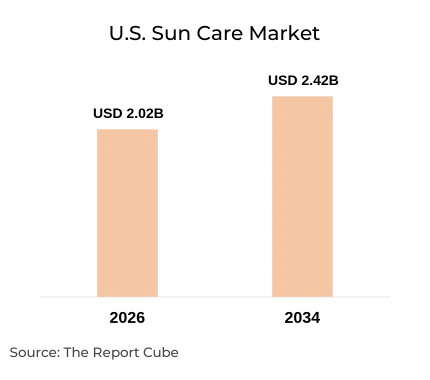
- The U.S. Sun Care Market was valued at USD 2.019 billion in 2026.
- Market size is projected to reach USD 2.421 billion by 2034.
- The market is expected to expand at a CAGR of 2.30% during 2026-2034.
- By product type, sunscreen products form the core category, supported by preventive skincare and UV protection needs.
- Rising skin cancer awareness and the shift from seasonal use to everyday SPF are the main long-term growth drivers.
- In June 2026, the FDA added bemotrizinol to the OTC sunscreen monograph, widening formulation options for manufacturers.
- Edgewell Personal Care, Beiersdorf, Kenvue and L’Oréal compete with premium specialists such as Supergoop! and Shiseido.
Market Outlook
The U.S. Sun Care Market covers consumer products that protect skin from ultraviolet radiation, including sunscreen lotions, creams, sprays, sticks, sunless tanning products and suntan oils. Demand reflects awareness of UV-related skin damage, outdoor recreation and the integration of sun protection into personal care routines.
The market is moving from seasonal sunscreen purchasing towards everyday SPF use and skincare-oriented formulations. Manufacturers compete on mineral ingredients, lightweight textures, multifunctional products and convenient formats. Pharmacies, supermarkets, specialty beauty retailers and e-commerce channels all contribute to product access across the United States.
The U.S. Sun Care Market is estimated at USD 2.019 billion in 2026 and is forecast to reach USD 2.421 billion by 2034, a CAGR of 2.30%. The figures follow a narrow retail definition covering sunscreen, sunless tanning and suntan lotions and oils. Growth is moderate, shaped by premium facial SPF, innovation and repeat purchases, while price sensitivity and category maturity limit expansion. Established brands benefit from distribution reach, and specialists compete through premium positioning.
Government Regulations
Sunscreens in the United States are regulated as over-the-counter (OTC) drugs by the U.S. Food and Drug Administration (FDA) under the OTC monograph system. Manufacturers must meet requirements on permitted active ingredients, concentrations, dosage forms, testing, labelling and effectiveness claims. On June 10, 2026, the FDA issued a final order adding bemotrizinol to the sunscreen monograph (M020), the first active ingredient added in more than 20 years. Products using it may be marketed without a new drug application if they comply with monograph conditions. Public health agencies such as the Centers for Disease Control and Prevention (CDC) reinforce demand by promoting skin cancer prevention. For market participants, the framework raises formulation and compliance costs, but the updated ingredient list creates room for product differentiation and closer alignment with international formulations.
U.S. Sun Care Market Dynamics
Demand in the U.S. Sun Care Market is shaped by public-health awareness, skincare behaviour, regulatory change and product innovation. The category is moving from seasonal protection to daily skincare use. Consumer price sensitivity, inconsistent application and FDA compliance requirements continue to influence manufacturer strategies and the pace of revenue growth.
|
Factor |
Type |
Specific Impact on Market |
Magnitude |
|---|---|---|---|
|
Skin cancer awareness and preventive care |
Driver |
Supports sunscreen and UV-protection purchases |
High |
|
Everyday SPF in skincare routines |
Driver |
Lifts demand for facial and multifunctional SPF products |
Medium-High |
|
FDA monograph expansion |
Opportunity |
New UV-filter options enable formulation innovation |
Medium-High |
|
OTC drug compliance requirements |
Challenge |
Raises testing, labelling and development costs |
Medium |
|
Seasonal and inconsistent usage |
Challenge |
Limits replenishment frequency and revenue growth |
Medium-High |
|
Premium and mineral formulations |
Trend |
Supports higher-value products and ingredient-led differentiation |
Medium-High |
Growth Drivers: Skin Cancer Awareness and Preventive Healthcare
The CDC reports that about 6.1 million U.S. adults are treated each year for basal cell and squamous cell carcinomas, at an estimated annual cost of USD 8.9 billion. These figures keep the health and economic case for UV protection prominent in public messaging. Greater awareness of cumulative sun damage encourages consumers to use sunscreen beyond holidays and beaches, sustaining repeat purchases and supporting demand for broad-spectrum, water-resistant and high-SPF products across age groups and retail channels.
Market Opportunities: Innovation in UV Filters and Sunscreen Formulations
The FDA’s June 2026 addition of bemotrizinol, permitted at concentrations up to 6% under monograph conditions, gives manufacturers a new permitted UV filter. Brands can use it to improve texture, broad-spectrum performance and cosmetic acceptability, particularly in facial and daily-wear products. It may also narrow the formulation gap between U.S. and international sunscreens. Companies with strong research capabilities and regulatory expertise are best placed to turn the new ingredient option into differentiated, premium-positioned launches.
Industry Challenges: Inconsistent Application and Seasonal Purchasing
Despite higher awareness, sunscreen use is not yet a consistent daily habit for many consumers, who still associate it with summer and outdoor leisure. This concentrates purchases in warmer months, creates uneven revenue across the year and limits replenishment frequency. Under-application of each product also reduces volume per user. Because the category is mature, the market’s moderate 2.30% forecast CAGR reflects these behavioural limits, even as innovation and premium products add incremental value.
Need Specific Data, Let’s Customize the Report for You
Request CustomizationMarket Trends: Mineral Formulations and Skincare-Integrated Sun Protection
Manufacturers are developing zinc oxide, titanium dioxide and hybrid formulations alongside tinted, lightweight and multifunctional SPF products that combine protection with hydration or cosmetic benefits. Consumers increasingly weigh ingredient transparency, sensitive-skin suitability and texture. This supports premium facial SPF and brand differentiation, although the pace of premiumisation across the whole category requires verification from official statistical sources, which do not currently publish comparable data.
U.S. Sun Care Market Segment Analysis
The U.S. Sun Care Market is segmented by product type, formulation, application format, SPF protection level, end user, price category and distribution channel. Comparable segment shares are not available from approved government or international sources, so no percentages are shown and no ranking is presented as verified.
By Product Type
- Sunscreen Products
- Sunless Tanning Products
- Suntan Lotions and Oils
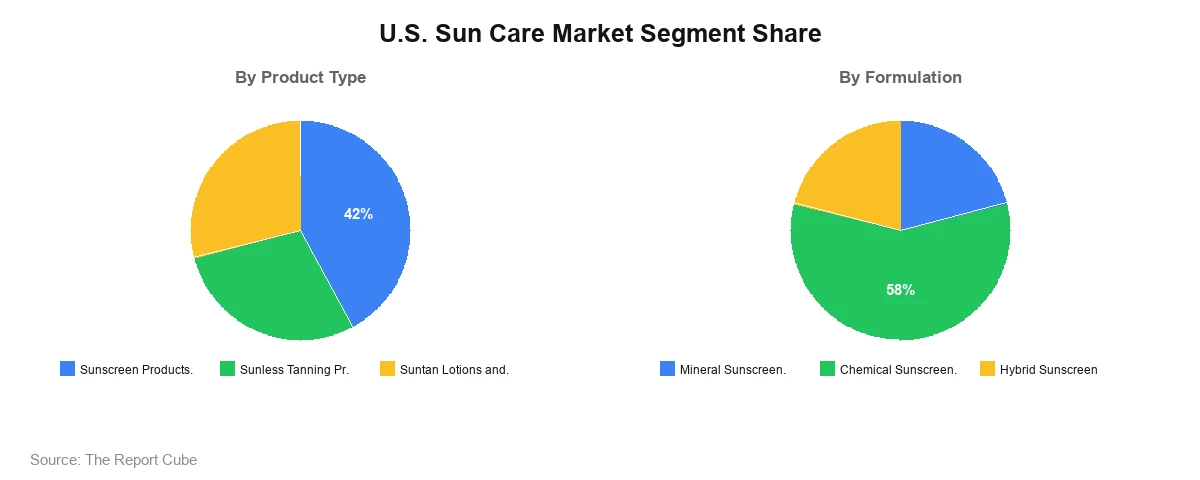
Sunscreen products represent the leading category, accounting for 42% of the broad U.S. Sun Care Market in 2025. The segment includes lotions, creams, sprays, sticks and gels designed to protect against UVA and UVB radiation. Sunless tanning products provide an alternative to UV-based tanning through self-tanning lotions, sprays and mousses. Suntan lotions and oils serve consumers seeking traditional recreational tanning products.
By Formulation
- Mineral Sunscreen
- Chemical Sunscreen
- Hybrid Sunscreen
Chemical sunscreens accounted for 58% of the U.S. sunscreen market in 2025. These formulations use organic UV filters to absorb ultraviolet radiation and are valued for their lightweight textures and cosmetic acceptability. Mineral sunscreens primarily use zinc oxide and titanium dioxide and appeal to consumers seeking mineral-based and sensitive-skin formulations. Hybrid sunscreens combine mineral and chemical UV filters to balance sun protection, formulation performance and application experience.
U.S. Sun Care Market Regional Analysis
Sun protection demand varies with climate, UV exposure, population density, outdoor recreation and consumer purchasing behaviour. Comparable regional retail revenue and share data are not published by approved government or international sources, so no regional shares or regional analysis paragraphs are provided. The table gives a qualitative assessment only.
|
Region |
Key Growth Factors |
Industry Trends |
|---|---|---|
|
Northeast |
Pharmacy retail, urban populations and premium skincare demand |
Facial SPF and skincare-integrated sun protection |
|
Midwest |
Family sun protection and seasonal outdoor recreation |
Seasonal purchasing with family-oriented formats |
|
South |
High outdoor exposure and recreational sunscreen use |
Water-resistant and high-SPF products |
|
West |
Outdoor lifestyle, skincare innovation and premium SPF |
Premium, mineral and multifunctional products |
Competitive Landscape
The U.S. Sun Care Market includes established consumer goods manufacturers, dermatological skincare companies, premium beauty brands and specialist sunscreen makers. Companies compete on brand recognition, UV protection performance, formulation innovation, retail distribution and pricing. The table summarizes capability and segment focus and does not represent market share.
|
Company |
Competitive Strength |
Primary Segment Served |
|---|---|---|
|
Edgewell Personal Care |
Established brands (Banana Boat, Hawaiian Tropic) and broad retail distribution |
Mass-market and family sun care |
|
Beiersdorf |
Coppertone brand and personal-care capabilities |
Traditional and family sunscreen |
|
Kenvue |
Neutrogena brand with skincare integration and consumer familiarity |
Mass-market facial and body sunscreen |
|
L’Oréal |
La Roche-Posay with dermatological positioning and premium distribution |
Premium facial and sensitive-skin SPF |
|
Sun Bum |
Distinctive lifestyle branding with younger consumer appeal |
Beach and lifestyle sunscreen |
|
Supergoop! |
Sunscreen specialisation and premium daily SPF positioning |
Premium facial SPF |
|
Shiseido |
Beauty expertise and premium skincare formulations |
Premium sun protection |
Edgewell Personal Care: Edgewell is a U.S.-listed personal care company that files annual reports with the U.S. Securities and Exchange Commission. Its sun care portfolio includes the Banana Boat and Hawaiian Tropic brands. These brands are positioned in mass-market sunscreen, family protection, sports and outdoor use. Its competitive strength rests on brand recognition and wide retail distribution across the United States.
Kenvue: Kenvue is a consumer health company whose portfolio includes Neutrogena. In sun care, Neutrogena is positioned in mass-market skincare, facial sunscreen and dermatology-oriented protection. Its strength lies in consumer familiarity and integration with broader skincare ranges, which supports daily-use facial SPF. Detailed company-specific facts should be confirmed against Kenvue’s official disclosures before publication.
Recent Developments and Updates
- June 2026: The U.S. Food and Drug Administration issued a final administrative order on June 10, 2026, adding bemotrizinol to the OTC sunscreen monograph. It allows use up to 6% under monograph conditions. This expands formulation options and supports product innovation.
U.S. Sun Care Market Future Outlook
The U.S. Sun Care Market is expected to grow from USD 2.019 billion in 2026 to USD 2.421 billion by 2034, a CAGR of 2.30%. Growth should be steady rather than rapid, supported by everyday SPF adoption, facial and multifunctional formulations, mineral products and new UV-filter options. Convenient formats such as sticks and gels and at-home tanning may add incremental demand across product categories.
Competition is likely to centre on formulation innovation, premium positioning, retail reach and digital engagement. Established manufacturers retain distribution advantages, while specialists compete through skincare benefits and brand identity. Challenges include price sensitivity, seasonality, inconsistent application and evolving FDA requirements. Forecast values are projections, and the later years of the series are analytical extensions rather than officially published figures.
U.S. Sun Care Market Report Coverage
This section summarizes the market definition, valuation, forecast assumptions, segmentation and competitive scope used in this U.S. Sun Care Market report.
|
Parameter |
Details |
|---|---|
|
Market Name |
U.S. Sun Care Market |
|
Market Size (Base Year) |
USD 2.019 billion (2026) |
|
Market Size (Forecast Year) |
USD 2.421 billion (2034) |
|
CAGR |
2.30% |
|
Base Year |
2026 |
|
Historical Period |
2021-2025 |
|
Forecast Period |
2026-2034 |
|
Geographic Scope |
United States |
|
Segmentation |
By Product Type; By Formulation; By Application Format; By SPF Protection Level; By End User; By Price Category; By Distribution Channel |
|
Regions Covered |
Northeast, Midwest, South, West |
|
Key Companies |
Edgewell Personal Care; Beiersdorf; Kenvue; L’Oréal; Sun Bum; Supergoop!; Shiseido |
|
Customization |
Available as per requirement |
Why Choose This U.S. Sun Care Market Report?
- Presents the 2026 valuation, 2034 forecast and 2.30% CAGR with consistent market definitions.
- Covers seven segmentation categories, with leading segments analysed in detail.
- Explains drivers, opportunities, challenges and trends affecting U.S. sun care demand.
- Provides a regional assessment across the Northeast, Midwest, South and West, with unavailable shares disclosed.
- Profiles key manufacturers and specialist brands by strength and segment focus.
- Highlights opportunities in UV-filter innovation, facial SPF and multifunctional products.
- Supports strategic decisions on product development, regulatory compliance and channel strategy.
Table of Contents
- Introduction
- Objective of the Study
- Product Definition
- Market Segmentation
- Study Variables
- Research Methodology
- Secondary Data Points
- Companies Interviewed
- Primary Data Points
- Breakdown of Primary Interviews
- Secondary Data Points
- Executive Summary
- Market Dynamics
- Drivers
- Challenges
- Opportunity Assessment
- Recent Trends and Developments
- Policy and Regulatory Landscape
- U.S. Sun Care Market Overview and Forecast Analysis (2021-2034)
- Market Size, By Value, By Growth Rate (CAGR/USD Billions)
- Demand – Supply Trends
- Market Share, By Product Type
- Sun Protection Products
- Sunless Tanning Products
- Suntan Lotions & Oils
- After-Sun Products
- Market Share, By Formulation
- Mineral-Based
- Chemical-Based
- Hybrid
- Market Share, By Application Format
- Creams
- Lotions
- Gels
- Sprays
- Sticks
- Mousses
- Oils
- Market Share, By SPF Protection Level
- Below SPF 20
- SPF 20–29
- SPF 30–49
- SPF 50–59
- SPF 60 and Above
- Market Share, By Consumer Orientation
- Adults
- Children
- Babies
- Unisex / Family
- Market Share, By Gender
- Male
- Female
- Market Share, By Price Category
- Mass Market
- Mid-Range / Masstige
- Premium
- Prestige / Luxury
- Market Share, By Distribution Channel
- Hypermarkets & Supermarkets
- Pharmacies & Drugstores
- Specialty Beauty Stores
- Department Stores
- Online Retail / E-commerce
- Other Retail Channels
- Market Share, By Region
- Northeast
- Midwest
- South
- West
- Market Share, By Competitors
- Competition Characteristics
- Revenue Shares
- Sun Protection Products U.S. Sun Care Market Overview, 2021-2034F
- By Value (USD Million)
- By Formulation – Market Size & Forecast 2021-2034, USD Million
- Mineral-Based
- Chemical-Based
- Hybrid
- Sunless Tanning Products U.S. Sun Care Market Overview, 2021-2034F
- By Value (USD Million)
- By Formulation – Market Size & Forecast 2021-2034, USD Million
- Mineral-Based
- Chemical-Based
- Hybrid
- Suntan Lotions & Oils U.S. Sun Care Market Overview, 2021-2034F
- By Value (USD Million)
- By Formulation – Market Size & Forecast 2021-2034, USD Million
- Mineral-Based
- Chemical-Based
- Hybrid
- After-Sun Products U.S. Sun Care Market Overview, 2021-2034F
- By Value (USD Million)
- By Formulation – Market Size & Forecast 2021-2034, USD Million
- Mineral-Based
- Chemical-Based
- Hybrid
- Competitive Outlook (Company Profile – Partial List)
- Edgewell Personal Care
- Company Overview
- Business Segments
- Strategic Alliances/Partnerships
- Recent Developments
- Beiersdorf AG
- Company Overview
- Business Segments
- Strategic Alliances/Partnerships
- Recent Developments
- L'Oréal S.A.
- Company Overview
- Business Segments
- Strategic Alliances/Partnerships
- Recent Developments
- Kenvue
- Company Overview
- Business Segments
- Strategic Alliances/Partnerships
- Recent Developments
- Shiseido Company
- Company Overview
- Business Segments
- Strategic Alliances/Partnerships
- Recent Developments
- Unilever PLC
- Company Overview
- Business Segments
- Strategic Alliances/Partnerships
- Recent Developments
- The Estée Lauder Companies
- Company Overview
- Business Segments
- Strategic Alliances/Partnerships
- Recent Developments
- Procter & Gamble
- Company Overview
- Business Segments
- Strategic Alliances/Partnerships
- Recent Developments
- Clarins Group
- Company Overview
- Business Segments
- Strategic Alliances/Partnerships
- Recent Developments
- Others
- Company Overview
- Business Segments
- Strategic Alliances/Partnerships
- Recent Developments
- Edgewell Personal Care
- Contact Us & Disclaimer
Top Key Players & Market Share Outlook
- Edgewell Personal Care
- Beiersdorf AG
- L'Oréal S.A.
- Kenvue
- Shiseido Company
- Unilever PLC
- The Estée Lauder Companies
- Procter & Gamble
- Clarins Group
- Others
Frequently Asked Questions