




Build Your Custom Market Intelligence Report
Customize Your ReportChina Veterinary Medicine Market Key Highlights
By Product:
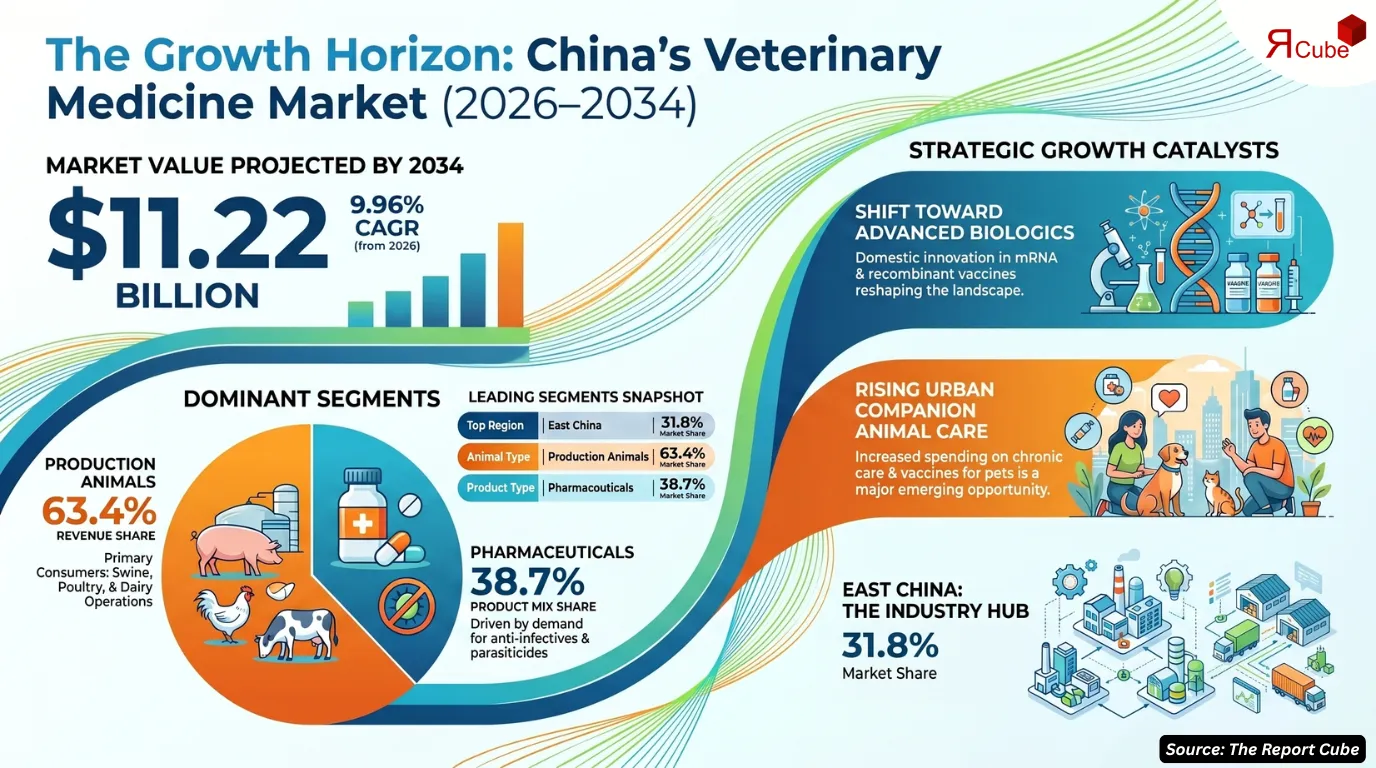
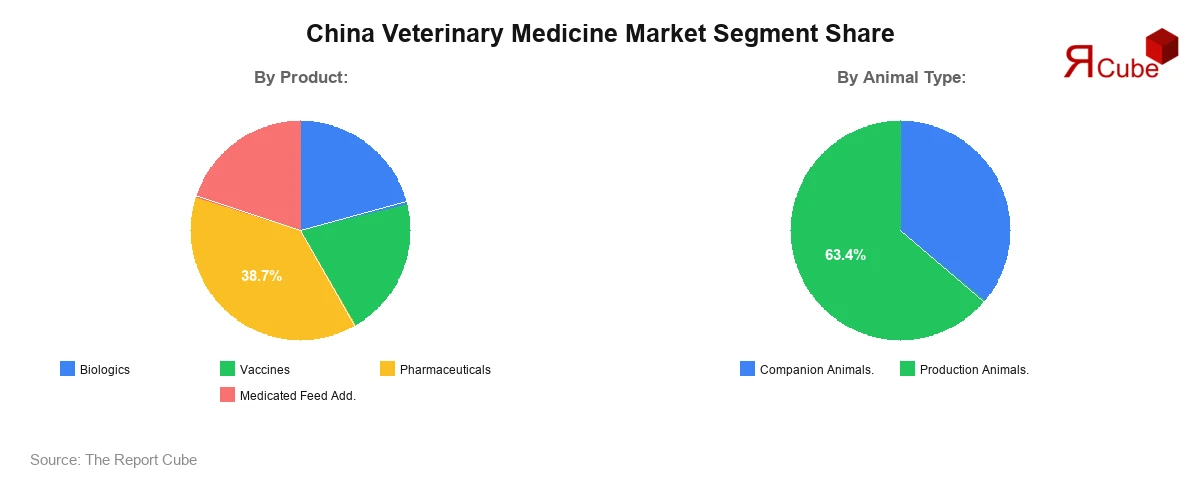
Pharmaceuticals segment leads the market with approximately 38.7% share.
By Animal Type:
Production Animals segment dominates the market with nearly 63.4% of revenue.
Regional Outlook:
East region dominates the China Veterinary Medicine Market with around 31.8% share.
China Veterinary Medicine Market Insights & Analysis
The China Veterinary Medicine Market is anticipated to register a CAGR of around 9.96% during the forecast period 2026-2034. The market size is valued at USD 5.25 billion in 2026 and is projected to reach USD 11.22 billion by 2034. Growth is being supported by the continued modernization of China's livestock sector, where large-scale farming operations are increasingly prioritizing disease prevention, productivity optimization, and compliance with stricter animal health standards. China remains the world's largest pork producer and one of the leading poultry-producing nations, creating sustained demand for veterinary vaccines, anti-infectives, parasiticides, and feed-based health solutions. Industry participants are expanding manufacturing capacity and investing in advanced biologics to address evolving disease challenges across commercial animal production systems.
Companion animal healthcare is becoming an increasingly important contributor to the China animal medicine market. Rising pet ownership across urban centers such as Shanghai, Beijing, Shenzhen, and Guangzhou has significantly increased spending on veterinary consultations, preventive vaccines, chronic disease management, and specialty pharmaceuticals. Regulatory efforts by the Ministry of Agriculture and Rural Affairs (MARA) to improve veterinary drug quality and traceability are further strengthening market confidence. Simultaneously, domestic companies are accelerating innovation in recombinant vaccines, precision biologics, and next-generation therapeutic products. These developments, combined with expanding veterinary healthcare infrastructure and digital distribution networks, are expected to support long-term market growth through 2034.
China Veterinary Medicine Market Impact Analysis
| Factor | Type | Specific Impact on Market | Magnitude | Business Implication |
|---|---|---|---|---|
| Rising Pet Ownership Nationwide | Consumer | More companion animals increase demand for chronic care drugs | High | Supports portfolio expansion in companion animal therapeutics |
| Expansion of Livestock Production | Market | Higher meat and dairy output raises need for herd health control | High | Strengthens demand for antiinfectives and preventive programs |
| Emergence of New Animal Diseases | Environmental | Outbreak risks drive vaccination and treatment requirements | High | Increases uptake of vaccines and emergency response products |
| Government Focus on Animal Health Laws | Regulatory | Stricter epidemic control rules raise compliance obligations | Medium | Rewards firms with strong pharmacovigilance and quality systems |
| Shift Toward Biologics and Vaccines | Technological | Faster growth of biologics changes revenue mix for suppliers | Medium | Requires R&D investment in advanced vaccine platforms |
| Entry of Multinational Pharma Players | Competitive | Global brands intensify competition in premium drug segments | Medium | Drives differentiation via local partnerships and pricing models |
| Regulated Import and Registration Process | Regulatory | Complex approvals extend time to market for new therapies | Medium | Necessitates early planning and local regulatory expertise |
China Veterinary Medicine Market Dynamics
Key Driver: Expansion of Intensive Livestock Farming and Animal Disease Prevention Programs
China's livestock industry continues to transition toward larger and more technologically advanced farming operations. Commercial producers are investing heavily in preventive animal healthcare to reduce mortality rates, improve feed conversion efficiency, and protect production output from disease outbreaks. Veterinary medicines have become an essential component of herd and flock management strategies, particularly within the swine, poultry, and dairy sectors. The recurring threat of economically damaging diseases has increased the importance of vaccination programs and routine pharmaceutical interventions throughout the production cycle.
Government-supported disease surveillance initiatives and stricter biosecurity requirements have further strengthened demand for veterinary products. Large livestock enterprises increasingly implement structured health management protocols that include preventive vaccination schedules, anti-parasitic treatments, and disease monitoring systems. Industry assessments indicate that veterinary healthcare expenditure per commercial livestock unit has steadily increased over recent years, reflecting growing awareness of the financial benefits associated with proactive disease management. This trend is expected to remain a major growth catalyst for the China veterinary medicine market during the forecast period.
Industry Trends: Rapid Advancement of Veterinary Biologics and Localized Innovation
Investment in veterinary biologics is reshaping the competitive landscape of China's animal health industry. Domestic manufacturers are allocating larger research budgets toward recombinant vaccines, attenuated biological products, and advanced immunological technologies designed to improve disease prevention outcomes. Increased emphasis on innovation is helping local companies strengthen their position in a market that was historically influenced by multinational animal health providers. The growing acceptance of biologics among livestock operators reflects a broader industry shift toward preventive healthcare solutions.
Technology-driven product development has become particularly visible in the vaccine segment. The completion of dedicated animal mRNA vaccine production infrastructure by leading domestic manufacturers signals a significant evolution in China's veterinary biotechnology capabilities. Research efforts are expanding beyond traditional livestock applications to include companion animal health and emerging infectious disease prevention. As commercialization of advanced biological products accelerates, the biologics segment is expected to record one of the fastest growth rates within the China veterinary medicine market over the next decade.
Book your FREE 30-minute expert consultation today
Contact UsMajor Challenge: Regulatory Complexity and Rising Product Development Costs
Developing and commercializing veterinary medicines in China requires compliance with comprehensive regulatory standards covering product safety, efficacy, manufacturing quality, and post-market monitoring. While these requirements support industry credibility and animal welfare objectives, they also increase development timelines and investment requirements. Manufacturers must complete extensive testing, documentation, and approval procedures before introducing new products to the market, particularly for innovative biological formulations.
The financial burden associated with research, facility upgrades, quality control systems, and regulatory compliance can be significant for smaller market participants. Companies pursuing advanced technologies such as recombinant vaccines or novel therapeutics often face extended commercialization timelines before achieving meaningful returns on investment. In addition, evolving regulations regarding antimicrobial usage and veterinary drug monitoring require continuous adaptation by manufacturers and distributors. These factors create operational challenges that may influence market expansion strategies across the industry.
Opportunity: Companion Animal Healthcare and Advanced Vaccine Technologies
China's companion animal population has expanded considerably over the past decade, creating attractive opportunities for veterinary pharmaceutical manufacturers. Pet owners are increasingly seeking preventive healthcare services, routine vaccinations, dermatology treatments, nutritional supplements, and chronic disease therapies for dogs and cats. This shift reflects changing household spending patterns and a stronger focus on pet wellness. Veterinary hospitals and specialized clinics are expanding service offerings to meet growing demand for advanced animal healthcare solutions.
At the same time, emerging vaccine technologies present substantial long-term growth potential. Increased investment in mRNA platforms, recombinant biological products, and precision immunization solutions is opening new avenues for disease prevention across both livestock and companion animal segments. Manufacturers that successfully combine innovative technologies with localized production capabilities are expected to gain a competitive advantage. These developments position the China animal medicine market for sustained expansion as healthcare standards continue to advance throughout the country's animal health ecosystem.
China Veterinary Medicine Market Segment-wise Analysis
By Product:
- Biologics
- Recombinant
- Attenuated
- Inactivated
- Others
- Vaccines
- Other Biologics
- Pharmaceuticals
- Parasiticides
- Analgesics
- Anti-inflammatory drugs
- Anti-infectives
- Others
- Medicated Feed Additives
- Antibiotics & antimicrobials
- Amino acids
- Others
Pharmaceuticals are projected to maintain their leadership position in the China veterinary medicine market, accounting for approximately 38.7% of total revenue in 2026. Their dominant position reflects extensive utilization across livestock and companion animal healthcare applications. Anti-infectives continue to generate substantial demand due to their role in managing bacterial infections and supporting herd health programs. Parasiticides and anti-inflammatory products also record strong adoption rates, particularly within commercial farming operations where disease-related productivity losses can have significant economic consequences.
The segment benefits from established prescribing practices, broad product availability, and widespread distribution through veterinary hospitals, pharmacies, agricultural supply stores, and online channels. Although biologics are expanding at a faster pace, pharmaceuticals remain the largest revenue-generating category due to their versatility, affordability, and critical role in routine animal healthcare management.
By Animal Type:
- Companion Animals
- Cats
- Horses
- Dogs
- Others
- Production Animals
- Pigs
- Cattle
- Poultry
- Sheep & Goats
- Others
Production animals account for the largest share of the China animal medicine market, representing approximately 63.4% of industry revenue. The segment's leadership is supported by China's vast livestock population and the economic importance of pork, poultry, dairy, and beef production. Commercial producers increasingly rely on veterinary medicines to enhance productivity, maintain animal welfare standards, and reduce disease-related financial losses. Vaccination programs, feed additives, anti-parasitic treatments, and therapeutic pharmaceuticals are routinely integrated into farm management practices.
Growing investments in biosecurity infrastructure and disease prevention strategies continue to support product demand across major livestock categories. While companion animal healthcare is expanding rapidly, production animals remain the primary revenue source due to the scale and frequency of veterinary medicine utilization within commercial agricultural operations.
Regional Projection of China Veterinary Medicine Industry
- North
- Northeast
- East
- South Central
- Southwest
- Northwest
East China is expected to remain the leading regional market, accounting for approximately 31.8% of total revenue throughout the forecast period. The region benefits from a highly developed agricultural sector, strong veterinary healthcare infrastructure, and a significant concentration of pharmaceutical and biotechnology manufacturers. Provinces such as Jiangsu, Zhejiang, and Shandong serve as important centers for animal production and veterinary product manufacturing, creating a favorable environment for industry growth.
Economic development across East China has also contributed to higher spending on companion animal healthcare services and premium veterinary products. The presence of leading domestic producers, research institutions, and advanced distribution networks supports rapid commercialization of new veterinary medicines. Furthermore, strong logistics capabilities facilitate efficient product delivery across both urban and rural markets. Continued investment in biotechnology innovation, livestock modernization, and veterinary healthcare infrastructure is expected to preserve East China's leadership position within the China veterinary medicine market through 2034.
Need insights for a specific region within this market?
Request Regional DataChina Veterinary Medicine Market Regional Analysis
The China veterinary medicine market shows strong regional variation in livestock intensity, farm scale, and animal health policies.
| Region | Demand Level | Key Areas | Product Dominance | Core Demand Logic | Growth Nature |
|---|---|---|---|---|---|
| North | High | Beijing, Hebei, Inner Mongolia | Antibiotics & vaccines | Large cattle and dairy clusters | Policy-led herd health upgrade |
| Northeast | High | Heilongjiang, Jilin, Liaoning | Vaccines & feed additives | Key grain and pig farming belt | State-backed farm expansion |
| East | Very High | Shandong, Jiangsu, Shanghai | Companion and swine drugs | Dense hog farms and pet owners | Value-added clinical products |
| South Central | Very High | Henan, Hubei, Guangdong | Poultry and swine vaccines | Intensive poultry and pig output | Fastest farm-scale driven growth |
| Southwest | Medium | Sichuan, Yunnan, Chongqing | Parasiticides & biologics | Mixed backyard and commercial herds | Formalization of smallholders |
| Northwest | Medium | Shaanxi, Gansu, Xinjiang | Ruminant health products | Pastoral sheep and beef systems | Gradual, infrastructure-linked |
Government Initiatives & Policies
- National Animal Epidemic Prevention Plan (2025-2030): China's Ministry of Agriculture and Rural Affairs continues strengthening surveillance, vaccination programs, and disease prevention systems for major livestock diseases, supporting broader adoption of veterinary medicines and biologics.
- National Veterinary Drug Safety Monitoring Program 2026: The program enhances veterinary drug quality supervision, antimicrobial stewardship, and product traceability, encouraging industry modernization and safer animal healthcare practices.
China Veterinary Medicine Industry Recent Developments
- 2025: Tianjin Ringpu Bio-Technology completed static acceptance of its dedicated animal mRNA vaccine production line in China. The facility supports product development for livestock, companion animals, and ruminants. The company also accumulated 124 new veterinary drug registration certificates and 339 authorized patents, strengthening innovation capabilities within China's veterinary biologics sector.
- 2025: Virbac launched its first locally manufactured veterinary product in China through a domestic manufacturing partnership focused on companion animal healthcare. The initiative covers research, development, and production activities, enabling faster market access, improved localization, and stronger competitiveness within China's rapidly growing pet healthcare segment.
Why Choose This Report?
- Provides a comprehensive overview of the overall market analysis, encompassing key trends, consumer behavior analysis, and risk assessment to support strategic decision-making.
- Provides accurate, up-to-date insights into market size, segmentation, and emerging opportunities, helping to minimize risk & capitalizing on growth.
- Gives deep understanding of target audience preferences, investment habits, and communication channels for enhanced product development & marketing effectiveness.
- Delivers competitive analysis & benchmarking, uncovering the strengths & weaknesses of market competitors to guide strategies.
- Consolidate comprehensive market intelligence, reducing reasoning & streamlining research efforts.
- Facilitates customized market segmentation & risk mitigation strategies, fine-tuned to the business objectives.
- Aids in identifying both market challenges & untapped opportunities within the industry to drive long-term business growth.
- Provides valuable information based on actual customer data & search trends.
Table of Contents
- Introduction
- Objective of the Study
- Product and Category Definition
- Market Segmentation
- Study Variables
- Research Methodology
- Secondary Data Points
- Breakdown of Secondary Sources
- Primary Data Points
- Breakdown of Primary Interviews
- Secondary Data Points
- Executive Summary
- Market Dynamics
- Emerging Opportunities
- Adoption Trends
- Demand Drivers
- Disruption Analysis (Challenges)
- Industry Analysis & Strategic Insights
- Supply/Value Chain Analysis
- Pricing Analysis
- Go-To-Market (GTM) Strategy
- BCG Matrix
- Recent Trends and Developments
- Import and Export Analysis
- Regulatory and Policy Landscape
- Region-wise policies
- Government Initiatives
- China Veterinary Medicine Market Overview and Forecast Analysis (2021-2034)
- Market Size, By Value, By Growth Rate (CAGR/USD Billion)
- Market Share, By Product
- Biologics
- Recombinant
- Attenuated
- Inactivated
- Others
- Vaccines
- Other Biologics
- Pharmaceuticals
- Parasiticides
- Analgesics
- Anti-inflammatory drugs
- Anti-infectives
- Others
- Medicated Feed Additives
- Antibiotics & antimicrobials
- Amino acids
- Others
- Biologics
- Market Share, By Animal Type
- Companion Animals
- Cats
- Horses
- Dogs
- Others
- Production Animals
- Pigs
- Cattle
- Poultry
- Sheep & Goats
- Others
- Companion Animals
- Market Share, By Route of Administration
- Topical
- Oral
- Injectable
- Other Routes of Administration
- Market Share, By Purpose
- Gastrointestinal Diseases
- Respiratory Diseases
- Parasitic Diseases
- Infectious Diseases
- Reproductive Disorders
- Pain & Inflammation Management
- Others
- Market Share, By End User
- Pet Care Centers
- Livestock Farms
- Animal Owners
- Veterinary Hospitals & Clinics
- Research Institutes
- Others
- Market Share, By Distribution Channel
- E-commerce Platforms
- Veterinary Pharmacies
- Agricultural Supply Stores
- Veterinary Hospitals & Clinics
- Others
- Market Share, By Prescription Type
- Over-the-Counter Medicines
- Prescription Medicines
- Market Share, By Region
- North
- Northeast
- East
- South Central
- Southwest
- Northwest
- Market Share, By Company
- Revenue Shares & Analysis
- Competitive Landscape
- North China Veterinary Medicine Market Overview and Forecast Analysis (2021-2034)
- Market Size, By Value, By Growth Rate (CAGR/USD Billion/Million)
- Market Share, By Product
- Market Share, By Animal Type
- Market Share, By Route of Administration
- Market Share, By Purpose
- Market Share, By End User
- Market Share, By Distribution Channel
- Market Share, By Prescription Type
- Northeast China Veterinary Medicine Market Overview and Forecast Analysis (2021-2034)
- Market Size, By Value, By Growth Rate (CAGR/USD Billion/Million)
- Market Share, By Product
- Market Share, By Animal Type
- Market Share, By Route of Administration
- Market Share, By Purpose
- Market Share, By End User
- Market Share, By Distribution Channel
- Market Share, By Prescription Type
- East China Veterinary Medicine Market Overview and Forecast Analysis (2021-2034)
- Market Size, By Value, By Growth Rate (CAGR/USD Billion/Million)
- Market Share, By Product
- Market Share, By Animal Type
- Market Share, By Route of Administration
- Market Share, By Purpose
- Market Share, By End User
- Market Share, By Distribution Channel
- Market Share, By Prescription Type
- South Central China Veterinary Medicine Market Overview and Forecast Analysis (2021-2034)
- Market Size, By Value, By Growth Rate (CAGR/USD Billion/Million)
- Market Share, By Product
- Market Share, By Animal Type
- Market Share, By Route of Administration
- Market Share, By Purpose
- Market Share, By End User
- Market Share, By Distribution Channel
- Market Share, By Prescription Type
- Southwest China Veterinary Medicine Market Overview and Forecast Analysis (2021-2034)
- Market Size, By Value, By Growth Rate (CAGR/USD Billion/Million)
- Market Share, By Product
- Market Share, By Animal Type
- Market Share, By Route of Administration
- Market Share, By Purpose
- Market Share, By End User
- Market Share, By Distribution Channel
- Market Share, By Prescription Type
- Northwest China Veterinary Medicine Market Overview and Forecast Analysis (2021-2034)
- Market Size, By Value, By Growth Rate (CAGR/USD Billion/Million)
- Market Share, By Product
- Market Share, By Animal Type
- Market Share, By Route of Administration
- Market Share, By Purpose
- Market Share, By End User
- Market Share, By Distribution Channel
- Market Share, By Prescription Type
- Competitive Analysis, 2026
- Market Share of Key Players
- Competitive Mapping for Each Segment and Companies Operating Regionally
- North China Veterinary Medicine Companies Share & Competitive Analysis, 2026
- Northeast China Veterinary Medicine Companies Share & Competitive Analysis, 2026
- East China Veterinary Medicine Companies Share & Competitive Analysis, 2026
- South Central China Veterinary Medicine Companies Share & Competitive Analysis, 2026
- Southwest China Veterinary Medicine Companies Share & Competitive Analysis, 2026
- Northwest China Veterinary Medicine Companies Share & Competitive Analysis, 2026
- Company Profile (Partial List)
- Pulike
- Company Overview
- Product Portfolio
- Strategic Alliances/Partnerships
- Recent Developments
- Elanco Animal Health
- Company Overview
- Product Portfolio
- Strategic Alliances/Partnerships
- Recent Developments
- Qilu Animal Health
- Company Overview
- Product Portfolio
- Strategic Alliances/Partnerships
- Recent Developments
- Jinhe
- Company Overview
- Product Portfolio
- Strategic Alliances/Partnerships
- Recent Developments
- Zoetis
- Company Overview
- Product Portfolio
- Strategic Alliances/Partnerships
- Recent Developments
- Hisun Animal Health
- Company Overview
- Product Portfolio
- Strategic Alliances/Partnerships
- Recent Developments
- Ceva Santé Animale
- Company Overview
- Product Portfolio
- Strategic Alliances/Partnerships
- Recent Developments
- Shengli Bio
- Company Overview
- Product Portfolio
- Strategic Alliances/Partnerships
- Recent Developments
- Ringpu
- Company Overview
- Product Portfolio
- Strategic Alliances/Partnerships
- Recent Developments
- Tairui
- Company Overview
- Product Portfolio
- Strategic Alliances/Partnerships
- Recent Developments
- Boehringer Ingelheim Animal Health
- Company Overview
- Product Portfolio
- Strategic Alliances/Partnerships
- Recent Developments
- Merck Animal Health
- Company Overview
- Product Portfolio
- Strategic Alliances/Partnerships
- Recent Developments
- Weierli
- Company Overview
- Product Portfolio
- Strategic Alliances/Partnerships
- Recent Developments
- CAHIC
- Company Overview
- Product Portfolio
- Strategic Alliances/Partnerships
- Recent Developments
- Veyong
- Company Overview
- Product Portfolio
- Strategic Alliances/Partnerships
- Recent Developments
- Others (Partial List)
- Pulike
- Contact Us and Disclaimer
Top Key Players & Market Share Outlook
- Pulike
- Elanco Animal Health
- Qilu Animal Health
- Jinhe
- Zoetis
- Hisun Animal Health
- Ceva Santé Animale
- Shengli Bio
- Ringpu
- Tairui
- Boehringer Ingelheim Animal Health
- Merck Animal Health
- Weierli
- CAHIC
- Veyong
Frequently Asked Questions






