



Build Your Custom Market Intelligence Report
Customize Your ReportGlobal Biologics Market Insights & Analysis
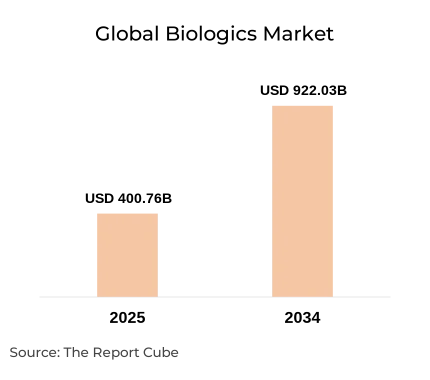
The Global Biologics Market is anticipated to register a CAGR of 9.7% during the forecast period 2026-2034. The market size was valued at USD 400.76 Billion in 2025 and is projected to reach USD 922.03 Billion by 2034. This sustained expansion reflects the growing reliance on biologic therapies for the treatment of complex, chronic, and life-threatening diseases where traditional small-molecule drugs often deliver limited efficacy. Biologics have become central to modern therapeutic strategies due to their high specificity, ability to target disease mechanisms at the molecular level, and improving long-term patient outcomes.
The biologics market has evolved rapidly over the past decade, driven by advances in biotechnology, genetic engineering, and cell culture technologies. Pharmaceutical companies are increasingly prioritizing biologic pipelines, as these products offer differentiated clinical value, strong intellectual property protection, and long commercial lifecycles. Rising prevalence of cancer, autoimmune disorders, diabetes, and rare diseases is intensifying demand for advanced biologic treatments. In parallel, supportive regulatory pathways, accelerated approvals, and expanding biologics manufacturing capacity are strengthening global market momentum, particularly across oncology and immunology segments.
Global Biologics Market Recent Developments
- 2025: Roche expanded its biologics manufacturing footprint to support growing oncology and immunology product demand.
- 2025: AbbVie advanced late-stage clinical development of next-generation monoclonal antibody therapies.
Government Initiatives & Policies
- U.S. FDA Biologics Regulatory Modernization: Supports faster approvals and enhanced review frameworks for biologic therapies.
- EU Pharmaceutical Strategy: Encourages innovation and access to advanced biologics across member states.

Global Biologics Market Dynamics
Key Driver: Rising Burden of Chronic and Complex Diseases
The primary driver of the global biologics market is the rising global burden of chronic, autoimmune, oncological, and rare diseases. Conditions such as cancer, rheumatoid arthritis, multiple sclerosis, diabetes, and inflammatory bowel disease continue to increase due to aging populations, lifestyle changes, and improved diagnostic rates. Biologics offer targeted mechanisms of action that improve disease control, reduce side effects, and enhance patient quality of life compared to conventional therapies. Oncology alone accounts for a significant share of biologics development, with immuno-oncology agents and monoclonal antibodies reshaping cancer treatment paradigms. As disease prevalence rises globally, biologics adoption is expected to accelerate further.
Major Challenge: High Development Costs and Pricing Pressures
A major challenge facing the biologics market is the high cost associated with research, development, manufacturing, and commercialization. Biologics require complex production processes involving living cells, stringent quality controls, and cold-chain logistics, all of which significantly increase costs. These high expenses translate into premium pricing, creating affordability and reimbursement challenges in both developed and emerging markets. Governments and payers are increasingly scrutinizing biologic drug pricing, leading to pressure on manufacturers to demonstrate cost-effectiveness and clinical value. Additionally, biosimilar competition is intensifying price pressure on established biologics.
Industry Trends: Expansion of Cell and Gene Therapies
A key trend shaping the biologics market is the rapid expansion of cell and gene therapy products. These advanced biologics offer transformative potential by addressing diseases at their genetic or cellular roots rather than managing symptoms. Gene therapies for rare genetic disorders and CAR-T cell therapies for oncology are gaining regulatory approvals and attracting significant investment. Although these therapies currently serve smaller patient populations, their high clinical impact and premium pricing contribute meaningfully to overall market value. Continued innovation in vector design, manufacturing scalability, and delivery technologies is expected to broaden their applicability.
Opportunity Ahead: Growth in Emerging Markets and Biosimilars
Emerging markets present significant growth opportunities for biologics manufacturers due to expanding healthcare infrastructure, rising income levels, and increasing access to advanced therapies. Countries in Asia Pacific and Latin America are investing in domestic biologics manufacturing and regulatory harmonization. At the same time, the growing acceptance of biosimilars offers opportunities to expand patient access while maintaining sustainable healthcare spending. Companies that strategically balance innovation with biosimilar portfolios are well positioned to capture long-term growth across diverse markets.
Global Biologics Market Segment-wise Analysis
By Product Type:
- Monoclonal Antibodies
- Vaccines
- Recombinant Proteins
- Fusion Proteins
- Cell and Gene Therapy Products
- Other Biologic Products
Monoclonal antibodies dominate the global biologics market, accounting for approximately 49% of total revenue in 2025. Their dominance is driven by widespread use in oncology, autoimmune disorders, and inflammatory diseases. These products offer high specificity and predictable safety profiles, making them preferred treatment options across multiple therapy areas. Vaccines represent a significant segment supported by immunization programs and innovation in mRNA and recombinant vaccine technologies. Cell and gene therapies, while smaller in volume, are among the fastest-growing segments due to their transformative clinical potential.
By Therapy Area:
- Oncology
- Autoimmune and Inflammatory Diseases
- Infectious Diseases
- Endocrine and Metabolic Disorders
- Cardiovascular and Other Chronic Diseases
- Other Therapy Areas
Oncology represents the leading therapy area, contributing nearly 38% of total biologics market revenue in 2025. The segment benefits from continuous innovation in immunotherapies, checkpoint inhibitors, and targeted biologics. Autoimmune and inflammatory diseases follow closely, driven by long-term treatment needs and expanding indications. Endocrine and metabolic disorders, particularly diabetes and growth hormone deficiencies, also contribute steady demand, supported by chronic disease management requirements.
Regional Projection of Global Biologics Industry
- North America
- Europe
- Asia Pacific
- Middle East and Africa
- South America
North America leads the global biologics market, accounting for approximately 44% of total revenue in 2025. The region benefits from strong research infrastructure, high healthcare spending, and early adoption of advanced biologic therapies. Europe follows closely, supported by robust regulatory frameworks and widespread biologics utilization across public healthcare systems. Asia Pacific is the fastest-growing region due to expanding patient populations, increasing biologics manufacturing capacity, and supportive government initiatives. The Middle East and Africa and South America show steady growth as access to advanced therapies improves.
Why Choose This Report?
- Provides a comprehensive overview of the overall market analysis, encompassing key trends, consumer behavior analysis, and risk assessment to support strategic decision-making.
- Provides accurate, up-to-date insights into market size, segmentation, and emerging opportunities, helping to minimize risk & capitalizing on growth.
- Gives deep understanding of target audience preferences, investment habits, and communication channels for enhanced product development & marketing effectiveness.
- Delivers competitive analysis & benchmarking, uncovering the strengths & weaknesses of market competitors to guide strategies.
- Consolidate comprehensive market intelligence, reducing reasoning & streamlining research efforts.
- Facilitates customized market segmentation & risk mitigation strategies, fine-tuned to the business objectives.
- Aids in identifying both market challenges & untapped opportunities within the industry to drive long-term business growth.
- Provides valuable information based on actual customer data & search trends.
Table of Contents
- Introduction
- Objective of the Study
- Product and Category Definition
- Market Segmentation
- Study Variables
- Research Methodology
- Secondary Data Points
- Breakdown of Secondary Sources
- Primary Data Points
- Breakdown of Primary Interviews
- Secondary Data Points
- Executive Summary
- Market Dynamics
- Drivers
- Challenges
- Opportunity Assessment
- Recent Trends and Developments
- Regulatory and Policy Landscape
- Global Biologics Market Overview (2020-2034)
- Market Size, By Value (USD Billion)
- Market Share, By Product Type
- Monoclonal Antibodies
- Vaccines
- Recombinant Proteins
- Fusion Proteins
- Cell and Gene Therapy Products
- Other Biologic Products
- Market Share, By Therapy Area
- Oncology
- Autoimmune and Inflammatory Diseases
- Infectious Diseases
- Endocrine and Metabolic Disorders
- Cardiovascular and Other Chronic Diseases
- Other Therapy Areas
- Market Share, By End Use
- Hospitals
- Specialty Clinics
- Diagnostic and Research Centers
- Retail and Online Pharmacies
- Other End Use Settings
- Market Share, By Manufacturing Type
- In-house Manufacturing
- Contract Manufacturing Organizations (CMOs/CDMOs)
- Market Share, By Region
- North America
- Europe
- Asia Pacific
- Middle East and Africa
- South America
- Market Share, By Company
- Revenue Shares
- Competitive Landscape
- North America Biologics Market
- Market Size, By Value (USD Billion)
- Market Share, By Product Type
- Market Share, By Therapy Area
- Market Share, By End Use
- Market Share, By Manufacturing Type
- Market Share, By Region/Country Group
- Market Share, By Country
- United States
- Canada
- Mexico
- Europe Biologics Market
- Market Size, By Value (USD Billion)
- Market Share, By Product Type
- Market Share, By Therapy Area
- Market Share, By End Use
- Market Share, By Manufacturing Type
- Market Share, By Region/Country Group
- Market Share, By Country
- Germany
- United Kingdom
- France
- Italy
- Spain
- Northern and Nordic Countries
- Rest of Europe
- Asia Pacific Biologics Market
- Market Size, By Value (USD Billion)
- Market Share, By Product Type
- Market Share, By Therapy Area
- Market Share, By End Use
- Market Share, By Manufacturing Type
- Market Share, By Region/Country Group
- Market Share, By Country
- China
- Japan
- South Korea
- India
- Indonesia
- Rest of Asia Pacific
- Middle East and Africa Biologics Market
- Market Size, By Value (USD Billion)
- Market Share, By Product Type
- Market Share, By Therapy Area
- Market Share, By End Use
- Market Share, By Manufacturing Type
- Market Share, By Region/Country Group
- Market Share, By Country
- Saudi Arabia
- United Arab Emirates
- South Africa
- Rest of Middle East and Africa
- South America Biologics Market
- Market Size, By Value (USD Billion)
- Market Share, By Product Type
- Market Share, By Therapy Area
- Market Share, By End Use
- Market Share, By Manufacturing Type
- Market Share, By Region/Country Group
- Market Share, By Country
- Brazil
- Argentina
- Chile
- Rest of South America
- Competitive Outlook and Company Profiles
- Amgen
- Company Overview
- Biologics Product Portfolio
- Strategic Alliances and Partnerships
- Recent Developments
- AbbVie
- Company Overview
- Biologics Product Portfolio
- Strategic Alliances and Partnerships
- Recent Developments
- F. Hoffmann-La Roche (Roche)
- Company Overview
- Biologics Product Portfolio
- Strategic Alliances and Partnerships
- Recent Developments
- Pfizer
- Company Overview
- Biologics Product Portfolio
- Strategic Alliances and Partnerships
- Recent Developments
- Johnson and Johnson / Janssen
- Company Overview
- Biologics Product Portfolio
- Strategic Alliances and Partnerships
- Recent Developments
- Sanofi
- Company Overview
- Biologics Product Portfolio
- Strategic Alliances and Partnerships
- Recent Developments
- Novartis
- Company Overview
- Biologics Product Portfolio
- Strategic Alliances and Partnerships
- Recent Developments
- Merck and Co.
- Company Overview
- Biologics Product Portfolio
- Strategic Alliances and Partnerships
- Recent Developments
- AstraZeneca
- Company Overview
- Biologics Product Portfolio
- Strategic Alliances and Partnerships
- Recent Developments
- Eli Lilly
- Company Overview
- Biologics Product Portfolio
- Strategic Alliances and Partnerships
- Recent Developments
- Others
- Amgen
- Contact Us and Disclaimer
Top Key Players & Market Share Outlook
- Amgen
- AbbVie
- F. Hoffmann-La Roche (Roche)
- Pfizer
- Johnson and Johnson / Janssen
- Sanofi
- Novartis
- Merck and Co.
- AstraZeneca
- Eli Lilly
- Others
Frequently Asked Questions






