


Build Your Custom Market Intelligence Report
Customize Your ReportKey Highlights
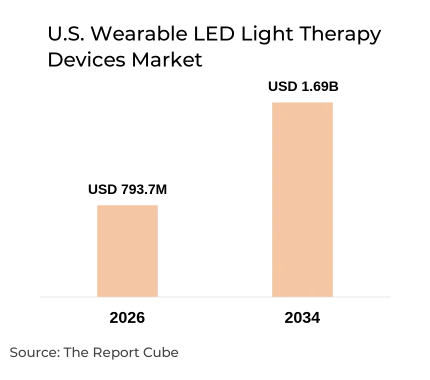
- The U.S. Wearable LED Light Therapy Devices Market was valued at USD 793.7 million in 2026.
- Market size is forecast to reach USD 1,689.2 million by 2034.
- The market is expected to expand at a CAGR of 9.90% during 2026-2034.
- By product type, LED Face Masks led with a 59% share in 2025, the latest year for which a share was supplied.
- Growing interest in at-home, non-invasive skincare and an older population, with 61.2 million people aged 65 and above in 2024 (U.S. Census Bureau), support demand.
- FDA 510(k) clearances, including K260715 in June 2026, are making regulatory status a key competitive factor.
- Celluma introduced its MYSTIQUE multifunctional wearable mask in April 2026, and CurrentBody launched Series 3 in September 2026.
Market Outlook
The U.S. Wearable LED Light Therapy Devices Market covers LED facial masks, neck and chest masks, eye-area devices and hair-growth caps or helmets. These products move selected light-based skincare and scalp treatments from clinics into home-use formats, giving consumers portable, non-invasive options within the wider beauty technology and consumer healthcare sector.
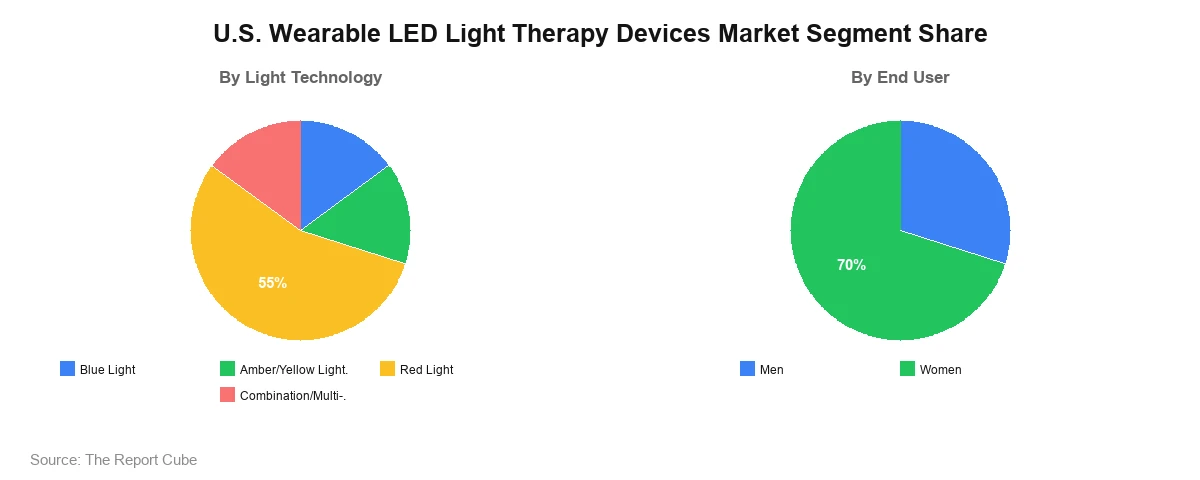
Demand comes mainly from consumers seeking convenient skincare routines, supported by online comparison of wavelengths, specifications and reviews. Core applications include skin rejuvenation, acne-related care, wrinkle reduction and hair-growth positioning. Women accounted for 70% of 2025 demand and online channels for 68%, which shows how strongly purchasing is concentrated in digital, consumer-led channels.
The market is valued at USD 793.7 million in 2026 and is projected to reach USD 1,689.2 million by 2034, a CAGR of 9.90%. Growth drivers include multi-wavelength designs, personalised dosing and wider retail access. Competition centres on clinical evidence, FDA regulatory status, comfort and brand trust, and future opportunity lies in hair-growth, multifunctional and professional-grade products.
Government Regulations
Wearable LED devices are regulated by the U.S. Food and Drug Administration according to intended use. The FDA classifies light-based over-the-counter wrinkle-reduction devices under product code OHS, regulated under 21 CFR 878.4810 as Class II devices that generally require 510(k) premarket notification. Recognised safety references include IEC 62471 and ANSI/IES RP-27 for photobiological safety. A 510(k) decision applies to the specific device and intended use cleared, and is not an endorsement of every marketing claim. The Federal Trade Commission separately requires health-related advertising claims to be truthful and supported by competent and reliable scientific evidence. Together these requirements shape product testing, labelling, claim substantiation and launch timelines. Manufacturers with cleared devices and documented evidence gain credibility with retailers and consumers, while new entrants face higher compliance costs.
U.S. Wearable LED Light Therapy Devices Market Dynamics
Demand is shaped by consumer interest in home-use skincare, demographic ageing, product innovation and regulatory scrutiny. Clinical evidence varies by wavelength and application, so manufacturers must balance product differentiation with substantiated claims. Retail digitalisation and premium positioning further influence pricing, distribution and competition across the U.S. Wearable LED Light Therapy Devices Market.
|
Factor |
Type |
Specific Impact on Market |
Magnitude |
|---|---|---|---|
|
At-home skincare adoption |
Driver |
Supports demand for wearable masks and caps used in routine skincare |
High |
|
Ageing population |
Driver |
Widens the consumer base for rejuvenation-focused products |
Medium |
|
Variable clinical evidence |
Challenge |
Limits generalisation of benefits across devices and applications |
Medium–High |
|
FDA and FTC requirements |
Challenge |
Raises testing, documentation and claim-substantiation costs |
Medium–High |
|
Multi-wavelength, personalised devices |
Trend |
Encourages premium product differentiation |
High |
|
Hair-growth and multifunctional devices |
Opportunity |
Creates room for scalp and combined face-scalp products |
Medium |
Growth Drivers: Rising Adoption of At-Home Skincare Technology
Consumers increasingly prefer convenient, non-invasive treatments that fit regular skincare routines, and wearable formats suit this behaviour. Hands-free masks and caps allow consistent use at home, while an ageing population broadens interest in wrinkle and skin-texture solutions. U.S. Census Bureau data show 61.2 million residents aged 65 and above in 2024, or 18.0% of the population, supporting long-term demand potential, although this does not measure device purchases directly.
Market Opportunities: Hair-Growth and Multifunctional Wearable Devices
Hair-growth caps and helmets are projected to be the fastest-growing product category, giving manufacturers an opening in scalp-related applications. Multifunctional devices that combine facial and scalp use, such as Celluma MYSTIQUE, broaden the value proposition within a single product. Companies pursuing this path need product-specific evidence and appropriate FDA status for each advertised use. Professional-to-home integration through dermatology and aesthetic practices offers an additional route to build credibility.
Industry Challenges: Variable Evidence and Compliance Costs
Clinical results differ by wavelength, treatment duration, device specification and study design, making outcomes hard to generalise across wearable LED products. Manufacturers must also manage FDA classification, labelling and photobiological safety, alongside FTC rules on substantiating health claims. These obligations increase testing, documentation and marketing-compliance costs, particularly for new treatment applications, and can slow the launch of new products for smaller firms with limited regulatory resources.
Need Specific Data, Let’s Customize the Report for You
Request CustomizationMarket Trends: Multi-Wavelength and Personalised Light Delivery
Manufacturers are combining red, blue, amber and near-infrared light in single wearable products to address several skincare needs. Personalised dosing is emerging alongside this, as shown by CurrentBody’s Series 3 launch in September 2026, which adjusts light dose to the selected wavelength combination. Online retail supports the trend: U.S. Census Bureau data show e-commerce at 17.1% of total retail sales in the second quarter of 2026, a general retail indicator rather than a device measure.
U.S. Wearable LED Light Therapy Devices Market Segment Analysis
The market is segmented by product type, light technology, price tier, end user and distribution channel. Leading-segment shares below are supplied 2025 values and are the latest available. Each category is shown as a separate view of the same market, so values should not be added across categories.
By Light Technology
- Blue Light
- Amber/Yellow Light
- Red Light
- Combination/Multi-wavelength
Red Light leads with a 55% share in 2025, owing to its broad use in rejuvenation and wrinkle-related facial and neck products. Combination/Multi-wavelength devices are the fastest-growing technology, with a projected 10.9% CAGR for 2026–2033, as they pair wavelengths for several applications in one device. Evidence should be assessed per wavelength and intended use. Blue Light, mainly used for acne-related care, and Amber/Yellow Light, used for cosmetic skin-appearance applications, hold smaller roles.
By End User
- Men
- Women
Women lead with a 70% share in 2025, supported by established skincare routines and strong engagement with technology-enabled beauty treatments. Men are the second segment and carry a projected 9.6% CAGR for 2026–2033, with demand linked to acne-related skincare, grooming and hair-related applications. Brands that position products specifically for male consumers, particularly hair-growth caps, may find room to expand within this smaller but faster-growing group.
U.S. Wearable LED Light Therapy Devices Market Regional Analysis
The market is analysed across the four U.S. Census regions. Revenue shares by region were not supplied or available from approved sources, so no regional percentages or rankings are presented. Regional demand is expected to reflect population, household purchasing power, beauty and skincare spending, retail accessibility and the presence of aesthetic-service providers.
|
Region |
Key Growth Factors |
Industry Trends |
|---|---|---|
|
Northeast |
Dense metropolitan populations, premium retail access |
Premium device adoption and specialty retail |
|
Midwest |
Broad consumer base, growing online access |
Reliance on e-commerce for product availability |
|
South |
Large and growing population across sixteen states |
Expanding online and mass retail distribution |
|
West |
Strong beauty-technology and aesthetic-service presence |
Early adoption of new device formats |
Competitive Landscape
The market includes specialist phototherapy manufacturers, premium skincare brands, consumer appliance companies and wellness technology firms. Competition rests on wavelength configuration, clinical evidence, FDA regulatory status, comfort, pricing and distribution reach. The table lists representative companies by capability and does not represent a market-share ranking.
|
Company |
Competitive Strength |
Primary Segment Served |
|---|---|---|
|
CurrentBody Skin |
Premium at-home LED masks and hair devices |
LED face masks, hair growth |
|
Shark Beauty (SharkNinja) |
Mainstream consumer reach with CryoGlow LED mask |
LED face masks, online and offline retail |
|
Omnilux |
Clinically positioned LED skincare |
LED face masks, premium tier |
|
Therabody |
Premium wellness and skincare technology (TheraFace) |
LED face masks, premium tier |
|
Dr. Dennis Gross Skincare |
Dermatologist-associated brand (SpectraLite FaceWare Pro) |
LED face masks, premium tier |
|
FOREO |
Technology-oriented devices with FDA 510(k) decisions for FAQ 201 and 202 |
LED face masks, online |
|
Solawave |
Consumer-focused red-light masks |
LED face masks, mid-range |
|
Qure Skincare |
Targeted at-home device (Q-Rejuvalight Pro) |
LED face masks |
|
HigherDOSE |
Premium red-light mask and hat |
Face masks and hair growth |
|
Celluma |
Professional-grade multifunctional LED therapy |
Professional/clinic grade, hair growth |
|
Déesse PRO |
Professional aesthetic LED masks |
Professional/clinic grade |
|
MZ SKIN |
Luxury skincare technology |
LED face masks, premium tier |
CurrentBody Skin: CurrentBody Skin, part of The Beauty Tech Group, sells LED face masks and hair-regrowth devices in the premium at-home segment. The group reported FY2025 revenue of GBP 141.0 million, with CurrentBody Skin contributing GBP 125.8 million, up 59.0% from the prior year. Its Series 2 mask received an FDA 510(k) decision in June 2025. This is company performance and not a measure of U.S. market share.
Celluma: Celluma, manufactured by BioPhotas, operates in professional-grade LED phototherapy. In April 2026 it introduced MYSTIQUE, a wearable LED mask intended for acne, facial wrinkles and scalp hair loss, at an introductory price of USD 795 against a stated retail price of USD 895. Its clinical orientation and multifunctional design position it in the professional/clinic-grade tier, which is the fastest-growing price segment.
Recent Developments and Updates
- April 2026: Celluma, manufactured by BioPhotas, introduced MYSTIQUE, a multifunctional wearable LED mask intended for acne, facial wrinkles and scalp hair loss. The launch reflects growing interest in devices serving several applications and supports the professional/clinic-grade segment.
- June 2026: The FDA issued a 510(k) decision (K260715) on June 3, 2026, for The Beauty Tech Group’s LED Multi Light Therapy Mask. The decision shows continued regulatory progress for multi-light wearable products and strengthens the compliance position of cleared devices.
- September 2026: CurrentBody Skin announced its Series 3 LED Mask with MyDose technology, using 750 LEDs across 125 chipsets and adjusting light dose to the selected wavelength combination. The launch illustrates the move toward personalised, multi-wavelength wearable devices.
U.S. Wearable LED Light Therapy Devices Market Future Outlook
The market is expected to grow from USD 793.7 million in 2026 to USD 1,689.2 million by 2034 at a CAGR of 9.90%, with growth moderating as adoption matures. Multi-wavelength designs, personalised dosing, hair-growth devices and professional-grade products offer the strongest opportunities. Expanding online and specialist retail access should keep wearable LED products within mainstream skincare and wellness routines across the forecast period.
Competition is likely to shift toward clinical evidence, product reliability, personalisation, pricing and customer retention, with replacement demand and upgrades gaining importance as the installed base grows. Challenges include uneven evidence across applications, FDA and FTC compliance costs and price competition from lower-cost devices. The 2034 value is an extended estimate, so actual outcomes will depend on regulation, consumer confidence and manufacturer execution.
U.S. Wearable LED Light Therapy Devices Market Report Coverage
This report summarises supplied valuation and forecasts estimates, segmentation, regional framework, regulatory context and competitive landscape for the U.S. Wearable LED Light Therapy Devices Market.
|
Parameter |
Details |
|---|---|
|
Market Name |
U.S. Wearable LED Light Therapy Devices Market |
|
Market Size (Base Year) |
USD 793.7 million (2026) |
|
Market Size (Forecast Year) |
USD 1,689.2 million (2034) |
|
CAGR |
9.90% (2026–2034) |
|
Base Year |
2026 |
|
Historical Period |
2021–2025 |
|
Forecast Period |
2026–2034 |
|
Geographic Scope |
United States |
|
Segmentation |
By Product Type; By Light Technology; By Price Tier; By End User; By Distribution Channel |
|
Regions Covered |
Northeast, Midwest, South, West |
|
Key Companies |
CurrentBody Skin; Shark Beauty (SharkNinja); Omnilux; Therabody; Dr. Dennis Gross Skincare; FOREO; Solawave; Qure Skincare; HigherDOSE; Celluma; Déesse PRO; MZ SKIN |
|
Customization |
Available as per requirement |
Why Choose This U.S. Wearable LED Light Therapy Devices Market Report?
- Presents the 2026 valuation, 2034 forecast and 9.90% CAGR.
- Segments the market by product type, light technology, price tier, end user and distribution channel.
- Reviews drivers, challenges, opportunities and trends using FDA, FTC and U.S. Census Bureau context.
- Provides a regional framework across the Northeast, Midwest, South and West, with unavailable shares identified.
- Profiles key companies by competitive strength and primary segment served.
- Highlights multi-wavelength, personalised, hair-growth and professional-grade opportunities.
- Supports product, regulatory, pricing and distribution decisions for manufacturers and retailers.
Table of Contents
- Introduction
- Objective of the Study
- Product Definition
- Market Segmentation
- Study Variables
- Research Methodology
- Secondary Data Points
- Companies Interviewed
- Primary Data Points
- Breakdown of Primary Interviews
- Secondary Data Points
- Executive Summary
- Market Dynamics
- Drivers
- Challenges
- Opportunity Assessment
- Recent Trends and Developments
- Policy and Regulatory Landscape
- U.S. Wearable LED Light Therapy Devices Market Overview and Forecast Analysis (2021-2034)
- Market Size, By Value, By Growth Rate (CAGR/USD Millions)
- Demand – Supply Trends
- Market Share, By Product Type
- LED Face Masks (Full Face LED Masks, Partial/Half Face LED Masks)
- LED Neck & Chest Masks
- LED Hair Growth Caps/Helmets
- LED Eye Masks
- Market Share, By Light Technology
- Blue Light
- Amber/Yellow Light
- Red Light
- Combination/Multi-wavelength
- Market Share, By Price Tier
- Mass/Entry (Up to USD 150)
- Mid-range (USD 151–300)
- Premium (USD 301–600)
- Professional/Clinic Grade (Above USD 600)
- Market Share, By End User
- Men
- Women
- Market Share, By Distribution Channel
- Online
- Offline
- Market Share, By Region
- Northeast
- Midwest
- South
- West
- Market Share, By Competitors
- Competition Characteristics
- Revenue Shares
- LED Face Masks (Full Face LED Masks, Partial/Half Face LED Masks) U.S. Wearable LED Light Therapy Devices Market Overview, 2021-2034F
- By Value (USD Million)
- By Light Technology – Market Size & Forecast 2021-2034, USD Million
- Blue Light
- Amber/Yellow Light
- Red Light
- Combination/Multi-wavelength
- LED Neck & Chest Masks U.S. Wearable LED Light Therapy Devices Market Overview, 2021-2034F
- By Value (USD Million)
- By Light Technology – Market Size & Forecast 2021-2034, USD Million
- Blue Light
- Amber/Yellow Light
- Red Light
- Combination/Multi-wavelength
- LED Hair Growth Caps/Helmets U.S. Wearable LED Light Therapy Devices Market Overview, 2021-2034F
- By Value (USD Million)
- By Light Technology – Market Size & Forecast 2021-2034, USD Million
- Blue Light
- Amber/Yellow Light
- Red Light
- Combination/Multi-wavelength
- LED Eye Masks U.S. Wearable LED Light Therapy Devices Market Overview, 2021-2034F
- By Value (USD Million)
- By Light Technology – Market Size & Forecast 2021-2034, USD Million
- Blue Light
- Amber/Yellow Light
- Red Light
- Combination/Multi-wavelength
- Competitive Outlook (Company Profile – Partial List)
- CurrentBody Skin
- Company Overview
- Business Segments
- Strategic Alliances/Partnerships
- Recent Developments
- Omnilux
- Company Overview
- Business Segments
- Strategic Alliances/Partnerships
- Recent Developments
- Therabody
- Company Overview
- Business Segments
- Strategic Alliances/Partnerships
- Recent Developments
- Dr. Dennis Gross Skincare
- Company Overview
- Business Segments
- Strategic Alliances/Partnerships
- Recent Developments
- FOREO
- Company Overview
- Business Segments
- Strategic Alliances/Partnerships
- Recent Developments
- Solawave
- Company Overview
- Business Segments
- Strategic Alliances/Partnerships
- Recent Developments
- HigherDOSE
- Company Overview
- Business Segments
- Strategic Alliances/Partnerships
- Recent Developments
- Qure Skincare
- Company Overview
- Business Segments
- Strategic Alliances/Partnerships
- Recent Developments
- CurrentBody Skin
- Contact Us & Disclaimer
Top Key Players & Market Share Outlook
- CurrentBody Skin
- Omnilux
- Therabody
- Dr. Dennis Gross Skincare
- FOREO
- Solawave
- HigherDOSE
- Qure Skincare
Frequently Asked Questions