



Build Your Custom Market Intelligence Report
Customize Your ReportJapan Wearable Medical Device Market Statistics and Insights
Market Insight
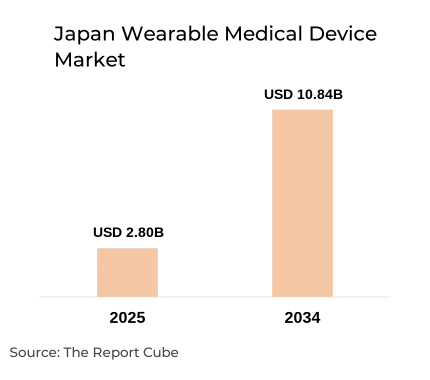
- Japan Wearable Medical Devices Market was valued at USD 2.8 billion in 2025.
- The market is expected to reach USD 10.84 billion by 2034.
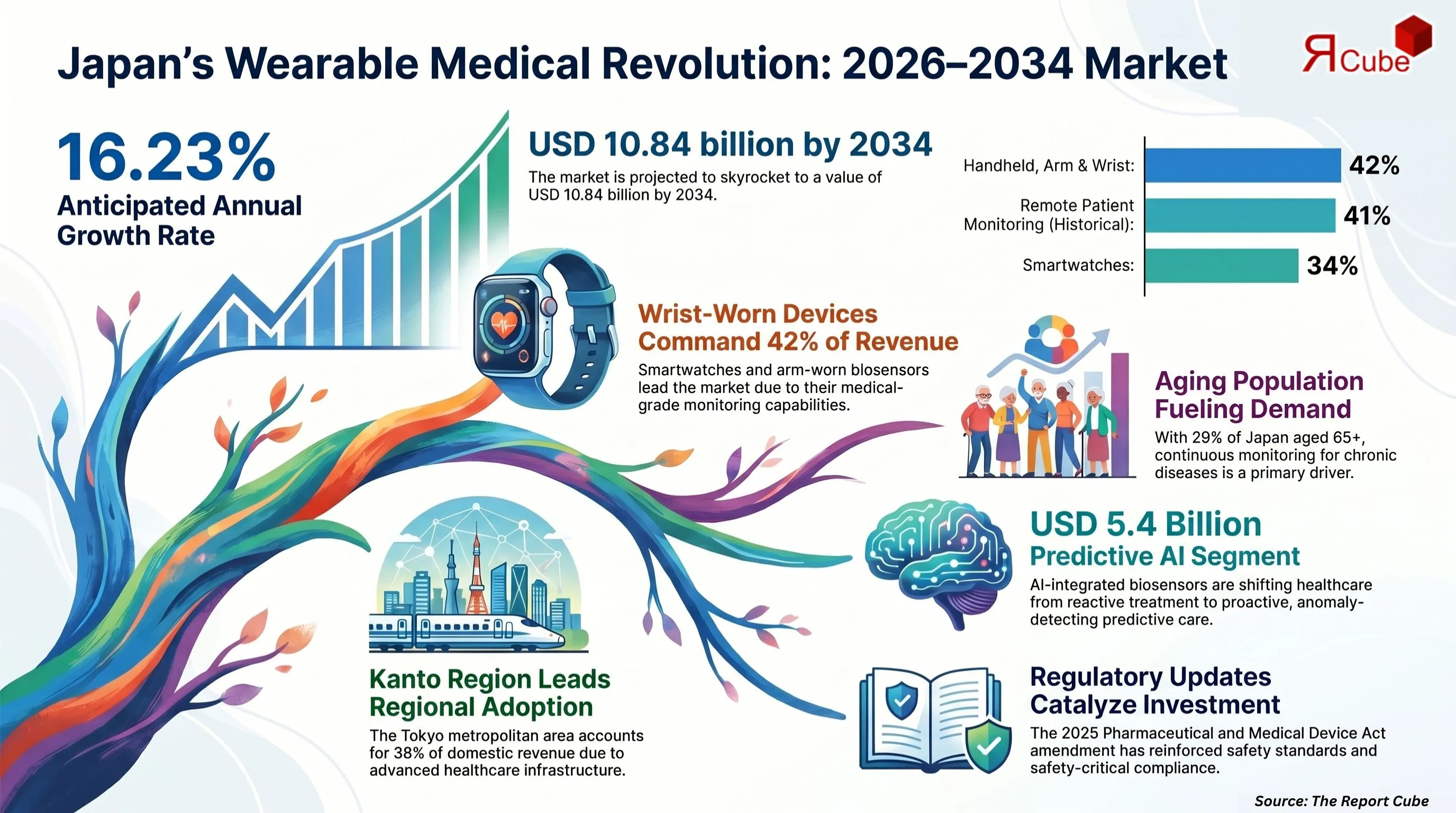
- The market is anticipated to expand at a CAGR of 16.23% during 2026–2034.
By Device
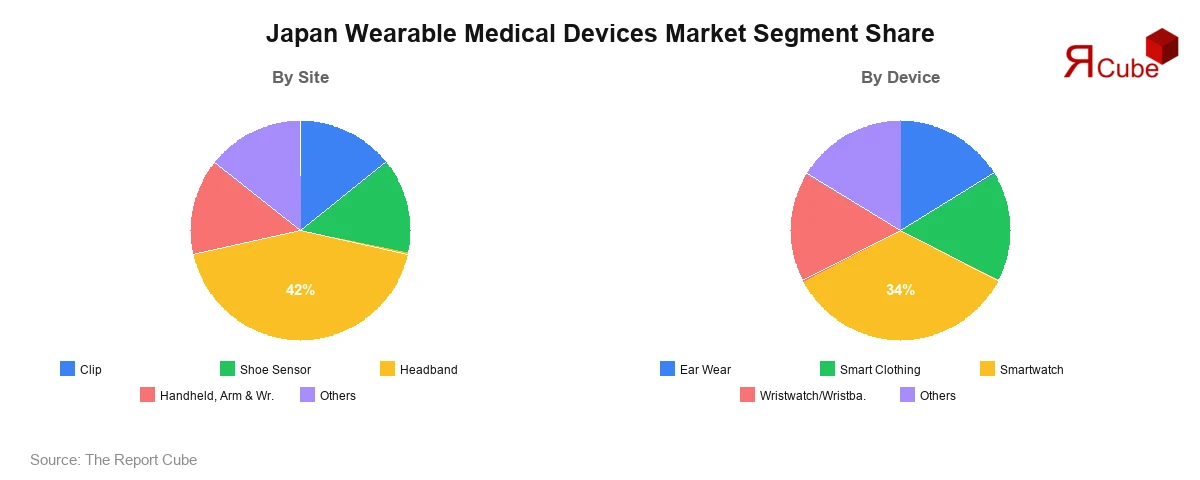
- Smartwatch segment dominates with approximately 34% market share.
Competitive Landscape
- More than 10 companies are actively engaged in producing Japan Wearable Medical Devices.
- Top 5 companies acquired around 58% of the market share.
- Apple Inc., Samsung, Fitbit (Google), OMRON Healthcare, Garmin Ltd., and others.
By Site
- Handheld, Arm & Wrist segment leads, capturing approximately 42% market share.
Japan Wearable Medical Device Market Insights & Analysis
The Japan Wearable Medical Devices Market is anticipated to register a 16.23% CAGR during 2026–2034. The market size was valued at USD 2.8 billion in 2025 and is projected to reach USD 10.84 billion by 2034. Japan's healthcare sector continues to embrace digital transformation at an accelerating pace, with wearable medical devices sitting at the center of this shift. The country's Ministry of Health, Labour and Welfare (MHLW) amended the Pharmaceutical and Medical Device Act (PMD Act) in May 2025, introducing stronger compliance obligations for device manufacturers and authorization holders.
This regulatory upgrade has reinforced product safety standards, increased accountability, and catalyzed fresh investment from both domestic and international players. In January 2025, MEDIROM MOTHER Labs deployed its recharge-free MOTHER Bracelet and REMONY remote health monitoring system to TOPPAN Inc.'s Electronics Division, demonstrating real-world enterprise adoption of 24/7 wearable health tracking. Additionally, Novocure's regulatory approval for its Optune Lua wearable Tumor Treating Fields (TTFields) system for non-small cell lung cancer in August 2025 underscores the expanding therapeutic scope of the market well beyond traditional fitness and diagnostics applications.
Japan Wearable Medical Device Market Dynamics
Key Market Driver Aging Population Fueling Chronic Disease Monitoring
Japan holds one of the world's oldest demographic profiles, with over 29% of its population aged 65 years or above as of 2025. This structural reality is creating sustained demand for wearable medical devices that enable non-invasive, continuous health monitoring at home. Cardiovascular disorders, type 2 diabetes, and hypertension, all age-linked conditions, are among the leading drivers of wearable adoption.
Remote patient monitoring (RPM) systems leveraging wrist-worn biosensors and ECG patches allow elderly patients to transmit real-time vitals directly to clinicians, reducing hospital readmissions and enabling early intervention. The RPM application segment captured a 41% revenue share in the historical period, highlighting the outsized role demographic pressure plays in shaping Japan's wearable medical device demand.
Major Industry Challenge Data Privacy Risks Undermining Consumer Confidence
As wearable medical devices collect increasingly sensitive biometric and clinical data, including continuous glucose readings, cardiac rhythms, and sleep architecture, concerns over cybersecurity vulnerabilities are emerging as a significant headwind. Unauthorized access to personal health records stored on cloud platforms or transmitted via Bluetooth could expose patients to privacy breaches.
Japan's Act on the Protection of Personal Information (APPI), last revised in 2022, mandates strict handling obligations, yet enforcement complexity across cross-border data flows involving global device manufacturers remains challenging. Consumer hesitancy to adopt advanced wearables due to data security concerns is slowing adoption in certain demographic segments, particularly among older adults who are simultaneously the most high-value users of remote monitoring solutions.
Emerging Trend Shaping Outlook AI-Integrated Biosensors Enabling Predictive Health Insights
The integration of artificial intelligence and machine learning algorithms into wearable biosensor platforms is transforming Japan's medical device landscape from reactive to proactive. Devices are increasingly capable of identifying anomalies in cardiac rhythms, blood oxygen saturation dips, and irregular glucose patterns, flagging potential events before clinical symptoms emerge.
SoftBank's partnership with medical institutions to deploy AI-powered remote monitoring, alongside growing adoption of AI-driven wearable analytics platforms, reflects a structural pivot toward predictive healthcare. The Japan wearable device predictive analytics segment is projected to reach USD 5.4 billion by 2034 at a 12.6% CAGR, signaling robust adjacent growth. As 5G connectivity expands nationwide, real-time data transmission from wearables to cloud-based AI engines will become standard, unlocking personalized care pathways at scale.
Need Specific Data, Let’s Customize the Report for You
Request CustomizationJapan Wearable Medical Device Market Segment-wise Analysis
Japan's wearable medical devices market spans a diverse array of form factors and device categories, each addressing distinct clinical and consumer use cases. The market's segmentation by site of wear and by device type reveals key pockets of demand concentration, technology differentiation, and investment priority across the 2026–2034 forecast period.
By Site
- Clip
- Shoe Sensor
- Headband
- Handheld, Arm & Wrist
- Others
The Handheld, Arm & Wrist segment commands the dominant position in this segmentation, accounting for approximately 42% of total market revenue. This leadership stems from the widespread familiarity and consumer acceptance of wrist-worn devices such as smartwatches and fitness bands, which combine medical-grade monitoring with everyday convenience. Devices in this category enable continuous tracking of heart rate, blood pressure, SpO2 levels, and electrocardiogram (ECG) readings, making them indispensable for both clinical remote monitoring and personal health management.
The Clip segment holds a notable secondary share, driven by pulse oximeters and ECG clip-on devices adopted widely across hospitals and home-care settings. Shoe Sensor devices are gaining traction for gait analysis and fall prevention among Japan's elderly population, while Headband wearables are emerging as niche solutions for neurological monitoring and sleep disorder diagnosis. The Others category captures patch-based and torso-mounted devices with specialized diagnostic functions.
By Device
- Ear Wear
- Smart Clothing
- Smartwatch
- Wristwatch/Wristband
- Others
The Smartwatch segment leads the By Device segmentation with approximately 34% market share, driven by its dual utility as both a consumer electronics product and a medical monitoring platform. Apple Watch's advanced cardiac monitoring features and OMRON's integration of clinical-grade blood pressure sensors into smartwatch form factors have significantly elevated the device type's clinical credibility in Japan.
The Wristwatch/Wristband segment complements smartwatch growth, particularly among price-sensitive and elderly demographics who prioritize simplicity and battery longevity over full-feature operating systems. Smart Clothing is an emerging high-growth sub-segment, incorporating textile-integrated sensors for posture correction, respiratory monitoring, and neuromuscular assessment. Ear Wear devices, including smart hearing aids with embedded biosensors, are gaining adoption given Japan's high prevalence of age-related hearing loss, with biometric monitoring capabilities creating a differentiated value proposition for audiological and cardiovascular care.
Regional Projection of Japan Wearable Medical Device Market
- Kanto Region
- Kansai Region
- Chubu Region
- Kyushu & Okinawa Region
The Kanto Region, encompassing Tokyo, Kanagawa, and Saitama, holds the leading regional position in the Japan Wearable Medical Devices Market, accounting for approximately 38% of total domestic revenue. Kanto's dominance is underpinned by its concentration of advanced healthcare infrastructure, high urbanization rates, and a dense network of hospitals, research institutions, and digital health startups actively piloting wearable technologies.
The region benefits from above-average household incomes that accelerate premium device adoption and early-stage clinical integration programs. Kyushu & Okinawa represents the fastest-growing regional segment, growing at approximately 15.2% CAGR, driven by rising elderly care demands and regional government investments in digital health infrastructure.
Japan Wearable Medical Device Market: Recent Development (2025)
- In January 2025, MEDIROM MOTHER Labs deployed its REMONY system to TOPPAN Inc., enabling enterprise-grade health monitoring.
- Apple Inc. reported a 12% year-on-year revenue increase from its wearables division in Japan, driven by Apple Watch Series 10 adoption.
- OMRON Healthcare expanded its blood pressure smartwatch lineup in Japan, targeting a gross margin improvement of approximately 8% on new SKUs.
- Novocure received regulatory approval in Japan for the Optune Lua wearable TTFields device for non-small cell lung cancer therapy in August 2025.
Japan Wearable Medical Devices Market Future Outlook (2034)
The Japan Wearable Medical Devices Market is poised for sustained high-velocity growth through 2034, supported by a projected CAGR of 16.23% and a target market value of USD 10.84 billion. Long-term expansion will be shaped by the convergence of AI-powered predictive analytics, flexible biosensor materials, and ubiquitous 5G connectivity enabling real-time clinical data transmission from wearable devices to healthcare providers.
The deepening integration of wearables into Japan's national digital health framework, including electronic health records and telemedicine platforms, will institutionalize device adoption across both acute and preventive care settings. Oncology-grade and neurology-grade wearable therapeutics, as demonstrated by the Optune Lua approval, signal a long-term shift from monitoring-only devices to active treatment platforms. Smart clothing and AI-embedded ear wear represent the next frontier of category expansion, with manufacturers competing on sensor precision, interoperability, and clinical validation to secure positioning in this high-growth market.
Why Choose This Report?
- Provides a comprehensive overview of the overall market analysis, encompassing key trends, consumer behavior analysis, and risk assessment to support strategic decision-making.
- Provides accurate, up-to-date insights into market size, segmentation, and emerging opportunities, helping to minimize risk & capitalizing on growth.
- Gives deep understanding of target audience preferences, investment habits, and communication channels for enhanced product development & marketing effectiveness.
- Delivers competitive analysis & benchmarking, uncovering the strengths & weaknesses of market competitors to guide strategies.
- Consolidate comprehensive market intelligence, reducing reasoning & streamlining research efforts.
- Facilitates customized market segmentation & risk mitigation strategies, fine-tuned to the business objectives.
- Aids in identifying both market challenges & untapped opportunities within the industry to drive long-term business growth.
- Provides valuable information based on actual customer data & search trends.
Table of Contents
- Introduction
- Objective of the study
- Product Definition
- Market Segmentation
- Study Variables
- Research Methodology
- Secondary Data Points
- Companies Interviewed
- Primary Data Points
- Breakdown of Primary Interviews
- Secondary Data Points
- Executive Summary
- Market Dynamics
- Drivers
- Challenges
- Opportunity Assessment
- Recent Trends and Developments
- Policy and Regulatory Landscape
- Japan Digital Health Market Overview and Forecast Analysis (2021-2034)
- Market Size, By Value, By growth rate (CAGR/USD Billions)
- Demand - Supply Trends
- Market Share, By Site
- Clip
- Shoe Sensor
- Headband
- Handheld, Arm & Wrist
- Others
- Market Share, By Device
- Ear Wear
- Smart Clothing
- Smartwatch
- Wristwatch/Wristband
- Others
- Market Share, By Application
- Sleep Tracking
- Obesity
- Diabetes Care
- Cardiac Health
- Fitness Monitoring
- Others
- Market Share, By Type
- Therapeutic Devices
- Diagnostic Devices
- Market Share, By Region
- Kanto Region
- Kansai Region
- Chubu Region
- Kyushu & Okinawa Region
- Market Share, By Competitors
- Competition Characteristics
- Revenue Shares
- Japan Clip Digital Health Market Overview, 2021-2034F
- By Value (USD Million)
- By Device- Market Size & Forecast 2021-2034, USD Million
- By Application- Market Size & Forecast 2021-2034, USD Million
- By Type- Market Size & Forecast 2021-2034, USD Million
- Japan Shoe Sensor Digital Health Market Overview, 2021-2034F
- By Value (USD Million)
- By Device- Market Size & Forecast 2021-2034, USD Million
- By Application- Market Size & Forecast 2021-2034, USD Million
- By Type- Market Size & Forecast 2021-2034, USD Million
- Japan Headband Digital Health Market Overview, 2021-2034F
- By Value (USD Million)
- By Device- Market Size & Forecast 2021-2034, USD Million
- By Application- Market Size & Forecast 2021-2034, USD Million
- By Type- Market Size & Forecast 2021-2034, USD Million
- Japan Handheld, Arm & Wrist Digital Health Market Overview, 2021-2034F
- By Value (USD Million)
- By Device- Market Size & Forecast 2021-2034, USD Million
- By Application- Market Size & Forecast 2021-2034, USD Million
- By Type- Market Size & Forecast 2021-2034, USD Million
- Japan Others Digital Health Market Overview, 2021-2034F
- By Value (USD Million)
- By Device- Market Size & Forecast 2021-2034, USD Million
- By Application- Market Size & Forecast 2021-2034, USD Million
- By Type- Market Size & Forecast 2021-2034, USD Million
- Competitive Outlook (Company Profile - Partial List)
- Apple Inc.
- Company Overview
- Business Segments
- Strategic Alliances/Partnerships
- Recent Developments
- SAMSUNG.
- Company Overview
- Business Segments
- Strategic Alliances/Partnerships
- Recent Developments
- Huawei Device Co., Ltd.
- Company Overview
- Business Segments
- Strategic Alliances/Partnerships
- Recent Developments
- Xiaomi.
- Company Overview
- Business Segments
- Strategic Alliances/Partnerships
- Recent Developments
- Fitbit (Google)
- Company Overview
- Business Segments
- Strategic Alliances/Partnerships
- Recent Developments
- Garmin Ltd.
- Company Overview
- Business Segments
- Strategic Alliances/Partnerships
- Recent Developments
- Sony Group Corp
- Company Overview
- Business Segments
- Strategic Alliances/Partnerships
- Recent Developments
- Nike, Inc.
- Company Overview
- Business Segments
- Strategic Alliances/Partnerships
- Recent Developments
- OMRON Healthcare
- Company Overview
- Business Segments
- Strategic Alliances/Partnerships
- Recent Developments
- Others
- Apple Inc.
- Contact Us & Disclaimer
Top Key Players & Market Share Outlook
- Apple Inc.
- SAMSUNG.
- Huawei Device Co., Ltd.
- Xiaomi.
- Fitbit (Google)
- Garmin Ltd.
- Sony Group Corp
- Nike, Inc.
- OMRON Healthcare
- Others
Frequently Asked Questions






