




Build Your Custom Market Intelligence Report
Customize Your ReportGlobal Whey Protein Market Insights & Analysis
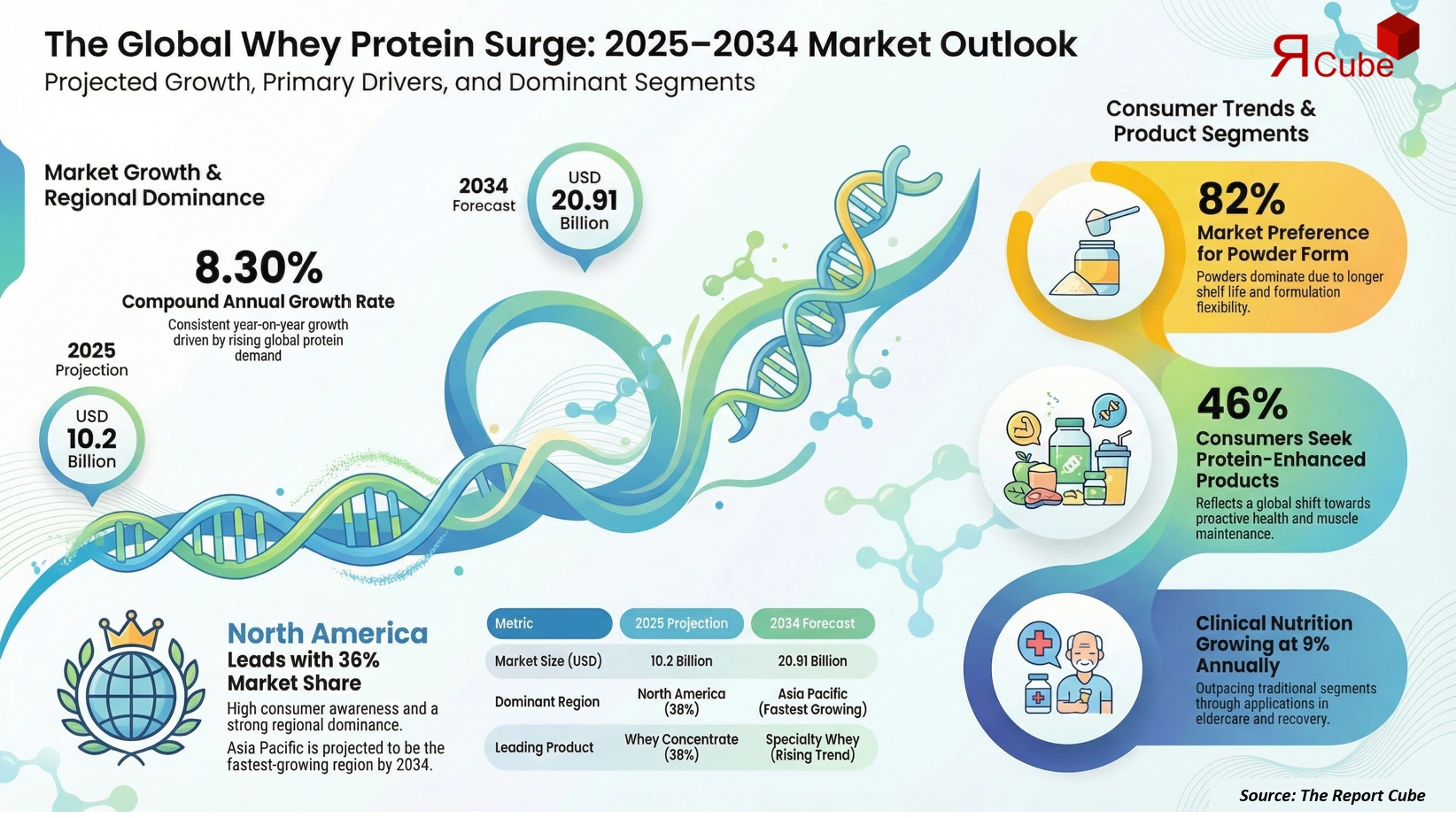
The Global Whey Protein Market is anticipated to register a CAGR of 8.30% during the forecast period 2026-2034. The market size was valued at USD 10.2 billion in 2025 and is projected to reach USD 20.91 billion by 2034. This strong growth outlook is primarily driven by rising global demand for high-quality protein supplements across sports nutrition, clinical nutrition, infant formula, and functional food applications. Whey protein, derived from dairy processing, is recognized for its high biological value, fast absorption, and rich amino acid profile, making it a preferred protein source among athletes, fitness enthusiasts, and aging populations.
Beyond traditional sports nutrition, whey protein is increasingly integrated into everyday diets through protein-enriched beverages, bakery products, ready-to-drink shakes, and medical nutrition solutions. Industry estimates indicate that nearly 46% of global consumers actively seek protein-enhanced food and beverage products, reflecting a shift toward proactive health management. The expanding elderly population, coupled with growing awareness of muscle maintenance, weight management, and metabolic health, continues to fuel demand. Additionally, innovation in filtration and processing technologies has enabled manufacturers to offer cleaner-label, lactose-reduced, and highly purified whey variants, supporting premiumization across developed and emerging markets.
Global Whey Protein Market Recent Developments
- 2025: Glanbia plc expanded its high-protein nutrition solutions portfolio for sports and active lifestyle consumers.
- 2025: Arla Foods Ingredients launched improved whey isolate solutions targeting medical and senior nutrition segments.
Government Initiatives & Policies
- U.S. Dietary Guidelines for Americans: Encourages adequate protein intake to support muscle health and aging populations.
- European Union Farm to Fork Strategy: Supports sustainable dairy processing and value-added protein ingredients.
Global Whey Protein Market Dynamics
Key Driver: Rising Demand for Sports Nutrition and High-Protein Diets
The primary growth driver for the whey protein market is the accelerating demand for sports nutrition and high-protein dietary regimes. Global participation in fitness activities has increased by more than 20% over the past five years, directly boosting consumption of protein powders, ready-to-mix supplements, and functional beverages. Whey protein concentrate and isolate remain widely preferred due to their superior digestibility and amino acid composition, particularly branched-chain amino acids. In addition, protein intake recommendations for active adults and aging populations are rising, further strengthening demand across gyms, online nutrition platforms, and healthcare nutrition channels.
Major Challenge: Price Volatility and Raw Material Dependence
Price volatility associated with dairy raw materials presents a key challenge for whey protein manufacturers. Whey prices are closely linked to global milk production cycles, feed costs, and energy prices, which can fluctuate significantly. Over the past three years, dairy input costs have varied by as much as 18-;22% annually in some regions. These fluctuations directly impact production margins and pricing stability, particularly for small and mid-sized processors. Additionally, supply chain disruptions and regional trade barriers can affect whey availability, requiring manufacturers to adopt long-term sourcing contracts and cost optimization strategies.
Industry Trends: Growth of Clean-Label and Specialized Whey Proteins
A prominent industry trend is the growing demand for clean-label and specialized whey protein products. Consumers increasingly seek low-lactose, low-fat, and minimally processed protein options with transparent ingredient sourcing. Native whey and hydrolyzed whey proteins are gaining popularity in premium sports and medical nutrition products due to improved digestibility and faster absorption rates. Market data suggests that specialty whey variants are growing nearly 1.6 times faster than conventional concentrates. This trend is encouraging innovation in membrane filtration, enzymatic hydrolysis, and customized protein formulations.
Opportunity Ahead: Expansion in Medical and Clinical Nutrition Applications
The expanding use of whey protein in medical and clinical nutrition presents a significant growth opportunity. Whey protein is increasingly recommended for patients with sarcopenia, malnutrition, and recovery needs due to illness or surgery. Clinical nutrition demand is growing at an estimated 9% annually, outpacing traditional sports nutrition segments. Hospitals, eldercare facilities, and home healthcare providers are adopting whey-based nutritional solutions to improve patient outcomes. Manufacturers focusing on pharmaceutical-grade quality standards and clinical validation are well-positioned to capitalize on this opportunity.
Global Whey Protein Market Segment-wise Analysis
By Product Type:
- Whey Concentrate
- Whey Isolate
- Whey Hydrolysate
- Native Whey
- Other Specialty Whey
Whey concentrate dominates the market, accounting for approximately 39% of total revenue in 2025. Its cost-effectiveness, balanced protein content, and wide applicability across food, beverage, and supplement products support its leading position. While isolates and hydrolysates command higher margins, concentrates remain the preferred option for mass-market protein formulations, particularly in developing economies and large-volume applications.
By Form:
- Powder Form
- Liquid Form
The powder form segment holds nearly 82% of total market share due to its longer shelf life, ease of transportation, and formulation flexibility. Powdered whey protein is widely used in retail supplements, sports nutrition blends, and industrial food processing. Liquid whey proteins, while gaining traction in ready-to-drink beverages, remain limited by storage and logistics constraints, ensuring powder’s continued dominance.
Regional Projection of Global Whey Protein Industry
- North America
- Europe
- Asia Pacific
- Latin America
- Middle East and Africa
North America leads the global whey protein market, accounting for approximately 36% of total revenue in 2025. High consumer awareness, strong sports nutrition culture, and widespread availability of premium protein products support regional dominance. Europe follows closely, driven by advanced dairy processing infrastructure and clinical nutrition demand. Asia Pacific represents the fastest-growing region, supported by rising disposable incomes, expanding fitness culture, and growing adoption of Western dietary patterns.
Why Choose This Report?
- Provides a comprehensive overview of the overall market analysis, encompassing key trends, consumer behavior analysis, and risk assessment to support strategic decision-making.
- Provides accurate, up-to-date insights into market size, segmentation, and emerging opportunities, helping to minimize risk & capitalizing on growth.
- Gives deep understanding of target audience preferences, investment habits, and communication channels for enhanced product development & marketing effectiveness.
- Delivers competitive analysis & benchmarking, uncovering the strengths & weaknesses of market competitors to guide strategies.
- Consolidate comprehensive market intelligence, reducing reasoning & streamlining research efforts.
- Facilitates customized market segmentation & risk mitigation strategies, fine-tuned to the business objectives.
- Aids in identifying both market challenges & untapped opportunities within the industry to drive long-term business growth.
- Provides valuable information based on actual customer data & search trends.
Table of Contents
- Introduction
- Objective of the Study
- Product and Category Definition
- Market Segmentation
- Study Variables
- Research Methodology
- Secondary Data Points
- Breakdown of Secondary Sources
- Primary Data Points
- Breakdown of Primary Interviews
- Secondary Data Points
- Executive Summary
- Market Dynamics
- Drivers
- Challenges
- Opportunity Assessment
- Recent Trends and Developments
- Regulatory and Policy Landscape
- Global Whey Protein Market Overview (2021-2034)
- Market Size, By Value (USD Billion)
- Market Share, By Product Type
- Whey Concentrate
- Whey Isolate
- Whey Hydrolysate
- Native Whey
- Other Specialty Whey
- Market Share, By Form
- Powder Form
- Liquid Form
- Market Share, By Application
- Sports Nutrition
- Dietary Supplements
- Infant Nutrition
- Clinical Nutrition
- Food Beverages
- Animal Nutrition
- Other Applications
- Market Share, By End User
- Food Manufacturers
- Sports Brands
- Infant Formula Makers
- Clinical Nutrition Firms
- Contract Manufacturers
- Market Share, By Distribution
- Supermarkets
- Hypermarkets
- Specialty Stores
- Pharmacies Drugstores
- Online Channels
- Other Channels
- Market Share, By Region
- North America
- Europe
- Asia Pacific
- Latin America
- Middle East and Africa
- Market Share, By Company
- Revenue Shares
- Competitive Landscape
- North America Whey Protein Market
- Market Size, By Value (USD Billion)
- Market Share, By Product Type
- Market Share, By Form
- Market Share, By Application
- Market Share, By End User
- Market Share, By Distribution
- Market Share, By Country
- United States
- Canada
- Mexico
- Europe Whey Protein Market
- Market Size, By Value (USD Billion)
- Market Share, By Product Type
- Market Share, By Form
- Market Share, By Application
- Market Share, By End User
- Market Share, By Distribution
- Market Share, By Country
- Germany
- France
- United Kingdom
- Italy
- Spain
- Nordic Countries
- Benelux
- Rest of Europe
- Asia Pacific Whey Protein Market
- Market Size, By Value (USD Billion)
- Market Share, By Product Type
- Market Share, By Form
- Market Share, By Application
- Market Share, By End User
- Market Share, By Distribution
- Market Share, By Country
- China
- India
- Japan
- South Korea
- Australia
- Rest of Asia Pacific
- Latin America Whey Protein Market
- Market Size, By Value (USD Billion)
- Market Share, By Product Type
- Market Share, By Form
- Market Share, By Application
- Market Share, By End User
- Market Share, By Distribution
- Market Share, By Country
- Brazil
- Argentina
- Chile
- Rest of Latin America
- Middle East and Africa Whey Protein Market
- Market Size, By Value (USD Billion)
- Market Share, By Product Type
- Market Share, By Form
- Market Share, By Application
- Market Share, By End User
- Market Share, By Distribution
- Market Share, By Country
- Saudi Arabia
- United Arab Emirates
- Turkey
- South Africa
- Rest of Middle East and Africa
- Competitive Outlook and Company Profiles
- Glanbia plc
- Company Overview
- Product Portfolio
- Strategic Alliances Partnerships
- Recent Developments
- Arla Foods Ingredients
- Company Overview
- Product Portfolio
- Strategic Alliances Partnerships
- Recent Developments
- Fonterra Co-operative Group
- Company Overview
- Product Portfolio
- Strategic Alliances Partnerships
- Recent Developments
- Lactalis Ingredients
- Company Overview
- Product Portfolio
- Strategic Alliances Partnerships
- Recent Developments
- Hilmar Cheese Company
- Company Overview
- Product Portfolio
- Strategic Alliances Partnerships
- Recent Developments
- Agropur Cooperative
- Company Overview
- Product Portfolio
- Strategic Alliances Partnerships
- Recent Developments
- Saputo Inc
- Company Overview
- Product Portfolio
- Strategic Alliances Partnerships
- Recent Developments
- FrieslandCampina Ingredients
- Company Overview
- Product Portfolio
- Strategic Alliances Partnerships
- Recent Developments
- Olam International
- Company Overview
- Product Portfolio
- Strategic Alliances Partnerships
- Recent Developments
- Leprino Foods Company
- Company Overview
- Product Portfolio
- Strategic Alliances Partnerships
- Recent Developments
- Others
- Glanbia plc
- Contact Us and Disclaimer
Top Key Players & Market Share Outlook
- Glanbia plc
- Arla Foods Ingredients
- Fonterra Co-operative Group
- Lactalis Ingredients
- Hilmar Cheese Company
- Agropur Cooperative
- Saputo Inc
- FrieslandCampina Ingredients
- Olam International
- Leprino Foods Company
- Others
Frequently Asked Questions






