



Build Your Custom Market Intelligence Report
Customize Your ReportGlobal Robotaxi Market Key Highlights
By Level of Autonomy:
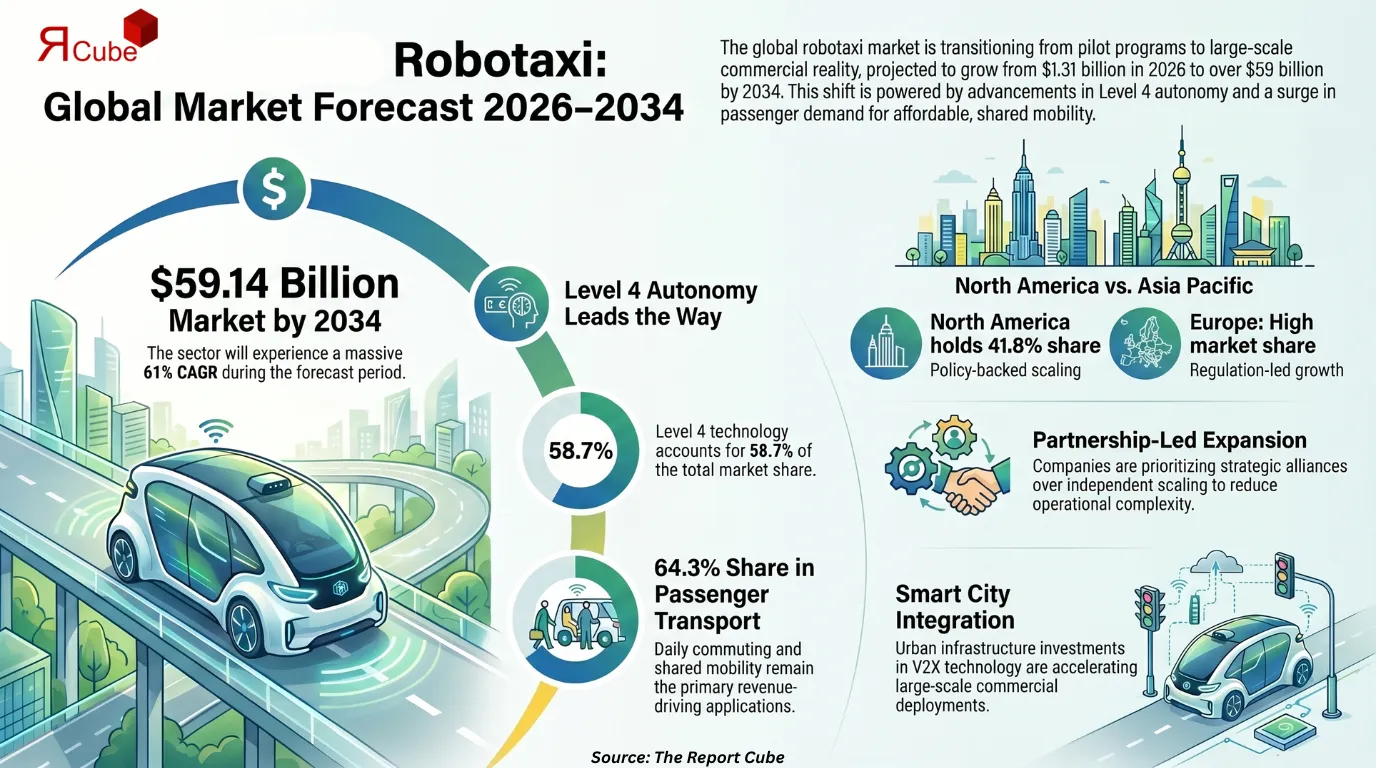
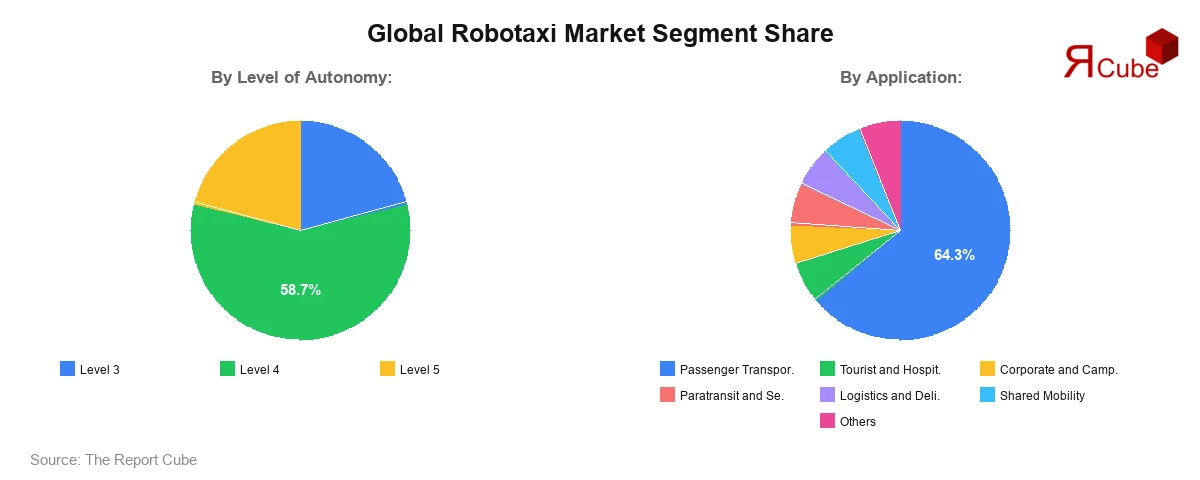
Level 4 segment leads the market with nearly 58.7% share.
By Application:
Passenger Transportation segment dominates the market with approximately 64.3% of total revenue.
Regional Outlook:
North America dominates the Global Robotaxi Market with around 41.8% share.
Global Robotaxi Market Insights & Analysis
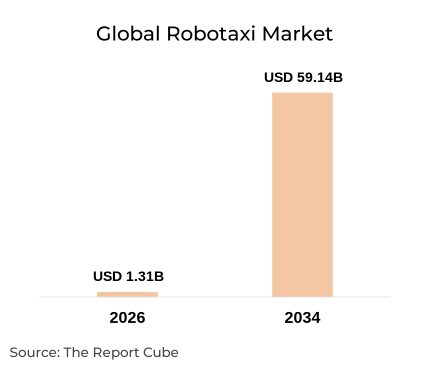
The Global Robotaxi Market is anticipated to register a CAGR of around 61% during the forecast period 2026-2034. The market size is valued at USD 1.31 billion in 2026 and is projected to reach USD 59.14 billion by 2034. Rapid progress in autonomous driving, artificial intelligence, sensor fusion, and connected mobility infrastructure is reshaping the global robotaxi landscape. Throughout 2025 and 2026, the industry gained significant momentum as autonomous ride-hailing services moved beyond pilot programs into broader commercial deployment across key markets, including the United States, China, and the Middle East. This growth has attracted substantial investment from technology firms, automotive manufacturers, and mobility operators that view autonomous transportation as a major long-term business opportunity.
The sector's expansion is being reinforced by a combination of strategic collaborations and evolving regulatory support. Several high-profile developments have highlighted the industry's accelerating maturity. Waymo broadened the reach of its commercial autonomous ride services through its partnership with Uber, while Zoox introduced public robotaxi operations in Las Vegas. In the Middle East, Baidu's Apollo Go advanced its global expansion plans through agreements in Dubai, and Tesla began operating unsupervised robotaxi services in Austin. At the same time, governments worldwide are increasingly encouraging autonomous mobility through pilot initiatives, safety regulations, and smart-city investments. Rising demand for affordable transportation, ongoing driver shortages, and continuous advancements in Level 4 autonomous technology are expected to drive sustained growth, wider adoption, and increasing market demand for robotaxi services across major urban centers in the years ahead.
Global Robotaxi Market Impact Analysis
| Factor | Type | Specific Impact on Market | Magnitude | Business Implication |
|---|---|---|---|---|
| Surging demand for autonomous ride hailing | Market | Accelerates shift from private vehicle ownership to robotaxis globally | High | Supports aggressive fleet scaling and city wise deployment roadmaps |
| Rapid advances in ADAS and sensor technologies | Technological | Improves safety, perception accuracy and operational reliability for fleets | High | Enables higher autonomy levels and lowers per mile operating expenses |
| High upfront capital and operating cost structure | Market | Costly LiDAR, cameras and compute delay breakeven for new operators | High | Drives partnerships, asset light models and phased city rollouts for viability |
| Evolving regulatory and safety approval frameworks | Regulatory | Pilots allowed but full scale commercial use depends on local rules | Medium | Requires proactive policy engagement and compliance centric product design |
| Post pandemic recovery in shared mobility adoption | Consumer | Demand rebounds as contact concerns ease and travel intensifies | Medium | Supports ramp up of robotaxi pilots tied to rising urban trip volumes |
| Asia Pacific leadership in autonomous mobility pilots | Environmental | Dense cities and policy support make region the fastest growing hub | High | Encourages prioritizing China and Asia Pacific for early scale deployments |
| Intensifying competition among global tech and auto players | Competitive | Multiple players invest in fleets, platforms and city partnerships | High | Necessitates differentiation on safety, uptime, pricing and user experience |
Global Robotaxi Market Dynamics
Key Driver: Increasing Commercial Deployment of Autonomous Ride-Hailing Services
The robotaxi market is entering a new phase of growth as the industry moves beyond limited pilot programs and into large-scale commercial deployment. Several technology leaders have already introduced paid autonomous ride-hailing services, signaling increasing trust in the capabilities and maturity of self-driving systems. At the same time, urban mobility providers are evaluating autonomous vehicle fleets as a practical solution for improving operational efficiency, reducing reliance on human drivers, and lowering long-term transportation expenses. Rising consumer acceptance of autonomous transportation, combined with growing ride demand, is further strengthening the commercial viability of robotaxi services.
Continuous advancements in artificial intelligence, machine learning, computer vision, high-definition mapping, and vehicle-to-network connectivity are enhancing the accuracy, safety, and reliability of autonomous driving systems. These innovations enable fleet operators to optimize vehicle utilization while significantly reducing labor-related costs. As autonomous technologies continue to meet increasingly stringent safety and regulatory standards, robotaxi services are expected to expand across more cities and metropolitan areas. This ongoing expansion is likely to create substantial opportunities for market growth over the forecast period, positioning robotaxis as a transformative component of future urban mobility ecosystems.
Industry Trends: Strategic Partnerships Becoming the Preferred Expansion Model
One of the most influential trends transforming the Robotaxi Market is the increasing adoption of partnership-led expansion strategies. Rather than developing and scaling operations independently, autonomous mobility companies are forming strategic alliances with vehicle manufacturers, ride-hailing platforms, technology providers, and transportation service operators to accelerate market entry and commercial deployment. These collaborative models enable participants to combine complementary capabilities, reduce operational complexity, and shorten the path to profitability.
A notable example of this trend is the collaboration among Uber, Lucid Motors, and Nuro, where each partner contributes specialized expertise across vehicle production, autonomous driving technology, and mobility service delivery. Such partnerships allow companies to leverage existing customer networks, infrastructure, and operational frameworks while minimizing the financial and technical risks associated with standalone expansion.
The industry is also witnessing a broader shift toward ecosystem-based growth models. Instead of creating entirely new transportation networks, robotaxi providers are integrating their services into established mobility ecosystems, enabling faster user adoption and improved fleet utilization. Simultaneously, growing investments in purpose-built autonomous vehicles are enhancing passenger comfort, safety, and operational efficiency. As these ecosystem partnerships continue to mature, they are expected to play a critical role in driving innovation, scalability, and long-term competitiveness across the autonomous transportation landscape.
Book your FREE 30-minute expert consultation today
Contact UsMajor Challenge: Regulatory Complexity and Safety Validation Requirements
Althrough significant technological progress and expanding pilot programs, regulatory compliance remains one of the most significant obstacles to widespread robotaxi adoption. Regulatory frameworks governing autonomous vehicles differ substantially across countries, states, and municipalities, creating a fragmented operating environment for market participants. Variations in testing standards, operational approvals, insurance requirements, safety certifications, and liability regulations often result in extended deployment timelines and increased compliance costs.
In addition to regulatory hurdles, maintaining public trust remains a critical challenge for the industry. Autonomous transportation services operate under intense public and governmental scrutiny, making safety performance a top priority. Even isolated incidents involving autonomous vehicles can trigger regulatory reviews, attract media attention, and affect consumer confidence in the technology.
To address these concerns, robotaxi operators continue to invest heavily in comprehensive safety validation programs, advanced cybersecurity frameworks, real-time fleet monitoring systems, sensor redundancy technologies, and AI-driven risk management solutions. While these investments strengthen operational reliability and regulatory readiness, they also increase capital requirements and create higher barriers to entry for emerging companies. Consequently, regulatory complexity and stringent safety expectations may continue to influence the pace of market expansion in several regions over the coming years.
Opportunity: Expansion into Smart Cities and Emerging Urban Mobility Networks
The rapid development of smart city infrastructure is creating substantial growth opportunities for the global robotaxi industry. Governments and urban planners are increasingly investing in intelligent transportation systems, connected road infrastructure, digital traffic management platforms, and vehicle-to-everything (V2X) communication technologies that support autonomous mobility operations. These advancements are establishing the technological foundation required for large-scale robotaxi deployment in urban environments.
Emerging economies across the Middle East and Asia-Pacific are becoming particularly attractive growth destinations due to proactive government support, favorable regulatory initiatives, and ambitious smart mobility programs. Cities such as Dubai, Abu Dhabi, Singapore, and several metropolitan regions in China are actively advancing autonomous transportation projects as part of broader smart city transformation strategies.
Furthermore, the integration of robotaxis with multimodal transportation networks is expected to unlock new revenue streams and enhance mobility accessibility. Applications across airport transportation services, tourism mobility corridors, first-mile and last-mile connectivity solutions, and corporate employee shuttle networks are expanding the commercial potential of autonomous ride services. According to industry observations highlighted by The Report Cube, the convergence of smart infrastructure, urban digitalization, and autonomous mobility innovation is expected to create a highly favorable environment for sustained robotaxi market growth throughout the forecast period.
Global Robotaxi Market Segment-wise Analysis
By Level of Autonomy:
- Level 3
- Level 4
- Level 5
Level 4 autonomous driving has emerged as the leading technology segment in the global robotaxi industry, accounting for an estimated 58.7% of total market revenue. Its strong market position is largely driven by its ability to deliver fully autonomous operations within clearly defined operational design domains (ODDs), making it a practical and commercially viable solution for real-world deployment. Industry leaders such as Waymo, Baidu, WeRide, and Zoox have focused their commercialization efforts on Level 4 systems because they offer a compelling balance between technological capability, operational efficiency, and regulatory feasibility. Unlike higher levels of autonomy that face significant technical and legal hurdles, Level 4 solutions are already proving their effectiveness in controlled urban environments.
The growing adoption of robotaxi services is further accelerating demand for Level 4 technology, particularly among fleet operators seeking dependable, scalable transportation solutions that require minimal human oversight. Continuous advancements in sensor fusion, high-definition mapping, artificial intelligence-driven perception, and real-time decision-making systems are enhancing vehicle safety, navigation accuracy, and operational reliability. As cities increasingly embrace autonomous mobility initiatives, Level 4 autonomy is expected to remain the foundation of near-term robotaxi commercialization and a key driver of future growth across the autonomous transportation ecosystem.
By Application:
- Passenger Transportation
- Tourist and Hospitality
- Corporate and Campus Shuttles
- Paratransit and Senior Mobility
- Logistics and Delivery
- Shared Mobility
- Others
Passenger transportation continues to be the primary revenue-driving segment of the global robotaxi market, contributing approximately 64.3% of total industry revenue. Its leadership position is largely fueled by the growing demand for affordable, convenient, and digitally enabled mobility solutions across rapidly urbanizing regions. Consumers increasingly rely on app-based transportation services for daily commuting, creating a strong foundation for autonomous ride-hailing adoption. The commercial deployment of robotaxi services by industry leaders such as Waymo, Uber, Baidu through its Apollo Go platform, and Zoox demonstrates the sector's increasing maturity and reinforces passenger transportation as the cornerstone of market growth. Rising traffic congestion in major cities, widespread smartphone penetration, and stronger consumer interest in sustainable transportation alternatives are further accelerating demand for autonomous passenger mobility services.
In addition, the integration of robotaxi networks with airports, tourism hubs, business centers, and public transportation systems is expanding their practical applications and improving accessibility for a broader user base. As public confidence in autonomous vehicle technology continues to strengthen and regulatory frameworks evolve, passenger transportation is expected to retain its dominant share of the robotaxi market, supporting long-term industry expansion and investment opportunities.
Regional Projection of Global Robotaxi Industry
- North America
- Europe
- Asia Pacific
- Middle East and Africa
- South America
North America continues to hold a dominant position in the global robotaxi industry, accounting for nearly 41.8% of total market revenue. The region's leadership is largely attributed to its mature autonomous vehicle ecosystem, robust venture capital funding environment, and the early commercialization of self-driving mobility services. The United States remains at the forefront of market growth, supported by the expanding operations and technological advancements of companies such as Waymo, Tesla, Zoox, Cruise, and Motional. These organizations are actively scaling pilot programs and commercial deployments across major urban centers, helping accelerate the transition toward autonomous transportation.
A key factor strengthening the regional market is the evolving regulatory landscape. Policy updates introduced throughout 2025 created clearer pathways for commercial autonomous vehicle deployment while preserving rigorous safety and compliance standards. This balance between innovation and oversight has encouraged further investment and market participation. Consumer familiarity with ride-hailing services, combined with the region's well-developed smart mobility infrastructure, continues to support widespread adoption. Cities such as Phoenix, San Francisco, Las Vegas, Austin, and Atlanta have emerged as important testing and commercialization hubs, offering real-world environments for autonomous mobility solutions.
Need insights for a specific region within this market?
Request Regional DataRegional Analysis of Global Robotaxi Market
The global robotaxi market shows varied regional maturity, pilots, and scale.
| Region | Demand Level | Key Areas | System Dominance | Core Demand Logic | Growth Nature |
|---|---|---|---|---|---|
| North America | Very High | U.S. Sunbelt & tech hubs | Level 4 robotaxis | Early pilots and AV leaders | Policy-backed scaling |
| Europe | High | Germany, U.K., Nordics | Mixed AV robo-fleets | Sustainability and safety focus | Regulation-led growth |
| Asia Pacific | Extremely High | China, Japan, South Korea | Large urban robo-fleets | Dense cities and tech funding | Fastest-growing region |
| Middle East & Africa | Medium | UAE, Saudi smart cities | Premium pilot services | Smart city and tourism push | Pilot-to-scale transition |
| South America | Low to Medium | Brazil, Mexico metros | Limited AV test fleets | Cost-led shared mobility tests | Long-term potential |
Government Initiatives & Policies
- United States NHTSA Automated Vehicle Framework (2025): The U.S. Department of Transportation introduced a new autonomous vehicle framework supporting commercial deployment, streamlined reporting requirements, and expanded vehicle exemptions to accelerate robotaxi innovation while maintaining safety oversight.
- Dubai Autonomous Vehicle Operating Regulations (2025): Dubai introduced executive regulations governing licensing, operational standards, infrastructure requirements, and commercial deployment procedures for autonomous vehicles, strengthening the region's robotaxi ecosystem and supporting large-scale rollout objectives.
Global Robotaxi Industry Recent Developments
- 2025: Zoox officially launched public robotaxi operations on the Las Vegas Strip using purpose-built autonomous vehicles without steering wheels or pedals. The deployment established one of the industry's earliest large-scale commercial services focused on high-density tourism corridors.
- 2025: Waymo launched paid autonomous ride-hailing operations in Atlanta through the Uber application, expanding commercial service coverage and demonstrating a partnership-based growth strategy across major metropolitan markets.
- 2025: Baidu Apollo Go signed a strategic agreement with Dubai's Roads and Transport Authority to deploy autonomous robotaxis, beginning with an initial fleet and targeting significant long-term expansion across the UAE. :contentReference[oaicite:5]{index=5}
- 2026: Tesla initiated fully unsupervised robotaxi rides in Austin using Model Y vehicles. The deployment tested Tesla's camera-based autonomous driving architecture within real-world urban operating conditions.
- 2025: Uber, Lucid Motors, and Nuro announced a strategic collaboration targeting deployment of over 20,000 autonomous robotaxis, reflecting increasing industry preference for integrated partnership models.
Why Choose This Report?
- Provides a comprehensive overview of the overall market analysis, encompassing key trends, consumer behavior analysis, and risk assessment to support strategic decision-making.
- Provides accurate, up-to-date insights into market size, segmentation, and emerging opportunities, helping to minimize risk & capitalizing on growth.
- Gives deep understanding of target audience preferences, investment habits, and communication channels for enhanced product development & marketing effectiveness.
- Delivers competitive analysis & benchmarking, uncovering the strengths & weaknesses of market competitors to guide strategies.
- Consolidate comprehensive market intelligence, reducing reasoning & streamlining research efforts.
- Facilitates customized market segmentation & risk mitigation strategies, fine-tuned to the business objectives.
- Aids in identifying both market challenges & untapped opportunities within the industry to drive long-term business growth.
- Provides valuable information based on actual customer data & search trends.
Table of Contents
- Introduction
- Objective of the Study
- Product and Category Definition
- Market Segmentation
- Study Variables
- Research Methodology
- Secondary Data Points
- Breakdown of Secondary Sources
- Primary Data Points
- Breakdown of Primary Interviews
- Secondary Data Points
- Executive Summary
- Market Dynamics
- Emerging Opportunities
- Adoption Trends
- Demand Drivers
- Disruption Analysis (Challenges)
- Industry Analysis & Strategic Insights
- Supply/Value Chain Analysis
- Pricing Analysis
- Go-To-Market (GTM) Strategy
- BCG Matrix
- Recent Trends and Developments
- Import and Export Analysis
- Regulatory and Policy Landscape
- Region-wise policies
- Government Initiatives
- Global Robotaxi Market Overview and Forecast Analysis (2021-2034)
- Market Size, By Value, By Growth Rate (CAGR/USD Billion)
- Market Share, By Level of Autonomy
- Level 3
- Level 4
- Level 5
- Market Share, By Architecture
- Purpose Built
- Retrofit
- Market Share, By Sensor Type
- Vision Based
- LIDAR Based
- Radar and Camera Based
- Others
- Market Share, By Vehicle Type
- Sedans
- Vans
- Micro and Minicabs
- Shuttles
- SUVs
- Others
- Market Share, By Vehicle Fuel
- Hybrid Vehicles
- Fuel Cell Vehicles
- ICE Vehicles
- Electric Vehicles
- Others
- Market Share, By Fleet Owner
- Third Party Fleet Operators
- Tech Company Owned
- OEM Owned and Operated
- P2P Owned
- Others
- Market Share, By Application
- Passenger Transportation
- Tourist and Hospitality
- Corporate and Campus Shuttles
- Paratransit and Senior Mobility
- Others
- Logistics and Delivery
- Shared Mobility
- Others
- Passenger Transportation
- Market Share, By Pricing Model
- Flat per Mile
- Dynamic Pricing
- Subscription
- Others
- Market Share, By Region
- North America
- Europe
- Asia Pacific
- Middle East and Africa
- South America
- Market Share, By Company
- Revenue Shares and Analysis
- Competitive Landscape
- North America Robotaxi Market Overview and Forecast Analysis (2021-2034)
- Market Size, By Value, By Growth Rate (CAGR/USD Billion/Million)
- Market Share, By Level of Autonomy
- Market Share, By Architecture
- Market Share, By Sensor Type
- Market Share, By Vehicle Type
- Market Share, By Vehicle Fuel
- Market Share, By Fleet Owner
- Market Share, By Application
- Market Share, By Pricing Model
- Market Share, By Country
- United States
- Canada
- Mexico
- Rest of North America
- Europe Robotaxi Market Overview and Forecast Analysis (2021-2034)
- Market Size, By Value, By Growth Rate (CAGR/USD Billion/Million)
- Market Share, By Level of Autonomy
- Market Share, By Architecture
- Market Share, By Sensor Type
- Market Share, By Vehicle Type
- Market Share, By Vehicle Fuel
- Market Share, By Fleet Owner
- Market Share, By Application
- Market Share, By Pricing Model
- Market Share, By Country
- Germany
- United Kingdom
- France
- Italy
- Spain
- Netherlands
- Russia
- Poland
- Belgium
- Sweden
- Rest of Europe
- Asia Pacific Robotaxi Market Overview and Forecast Analysis (2021-2034)
- Market Size, By Value, By Growth Rate (CAGR/USD Billion/Million)
- Market Share, By Level of Autonomy
- Market Share, By Architecture
- Market Share, By Sensor Type
- Market Share, By Vehicle Type
- Market Share, By Vehicle Fuel
- Market Share, By Fleet Owner
- Market Share, By Application
- Market Share, By Pricing Model
- Market Share, By Country
- China
- India
- Japan
- South Korea
- Australia
- Indonesia
- Thailand
- Malaysia
- Vietnam
- Philippines
- Singapore
- New Zealand
- Rest of Asia Pacific
- Middle East and Africa Robotaxi Market Overview and Forecast Analysis (2021-2034)
- Market Size, By Value, By Growth Rate (CAGR/USD Billion/Million)
- Market Share, By Level of Autonomy
- Market Share, By Architecture
- Market Share, By Sensor Type
- Market Share, By Vehicle Type
- Market Share, By Vehicle Fuel
- Market Share, By Fleet Owner
- Market Share, By Application
- Market Share, By Pricing Model
- Market Share, By Country
- Saudi Arabia
- United Arab Emirates
- South Africa
- Egypt
- Nigeria
- Morocco
- Turkey
- Rest of Middle East and Africa
- South America Robotaxi Market Overview and Forecast Analysis (2021-2034)
- Market Size, By Value, By Growth Rate (CAGR/USD Billion/Million)
- Market Share, By Level of Autonomy
- Market Share, By Architecture
- Market Share, By Sensor Type
- Market Share, By Vehicle Type
- Market Share, By Vehicle Fuel
- Market Share, By Fleet Owner
- Market Share, By Application
- Market Share, By Pricing Model
- Market Share, By Country
- Brazil
- Argentina
- Chile
- Colombia
- Peru
- Rest of South America
- Competitive Analysis, 2026
- Market Share of Key Players
- Competitive Mapping for Each Segment and Companies Operating Regionally
- North America Robotaxi Companies Share and Competitive Analysis, 2026
- Europe Robotaxi Companies Share and Competitive Analysis, 2026
- Asia Pacific Robotaxi Companies Share and Competitive Analysis, 2026
- Middle East and Africa Robotaxi Companies Share and Competitive Analysis, 2026
- South America Robotaxi Companies Share and Competitive Analysis, 2026
- Company Profile (Partial List)
- Grab
- Company Overview
- Product Portfolio
- Strategic Alliances/Partnerships
- Recent Developments
- Waymo
- Company Overview
- Product Portfolio
- Strategic Alliances/Partnerships
- Recent Developments
- AutoX
- Company Overview
- Product Portfolio
- Strategic Alliances/Partnerships
- Recent Developments
- Lucid
- Company Overview
- Product Portfolio
- Strategic Alliances/Partnerships
- Recent Developments
- WeRide
- Company Overview
- Product Portfolio
- Strategic Alliances/Partnerships
- Recent Developments
- Bolt Go
- Company Overview
- Product Portfolio
- Strategic Alliances/Partnerships
- Recent Developments
- Zoox
- Company Overview
- Product Portfolio
- Strategic Alliances/Partnerships
- Recent Developments
- Tesla
- Company Overview
- Product Portfolio
- Strategic Alliances/Partnerships
- Recent Developments
- Mobileye
- Company Overview
- Product Portfolio
- Strategic Alliances/Partnerships
- Recent Developments
- Motional
- Company Overview
- Product Portfolio
- Strategic Alliances/Partnerships
- Recent Developments
- MOAI
- Company Overview
- Product Portfolio
- Strategic Alliances/Partnerships
- Recent Developments
- Nuro
- Company Overview
- Product Portfolio
- Strategic Alliances/Partnerships
- Recent Developments
- DiDi
- Company Overview
- Product Portfolio
- Strategic Alliances/Partnerships
- Recent Developments
- Uber
- Company Overview
- Product Portfolio
- Strategic Alliances/Partnerships
- Recent Developments
- Kakao
- Company Overview
- Product Portfolio
- Strategic Alliances/Partnerships
- Recent Developments
- Cruise
- Company Overview
- Product Portfolio
- Strategic Alliances/Partnerships
- Recent Developments
- Mav Mobility
- Company Overview
- Product Portfolio
- Strategic Alliances/Partnerships
- Recent Developments
- Pony.ai
- Company Overview
- Product Portfolio
- Strategic Alliances/Partnerships
- Recent Developments
- Baidu Apollo Go
- Company Overview
- Product Portfolio
- Strategic Alliances/Partnerships
- Recent Developments
- Verra Mobility
- Company Overview
- Product Portfolio
- Strategic Alliances/Partnerships
- Recent Developments
- Others (Partial List)
- Grab
- Contact Us and Disclaimer
Top Key Players & Market Share Outlook
- Grab
- Waymo
- AutoX
- Lucid
- WeRide
- Bolt Go
- Zoox
- Tesla
- Mobileye
- Motional
- MOAI
- Nuro
- DiDi
- Uber
- Kakao
- Cruise
- Mav Mobility
- Pony.ai
- Baidu Apollo Go
- Verra Mobility
Frequently Asked Questions






