



Build Your Custom Market Intelligence Report
Customize Your ReportIndia Automotive AI Market Key Highlights
By AI Technology:
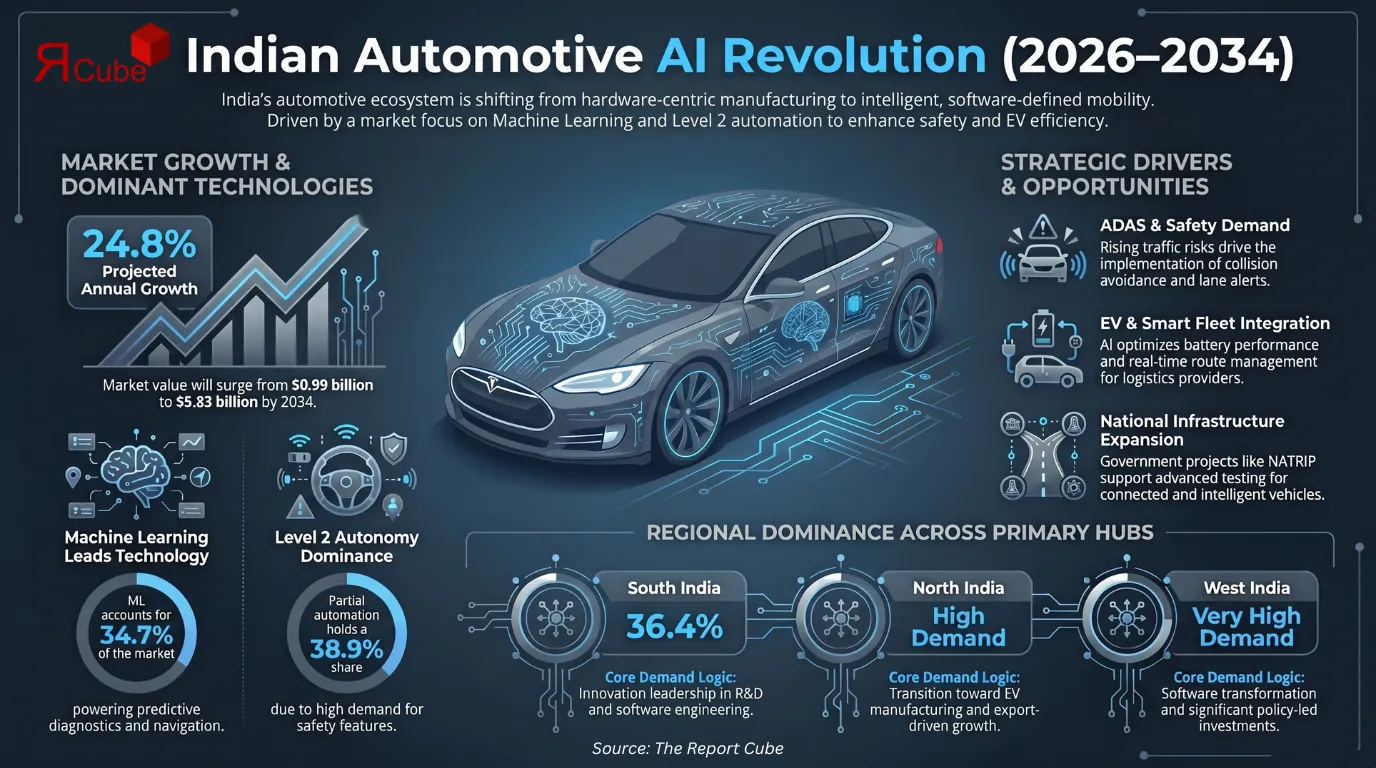
Machine Learning (ML) segment leads the market with nearly 34.7% share.
By Vehicle Autonomy Level:
Level 2 (Partial Automation) segment dominates the market with around 38.9% of revenue.
Regional Outlook:
South India dominates the India Automotive AI market with approximately 36.4% share.
India Automotive AI Market Insights & Analysis
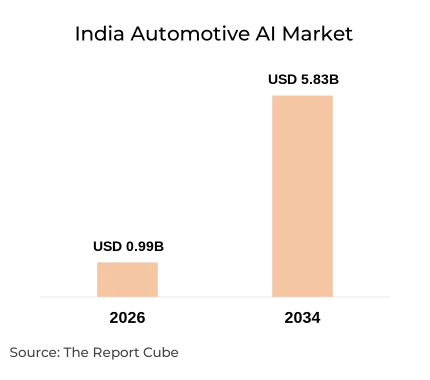
The India Automotive AI Market is anticipated to register a CAGR of around 24.8% during the forecast period 2026-2034. The market size is valued at USD 0.99 billion in 2026 and is projected to reach USD 5.83 billion by 2034. Growing demand for intelligent mobility systems, connected vehicles, and advanced driver-assistance technologies is reshaping the automotive AI market size across India. Automotive manufacturers are actively integrating artificial intelligence into vehicle safety, navigation, infotainment, fleet management, and predictive diagnostics to improve operational efficiency and customer experience. Rising investments in electric mobility and software-defined vehicle architecture are also accelerating automotive AI market growth.
India’s automotive ecosystem is gradually shifting from hardware-centric manufacturing toward intelligent and software-enabled mobility solutions. Leading OEMs, mobility startups, and global technology companies are expanding research partnerships focused on computer vision, machine learning, and autonomous driving technologies adapted for Indian road conditions. The rise of electric passenger vehicles and AI-enabled two-wheelers is strengthening demand for real-time analytics, over-the-air software updates, and intelligent energy optimization systems. Government-backed initiatives supporting smart mobility infrastructure, EV adoption, and digital manufacturing are further reinforcing long-term growth opportunities across the India automotive AI industry.
India Automotive AI Market Impact Analysis
| Factor | Type | Specific Impact on Market | Magnitude | Business Implication |
|---|---|---|---|---|
| Rising Demand for ADAS and Safety | Consumer | Consumers seek enhanced safety in premium vehicles | High | Develop AI-driven ADAS for mass and premium segments |
| Government Safety Regulations | Regulatory | Mandates on safety features accelerate AI integration | High | Align product roadmap with compliance timelines early |
| Expansion of Connected Vehicles | Technological | 10M+ connected vehicles drive AI analytics demand | High | Build cloud-based platforms for data-driven insights |
| Growth in Electric Vehicle Adoption | Market | 49% EV CAGR creates AI demand for battery and range | High | Develop AI solutions for EV efficiency and diagnostics |
| Automotive Production Scale | Market | 25M+ units in 2023 fuel AI adoption in manufacturing | Medium–High | Target OEMs and tier-1 suppliers with automation tools |
| AI-Driven Manufacturing Efficiency | Technological | Automation boosts production efficiency by 15–20% | Medium | Offer predictive maintenance and quality AI solutions |
| Supply Chain Digitalization | Technological | AI improves demand accuracy and cuts logistics costs | Medium | Provide AI for real-time tracking and route planning |
| Lack of Comprehensive AI Regulation | Regulatory | No dedicated AI law; sector-driven governance evolves | Medium | Monitor evolving frameworks and engage policymakers |
| Rising Middle-Class Spending Power | Consumer | Income growth drives preference for smart vehicles | Medium | Position AI features as value-add for aspirational buyers |
| Global Competitive Pressure | Competitive | OEMs accelerate AI adoption to match global standards | Medium | Localize AI development and form strategic partnerships |
India Automotive AI Market Dynamics
Key Driver: Growing Deployment of Intelligent Safety and Driver Assistance Technologies
The rising implementation of AI-enabled safety technologies across passenger and commercial vehicles is emerging as a major factor supporting India automotive AI market growth. Vehicle manufacturers are increasingly integrating intelligent systems such as adaptive cruise control, lane departure alerts, collision avoidance technologies, and driver monitoring platforms to enhance vehicle safety standards. Demand for these technologies is rising steadily across urban regions where traffic congestion and accident risks continue to increase. Automotive brands are also strengthening their premium vehicle portfolios with AI-supported mobility features designed to improve driving convenience and real-time road awareness.
Automotive AI adoption is expanding beyond luxury vehicles as mid-range passenger car manufacturers introduce semi-autonomous features into mainstream models. Cloud connectivity and real-time data processing capabilities are allowing automotive companies to improve predictive maintenance, remote diagnostics, and fleet optimization solutions. Growing collaboration between automotive OEMs and semiconductor providers is accelerating the deployment of intelligent vehicle platforms tailored for Indian mobility requirements. Increasing awareness regarding road safety and vehicle automation is expected to sustain long-term demand for AI-powered automotive systems.
Industry Trends: Expansion of Software-Defined Mobility Platforms Across India
The Indian automotive industry is rapidly embracing software-defined vehicle ecosystems supported by artificial intelligence, cloud computing, and connected mobility technologies. Automotive manufacturers are prioritizing AI-native vehicle platforms capable of improving battery performance, intelligent energy distribution, and adaptive driving functionality. Real-time vehicle intelligence powered by machine learning and computer vision technologies is becoming a defining feature within new-generation electric and connected vehicles. This transition is reshaping product development strategies across the automotive sector.
Technology providers and automotive companies are increasing investments in AI engineering centers, autonomous simulation environments, and digital mobility platforms. In 2025 and 2026, multiple industry participants expanded development activities focused on predictive maintenance, intelligent cockpit systems, and AI-based telematics solutions. Generative AI applications are also gaining visibility within personalized infotainment and voice-assistance systems designed for connected mobility experiences. As software integration becomes central to vehicle development, automotive companies are strengthening partnerships with cloud infrastructure and embedded AI solution providers across India.
Major Challenge: Complex Real-World Validation Requirements for Autonomous Systems
The India automotive AI industry faces significant operational challenges associated with testing and validating autonomous and semi-autonomous driving technologies under diverse traffic conditions. AI-powered mobility systems require extensive calibration and validation due to India’s mixed traffic environments involving pedestrians, two-wheelers, commercial vehicles, and inconsistent road infrastructure. Real-world driving complexity increases the need for advanced sensor integration, localized AI training models, and high-performance automotive computing systems.
Automotive companies are also encountering elevated costs related to LiDAR integration, AI processing chips, cybersecurity frameworks, and edge computing infrastructure. Developing reliable autonomous mobility systems requires continuous software upgrades and large-scale driving data analysis, which can increase development timelines and operational expenses. In addition, the limited availability of highly specialized automotive AI engineers and software validation experts continues to challenge faster deployment of advanced autonomous vehicle technologies across India’s evolving mobility ecosystem.
Opportunity: AI-Driven Expansion Across Electric Vehicles and Smart Fleet Operations
India’s rapidly expanding electric mobility sector is creating substantial opportunities for AI integration across vehicle intelligence, energy optimization, and connected transportation services. Automotive manufacturers are increasingly deploying AI-powered battery analytics, intelligent charging management systems, and predictive diagnostics to improve electric vehicle efficiency and lifecycle management. These technologies are becoming particularly important as India scales domestic EV manufacturing and charging infrastructure development.
Commercial mobility operators and logistics providers are also adopting AI-enabled telematics and fleet intelligence platforms to improve route optimization, fuel efficiency, and predictive maintenance capabilities. Connected fleet management solutions are helping businesses reduce downtime and enhance operational performance through real-time vehicle monitoring. Rising investment in AI-enabled automotive software platforms, combined with expanding digital infrastructure and smart mobility initiatives, is expected to create long-term growth opportunities across passenger mobility, commercial transportation, and electric two-wheeler ecosystems in India.
India Automotive AI Market Segment-wise Analysis
By AI Technology:
- Computer Vision
- Generative AI
- Deep Learning
- Natural Language Processing (NLP)
- Machine Learning (ML)
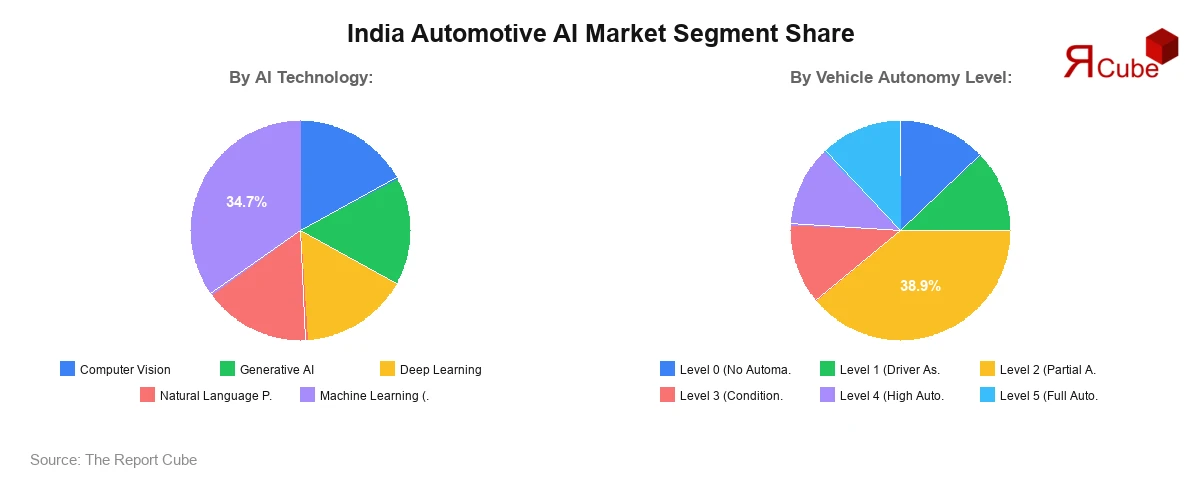
Machine Learning (ML) held the leading position within the India automotive AI market due to its extensive deployment across predictive analytics, driver behavior monitoring, intelligent navigation, and connected vehicle diagnostics. The segment accounted for nearly 34.7% market share in 2026 as automotive manufacturers accelerated the use of machine learning algorithms to improve vehicle performance, operational safety, and predictive servicing capabilities. AI-enabled mobility systems supported by ML are increasingly helping OEMs process real-time driving data and optimize vehicle efficiency under varying road conditions.
Growing deployment of connected vehicles and cloud-integrated automotive platforms is further strengthening machine learning adoption across India’s mobility ecosystem. Automotive companies are utilizing ML-driven analytics to enhance electric vehicle battery performance, autonomous decision-making, and fleet intelligence operations. Demand is also rising from mobility service providers seeking AI-powered solutions capable of improving route management, driver safety, and maintenance scheduling. Continued advancements in automotive edge computing and embedded AI processors are expected to reinforce the segment’s long-term growth.
By Vehicle Autonomy Level:
- Level 0 (No Automation)
- Level 1 (Driver Assistance)
- Level 2 (Partial Automation)
- Level 3 (Conditional Automation)
- Level 4 (High Automation)
- Level 5 (Full Automation)
Level 2 (Partial Automation) emerged as the dominant segment within the India automotive AI market, accounting for approximately 38.9% revenue share in 2026. The segment’s leadership is primarily driven by rising consumer preference for intelligent safety technologies such as adaptive cruise control, automated braking systems, parking assistance, and lane-centering functionality. Automotive manufacturers are increasingly integrating these semi-autonomous features into premium and upper mid-range passenger vehicles to improve driving safety and user convenience.
The commercialization of Level 2 automation is expanding steadily due to its practical compatibility with existing road infrastructure and driving environments in India. Automotive OEMs are prioritizing scalable AI-supported driver assistance technologies that can operate effectively within urban traffic conditions while maintaining affordability for broader vehicle segments. Rising awareness regarding road safety, increasing regulatory focus on intelligent safety systems, and growing availability of connected vehicle technologies are expected to continue supporting demand for Level 2 autonomous mobility platforms throughout the forecast period.
Regional Projection of India Automotive AI Industry
- North India
- South India
- West India
- East India
- Central India
South India accounted for the leading share of the India automotive AI market, contributing nearly 36.4% of total industry revenue in 2026. The region benefits from a strong automotive manufacturing ecosystem supported by major production hubs across Tamil Nadu, Karnataka, and Telangana. Cities such as Bengaluru, Chennai, and Hyderabad have emerged as strategic centers for automotive software engineering, AI research, connected mobility innovation, and electric vehicle technology development. The presence of established automotive OEMs, semiconductor companies, and cloud technology providers continues to strengthen regional market expansion.
Increasing investments in electric mobility infrastructure and software-defined vehicle development are further accelerating automotive AI adoption across South India. The region is also attracting significant R&D activities related to autonomous driving simulation, predictive vehicle analytics, and intelligent transportation systems tailored for Indian traffic environments. Collaboration between technology startups, automotive engineering firms, and global mobility companies is supporting innovation across AI-enabled telematics, connected fleet management, and advanced driver-assistance technologies. These factors are expected to maintain South India’s leadership position throughout the forecast period.
Need insights for a specific region within this market?
Request Regional DataIndia Automotive AI Industry Regional Analysis
The India automotive AI industry varies significantly across regions due to OEM concentration, R&D infrastructure, and technology adoption levels.
| Region | Demand Level | Key Areas | System Dominance | Core Demand Logic | Growth Nature |
|---|---|---|---|---|---|
| North India | High | Delhi NCR, Gurgaon, Manesar | Telematics & Predictive AI | ICE vehicle manufacturing & export hubs | EV transition-driven |
| South India | Extremely High | Chennai, Bangalore, Hyderabad | ADAS & Automotive R&D AI | OEM R&D centers & multilingual NLP | Innovation leadership |
| West India | Very High | Pune, Mumbai, Aurangabad | Manufacturing AI & SDV | Software transformation & policy support | Rs 10,000 Cr investment |
| East India | Medium | Kolkata, Jamshedpur | Supply chain & logistics AI | Component manufacturing & tier-2 focus | Emerging ecosystem |
| Central India | Medium-High | Indore, Bhopal | AI city & governance AI | Tier-2 tech hub & data center incentives | Policy-led expansion |
Government Initiatives & Policies
- National Automotive Testing and R&D Infrastructure Project (NATRiP) Expansion: In 2025, India expanded advanced automotive testing infrastructure to support ADAS validation, connected mobility testing, and intelligent transportation system development for AI-enabled vehicles.
- IndiaAI Mission for Intelligent Mobility: During 2026, the government strengthened AI-focused innovation funding and semiconductor ecosystem support to accelerate AI integration across automotive manufacturing and smart mobility technologies.
India Automotive AI Industry Recent Developments
- April 2026: JSW Motors and Tata Elxsi launched the JNEXT Technology Center in Pune focused on AI-powered connected mobility, predictive maintenance, digital twins, and software-defined vehicle platforms for next-generation electric vehicles. The initiative strengthened domestic automotive AI engineering capabilities and accelerated intelligent EV software innovation.
- February 2026: Mobileye and ARAI introduced India’s first dedicated ADAS Test City in Pune to support real-world testing of AI-driven autonomous mobility and ADAS technologies under Indian traffic conditions. The development improved validation infrastructure for intelligent driving systems and localized safety technologies.
- January 2026: Matter unveiled India’s first AI-Defined Vehicle platform for electric two-wheelers integrating AI-based diagnostics, rider safety systems, adaptive energy management, and real-time vehicle intelligence. The launch accelerated AI adoption across India’s rapidly growing electric two-wheeler segment.
Why Choose This Report?
- Provides a comprehensive overview of the overall market analysis, encompassing key trends, consumer behavior analysis, and risk assessment to support strategic decision-making.
- Provides accurate, up-to-date insights into market size, segmentation, and emerging opportunities, helping to minimize risk & capitalizing on growth.
- Gives deep understanding of target audience preferences, investment habits, and communication channels for enhanced product development & marketing effectiveness.
- Delivers competitive analysis & benchmarking, uncovering the strengths & weaknesses of market competitors to guide strategies.
- Consolidate comprehensive market intelligence, reducing reasoning & streamlining research efforts.
- Facilitates customized market segmentation & risk mitigation strategies, fine-tuned to the business objectives.
- Aids in identifying both market challenges & untapped opportunities within the industry to drive long-term business growth.
- Provides valuable information based on actual customer data & search trends.
Table of Contents
- Introduction
- Objective of the Study
- Product and Category Definition
- Market Segmentation
- Study Variables
- Research Methodology
- Secondary Data Points
- Breakdown of Secondary Sources
- Primary Data Points
- Breakdown of Primary Interviews
- Secondary Data Points
- Executive Summary
- Market Dynamics
- Emerging Opportunities
- Adoption Trends
- Demand Drivers
- Disruption Analysis (Challenges)
- Industry Analysis & Strategic Insights
- Supply/Value Chain Analysis
- Pricing Analysis
- Go-To-Market (GTM) Strategy
- BCG Matrix
- Recent Trends and Developments
- Import and Export Analysis
- Regulatory and Policy Landscape
- Region-wise Policies
- Government Initiatives
- India Automotive AI Market Overview and Forecast Analysis (2021-2034)
- Market Size, By Value, By Growth Rate (CAGR / USD Billion)
- Market Share, By Component
- Services
- OTA (Over-the-Air) Update Services
- Consulting & Support Services
- Simulation & Validation Services
- AI System Integration
- Software
- AI Middleware & Operating Systems
- Predictive Analytics Software
- Perception Software
- Generative AI & In-Vehicle AI Assistant Software
- Autonomous Driving Software Stack
- Hardware
- GPUs / NPUs / Edge AI Chips
- High-Performance Computing (HPC) Units
- Sensors
- Radar
- Ultrasonic Sensors
- LiDAR
- Cameras
- AI Accelerators & Automotive SoCs
- Services
- Market Share, By AI Technology
- Computer Vision
- Generative AI
- Deep Learning
- Natural Language Processing (NLP)
- Machine Learning (ML)
- Market Share, By Vehicle Autonomy Level
- Level 0 (No Automation)
- Level 1 (Driver Assistance)
- Level 2 (Partial Automation)
- Level 3 (Conditional Automation)
- Level 4 (High Automation)
- Level 5 (Full Automation)
- Market Share, By Vehicle Type
- Heavy Commercial Vehicles (HCVs)
- Robotaxis & Autonomous Shuttles
- Passenger Vehicles
- Off-Highway Vehicles
- Buses & Coaches
- Light Commercial Vehicles (LCVs)
- Market Share, By Propulsion Type
- Battery Electric Vehicles (BEVs)
- Fuel Cell Electric Vehicles (FCEVs)
- Plug-in Hybrid Electric Vehicles (PHEVs)
- Hybrid Electric Vehicles (HEVs)
- Internal Combustion Engine (ICE) Vehicles
- Market Share, By Connectivity Type
- Non-Connected Vehicles
- Connected Vehicles
- Market Share, By Sales Channel
- Aftermarket AI Solutions
- OEM (Integrated AI Systems)
- Market Share, By Application
- Predictive Maintenance
- Insurance Telematics & Risk Analytics
- Fleet Management & Route Optimization
- Vehicle Personalization & Recommendation Systems
- Advanced Driver Assistance Systems (ADAS)
- Cybersecurity & Threat Detection
- Autonomous Driving
- Energy & Battery Management
- Driver & Occupant Monitoring Systems
- Intelligent Infotainment Systems
- Market Share, By End User
- Fleet Operators
- Insurance Companies
- Tier-1 Automotive Suppliers
- Mobility-as-a-Service (MaaS) Providers
- Automotive OEMs
- Market Share, By Region
- North India
- South India
- West India
- East India
- Central India
- Market Share, By Company
- Revenue Shares & Analysis
- Competitive Landscape
- India Automotive AI Market - North India Overview and Forecast Analysis (2021-2034)
- Market Size, By Value, By Growth Rate (CAGR / USD Billion/Million)
- Market Share, By Component
- Market Share, By AI Technology
- Market Share, By Vehicle Autonomy Level
- Market Share, By Vehicle Type
- Market Share, By Propulsion Type
- Market Share, By Connectivity Type
- Market Share, By Sales Channel
- Market Share, By Application
- Market Share, By End User
- India Automotive AI Market - South India Overview and Forecast Analysis (2021-2034)
- Market Size, By Value, By Growth Rate (CAGR / USD Billion/Million)
- Market Share, By Component
- Market Share, By AI Technology
- Market Share, By Vehicle Autonomy Level
- Market Share, By Vehicle Type
- Market Share, By Propulsion Type
- Market Share, By Connectivity Type
- Market Share, By Sales Channel
- Market Share, By Application
- Market Share, By End User
- India Automotive AI Market - West India Overview and Forecast Analysis (2021-2034)
- Market Size, By Value, By Growth Rate (CAGR / USD Billion/Million)
- Market Share, By Component
- Market Share, By AI Technology
- Market Share, By Vehicle Autonomy Level
- Market Share, By Vehicle Type
- Market Share, By Propulsion Type
- Market Share, By Connectivity Type
- Market Share, By Sales Channel
- Market Share, By Application
- Market Share, By End User
- India Automotive AI Market - East India Overview and Forecast Analysis (2021-2034)
- Market Size, By Value, By Growth Rate (CAGR / USD Billion/Million)
- Market Share, By Component
- Market Share, By AI Technology
- Market Share, By Vehicle Autonomy Level
- Market Share, By Vehicle Type
- Market Share, By Propulsion Type
- Market Share, By Connectivity Type
- Market Share, By Sales Channel
- Market Share, By Application
- Market Share, By End User
- India Automotive AI Market - Central India Overview and Forecast Analysis (2021-2034)
- Market Size, By Value, By Growth Rate (CAGR / USD Billion/Million)
- Market Share, By Component
- Market Share, By AI Technology
- Market Share, By Vehicle Autonomy Level
- Market Share, By Vehicle Type
- Market Share, By Propulsion Type
- Market Share, By Connectivity Type
- Market Share, By Sales Channel
- Market Share, By Application
- Market Share, By End User
- Competitive Analysis, 2026
- Market Share of Key Players
- Competitive Mapping for Each Segment and Companies Operating by Region
- North India Automotive AI Companies Share & Competitive Analysis, 2026
- South India Automotive AI Companies Share & Competitive Analysis, 2026
- West India Automotive AI Companies Share & Competitive Analysis, 2026
- East India Automotive AI Companies Share & Competitive Analysis, 2026
- Central India Automotive AI Companies Share & Competitive Analysis, 2026
- Company Profile (Partial List)
- Robert Bosch GmbH
- Company Overview
- Product Portfolio
- Strategic Alliances/Partnerships
- Recent Developments
- NVIDIA Corporation
- Company Overview
- Product Portfolio
- Strategic Alliances/Partnerships
- Recent Developments
- Mercedes-Benz Group AG
- Company Overview
- Product Portfolio
- Strategic Alliances/Partnerships
- Recent Developments
- Amazon Web Services, Inc.
- Company Overview
- Product Portfolio
- Strategic Alliances/Partnerships
- Recent Developments
- ZF Friedrichshafen AG
- Company Overview
- Product Portfolio
- Strategic Alliances/Partnerships
- Recent Developments
- Intel Corporation
- Company Overview
- Product Portfolio
- Strategic Alliances/Partnerships
- Recent Developments
- Microsoft Corporation
- Company Overview
- Product Portfolio
- Strategic Alliances/Partnerships
- Recent Developments
- Continental AG
- Company Overview
- Product Portfolio
- Strategic Alliances/Partnerships
- Recent Developments
- Aptiv PLC
- Company Overview
- Product Portfolio
- Strategic Alliances/Partnerships
- Recent Developments
- Qualcomm Incorporated
- Company Overview
- Product Portfolio
- Strategic Alliances/Partnerships
- Recent Developments
- Others (Partial List)
- Robert Bosch GmbH
- Contact Us and Disclaimer
Top Key Players & Market Share Outlook
- Robert Bosch GmbH
- NVIDIA Corporation
- Mercedes-Benz Group AG
- Amazon Web Services, Inc.
- ZF Friedrichshafen AG
- Intel Corporation
- Microsoft Corporation
- Continental AG
- Aptiv PLC
- Qualcomm Incorporated
- Others
Frequently Asked Questions






