



Build Your Custom Market Intelligence Report
Customize Your ReportIndia Semiconductor Market Insights & Analysis
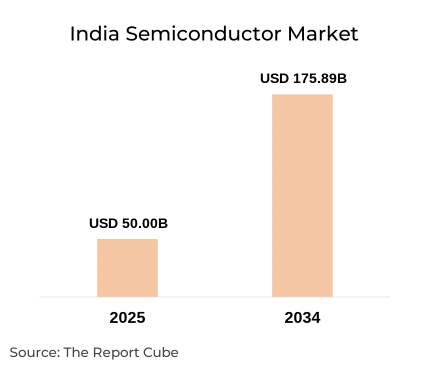
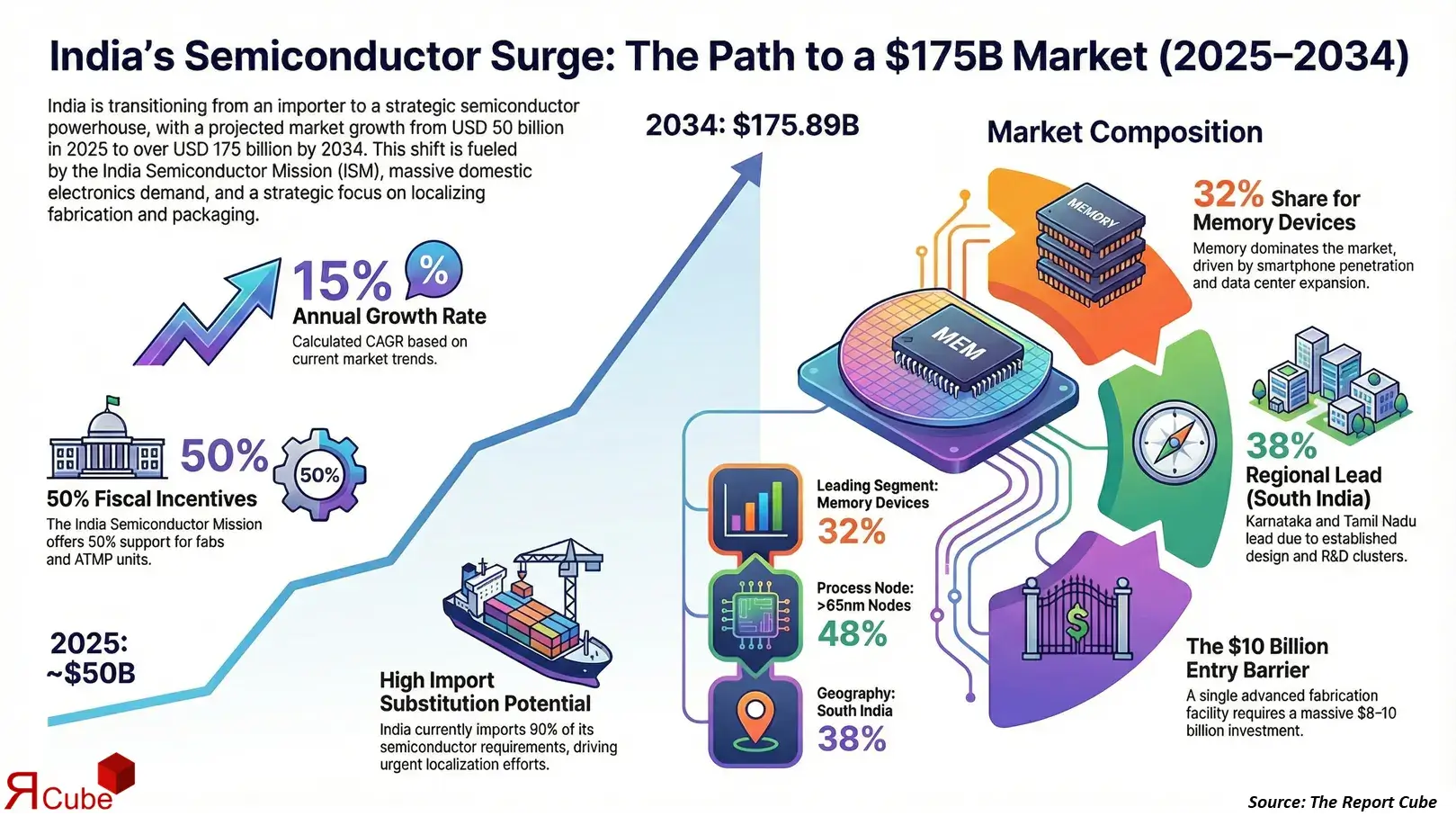
The India Semiconductor Market is anticipated to register a 15.00% CAGR during the forecast period of 2026-2034. The market size was valued at USD 50 billion in 2025 and is projected to reach USD 175.89 billion by 2034. India is rapidly positioning itself as a strategic global semiconductor hub, driven by rising domestic electronics consumption, strong government backing, and increasing investments from global chipmakers.
Growing demand from smartphones, consumer electronics, automotive electronics, data centers, and emerging technologies such as artificial intelligence, 5G, and IoT is significantly accelerating semiconductor consumption. India currently imports nearly 90% of its semiconductor requirements, highlighting strong localization potential. This demand-supply gap has prompted the government to aggressively promote domestic fabrication, assembly, testing, marking, and packaging (ATMP) facilities.
Moreover, India’s vast engineering talent pool, cost-efficient manufacturing environment, and expanding electronics manufacturing services (EMS) ecosystem strengthen its competitiveness. Strategic collaborations between global technology leaders and Indian firms are reshaping the value chain. With strong policy push, capital incentives, and rising private sector participation, the India Semiconductor Market is set to witness exponential growth through 2034.
India Semiconductor Market Recent Developments
- 2025: Tata Electronics accelerated construction of India’s first advanced semiconductor fabrication facility in Gujarat.
- 2025: Micron Technology India expanded its ATMP plant operations to support domestic memory chip demand.
Government Initiatives & Policies
- India Semiconductor Mission (ISM): Offers fiscal incentives up to 50% for semiconductor fabs and ATMP units.
- Production Linked Incentive (PLI) Scheme: Supports electronics and semiconductor manufacturing expansion.
India Semiconductor Market Dynamics
Key Driver: Strong Government Support and Rising Electronics Manufacturing
Government intervention is the most significant driver of the India Semiconductor Market. The launch of the India Semiconductor Mission with multi-billion-dollar incentives has improved investor confidence and accelerated project approvals. Domestic electronics production surpassed USD 115 billion in 2024, creating massive downstream demand for semiconductors. Additionally, increasing adoption of electric vehicles, smart infrastructure, and defense electronics is further boosting chip demand. Strategic geopolitical realignments are encouraging global firms to diversify supply chains toward India, strengthening the country’s long-term semiconductor manufacturing prospects.
Book your FREE 30-minute expert consultation today
Contact UsIndustry Trends: Shift Toward Advanced Nodes and Design-led Innovation
The market is witnessing a clear transition from legacy nodes toward advanced process nodes below 45nm, particularly for high-performance computing and telecom applications. India is also emerging as a global semiconductor design powerhouse, accounting for nearly 20% of the world’s chip design engineers. Companies are increasingly focusing on fabless design, system-on-chip development, and specialized chips for AI, automotive, and industrial automation. Collaboration between academia and industry is strengthening R&D, while startups are gaining traction in chip design and verification.
Major Challenge: High Capital Intensity and Infrastructure Gaps
Semiconductor fabrication requires massive capital investments, with a single advanced fab costing over USD 8-10 billion. India faces challenges related to water availability, uninterrupted power supply, and advanced logistics infrastructure, which are critical for fabs. Additionally, long gestation periods and technology complexity create financial risks for new entrants. Skill gaps in high-end manufacturing processes also remain a concern, requiring sustained workforce development and international knowledge transfer.
Opportunity: Growing Demand from Automotive, AI, and Data Centers
India’s rapidly expanding automotive electronics market, particularly electric vehicles and advanced driver-assistance systems, offers a major growth opportunity. Data center capacity in India is projected to grow at over 20% annually, significantly increasing demand for memory and logic chips. The rise of AI adoption across industries further boosts demand for specialized processors. With domestic fabs coming online, India can significantly reduce import dependency and become a key exporter of semiconductors in the Asia-Pacific region.
India Semiconductor Market Segment-wise Analysis
By Device Type:
- Memory Devices
- Logic Devices
- Analog IC
- Microprocessors
- Microcontrollers
- Sensors
- Power Discretes
- Other Devices
Memory devices dominate the India Semiconductor Market, accounting for approximately 32% of total market share in 2025. This dominance is driven by rising smartphone penetration, data center expansion, and cloud computing growth. DRAM and NAND flash demand continues to surge, particularly from enterprise storage and consumer electronics. Logic devices and microcontrollers are also witnessing strong growth due to increasing use in automotive electronics and industrial automation. Power discretes are gaining importance with the expansion of renewable energy and EV charging infrastructure.
By Process Node:
- >65nm Nodes
- 45-65nm Nodes
- 20-45nm Nodes
- <20nm Nodes
Nodes above 65nm currently hold nearly 48% market share due to their widespread use in automotive, power management, and industrial applications. However, the fastest growth is observed in the 20-45nm segment, driven by demand for performance-efficient chips in telecom and consumer electronics. Sub-20nm nodes are expected to gain momentum post-2028 as advanced fabrication facilities become operational in India, supporting AI and high-performance computing applications.
Regional Projection of India Semiconductor Industry
- North India
- South India
- West India
- East India
South India leads the India Semiconductor Market with an estimated 38% regional share in 2025. The region benefits from strong design ecosystems, major R&D centers, and established electronics clusters in Karnataka and Tamil Nadu. West India follows closely, driven by large-scale fabrication investments in Gujarat and Maharashtra. North India is emerging as a policy and innovation hub, while East India offers long-term potential due to improving infrastructure and state-level incentives.
Need insights for a specific region within this market?
Request Regional DataWhy Choose This Report?
- Provides a comprehensive overview of the overall market analysis, encompassing key trends, consumer behavior analysis, and risk assessment to support strategic decision-making.
- Provides accurate, up-to-date insights into market size, segmentation, and emerging opportunities, helping to minimize risk & capitalizing on growth.
- Gives deep understanding of target audience preferences, investment habits, and communication channels for enhanced product development & marketing effectiveness.
- Delivers competitive analysis & benchmarking, uncovering the strengths & weaknesses of market competitors to guide strategies.
- Consolidate comprehensive market intelligence, reducing reasoning & streamlining research efforts.
- Facilitates customized market segmentation & risk mitigation strategies, fine-tuned to the business objectives.
- Aids in identifying both market challenges & untapped opportunities within the industry to drive long-term business growth.
- Provides valuable information based on actual customer data & search trends.
Table of Contents
- Introduction
- Objective of the Study
- Product and Category Definition
- Market Segmentation
- Study Variables
- Research Methodology
- Secondary Data Points
- Breakdown of Secondary Sources
- Primary Data Points
- Breakdown of Primary Interviews
- Secondary Data Points
- Executive Summary
- Market Dynamics
- Drivers
- Challenges
- Opportunity Assessment
- Recent Trends and Developments
- Regulatory and Policy Landscape
- India Semiconductor Market Overview (2021-2034)
- Market Size, By Value (USD Billion)
- Market Share, By Device Type
- Memory Devices
- Logic Devices
- Analog IC
- Microprocessors
- Microcontrollers
- Sensors
- Power Discretes
- Other Devices
- Market Share, By Process Node
- >65nm Nodes
- 45-65nm Nodes
- 20-45nm Nodes
- <20nm Nodes
- Market Share, By Business Model
- IDM
- Fabless Design
- Foundry
- OSAT / ATMP
- Market Share, By End Use
- Consumer Electronics
- Telecom & 5G
- Automotive & EV
- Industrial & Power
- Data Center & Cloud
- Defense & Aerospace
- Others
- Market Share, By Region
- North India
- South India
- West India
- East India
- Market Share, By Company
- Revenue Shares
- Competition Characteristics
- Revenue Shares & Analysis
- North India Semiconductor Market
- Market Size, By Value (USD Billion)
- Market Share, By Device Type
- Market Share, By Business Model
- Market Share, By End Use
- Market Share, By State
- Uttar Pradesh
- Delhi NCR
- Haryana
- Rajasthan
- Other North India
- South India Semiconductor Market
- Market Size, By Value (USD Billion)
- Market Share, By Device Type
- Market Share, By Business Model
- Market Share, By End Use
- Market Share, By State
- Karnataka
- Tamil Nadu
- Telangana
- Andhra Pradesh
- Other South India
- West India Semiconductor Market
- Market Size, By Value (USD Billion)
- Market Share, By Device Type
- Market Share, By Business Model
- Market Share, By End Use
- Market Share, By State
- Gujarat
- Maharashtra
- Rajasthan
- Goa
- Other West India
- East India Semiconductor Market
- Market Size, By Value (USD Billion)
- Market Share, By Device Type
- Market Share, By Business Model
- Market Share, By End Use
- Market Share, By State
- West Bengal
- Odisha
- Assam & Northeast
- Jharkhand
- Other East India
- Competitive Outlook and Company Profiles
- Tata Electronics
- Company Overview
- Product Portfolio
- Strategic Alliances/Partnerships
- Recent Developments
- Micron Technology India
- Company Overview
- Product Portfolio
- Strategic Alliances/Partnerships
- Recent Developments
- Samsung Semiconductor India
- Company Overview
- Product Portfolio
- Strategic Alliances/Partnerships
- Recent Developments
- Qualcomm India
- Company Overview
- Product Portfolio
- Strategic Alliances/Partnerships
- Recent Developments
- NXP Semiconductors India
- Company Overview
- Product Portfolio
- Strategic Alliances/Partnerships
- Recent Developments
- AMD India
- Company Overview
- Product Portfolio
- Strategic Alliances/Partnerships
- Recent Developments
- Intel India
- Company Overview
- Product Portfolio
- Strategic Alliances/Partnerships
- Recent Developments
- Broadcom India
- Company Overview
- Product Portfolio
- Strategic Alliances/Partnerships
- Recent Developments
- STMicroelectronics India
- Company Overview
- Product Portfolio
- Strategic Alliances/Partnerships
- Recent Developments
- MosChip Technologies
- Company Overview
- Product Portfolio
- Strategic Alliances/Partnerships
- Recent Developments
- Others
- Tata Electronics
- Contact Us and Disclaimer
Top Key Players & Market Share Outlook
- Tata Electronics
- Micron Technology India
- Samsung Semiconductor India
- Qualcomm India
- NXP Semiconductors India
- AMD India
- Intel India
- Broadcom India
- STMicroelectronics India
- MosChip Technologies
- Others
Frequently Asked Questions






