



Build Your Custom Market Intelligence Report
Customize Your ReportIndia Human Machine Interface (HMI) Market Insights & Analysis
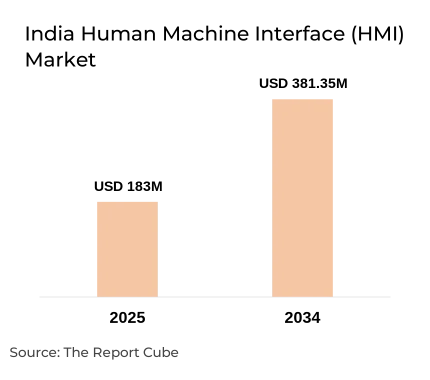
The India Human Machine Interface (HMI) Market is anticipated to register a 8.50% CAGR during 2026-2034. The market size was valued at USD 183 Million in 2025 and is projected to reach USD 381.35 Million by 2034. Growth in this market is driven by India’s accelerating industrial automation initiatives, expanding smart manufacturing adoption, and rising investments across process industries, discrete manufacturing, and infrastructure projects. As Indian industries move toward Industry 4.0 frameworks, HMIs are increasingly deployed as critical interfaces that enhance operational visibility, machine efficiency, and real-time decision-making.
The integration of HMIs with PLCs, SCADA systems, and industrial IoT platforms has strengthened their value proposition across factories, utilities, and energy facilities. Additionally, government-led manufacturing programs, rising labor costs, and the need for higher productivity are pushing enterprises to modernize control systems. Improved graphical interfaces, touch-based displays, and remote monitoring capabilities have further widened adoption among small and mid-sized enterprises, positioning the HMI market as a foundational layer in India’s evolving automation ecosystem.
India HMI Market Recent Developments
- 2025: Siemens India expanded its industrial HMI portfolio with advanced touchscreen panels supporting IIoT connectivity and enhanced cybersecurity features.
- 2025: Schneider Electric India launched next-generation HMI software upgrades focused on energy monitoring and real-time industrial analytics.
Government Initiatives & Policies
- Make in India: Promotes domestic manufacturing and automation adoption across industrial sectors.
- National Smart Manufacturing Mission: Encourages digital transformation, automation, and smart factory deployment in Indian industries.
India Human Machine Interface (HMI) Market Dynamics
Key Driver: Rapid industrial automation and smart factory adoption
The primary driver of the India HMI market is the rapid expansion of industrial automation across manufacturing, utilities, and infrastructure sectors. Indian manufacturers are increasingly deploying automated production lines to improve throughput, reduce downtime, and ensure consistent quality. HMIs play a central role by providing operators with real-time process visibility, alarm management, and intuitive machine controls. According to industry estimates, automated production facilities report productivity improvements of nearly 15-20% after deploying advanced HMI-integrated control systems. Sectors such as automotive, pharmaceuticals, food and beverages, and power generation are leading adopters due to strict compliance requirements and operational complexity. Additionally, rising labor shortages in skilled shop-floor roles are pushing companies to adopt intuitive HMI solutions that reduce operator training time. This sustained automation momentum is expected to drive long-term demand for both embedded and standalone HMI systems across India.
 Market Report and Forecast 2026-2034.webp "India Human Machine Interface (HMI) Market Report and Forecast 2026-2034 Infographic")
Industry Trends: Shift toward software-driven and IIoT-enabled HMIs
A key trend shaping the India HMI market is the transition from hardware-centric interfaces to software-driven, IIoT-enabled HMI platforms. Modern HMIs increasingly integrate cloud connectivity, data visualization dashboards, and remote access features, enabling predictive maintenance and real-time performance tracking. Software-based HMIs are gaining popularity as they reduce hardware dependency and allow flexible deployment across multiple devices. Industry data indicates that software-configured HMIs now account for over 40% of new installations in greenfield automation projects. Additionally, cybersecurity-by-design, web-based visualization, and mobile-compatible interfaces are becoming standard features. Vendors are also focusing on scalable HMI architectures that seamlessly integrate with MES and ERP systems, reflecting the broader digital transformation trend across Indian manufacturing environments.
Major Challenge: High integration complexity and legacy system compatibility
Despite strong growth prospects, integration complexity remains a major challenge in the India HMI market. Many industrial facilities operate legacy equipment with limited digital compatibility, making HMI upgrades costly and time-consuming. Integration issues often require custom engineering, increasing project timelines and total cost of ownership. Surveys suggest that nearly 30% of mid-sized manufacturers delay HMI upgrades due to concerns over system interoperability and production disruptions. Additionally, a shortage of skilled automation professionals capable of managing advanced HMI platforms further compounds deployment challenges. These factors can slow adoption among smaller enterprises, highlighting the need for standardized, plug-and-play HMI solutions that minimize customization requirements.
Opportunity: Expansion across SMEs and infrastructure modernization
The growing modernization of infrastructure and rising automation adoption among small and medium enterprises present significant opportunities for the India HMI market. Government-backed infrastructure projects in power, water treatment, transportation, and smart cities increasingly rely on HMI-enabled monitoring systems. SMEs, which contribute nearly 30% to India’s industrial output, are gradually investing in cost-effective HMI solutions to enhance operational control and reduce downtime. Vendors offering modular, scalable, and subscription-based HMI software are well-positioned to capture this segment. Additionally, localized manufacturing and service support can improve affordability and accelerate adoption, creating a strong growth runway over the forecast period.
India HMI Market Segment-wise Analysis
By Offering:
- Hardware
- Software
- Services
Hardware remains the leading offering segment in the India HMI market, accounting for approximately 46% of total revenue. Demand is driven by touchscreen panels, industrial displays, and ruggedized operator terminals deployed across factories and infrastructure facilities. However, software is the fastest-growing sub-segment, fueled by the shift toward flexible visualization platforms and IIoT integration. Services, including system integration and maintenance, continue to gain traction as enterprises seek long-term operational reliability and performance optimization.
By Configuration:
- Embedded HMI
- Standalone HMI
Standalone HMI systems dominate the configuration segment, holding an estimated 58% market share due to their versatility and ease of deployment across diverse industrial environments. These systems are widely used in automotive, packaging, and process industries where centralized control is essential. Embedded HMIs are gaining adoption in compact machinery and OEM equipment, supported by lower costs and space efficiency. Growth in embedded solutions aligns with the increasing demand for machine-level automation and smart equipment manufacturing.
Regional Projection of India Human Machine Interface Industry
- North India
- West India
- South India
- East India
West India leads the India HMI market with an estimated 34% revenue share, driven by a strong concentration of manufacturing hubs in Maharashtra and Gujarat. The region benefits from robust automotive, chemical, and energy sectors that actively invest in automation upgrades. South India follows closely, supported by electronics manufacturing, pharmaceuticals, and IT-enabled industrial solutions. North India shows steady growth due to infrastructure and power sector investments, while East India remains an emerging market with increasing adoption in mining and utilities. Regional industrial density and automation readiness remain key determinants of HMI demand.
Why Choose This Report?
- Provides a comprehensive overview of the overall market analysis, encompassing key trends, consumer behavior analysis, and risk assessment to support strategic decision-making.
- Provides accurate, up-to-date insights into market size, segmentation, and emerging opportunities, helping to minimize risk & capitalizing on growth.
- Gives deep understanding of target audience preferences, investment habits, and communication channels for enhanced product development & marketing effectiveness.
- Delivers competitive analysis & benchmarking, uncovering the strengths & weaknesses of market competitors to guide strategies.
- Consolidate comprehensive market intelligence, reducing reasoning & streamlining research efforts.
- Facilitates customized market segmentation & risk mitigation strategies, fine-tuned to the business objectives.
- Aids in identifying both market challenges & untapped opportunities within the industry to drive long-term business growth.
- Provides valuable information based on actual customer data & search trends.
Table of Contents
- Introduction
- Objective of the Study
- Product and Category Definition
- Market Segmentation
- Study Variables
- Research Methodology
- Secondary Data Points
- Breakdown of Secondary Sources
- Primary Data Points
- Breakdown of Primary Interviews
- Secondary Data Points
- Executive Summary
- Market Dynamics
- Drivers
- Challenges
- Opportunity Assessment
- Recent Trends and Developments
- Regulatory and Policy Landscape
- India Human Machine Interface (HMI) Market Overview (2021-2034)
- Market Size, By Value (USD Million)
- Market Share, By Offering
- Hardware
- Software
- Services
- Market Share, By Configuration
- Embedded HMI
- Standalone HMI
- Market Share, By Technology
- Tactile HMI
- Motion HMI
- Acoustic HMI
- Bionic HMI
- Market Share, By End User
- Automotive
- Oil & Gas
- Manufacturing
- Energy & Utilities
- Pharma & Chemicals
- Other Industries
- Market Share, By Region
- North India
- West India
- South India
- East India
- Market Share, By Company
- Market Share, By Company
- Competition Characteristics
- Revenue Shares & Analysis
- North India HMI Market
- Market Size, By Value (USD Million)
- Market Share, By Offering
- Market Share, By Configuration
- Market Share, By Technology
- Market Share, By End User
- West India HMI Market
- Market Size, By Value (USD Million)
- Market Share, By Offering
- Market Share, By Configuration
- Market Share, By Technology
- Market Share, By End User
- South India HMI Market
- Market Size, By Value (USD Million)
- Market Share, By Offering
- Market Share, By Configuration
- Market Share, By Technology
- Market Share, By End User
- East India HMI Market
- Market Size, By Value (USD Million)
- Market Share, By Offering
- Market Share, By Configuration
- Market Share, By Technology
- Market Share, By End User
- Competitive Outlook and Company Profiles
- Siemens India
- Company Overview
- Product Portfolio
- Strategic Alliances/Partnerships
- Recent Developments
- Schneider Electric India
- Company Overview
- Product Portfolio
- Strategic Alliances/Partnerships
- Recent Developments
- Rockwell Automation India
- Company Overview
- Product Portfolio
- Strategic Alliances/Partnerships
- Recent Developments
- ABB India
- Company Overview
- Product Portfolio
- Strategic Alliances/Partnerships
- Recent Developments
- Mitsubishi Electric India
- Company Overview
- Product Portfolio
- Strategic Alliances/Partnerships
- Recent Developments
- Honeywell Automation India
- Company Overview
- Product Portfolio
- Strategic Alliances/Partnerships
- Recent Developments
- Emerson Electric India
- Company Overview
- Product Portfolio
- Strategic Alliances/Partnerships
- Recent Developments
- Yokogawa India
- Company Overview
- Product Portfolio
- Strategic Alliances/Partnerships
- Recent Developments
- GE Automation India
- Company Overview
- Product Portfolio
- Strategic Alliances/Partnerships
- Recent Developments
- Advantech India
- Company Overview
- Product Portfolio
- Strategic Alliances/Partnerships
- Recent Developments
- Others
- Siemens India
- Contact Us and Disclaimer
Top Key Players & Market Share Outlook
- Siemens India
- Schneider Electric India
- Rockwell Automation India
- ABB India
- Mitsubishi Electric India
- Honeywell Automation India
- Emerson Electric India
- Yokogawa India
- GE Automation India
- Advantech India
- Others
Frequently Asked Questions






