India Packaged Food Market to Cross USD 233.87 Billion by 2034, Backed by Quick Commerce Growth, Millet Category Rise & Tightening FSSAI Norms
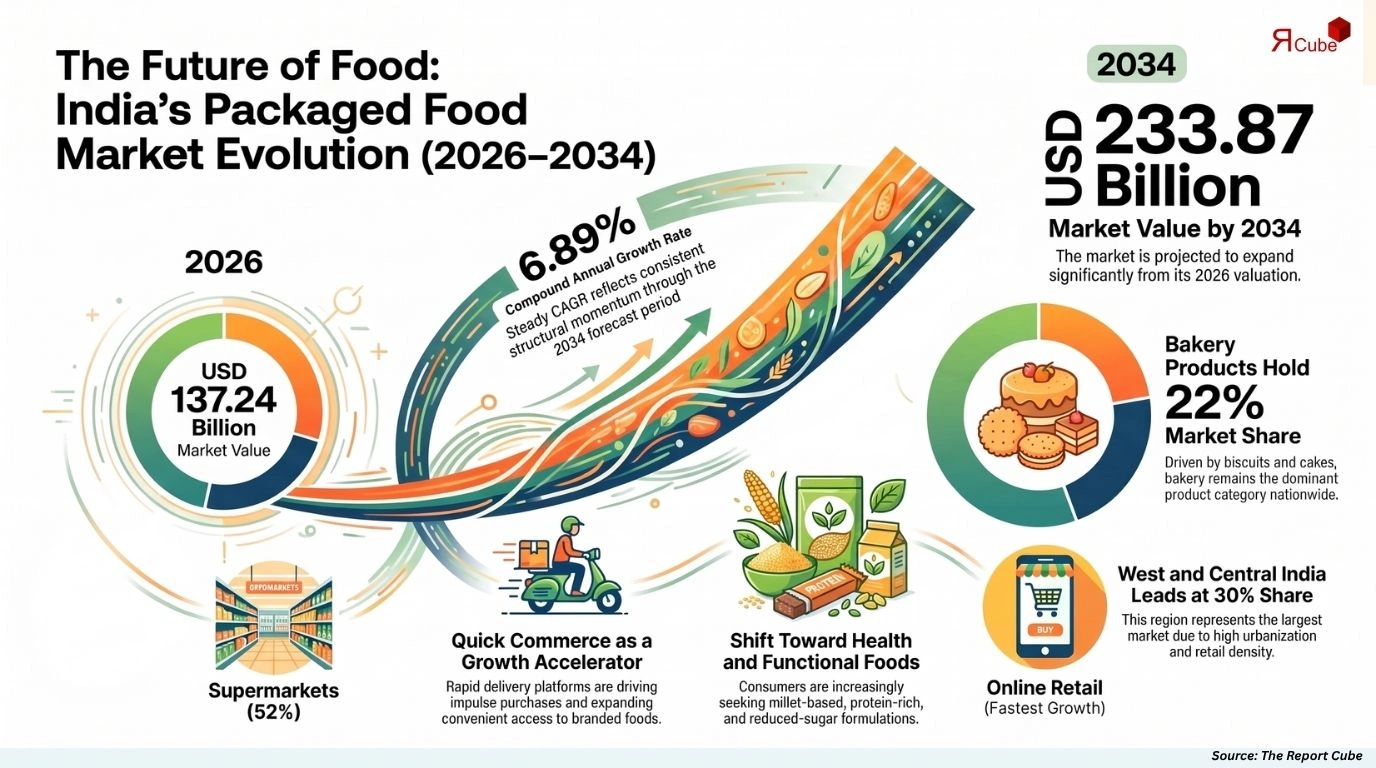
A new study by The Report Cube on the India Packaged Food Market shows the sector growing steadily through 2026–2034, with more households in Tier-2 and Tier-3 cities switching from unbranded local food to packaged alternatives as incomes rise and delivery infrastructure improves. The market was valued at USD 137.24 billion in 2026, is expected to grow at a CAGR of 6.89%, and should reach USD 233.87 billion by 2034.
Key Dynamics Affecting the India Packaged Food Market
- Annual per capita packaged food spend in India stood at around INR 7,000 in FY2024 - well below regional peers - which tells you how much room remains. Female workforce participation reached 41.7% in 2023–24, and that number matters here: dual-income households buy more ready-to-eat, portion-controlled, and convenience formats. The addressable market grows each time another city household adds a second earner.
- Quick commerce has changed what packaged food brands actually need to build. By April 2026, Blinkit was running roughly 2,100 dark stores; Swiggy Instamart and Zepto together had around 1,100–1,200. Brands that want shelf space in these networks now design specific SKUs for dark-store catalogues - smaller packs, tamper-evident seals, bundles that work within a 10–30 minute delivery window. It is a different product brief than general trade.
- FSSAI notified its Labelling and Display First Amendment Regulations on March 30, 2026, enforceable from July 2027. Separately, pending draft rules would require larger front-of-pack disclosures for added sugar, saturated fat, and sodium. For manufacturers currently using vague health claims or ingredient lists that won't survive audit, the clock is running. Reformulation, relabeling, and ingredient sourcing changes all take time and money.
- The PLI scheme for food processing attracted investment across 213+ locations and created over 2.89 lakh jobs by late 2024. A separate Rs. 800 crore allocation targets millet products specifically - biscuits, breakfast cereals, snacks, ready-to-cook formats. Domestic competition in this sub-segment is thin, and health-focused buyers in Western export markets are actively looking for suppliers. It is one of the cleaner early-mover openings in Indian packaged food right now.
- Bakery holds the largest product share at roughly 22.5% in 2025 - biscuits, rusks, and packaged bread sold at price points that reach kirana stores nationwide. Parle-G alone is among the world's largest biscuit brands by volume. Above this base, processed dairy, functional beverages, and protein-forward snacks are growing faster, pulled by a middle-income consumer segment - households earning USD 10,000–50,000 annually - that made up 34.5% of the country in 2023.
- West and Central India account for 30% of market share, with Maharashtra and Gujarat driving most of it through both consumption and food processing capacity. South India at 24.1% is growing faster than any other region. Cold chain is a real constraint: 70–75% of India's installed cold storage sits in five states, which leaves significant gaps across Madhya Pradesh, Chhattisgarh, and the Northeast. PMKSY offers 35–50% capital grants for integrated cold chain projects, but claim processing delays have slowed many of them down.
- Where private capital is going: D2C health-food brands, millet-based product lines, plant-based dairy, and packaged food labels built natively for quick commerce. AI-based demand forecasting and supply chain tools are also attracting investment, mainly because dark store restocking errors cut directly into brand ratings on these platforms.
Need Specific Data, Let’s Customize the Report for You
Request CustomizationWhich of the Segments, Under Product Type Classification, Influences the Market Share?
Across Product Type, the India Packaged Food Industry is segmented as:
- Bakery Products
- Dairy Products
- Beverages
- Breakfast Products
- Meals & Ready-to-Eat
- Others (Snacks, Condiments, Health Foods)
Bakery Products lead by share - not because of premiumization, but because biscuits and rusks move through every channel at every price point. The faster-growing segments are Ready-to-Eat Meals, Functional Beverages, and health-positioned snacks, where younger urban consumers are trading up and looking for low-sugar, high-protein, and millet-based options that give them a reason to pay more.
Regional Analysis: India Packaged Food Market
- North India
- West & Central India
- South India
- East & Northeast India
West & Central India leads on volume. South India leads on growth rate - higher organized retail density, stronger health awareness, and faster D2C adoption. North India holds steady on staple demand. East & Northeast is the longest-term opportunity; distribution and cold chain infrastructure there are still catching up.
Company Profile: Leading India Packaged Food Market Players
The companies with staying power in this market combine old distribution reach with newer digital channels. ITC's rural network - built over decades - helped it maintain volumes when urban demand softened; its Aashirvaad, Bingo, and Sunfeast brands cover staples, snacks, and bakery across price tiers. Nestle India runs on Maggi and Nescafe but has pushed NutriChoice and health-adjacent lines harder in recent years. The common thread across major players is that no single channel is enough anymore - kirana reach, modern trade, and quick commerce all need separate attention.
Key players include: Nestle India Ltd., ITC Limited, Britannia Industries Ltd., Hindustan Unilever Limited (HUL), Tata Consumer Products Limited, PepsiCo India, Parle Products Pvt. Ltd., Adani Wilmar, Haldiram's, Dabur India, Gujarat Cooperative Milk Marketing Federation (Amul), and Others.
Questions Answered in the India Packaged Food Market Research Report
- What is the current market size & future growth forecast underlined in the India Packaged Food Market research report?
- Which major factors are driving the rapid expansion of the India Packaged Food Industry across major regions?
- What emerging trends are restructuring the competitive landscape according to the latest market insights?
- How is consumer demand evolving, and what impact does it have on the India Packaged Food Market growth?
- Which leading companies are dominating the India Packaged Food Industry, and what strategies are they adopting?
- What technological advancements are influencing product adoption & market penetration?
- How does the report evaluate regional performance & identify high-growth market opportunities?
- What challenges & risks could potentially affect market stability, according to the research findings by the analysts?