



Build Your Custom Market Intelligence Report
Customize Your ReportIndia Packaged Food Market Key Takeaways
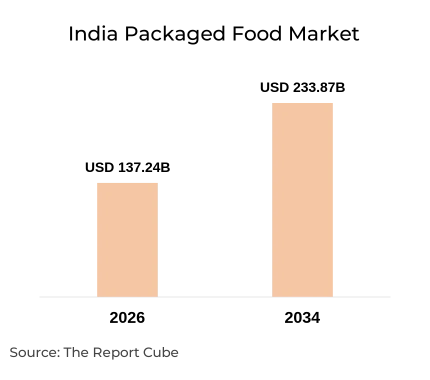
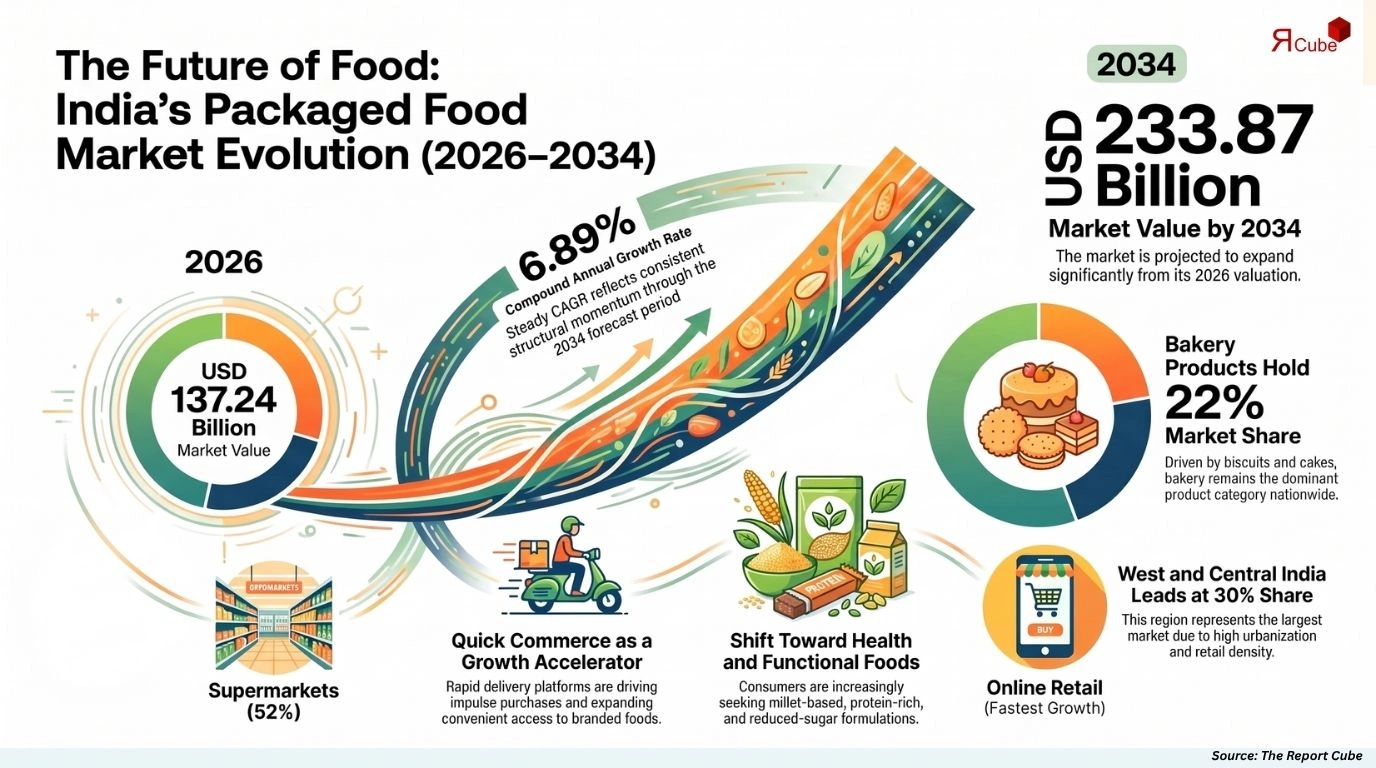
- Market size reaches USD 137.24 billion in 2026.
- Market size is projected at USD 233.87 billion by 2034.
- Market CAGR is expected to reach 6.89% during 2026-2034.
- Key players include ITC, Tata Consumer, Nestlé, and Amul.
- Bakery Products remain the dominant product type segment.
- West and Central India represents the leading regional market.
- South India is expected to register fastest regional growth.
- Quick commerce accelerates convenience-led packaged food category expansion.
India Packaged Food Market Insights & Analysis
The India Packaged Food Market is anticipated to register a 6.89% CAGR during 2026-2034. The market size was valued at USD 137.24 billion in 2026 and is projected to reach USD 233.87 billion by 2034. Market expansion is being supported by urbanization, rising disposable incomes, dual-income households, premiumization, and deeper penetration of organized retail and e-commerce. Modern retail, quick commerce, and digital grocery are becoming important routes for product discovery and replenishment. Tata Consumer Products reported 66% e-commerce growth in FY2025, while its India Foods business grew 29%, highlighting accelerating demand for branded convenience-oriented food portfolios.
Government initiatives are strengthening the food-processing ecosystem through infrastructure, cold-chain development, cluster development, and manufacturing incentives. PMKSY supports integrated cold chain, food-processing capacity, agro-processing clusters, and food-safety infrastructure, while PMFME supports micro food-processing enterprises, common infrastructure, branding, and marketing. By March 2025, 1,646 PMKSY projects had been approved, with estimated benefits for approximately 5.1 million farmers.
India Packaged Food Market Dynamics
The market is gaining structural momentum as Indian households increasingly shift from loose and locally prepared formats toward branded, standardized, convenient, and differentiated packaged foods. Expansion across Tier-2 and Tier-3 cities is broadening the addressable consumer base, while modern retail, e-commerce, and quick commerce are improving product availability. Health-oriented formulations, regional flavors, premium products, ready-to-eat meals, and functional beverages are increasing consumption occasions and encouraging manufacturers to expand portfolios.
|
Factor |
Type |
Specific Impact on Market |
Magnitude |
|---|---|---|---|
|
Urbanization and income growth |
Driver |
Expands household spending on branded convenience foods |
High |
|
Modern retail expansion |
Driver |
Improves assortment, visibility, and nationwide product access |
High |
|
Quick-commerce penetration |
Driver |
Accelerates impulse purchases and replenishment frequency |
High |
|
Food safety regulation |
Restraint |
Raises compliance requirements for packaging and labeling |
Moderate |
|
Health-oriented consumption |
Trend |
Shifts demand toward nutritious, functional, and clean-label products |
High |
Key Market Driver: Convenience-Led Urban Consumption Expansion
Rising urban employment, longer commuting patterns, and increasingly time-constrained households are accelerating demand for ready-to-eat, ready-to-cook, breakfast, snack, and packaged beverage formats. The shift is particularly significant among younger consumers who combine convenience with expectations around nutrition, premium quality, and recognizable brands. Organized retail and digital channels are improving product availability beyond major metros, while manufacturers are introducing smaller packs and occasion-specific formats to reach price-sensitive consumers. ITC and Tata Consumer Products continue to report strong momentum across modern trade, e-commerce, and quick commerce.
Major Industry Challenge: Fragmented Regional Consumer Preferences
India's packaged food industry operates across highly differentiated regional taste profiles, languages, consumption habits, and purchasing patterns. Products successful in North India may require different flavor profiles, pack sizes, pricing architecture, and distribution strategies in southern or northeastern markets. Manufacturers therefore increasingly need localized portfolios rather than uniform national propositions. Regional customization creates significant opportunities for innovation but requires disciplined consumer research, local sourcing, and differentiated route-to-market strategies to maintain relevance across India's diverse consumption landscape.
Emerging Trend Shaping Outlook: Healthier Functional Packaged Food Innovation
Health and wellness is increasingly influencing product development across breakfast foods, beverages, dairy, snacks, and prepared meals. Manufacturers are responding with higher-protein products, millet-based formulations, reduced-sugar offerings, functional ingredients, and specialized nutrition propositions. Nestlé India introduced a no-refined-sugar CEREGROW variant in 2025, while Tata Consumer Products expanded its portfolio with unpolished millets and differentiated food formats. These developments indicate that nutritional positioning is moving from niche differentiation toward mainstream portfolio strategy, particularly among urban households seeking convenience without compromising health priorities.
Need Specific Data, Let’s Customize the Report for You
Request CustomizationIndia Packaged Food Market Segment-wise Analysis
Product and distribution structures are evolving simultaneously, with established packaged categories retaining scale while digital channels create new consumption occasions. Bakery and supermarket formats remain important revenue contributors, whereas convenience-oriented categories and online channels are positioned for faster structural expansion.
By Product Type
- Bakery Products
- Dairy Product
- Beverages
- Breakfast Products
- Meals
- Others
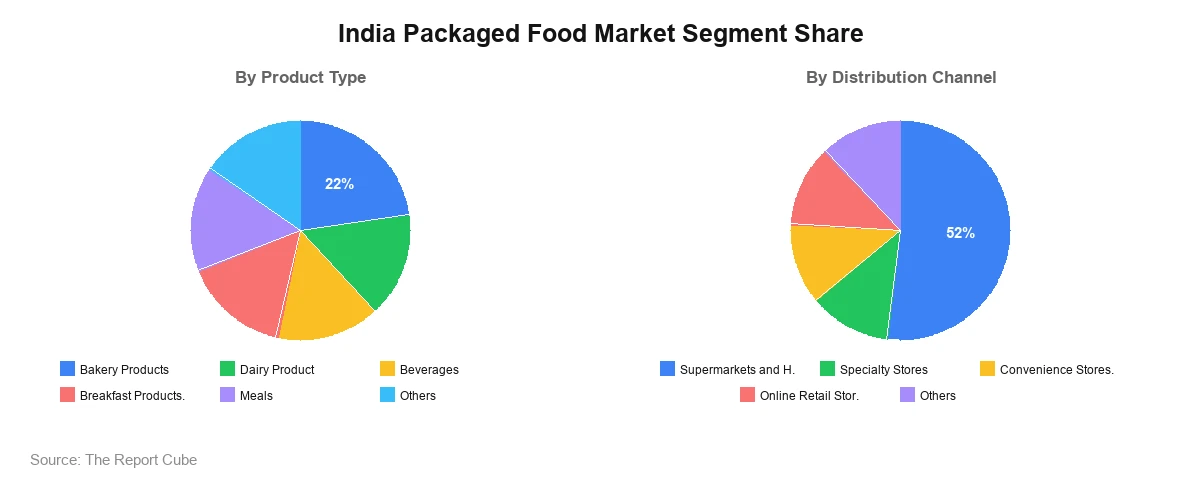
Bakery Products represent the dominant product category, supported by biscuits, breads, rusks, cakes, and related products that combine frequent consumption with broad affordability. The segment accounted for approximately 22% of the market in 2025 in the referenced industry assessment. Strong brand recognition, multiple price points, convenient pack sizes, long shelf life, and broad retail availability reinforce category leadership. Major manufacturers such as Britannia Industries, ITC, and Parle Products maintain extensive bakery portfolios spanning mass-market and premium products, enabling continued penetration across metropolitan and emerging urban markets.
Dairy products continue expanding through packaged milk, yogurt, cheese, paneer, butter, and other value-added formats, supported by cold-chain development and rising preference for branded products. Beverages are gaining momentum through functional drinks, ready-to-drink products, premium coffee, and health-focused formulations. Breakfast products benefit from convenience and nutrition trends, while meals are expanding through ready-to-eat and ready-to-cook formats. Tata Consumer Products continues to expand its foods and beverage portfolio through product innovation, while ITC is scaling convenience-oriented frozen and meal-related offerings.
By Distribution Channel
- Supermarkets and Hypermarkets
- Specialty Stores
- Convenience Stores
- Online Retail Stores
- Others
Supermarkets and Hypermarkets represent the dominant distribution channel because they provide broad assortment, established consumer trust, promotional visibility, and convenient one-stop shopping. The channel accounted for approximately 52% of market sales in 2025 in the referenced industry assessment. Large-format retail also enables manufacturers to introduce premium variants, multipacks, seasonal products, and new categories while supporting product discovery. Its relevance remains particularly strong in metropolitan and Tier-1 markets, where organized retail infrastructure and branded packaged-food penetration are comparatively advanced.
Specialty stores retain importance for premium, organic, nutritional, and category-specific products, while convenience stores benefit from proximity and rapid replenishment. Online Retail Stores are expected to expand faster as smartphone adoption, digital grocery penetration, and quick commerce improve delivery speed and assortment. ITC has reported robust growth in e-commerce, quick commerce, and modern trade, while Tata Consumer Products has also reported strong digital-channel performance. These channels increasingly support product discovery, targeted promotions, and frequent purchases of convenience-oriented packaged foods.
Regional Projection of India Packaged Food Market
Regional performance varies considerably because income levels, urbanization, retail infrastructure, food preferences, and supply-chain maturity differ across India. West and Central India maintains the leading position, while South India is positioned for faster growth as urban consumption, modern retail, digital commerce, and packaged dairy, beverages, and convenience foods deepen.
|
Region |
Estimated Market Share |
Key Growth Factors |
Consumer Trends |
|---|---|---|---|
|
North India |
26.4% |
Tier-2 expansion, organized retail, convenience demand |
Value-conscious branded consumption |
|
West and Central India |
30.0% |
Urbanization, organized retail, manufacturing clusters |
Premiumization and diversified consumption |
|
South India |
24.1% |
Urbanization, e-commerce, wellness, cold-chain infrastructure |
Health, premium, functional, regional products |
|
East and Northeast India |
19.5% |
Infrastructure, modern retail, rising affordability |
Growing branded-food adoption |
- North India: Strong demand for bakery, dairy, beverages, staples, and breakfast products is supported by expanding urban retail and branded-food penetration.
- West and Central India: The leading region benefits from organized retail density, established processing infrastructure, strong distribution networks, and high branded packaged-food adoption.
- South India: The fastest-growing regional market is supported by urbanization, premium consumption, packaged dairy, beverages, convenience foods, and digitally enabled grocery purchasing.
- East and Northeast India: Improving infrastructure, rising incomes, modern retail penetration, and local manufacturing investments are expanding packaged-food accessibility across emerging urban centers.
West and Central India is the leading regional market, with approximately 30.0% share in the referenced industry assessment, supported by concentrated urban demand and developed retail infrastructure. South India follows as a major consumption center and is positioned for faster expansion, while North India benefits from strong population density and packaged staples consumption. East and Northeast India represent a comparatively underpenetrated opportunity as infrastructure and branded distribution improve.
India Packaged Food Market: Recent Development (2025)
- Nestlé India launched KITKAT Professional Spread for HoReCa culinary applications across India during March 2025.
- Nestlé India launched Munch Choco Fills, expanding its breakfast cereal portfolio nationwide during February 2025.
- ITC expanded Sunfeast Baked Creations premium cookies and cakes through hyperlocal quick-commerce distribution during 2025.
- Tata Consumer Products launched regional gravy mixes and unpolished millets within Tata Sampann during September 2025.
India Packaged Food Market Future Outlook (2034)
The market is expected to maintain a 6.89% CAGR through 2034 and reach USD 233.87 billion. Growth opportunities will increasingly emerge from Tier-2 and Tier-3 cities, quick commerce, premium packaged foods, functional beverages, convenient meals, breakfast products, and healthier formulations. Companies with strong regional distribution and differentiated portfolios should benefit from India's fragmented consumption landscape. Technology advancement will strengthen demand forecasting, personalized merchandising, inventory optimization, quality monitoring, and supply-chain visibility. AI-driven transformation is expected to improve product recommendation, consumer segmentation, demand sensing, and digital commerce execution.
Long-term expansion will be shaped by continued urbanization, rising household purchasing power, organized retail penetration, and increasing acceptance of branded packaged alternatives. Government-backed infrastructure programs are improving cold-chain and food-processing capacity, while evolving food-safety requirements are encouraging stronger packaging and quality systems. PMKSY projects had an estimated potential to benefit 5.1 million farmers and generate more than 0.74 million direct and indirect jobs when operational. By 2034, online and quick-commerce channels should play a larger role in category creation and consumer discovery.
India Packaged Food Market Report Coverage
|
Report Attribute |
Details |
|---|---|
|
Market Name |
India Packaged Food Market |
|
Market Size (2026) |
USD 137.24 billion |
|
Market Size (2034) |
USD 233.87 billion |
|
Forecast Period |
2026-2034 |
|
CAGR |
6.89% |
|
Base Year |
2025 |
|
Historical Years |
2020-2025 |
|
Forecast Years |
2026-2034 |
|
Segments Covered |
Product Type and Distribution Channel |
|
Regions Covered |
North India; West and Central India; South India; East and Northeast India |
|
Key Companies |
ITC Limited; Tata Consumer Products; Adani Wilmar; Nestlé India; Hindustan Unilever (HUL); PepsiCo India; Amul; Parle Products; Britannia Industries; Others |
|
Customization |
Available according to client requirements |
Why Choose This Report?
- Provides structured analysis of India's packaged food industry dynamics.
- Evaluates major segments using demand and adoption indicators.
- Assesses regional differences across India's major consumption markets.
- Profiles leading companies shaping competitive market development.
- Highlights emerging opportunities across products and distribution channels.
- Incorporates government initiatives influencing food-processing infrastructure development.
- Tracks recent corporate launches and strategic market developments.
- Provides forward-looking insights supporting informed business planning.
Table of Contents
- Introduction
- Objective of the Study
- Product Definition
- Market Segmentation
- Study Variables
- Research Methodology
- Secondary Data Points
- Companies Interviewed
- Primary Data Points
- Breakdown of Primary Interviews
- Secondary Data Points
- Executive Summary
- Market Dynamics
- Drivers
- Challenges
- Opportunity Assessment
- Recent Trends and Developments
- Policy and Regulatory Landscape
- India Packaged Food Market Overview and Forecast Analysis (2021-2034)
- Market Size, By Value, By Growth Rate (CAGR/USD Billions)
- Demand – Supply Trends
- Market Share, By Product Type
- Bakery Products
- Dairy Product
- Beverages
- Breakfast Products
- Meals
- Others
- Market Share, By Distribution Channel
- Supermarkets and Hypermarkets
- Specialty Stores
- Convenience Stores
- Online Retail Stores
- Others
- Market Share, By Region
- North India
- West and Central India
- South India
- East and Northeast India
- Market Share, By Competitors
- Competition Characteristics
- Revenue Shares
- Bakery Products India Packaged Food Market Overview, 2021-2034F
- By Value (USD Million)
- By Distribution Channel – Market Size & Forecast 2021-2034, USD Million
- Supermarkets and Hypermarkets
- Specialty Stores
- Convenience Stores
- Online Retail Stores
- Others
- Dairy Product India Packaged Food Market Overview, 2021-2034F
- By Value (USD Million)
- By Distribution Channel – Market Size & Forecast 2021-2034, USD Million
- Supermarkets and Hypermarkets
- Specialty Stores
- Convenience Stores
- Online Retail Stores
- Others
- Beverages India Packaged Food Market Overview, 2021-2034F
- By Value (USD Million)
- By Distribution Channel – Market Size & Forecast 2021-2034, USD Million
- Supermarkets and Hypermarkets
- Specialty Stores
- Convenience Stores
- Online Retail Stores
- Others
- Breakfast Products India Packaged Food Market Overview, 2021-2034F
- By Value (USD Million)
- By Distribution Channel – Market Size & Forecast 2021-2034, USD Million
- Supermarkets and Hypermarkets
- Specialty Stores
- Convenience Stores
- Online Retail Stores
- Others
- Meals India Packaged Food Market Overview, 2021-2034F
- By Value (USD Million)
- By Distribution Channel – Market Size & Forecast 2021-2034, USD Million
- Supermarkets and Hypermarkets
- Specialty Stores
- Convenience Stores
- Online Retail Stores
- Others
- Others India Packaged Food Market Overview, 2021-2034F
- By Value (USD Million)
- By Distribution Channel – Market Size & Forecast 2021-2034, USD Million
- Supermarkets and Hypermarkets
- Specialty Stores
- Convenience Stores
- Online Retail Stores
- Others
- Competitive Outlook (Company Profile – Partial List)
- ITC Limited
- Company Overview
- Business Segments
- Strategic Alliances/Partnerships
- Recent Developments
- Tata Consumer Products
- Company Overview
- Business Segments
- Strategic Alliances/Partnerships
- Recent Developments
- Adani Wilmar
- Company Overview
- Business Segments
- Strategic Alliances/Partnerships
- Recent Developments
- Nestlé India
- Company Overview
- Business Segments
- Strategic Alliances/Partnerships
- Recent Developments
- Hindustan Unilever (HUL)
- Company Overview
- Business Segments
- Strategic Alliances/Partnerships
- Recent Developments
- PepsiCo India
- Company Overview
- Business Segments
- Strategic Alliances/Partnerships
- Recent Developments
- Amul
- Company Overview
- Business Segments
- Strategic Alliances/Partnerships
- Recent Developments
- Parle Products
- Company Overview
- Business Segments
- Strategic Alliances/Partnerships
- Recent Developments
- Britannia Industries
- Company Overview
- Business Segments
- Strategic Alliances/Partnerships
- Recent Developments
- Others
- ITC Limited
- Contact Us & Disclaimer
Top Key Players & Market Share Outlook
- ITC Limited
- Tata Consumer Products
- Adani Wilmar
- Nestlé India
- Hindustan Unilever (HUL)
- PepsiCo India
- Amul
- Parle Products
- Britannia Industries
- Others
Frequently Asked Questions






