



Build Your Custom Market Intelligence Report
Customize Your ReportVietnam Cold Chain Logistics Market Key Highlights
By Service Type:
Temperature-Controlled Storage segment leads the market, with around 38% market share.
By Application:
Meat and Seafood segment dominate the market, accounting for nearly 34% of total revenue.
Regional Outlook:
Southern region dominates the Vietnam cold chain logistics market, with around 46% market share.
Government Initiatives & Policies
- Vietnam National Logistics Development Plan 2025–2035: The Vietnamese government introduced a long-term strategy to modernize logistics infrastructure including refrigerated transport networks and cold storage capacity to support agricultural exports and pharmaceutical distribution.
- National Digital Transformation Program for Logistics: Vietnam's government promotes digital platforms for logistics tracking, temperature monitoring systems, and supply-chain optimization to strengthen cold chain infrastructure for agriculture and healthcare sectors.
Vietnam Cold Chain Logistics Market Insights & Analysis
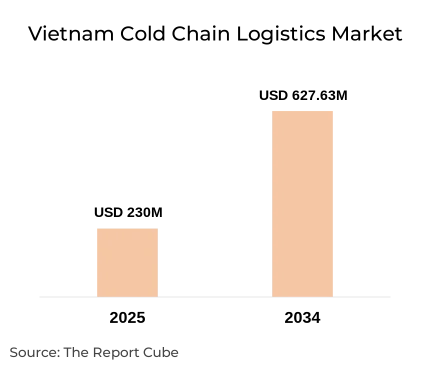
The Vietnam Cold Chain Logistics Market is anticipated to register a CAGR of 11.8% during 2026-2034. The market size was valued at USD 230 million in 2025 and is projected to reach USD 627.63 million by 2034. Vietnam’s rapidly expanding food export sector, growing pharmaceutical demand, and modernization of retail distribution networks are shaping strong momentum for the cold chain logistics industry. As Vietnam becomes one of Southeast Asia’s key agricultural exporters, efficient temperature-controlled supply chains are becoming essential to preserve product quality and maintain international compliance standards.
Cold chain logistics plays a vital role in supporting Vietnam’s seafood, fruit, and pharmaceutical sectors. Vietnam exported more than USD 9 billion worth of seafood in 2024, according to trade authorities, and these products require reliable temperature-controlled storage and transportation to maintain freshness during international shipment. The shift toward organized retail is also strengthening demand for cold chain infrastructure. Large supermarket chains such as VinMart and international retail brands are expanding refrigerated supply chains to ensure product safety and longer shelf life. This transformation is gradually moving Vietnam’s distribution system away from traditional wet markets toward modern cold-chain-enabled retail formats.
Investment activity is another strong growth catalyst. Several international logistics companies have entered Vietnam to build modern refrigerated warehouses and integrated logistics parks. South Korea, Japan, and Singapore-based logistics investors are actively developing cold storage facilities near major industrial zones and seaports. For example, Dong Nai, Binh Duong, and Ho Chi Minh City have become strategic hubs for cold chain logistics due to their proximity to food processing clusters and export ports. The government is also supporting logistics modernization through infrastructure upgrades, including highways, seaports, and smart logistics systems that improve delivery efficiency.
Technological advancement is gradually reshaping the industry as well. Cold chain operators are deploying Internet of Things sensors, GPS tracking, and automated warehouse management systems to monitor temperature conditions across the supply chain. These systems help logistics providers prevent spoilage, maintain product quality, and comply with international food safety standards. As Vietnam strengthens its position in global food trade and pharmaceutical distribution, the adoption of advanced cold chain logistics technologies is expected to accelerate further throughout the forecast period.
Vietnam Cold Chain Logistics Market Dynamics
Key Driver: Expanding Food Export Industry Driving Demand for Refrigerated Logistics
The expansion of Vietnam’s food and seafood export industry is one of the most significant factors driving demand for cold chain logistics services. Vietnam is among the world’s leading exporters of shrimp, pangasius fish, tropical fruits, and processed food products. These goods require consistent temperature control from production facilities to international shipping ports to maintain freshness and meet strict food safety standards in export markets such as the United States, Europe, and Japan. As export volumes increase, logistics companies must expand refrigerated warehouses and transport networks capable of handling large volumes of perishable products.
The growth of Vietnam’s domestic food consumption is also supporting this demand. Urbanization and rising incomes are encouraging consumers to purchase more frozen food, packaged meat, dairy products, and ready-to-eat meals. Supermarkets and convenience stores rely heavily on cold chain infrastructure to ensure product safety and quality. As modern retail channels continue to expand across Vietnam’s major cities, logistics providers are scaling refrigerated distribution networks to serve supermarkets, restaurants, and food service businesses.
Government policies promoting agricultural modernization are also encouraging cold chain investments. Vietnam aims to increase the value of agricultural exports through improved product quality and post-harvest management. Cold storage facilities help reduce food loss during transportation and extend product shelf life, which directly increases export value. This combination of export growth, domestic food demand, and government support is creating a strong foundation for long-term expansion in Vietnam’s cold chain logistics sector.
Book your FREE 30-minute expert consultation today
Contact UsIndustry Trends: Digital Monitoring and Smart Cold Storage Transforming Supply Chains
Technology adoption is emerging as a major trend in Vietnam’s cold chain logistics industry. Logistics companies are increasingly investing in digital monitoring systems that track temperature, humidity, and shipment location throughout the supply chain. These systems provide real-time alerts when temperature fluctuations occur, enabling logistics operators to respond quickly and prevent product damage. Such digital monitoring tools are particularly important for pharmaceutical shipments and seafood exports where strict temperature control is required.
Another notable trend is the development of large-scale automated cold storage facilities. Automated warehouses equipped with robotic pallet systems and advanced inventory management software allow companies to manage higher volumes of frozen and chilled products with greater efficiency. These modern facilities reduce labor costs, improve operational accuracy, and optimize warehouse space utilization. As Vietnam’s logistics sector continues to mature, more companies are adopting these advanced storage technologies to handle growing demand.
Integration between transportation and storage services is also becoming common. Many logistics companies now offer end-to-end cold chain solutions that include warehousing, transportation, packaging, customs documentation, and distribution services. This integrated approach simplifies supply chain management for exporters and food manufacturers. As Vietnam’s cold chain ecosystem evolves, logistics providers that deliver fully integrated services are gaining stronger market positioning and long-term contracts with major clients.
Major Challenge: Limited Cold Storage Infrastructure in Secondary Regions
While Vietnam’s cold chain logistics industry is expanding rapidly, infrastructure limitations remain a major challenge. Many secondary cities and rural agricultural areas still lack adequate refrigerated storage and transportation facilities. Farmers and small exporters often struggle to access cold storage immediately after harvest, which can lead to significant post-harvest losses. According to industry estimates, Vietnam experiences food loss rates of 10% to 25% for perishable products due to limited cold chain coverage in certain regions.
Infrastructure gaps are particularly noticeable in central and northern agricultural provinces where fruit and vegetable production is high but logistics infrastructure remains limited. Transporting perishable products from farms to major distribution centers can take several hours, increasing the risk of spoilage. Logistics companies are working to address these challenges by building smaller regional cold storage hubs and expanding refrigerated truck fleets. However, the investment required for such infrastructure expansion remains substantial.
Energy consumption is another operational concern. Cold storage facilities require significant electricity to maintain low temperatures, and energy costs can increase operating expenses for logistics providers. Many companies are exploring energy-efficient refrigeration systems and renewable energy solutions to manage these costs. Addressing infrastructure limitations and improving energy efficiency will be essential for sustaining long-term growth in Vietnam’s cold chain logistics sector.
Opportunity: Pharmaceutical and Vaccine Distribution Expanding Cold Chain Demand
The pharmaceutical and healthcare sectors present a significant growth opportunity for Vietnam’s cold chain logistics industry. Many pharmaceutical products, vaccines, and biotech materials must be stored and transported within specific temperature ranges to maintain effectiveness. As Vietnam expands its healthcare infrastructure and pharmaceutical manufacturing capacity, the demand for specialized cold chain logistics services is increasing.
International pharmaceutical companies operating in Vietnam require reliable temperature-controlled logistics networks to distribute medicines and vaccines across hospitals and healthcare facilities. This requirement has encouraged logistics providers to invest in advanced refrigerated warehouses and validated transport systems designed specifically for pharmaceutical products. Compliance with global regulatory standards such as Good Distribution Practices (GDP) is becoming increasingly important in this segment.
Vietnam’s biotech research and clinical trials industry is also developing rapidly. Research organizations require secure cold chain transportation for biological samples and temperature-sensitive laboratory materials. Logistics providers that can offer specialized pharmaceutical cold chain services will gain strong competitive advantages as the healthcare industry continues to grow. This emerging demand is expected to create new revenue streams for logistics companies operating in Vietnam’s cold chain sector.
Vietnam Cold Chain Logistics Market Segment-wise Analysis
By Service Type:
- Temperature-Controlled Storage
- Temperature-Controlled Transportation
- Value-Added Cold Chain Services
- Cold Chain Management Solutions
The temperature-controlled storage segment accounts for nearly 38% of the Vietnam cold chain logistics market. Refrigerated warehousing facilities play a critical role in preserving perishable products before distribution or export. Food processors, seafood exporters, and retail distribution companies rely heavily on cold storage infrastructure to maintain product freshness. Vietnam’s growing food processing sector has significantly increased demand for frozen and chilled storage capacity, particularly near seaports and industrial zones.
Major logistics companies are investing heavily in automated cold storage warehouses to support this demand. Modern facilities equipped with temperature-monitoring sensors and digital inventory systems allow operators to manage thousands of pallets of frozen products efficiently. Refrigerated cross-dock facilities are also gaining importance as they enable faster product transfer between transportation modes. With food exports and organized retail expanding steadily, temperature-controlled storage is expected to remain the dominant service category within Vietnam’s cold chain logistics industry.
By Application:
- Meat and Seafood
- Dairy Products
- Fruits and Vegetables
- Bakery and Confectionery
- Processed and Packaged Foods
- Pharmaceuticals and Vaccines
- Biotech and Clinical Products
- Others
The meat and seafood segment holds the largest share of the Vietnam cold chain logistics market, accounting for nearly 34% of total revenue. Vietnam’s seafood industry is a major contributor to the country’s export economy, with shrimp, tuna, and pangasius fish shipped to global markets. Maintaining product freshness during long shipping distances requires reliable refrigerated storage and transportation systems. Cold chain logistics providers ensure that seafood products remain within safe temperature ranges from processing plants to international export ports.
The domestic meat consumption market is also expanding, particularly in urban areas where consumers increasingly purchase packaged meat products from supermarkets. Retail chains depend on refrigerated transportation networks to distribute meat products safely across their store networks. As food safety regulations become stricter and consumer awareness about product quality increases, the demand for specialized cold chain logistics services for meat and seafood is expected to grow steadily in Vietnam.
Regional Projection of Vietnam Cold Chain Logistics Industry
- Northern
- Central
- Southern
- Others
The southern region holds the largest share of the Vietnam cold chain logistics market, accounting for approximately 46% of total market revenue. This region includes major economic hubs such as Ho Chi Minh City, Dong Nai, and Binh Duong, which host large food processing industries and export-oriented manufacturing facilities. The presence of major seaports and international airports also supports strong cold chain logistics activity in this region. Export shipments of seafood, fruits, and processed foods frequently pass through southern logistics hubs before reaching global markets.
Southern Vietnam also benefits from a high concentration of modern cold storage facilities developed by both domestic and international logistics companies. Industrial parks and logistics zones in the region have attracted investment in large refrigerated warehouses capable of handling export shipments and retail distribution. In addition, the region’s strong retail sector supports continuous demand for refrigerated transportation services. With ongoing infrastructure development and growing trade activity, southern Vietnam is expected to maintain its leadership position in the country’s cold chain logistics industry throughout the forecast period.
Vietnam Cold Chain Logistics Market Recent Developments
- 2025: Lotte Global Logistics broke ground on a new cold-chain logistics hub in Nhon Trach Industrial Park, Dong Nai, with an investment of approximately USD 34 million. The facility spans around 5.5 hectares and is expected to begin operations in 2026, significantly expanding refrigerated storage capacity and strengthening Korea-Vietnam logistics collaboration.
- 2025: Transimex Corporation announced during its annual general meeting that it aims to achieve more than VND 204 billion in net profit in 2025. The company plans to strengthen its integrated logistics, warehousing, and distribution services to capture growing demand from global trade and supply chain restructuring.
- 2025: ABA Cooltrans highlighted strong growth expectations for Vietnam’s cold chain logistics sector in 2025. The company emphasized increasing demand from food processing, retail, and pharmaceutical customers and confirmed plans to expand integrated cold storage and refrigerated transportation services.
Need insights for a specific region within this market?
Request Regional DataWhy Choose This Report?
- Provides a comprehensive overview of the overall market analysis, encompassing key trends, consumer behavior analysis, and risk assessment to support strategic decision-making.
- Provides accurate, up-to-date insights into market size, segmentation, and emerging opportunities, helping to minimize risk & capitalizing on growth.
- Gives deep understanding of target audience preferences, investment habits, and communication channels for enhanced product development & marketing effectiveness.
- Delivers competitive analysis & benchmarking, uncovering the strengths & weaknesses of market competitors to guide strategies.
- Consolidate comprehensive market intelligence, reducing reasoning & streamlining research efforts.
- Facilitates customized market segmentation & risk mitigation strategies, fine-tuned to the business objectives.
- Aids in identifying both market challenges & untapped opportunities within the industry to drive long-term business growth.
- Provides valuable information based on actual customer data & search trends.
Table of Contents
- Introduction
- Objective of the Study
- Product and Category Definition
- Market Segmentation
- Study Variables
- Research Methodology
- Secondary Data Points
- Breakdown of Secondary Sources
- Primary Data Points
- Breakdown of Primary Interviews
- Secondary Data Points
- Executive Summary
- Market Dynamics
- Drivers
- Challenges
- Opportunity Assessment
- Recent Trends and Developments
- Regulatory and Policy Landscape
- Vietnam Cold Chain Logistics Market Overview (2021-2034)
- Market Size, By Value (USD Million)
- Market Share, By Service Type
- Temperature-Controlled Storage
- Refrigerated Warehousing
- Frozen Warehousing
- Cross-Dock Facilities
- Temperature-Controlled Transportation
- Road Transportation
- Rail Transportation
- Sea Transportation
- Air Transportation
- Value-Added Cold Chain Services
- Packaging and Repacking
- Order Picking and Kitting
- Quality Inspection
- Customs and Documentation Support
- Cold Chain Management Solutions
- Inventory Management
- Route Optimization
- Temperature Monitoring and Tracking
- Compliance and Certification Support
- Temperature-Controlled Storage
- Market Share, By Temperature Range
- Chilled (2-8°C)
- Frozen (Below −18°C)
- Deep-Frozen and Ultra-Low
- Market Share, By Storage Type
- Public Cold Stores
- Private Cold Stores
- Contract Cold Stores
- Market Share, By Transportation Mode
- Refrigerated Trucks and Trailers
- Refrigerated Containers
- Rail Reefers
- Air Freight Cold Chain
- Market Share, By Application
- Meat and Seafood
- Dairy Products
- Fruits and Vegetables
- Bakery and Confectionery
- Processed and Packaged Foods
- Pharmaceuticals and Vaccines
- Biotech and Clinical Products
- Others
- Market Share, By End User
- Food and Beverage Manufacturers
- Retail Chains and Supermarkets
- Food Service and Hospitality
- Importers and Exporters
- Pharmaceutical and Healthcare Companies
- Logistics and 3PL Providers
- Market Share, By Region
- Northern
- Central
- Southern
- Others
- Market Share, By Company
- Revenue Shares and Analysis
- Competitive Landscape
- Northern Vietnam Cold Chain Logistics Market
- Market Size, By Value (USD Million)
- Market Share, By Service Type
- Market Share, By Temperature Range
- Market Share, By Storage Type
- Market Share, By Transportation Mode
- Market Share, By Application
- Market Share, By End User
- Central Vietnam Cold Chain Logistics Market
- Market Size, By Value (USD Million)
- Market Share, By Service Type
- Market Share, By Temperature Range
- Market Share, By Storage Type
- Market Share, By Transportation Mode
- Market Share, By Application
- Market Share, By End User
- Southern Vietnam Cold Chain Logistics Market
- Market Size, By Value (USD Million)
- Market Share, By Service Type
- Market Share, By Temperature Range
- Market Share, By Storage Type
- Market Share, By Transportation Mode
- Market Share, By Application
- Market Share, By End User
- Competitive Outlook and Company Profiles
- ABA Cooltrans
- Company Overview
- Product Portfolio
- Strategic Alliances/Partnerships
- Recent Developments
- Lotte Global Logistics
- Company Overview
- Product Portfolio
- Strategic Alliances/Partnerships
- Recent Developments
- Lineage Logistics
- Company Overview
- Product Portfolio
- Strategic Alliances/Partnerships
- Recent Developments
- Swire Cold Storage
- Company Overview
- Product Portfolio
- Strategic Alliances/Partnerships
- Recent Developments
- Transimex Corporation
- Company Overview
- Product Portfolio
- Strategic Alliances/Partnerships
- Recent Developments
- Mekong Logistics
- Company Overview
- Product Portfolio
- Strategic Alliances/Partnerships
- Recent Developments
- Kuehne + Nagel
- Company Overview
- Product Portfolio
- Strategic Alliances/Partnerships
- Recent Developments
- Sotrans (South Logistics)
- Company Overview
- Product Portfolio
- Strategic Alliances/Partnerships
- Recent Developments
- Gemadept Logistics
- Company Overview
- Product Portfolio
- Strategic Alliances/Partnerships
- Recent Developments
- Vinafco JSC
- Company Overview
- Product Portfolio
- Strategic Alliances/Partnerships
- Recent Developments
- Konoike Vina
- Company Overview
- Product Portfolio
- Strategic Alliances/Partnerships
- Recent Developments
- MP Logistics
- Company Overview
- Product Portfolio
- Strategic Alliances/Partnerships
- Recent Developments
- Hoang Lai Group
- Company Overview
- Product Portfolio
- Strategic Alliances/Partnerships
- Recent Developments
- Linfox Vietnam
- Company Overview
- Product Portfolio
- Strategic Alliances/Partnerships
- Recent Developments
- CLK Cold Storage
- Company Overview
- Product Portfolio
- Strategic Alliances/Partnerships
- Recent Developments
- New Land Logistics
- Company Overview
- Product Portfolio
- Strategic Alliances/Partnerships
- Recent Developments
- Others
- ABA Cooltrans
- Contact Us and Disclaimer
Top Key Players & Market Share Outlook
- ABA Cooltrans
- Lotte Global Logistics
- Lineage Logistics
- Swire Cold Storage
- Transimex Corporation
- Mekong Logistics
- Kuehne + Nagel
- Sotrans (South Logistics)
- Gemadept Logistics
- Vinafco JSC
- Konoike Vina
- MP Logistics
- Hoang Lai Group
- Linfox Vietnam
- CLK Cold Storage
- New Land Logistics
Frequently Asked Questions






