



Build Your Custom Market Intelligence Report
Customize Your ReportSingapore Warehouse Automation for E-commerce Market Key Highlights
By Automation Type:
Automated Storage and Retrieval Systems (ASRS) segment leads the market, with around 34% share.
By Function:
Picking segment dominates the market, accounting for nearly 29% of total revenue.
Regional Outlook:
West region dominates the singapore warehouse automation for e-commerce market, with around 31% share.
Government Initiatives & Policies
- Singapore Logistics Industry Digital Plan (updated 2025): Supports SMEs and large logistics firms in adopting robotics, WMS, and AI-driven warehouse automation solutions.
- Enterprise Development Grant (EDG) & Productivity Solutions Grant (PSG) - Automation Track (2025 enhancement): Provides funding support for robotics, AMRs, and warehouse digitalization projects.
Singapore Warehouse Automation for E-commerce Market Insights & Analysis
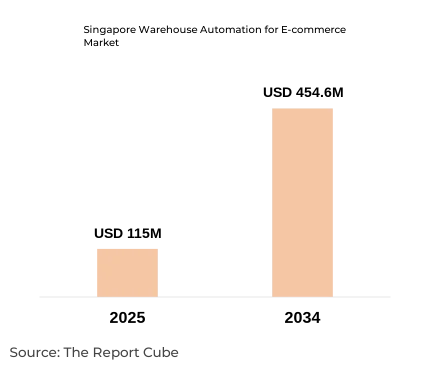
The Singapore Warehouse Automation for E-commerce Market is anticipated to register a CAGR: 16.5% during 2026-34. The market size was valued at USD 115 million in 2025 and is projected to reach USD 454.60 million by 2034. Strong cross-border trade flows, high labor costs, and space constraints are driving aggressive automation adoption across Singapore’s e-commerce warehousing ecosystem.
Singapore’s e-commerce gross merchandise value continues to expand at double-digit rates, fueled by rising online grocery, electronics, and fashion demand. With over 90% internet penetration and one of Asia’s highest digital payment adoption rates, order volumes per square meter in Singapore are among the region’s highest. Limited land availability has resulted in multi-story ramp-up warehouses in areas such as Tuas, Jurong, and Pioneer. These vertical facilities require dense storage technologies such as ASRS, shuttle systems, and goods-to-person robotics to maximize cubic utilization. Automated systems can increase storage density by up to 40% compared to conventional racking layouts.
In parallel, labor constraints remain structural. Singapore’s tight foreign worker quotas and rising wages are accelerating investment in AMRs, AGVs, and automated picking systems. Fulfillment centers deploying goods-to-person solutions report productivity gains of 2.5x to 3x compared to manual picking. Robotics adoption is particularly strong among third-party logistics (3PL) operators serving regional cross-border hubs, where throughput volatility demands flexible automation.
Technology integration is another defining factor. Advanced warehouse control systems (WCS) and warehouse execution systems (WES) are being integrated with e-commerce platforms for real-time inventory visibility. AI-driven demand forecasting and automated order consolidation are reducing fulfillment errors and improving same-day delivery reliability. As Singapore strengthens its position as Southeast Asia’s logistics gateway, automation investment is transitioning from selective upgrades to full-scale lights-out warehouse models.
Singapore Warehouse Automation for E-commerce Market Dynamics
Key Driver: Space Optimization and High Labor Costs Accelerating Automation
Singapore’s industrial land scarcity makes warehouse space among the most expensive in Asia. Rental rates in prime logistics zones increased by nearly 8% year-over-year in 2025, prompting operators to prioritize vertical automation. ASRS and shuttle-based systems allow higher storage density while reducing aisle requirements. At the same time, logistics wages rose by approximately 6% annually, intensifying pressure on fulfillment margins. Automation reduces dependency on manual labor, particularly in repetitive picking and sorting functions. E-commerce players processing over 50,000 daily orders are increasingly shifting toward fully automated picking cells to maintain profitability and service-level agreements.

Book your FREE 30-minute expert consultation today
Contact UsIndustry Trends: Rise of AMRs, AI-Orchestrated Fulfillment, and Micro-Fulfillment Centers
Autonomous Mobile Robots (AMRs) are becoming central to Singapore’s e-commerce warehouses due to their scalability and adaptability in high-density facilities. AMRs reduce walking distances for pickers by up to 70%, significantly improving throughput. AI-powered orchestration software now dynamically allocates tasks based on real-time order inflow. Micro-fulfillment centers integrated within urban zones are emerging to support same-day and two-hour delivery models. These compact facilities rely heavily on shuttle-based ASRS and robotic picking systems. Additionally, integration between WMS and robotic control platforms is streamlining cross-border order consolidation, critical for Singapore’s role as a regional redistribution hub.
Major Challenge: High Capital Investment and Integration Complexity
Deploying advanced automation requires substantial upfront capital expenditure. A fully automated warehouse installation in Singapore can exceed USD 15-25 million depending on system scale and complexity. Integration challenges between legacy ERP systems and modern WMS/WCS platforms can delay deployment timelines. SMEs face additional hurdles in accessing technical expertise for system optimization. While government grants offset part of the cost, ROI realization depends on stable order volumes. Rapid technological evolution also raises concerns over system obsolescence, requiring scalable and modular automation designs.
Opportunity: Regional Cross-Border Fulfillment Hub Expansion
Singapore’s strategic position enables it to function as a Southeast Asian cross-border e-commerce hub. Automated fulfillment centers are increasingly handling orders for Malaysia, Indonesia, and Thailand. Cross-border shipments represent nearly 35% of total e-commerce parcel volume processed in major automated facilities. Robotics-enabled order consolidation improves accuracy and reduces customs processing delays. As ASEAN digital trade agreements expand, automated warehouses are expected to become key enablers of regional e-commerce integration. This regionalization presents sustained opportunities for technology providers and system integrators.
Singapore Warehouse Automation for E-commerce Market Segment-wise Analysis
By Automation Type:
- Automated Storage and Retrieval Systems (ASRS)
- Conveyors and Sortation Systems
- Automated Guided Vehicles (AGVs) and Autonomous Mobile Robots (AMRs)
- Picking and Packing Systems
- Automated Material Handling Equipment
- Warehouse Control Systems and Warehouse Management Systems
- Industrial Automation and Controls
- Other Automation Solutions
Automated Storage and Retrieval Systems (ASRS) account for around 34% of total market share in 2025. High-rise warehouses in western Singapore rely heavily on unit-load and shuttle-based ASRS to maximize cubic storage. Shuttle systems enable rapid bin retrieval, supporting order processing speeds exceeding 500 lines per hour per workstation. Mini-load ASRS is widely adopted for high-SKU e-commerce operations, particularly in electronics and healthcare segments. As space efficiency becomes a critical KPI, ASRS installations are projected to remain the largest investment category through 2034.
By Function:
- Storage
- Picking
- Sorting
- Packing
- Loading and Unloading
- Internal Transport and Movement
- Order Consolidation and Dispatch
Picking represents nearly 29% of total revenue due to its labor-intensive nature and direct impact on order accuracy. Goods-to-person systems and pick-to-light technologies significantly enhance picking speed while reducing errors below 0.2%. E-commerce operators emphasize rapid fulfillment cycles, particularly for same-day deliveries. Robotic picking arms integrated with AI vision systems are gaining traction in large fulfillment centers. As SKU diversity expands, advanced picking technologies are becoming indispensable for maintaining service-level targets.
Regional Projection of Singapore Warehouse Automation for E-commerce Industry
- West
- East
- North
- Northeast
- Central
The West region leads with approximately 31% market share, supported by Tuas and Jurong industrial estates hosting large multi-story logistics hubs. Proximity to port terminals strengthens cross-border trade operations. Eastern and Central regions are witnessing growth in smaller automated urban fulfillment centers catering to last-mile delivery. Northern districts are gradually developing logistics parks but remain secondary compared to western industrial clusters. Regional infrastructure connectivity directly influences automation deployment intensity.
Singapore Warehouse Automation for E-commerce Market Recent Developments
- 2025: Swisslog released its 2025 AutoStore “State of the Warehouse Management and Fulfillment” analysis, highlighting its SynQ-enabled integrated automation platform that enhances performance visibility and warehouse execution optimization for e-commerce fulfillment operations.
- 2025: XSQUARE Technologies signed an MoU with Alkhorayef Commercial Company to deploy intelligent AMR-based warehouse automation solutions, strengthening its robotics orchestration capabilities and expanding international logistics automation partnerships.
Need insights for a specific region within this market?
Request Regional DataWhy Choose This Report?
- Provides a comprehensive overview of the overall market analysis, encompassing key trends, consumer behavior analysis, and risk assessment to support strategic decision-making.
- Provides accurate, up-to-date insights into market size, segmentation, and emerging opportunities, helping to minimize risk & capitalizing on growth.
- Gives deep understanding of target audience preferences, investment habits, and communication channels for enhanced product development & marketing effectiveness.
- Delivers competitive analysis & benchmarking, uncovering the strengths & weaknesses of market competitors to guide strategies.
- Consolidate comprehensive market intelligence, reducing reasoning & streamlining research efforts.
- Facilitates customized market segmentation & risk mitigation strategies, fine-tuned to the business objectives.
- Aids in identifying both market challenges & untapped opportunities within the industry to drive long-term business growth.
- Provides valuable information based on actual customer data & search trends.
Table of Contents
- Introduction
- Objective of the Study
- Product and Category Definition
- Scope of the Singapore Warehouse Automation for E-commerce Market
- Market Segmentation
- Study Variables and Assumptions
- Research Methodology
- Secondary Data Points
- Breakdown of Secondary Sources
- Primary Data Points
- Breakdown of Primary Interviews
- Data Triangulation and Validation
- Limitations of the Study
- Secondary Data Points
- Executive Summary
- Market Dynamics
- Drivers
- Challenges
- Opportunity Assessment
- Impact of Macroeconomic and E-commerce Trends in Singapore
- Recent Trends and Developments
- Regulatory and Policy Landscape
- Relevant Logistics and Warehouse Regulations
- Incentives and Support for Automation and Digitalization
- Data, Cybersecurity, and Safety Standards
- Singapore Warehouse Automation for E-commerce Market Overview (2021-2034)
- Market Size, By Value (USD Million)
- Market Share, By Automation Type
- Automated Storage and Retrieval Systems (ASRS)
- Unit-Load ASRS
- Mini-Load ASRS
- Shuttle-Based ASRS
- Pallet Shuttle Systems
- Conveyors and Sortation Systems
- Belt Conveyors
- Roller Conveyors
- Cross-Belt Sorters
- Shoe Sorters
- Automated Guided Vehicles (AGVs) and Autonomous Mobile Robots (AMRs)
- Towing AGVs
- Unit-Load AGVs
- Pallet AGVs
- Pallet Handling AMRs
- Goods-to-Person AMRs
- Picking and Packing Systems
- Goods-to-Person Picking Systems
- Pick-to-Light Systems
- Put-to-Light Systems
- Automated Packing Stations
- Automated Material Handling Equipment
- Automated Palletizers and Depalletizers
- Automated Lift Trucks
- Automated Dock Handling Systems
- Warehouse Control Systems and Warehouse Management Systems
- Warehouse Management Systems (WMS)
- Warehouse Control Systems (WCS)
- Warehouse Execution Systems (WES)
- Industrial Automation and Controls
- Programmable Logic Controllers (PLCs)
- Industrial PCs
- Human-Machine Interfaces (HMIs)
- Industrial Networks and I/O Systems
- Other Automation Solutions
- Automated Storage and Retrieval Systems (ASRS)
- Market Share, By Function
- Storage
- Picking
- Sorting
- Packing
- Loading and Unloading
- Internal Transport and Movement
- Order Consolidation and Dispatch
- Market Share, By Level of Automation
- Conventional Mechanized Systems
- Semi-Automated Systems
- Fully Automated and Lights-Out Systems
- Others
- Market Share, By E-commerce Use Case
- B2C E-commerce Fulfillment
- B2B E-commerce Fulfillment
- Omnichannel Retail Fulfillment
- Third-Party Logistics (3PL) E-commerce Fulfillment
- Cross-Border and Regional Fulfillment Hubs
- Market Share, By Facility Size
- Small Warehouses
- Medium Warehouses
- Large Warehouses
- Market Share, By Region
- East
- North
- Northeast
- West
- Central
- Market Share, By Company
- Revenue Shares and Analysis
- Competitive Landscape
- East Singapore Warehouse Automation for E-commerce Market
- Market Size, By Value (USD Million)
- Market Share, By Automation Type
- Market Share, By Function
- Market Share, By Level of Automation
- Market Share, By E-commerce Use Case
- Market Share, By Facility Size
- North Singapore Warehouse Automation for E-commerce Market
- Market Size, By Value (USD Million)
- Market Share, By Automation Type
- Market Share, By Function
- Market Share, By Level of Automation
- Market Share, By E-commerce Use Case
- Market Share, By Facility Size
- Northeast Singapore Warehouse Automation for E-commerce Market
- Market Size, By Value (USD Million)
- Market Share, By Automation Type
- Market Share, By Function
- Market Share, By Level of Automation
- Market Share, By E-commerce Use Case
- Market Share, By Facility Size
- West Singapore Warehouse Automation for E-commerce Market
- Market Size, By Value (USD Million)
- Market Share, By Automation Type
- Market Share, By Function
- Market Share, By Level of Automation
- Market Share, By E-commerce Use Case
- Market Share, By Facility Size
- Central Singapore Warehouse Automation for E-commerce Market
- Market Size, By Value (USD Million)
- Market Share, By Automation Type
- Market Share, By Function
- Market Share, By Level of Automation
- Market Share, By E-commerce Use Case
- Market Share, By Facility Size
- Competitive Outlook and Company Profiles
- Swisslog
- Company Overview
- Product Portfolio
- Strategic Alliances/Partnerships
- Recent Developments
- SSI Schaefer
- Company Overview
- Product Portfolio
- Strategic Alliances/Partnerships
- Recent Developments
- Daifuku
- Company Overview
- Product Portfolio
- Strategic Alliances/Partnerships
- Recent Developments
- Dematic
- Company Overview
- Product Portfolio
- Strategic Alliances/Partnerships
- Recent Developments
- Jungheinrich
- Company Overview
- Product Portfolio
- Strategic Alliances/Partnerships
- Recent Developments
- Vanderlande
- Company Overview
- Product Portfolio
- Strategic Alliances/Partnerships
- Recent Developments
- XSQUARE Tech
- Company Overview
- Product Portfolio
- Strategic Alliances/Partnerships
- Recent Developments
- Infolog
- Company Overview
- Product Portfolio
- Strategic Alliances/Partnerships
- Recent Developments
- HWArobotics
- Company Overview
- Product Portfolio
- Strategic Alliances/Partnerships
- Recent Developments
- Beckhoff
- Company Overview
- Product Portfolio
- Strategic Alliances/Partnerships
- Recent Developments
- Element Logic
- Company Overview
- Product Portfolio
- Strategic Alliances/Partnerships
- Recent Developments
- A-Plus Automation
- Company Overview
- Product Portfolio
- Strategic Alliances/Partnerships
- Recent Developments
- TGW Logistics
- Company Overview
- Product Portfolio
- Strategic Alliances/Partnerships
- Recent Developments
- GreyOrange
- Company Overview
- Product Portfolio
- Strategic Alliances/Partnerships
- Recent Developments
- Murata Machinery
- Company Overview
- Product Portfolio
- Strategic Alliances/Partnerships
- Recent Developments
- Kardex Remstar
- Company Overview
- Product Portfolio
- Strategic Alliances/Partnerships
- Recent Developments
- Others
- Swisslog
- Contact Us and Disclaimer
Top Key Players & Market Share Outlook
- Swisslog
- SSI Schaefer
- Daifuku
- Dematic
- Jungheinrich
- Vanderlande
- XSQUARE Tech
- Infolog
- HWArobotics
- Beckhoff
- Element Logic
- A-Plus Automation
- TGW Logistics
- GreyOrange
- Murata Machinery
- Kardex Remstar
Frequently Asked Questions