




Build Your Custom Market Intelligence Report
Customize Your ReportSingapore Real Estate Market Insights & Analysis
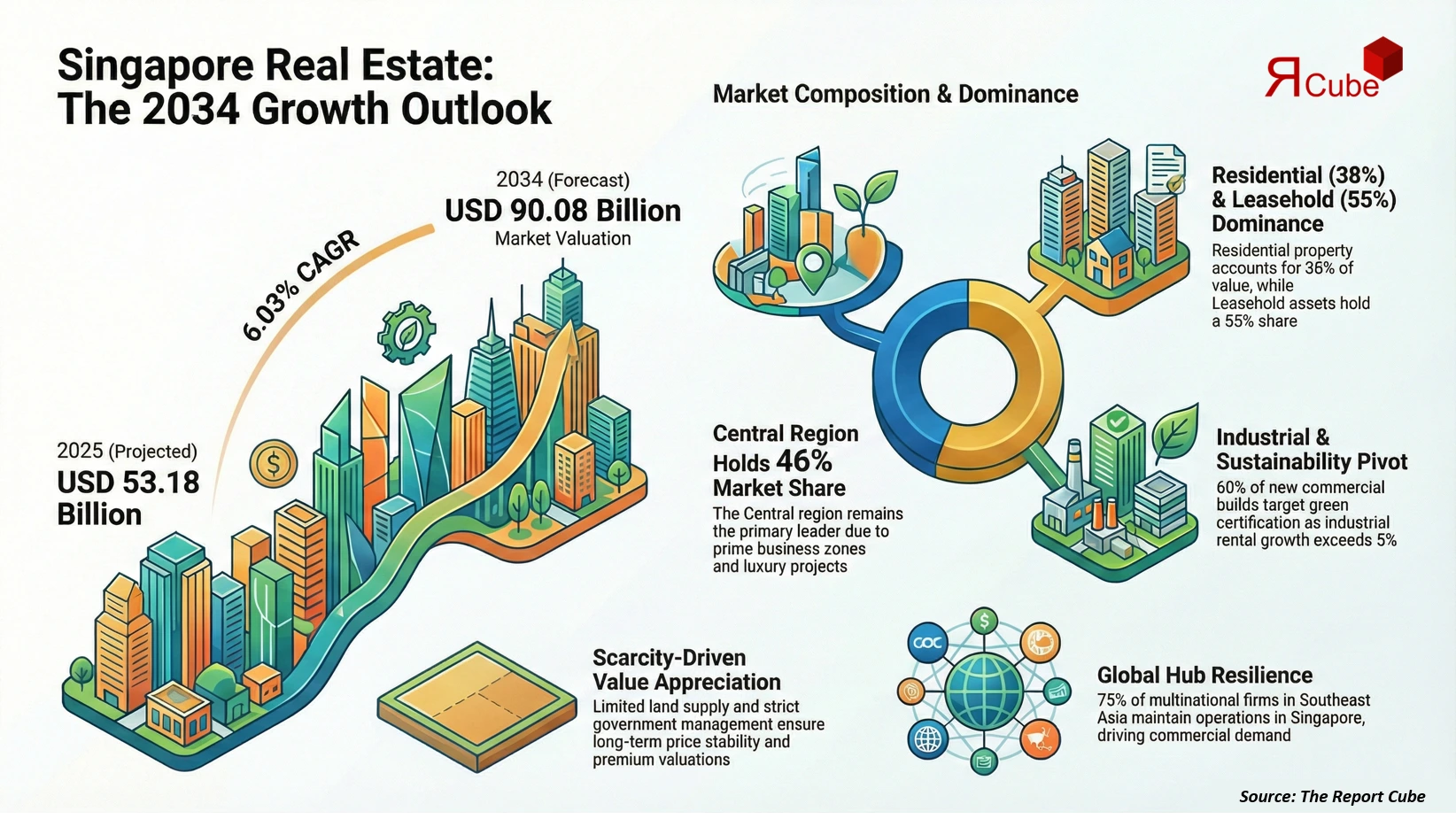
The Singapore Real Estate Market is anticipated to register a CAGR of 6.03% during 2026-2034. The market size was valued at USD 53.18 billion in 2025 and is projected to reach USD 90.08 billion by 2034. Singapore’s real estate sector remains one of the most resilient and structured markets in Asia, supported by strong regulatory oversight, transparent governance, and consistent foreign investment interest. Despite global economic volatility, demand across residential, commercial, and industrial segments continues to remain firm due to Singapore’s position as a global financial, logistics, and innovation hub.
The market benefits from a stable political environment, robust legal framework, and limited land availability, which collectively support long-term price appreciation. Residential demand is sustained by population growth, household formation, and a strong expatriate base, while the commercial segment benefits from multinational corporate presence and regional headquarters operations. Industrial and logistics assets are gaining traction due to supply chain diversification and advanced manufacturing investments. Together, these interconnected drivers ensure steady growth across property categories.
Moreover, sustainability initiatives, smart city planning, and transit-oriented developments are shaping future supply. Developers are increasingly focusing on green-certified buildings and mixed-use projects that enhance land efficiency. These structural strengths position the Singapore Real Estate Market for balanced, long-term expansion through 2034.
Singapore Real Estate Market Recent Developments
- 2025: CapitaLand accelerated mixed-use redevelopment projects in central Singapore to optimize land value.
- 2025: Frasers Property expanded its logistics and industrial portfolio through strategic asset enhancement initiatives.
Government Initiatives & Policies
- Urban Redevelopment Authority Master Plan: Guides sustainable land use, housing supply, and commercial zoning strategies.
- Green Mark Incentive Scheme: Encourages energy-efficient and sustainable building developments nationwide.
Singapore Real Estate Market Dynamics
Key Driver: Limited Land Supply Coupled with Strong Economic Fundamentals
Limited land availability remains a core driver of the Singapore Real Estate Market, reinforcing long-term value appreciation across asset classes. With land scarcity inherent to the city-state, new supply is carefully managed through government land sales and zoning regulations. This controlled pipeline supports price stability even during economic slowdowns. Simultaneously, Singapore’s strong economic fundamentals, including high GDP per capita, diversified industries, and regional headquarters activity, sustain consistent real estate demand. Approximately 75% of multinational firms operating in Southeast Asia maintain significant operations in Singapore, driving ongoing demand for office, residential, and industrial properties.
Book your FREE 30-minute expert consultation today
Contact UsIndustry Trends: Shift Toward Mixed-Use and Sustainable Developments
A major trend shaping the market is the growing preference for mixed-use developments that integrate residential, commercial, retail, and lifestyle components. These projects maximize land efficiency while enhancing community engagement and convenience. Sustainability has also become a defining factor, with over 60% of new commercial developments targeting green certification standards. Developers are integrating energy-efficient designs, smart building systems, and wellness-oriented features to attract tenants and investors. This trend aligns with national sustainability goals and enhances long-term asset value.
Major Challenge: Regulatory Measures and Affordability Constraints
While regulatory measures ensure market stability, they also present challenges for short-term growth. Cooling measures such as additional buyer’s stamp duties and loan-to-value limits can dampen speculative demand, particularly in the residential segment. Affordability concerns remain prominent for first-time buyers, especially amid rising construction and financing costs. Developers must navigate these constraints while maintaining profitability, making project planning and pricing strategies increasingly complex.
Opportunity: Growth in Industrial and Logistics Real Estate
The industrial and logistics segment presents a significant growth opportunity within the Singapore Real Estate Market. Demand for modern warehouses, data centers, and high-specification industrial facilities is rising due to e-commerce expansion, digitalization, and advanced manufacturing. Rental growth in prime logistics assets exceeded 5% annually in recent years, reflecting tight supply and strong tenant demand. Strategic positioning near ports and transport hubs further enhances the attractiveness of this segment.
Singapore Real Estate Market Segment-wise Analysis
By Property:
- Residential
- Commercial
- Industrial
- Retail
The residential segment leads the market by property type, accounting for approximately 38% of total market value in 2025. Demand is driven by household formation, upgrader activity, and sustained interest from high-net-worth investors. The commercial segment follows closely, supported by office leasing demand from finance, technology, and professional services firms. Industrial properties are gaining momentum due to logistics and data center investments, while retail remains stable, supported by experiential and suburban formats.
By Tenure:
- Freehold
- Leasehold
- HDB Public
Leasehold properties dominate the Singapore Real Estate Market by tenure, holding nearly 55% market share. This dominance reflects government land ownership structures and long-term lease frameworks that ensure controlled development. Freehold assets command premium valuations due to scarcity, while HDB public housing plays a crucial role in ensuring housing affordability and social stability, forming the foundation of Singapore’s residential ecosystem.
Regional Projection of Singapore Real Estate Industry
- Central
- North
- North East
- East
- West
The Central region leads the Singapore Real Estate Market, contributing approximately 46% of total market value in 2025. This dominance is attributed to the concentration of prime residential districts, central business zones, and integrated developments. High rental yields, premium office demand, and luxury residential projects underpin the region’s leadership. While Central Singapore remains dominant, the East and North East regions are emerging as growth corridors due to infrastructure upgrades and suburban commercial expansion.
Need insights for a specific region within this market?
Request Regional DataWhy Choose This Report?
- Provides a comprehensive overview of the overall market analysis, encompassing key trends, consumer behavior analysis, and risk assessment to support strategic decision-making.
- Provides accurate, up-to-date insights into market size, segmentation, and emerging opportunities, helping to minimize risk & capitalizing on growth.
- Gives deep understanding of target audience preferences, investment habits, and communication channels for enhanced product development & marketing effectiveness.
- Delivers competitive analysis & benchmarking, uncovering the strengths & weaknesses of market competitors to guide strategies.
- Consolidate comprehensive market intelligence, reducing reasoning & streamlining research efforts.
- Facilitates customized market segmentation & risk mitigation strategies, fine-tuned to the business objectives.
- Aids in identifying both market challenges & untapped opportunities within the industry to drive long-term business growth.
- Provides valuable information based on actual customer data & search trends.
Table of Contents
- Introduction
- Objective of the Study
- Product and Category Definition
- Market Segmentation
- Study Variables
- Research Methodology
- Secondary Data Points
- Breakdown of Secondary Sources
- Primary Data Points
- Breakdown of Primary Interviews
- Secondary Data Points
- Executive Summary
- Market Dynamics
- Drivers
- Challenges
- Opportunity Assessment
- Recent Trends and Developments
- Regulatory and Policy Landscape
- Singapore Real Estate Market Overview (2020-2034)
- Market Size, By Value (USD Billion)
- Market Share, By Segment
- Residential
- Commercial
- Industrial
- Retail
- Hospitality
- Market Share, By Tenure
- Freehold
- Leasehold
- HDB Public
- Market Share, By Buyer Type
- Owner-Occupier
- Private Investor
- Institutional
- Market Share, By Use Case
- Owner-Occupied
- Investment
- REITs
- Market Share, By Region
- Central
- North
- North East
- East
- West
- Market Share, By Company
- Revenue Shares
- Competition Characteristics
- Revenue Shares & Analysis
- North East Real Estate Market
- Market Size, By Value (USD Billion)
- Market Share, By Segment
- Market Share, By Tenure
- Market Share, By Buyer Type
- Market Share, By Use Case
- Market Share, By Town
- Ang Mo Kio
- Hougang
- Punggol
- Seletar
- Sengkang
- Serangoon
- North-Eastern Islands
- Central Real Estate Market
- Market Size, By Value (USD Billion)
- Market Share, By Segment
- Market Share, By Tenure
- Market Share, By Buyer Type
- Market Share, By Use Case
- North Real Estate Market
- Market Size, By Value (USD Billion)
- Market Share, By Segment
- Market Share, By Tenure
- Market Share, By Buyer Type
- Market Share, By Use Case
- East Real Estate Market
- Market Size, By Value (USD Billion)
- Market Share, By Segment
- Market Share, By Tenure
- Market Share, By Buyer Type
- Market Share, By Use Case
- West Real Estate Market
- Market Size, By Value (USD Billion)
- Market Share, By Segment
- Market Share, By Tenure
- Market Share, By Buyer Type
- Market Share, By Use Case
- Competitive Outlook and Company Profiles
- CapitaLand Group
- Company Overview
- Portfolio Overview
- Strategic Alliances/Partnerships
- Recent Developments
- City Developments
- Company Overview
- Portfolio Overview
- Strategic Alliances/Partnerships
- Recent Developments
- Frasers Property
- Company Overview
- Portfolio Overview
- Strategic Alliances/Partnerships
- Recent Developments
- UOL Group
- Company Overview
- Portfolio Overview
- Strategic Alliances/Partnerships
- Recent Developments
- Mapletree Investments
- Company Overview
- Portfolio Overview
- Strategic Alliances/Partnerships
- Recent Developments
- Far East Organization
- Company Overview
- Portfolio Overview
- Strategic Alliances/Partnerships
- Recent Developments
- GuocoLand Limited
- Company Overview
- Portfolio Overview
- Strategic Alliances/Partnerships
- Recent Developments
- Keppel Land
- Company Overview
- Portfolio Overview
- Strategic Alliances/Partnerships
- Recent Developments
- Oxley Holdings
- Company Overview
- Portfolio Overview
- Strategic Alliances/Partnerships
- Recent Developments
- Bukit Sembawang
- Company Overview
- Portfolio Overview
- Strategic Alliances/Partnerships
- Recent Developments
- Others
- CapitaLand Group
- Contact Us and Disclaimer
Top Key Players & Market Share Outlook
- CapitaLand Group
- City Developments
- Frasers Property
- UOL Group
- Mapletree Investments
- Far East Organization
- GuocoLand Limited
- Keppel Land
- Oxley Holdings
- Bukit Sembawang
- Others
Frequently Asked Questions






