



Build Your Custom Market Intelligence Report
Customize Your ReportUAE Smart Building Technology Market Insights & Analysis
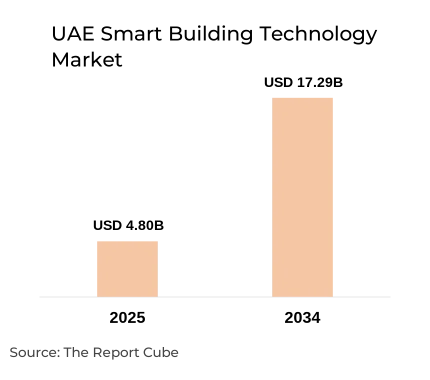
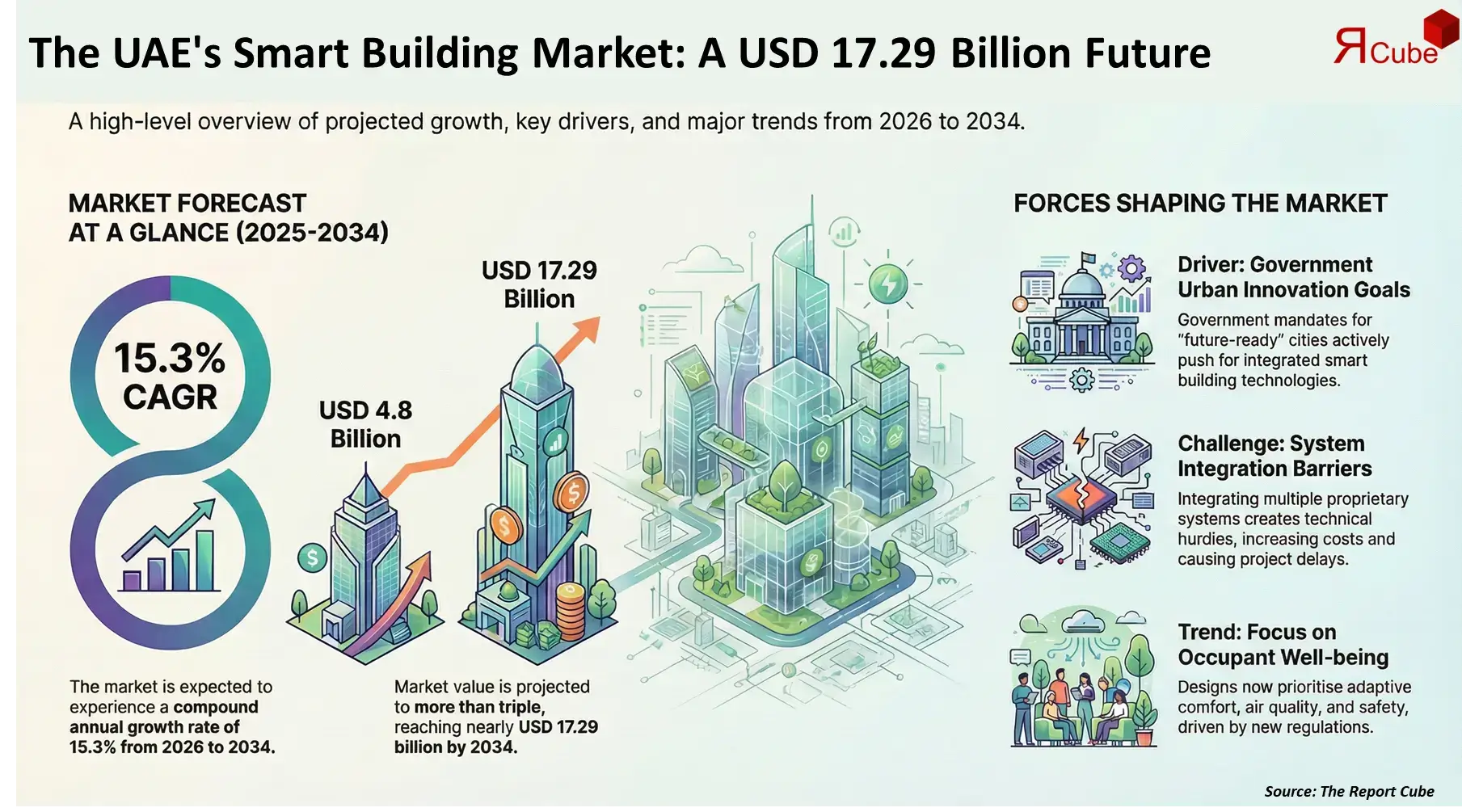
The UAE Smart Building Technology Market is anticipated to register a CAGR of 15.30% during 2026-2034. The market size was valued at USD 4.8 billion in 2025 and is projected to reach USD 17.29 billion by 2034. This rapid expansion reflects the UAE’s strong commitment to digital transformation, sustainable infrastructure, and energy efficiency across commercial, residential, and public buildings. Smart building technologies are increasingly viewed as a core enabler of operational efficiency, occupant comfort, and long-term cost optimization.
Urbanization, coupled with the government’s vision for smart cities, is accelerating adoption across major emirates. Advanced automation systems, intelligent energy controls, and integrated security solutions are becoming standard features in new construction projects. At the same time, retrofitting existing buildings with smart technologies is gaining traction, driven by rising energy costs and stricter sustainability benchmarks. Developers and facility managers are prioritizing technologies that reduce carbon footprints while enhancing asset value.
Furthermore, the UAE’s position as a regional business and tourism hub is reinforcing demand for technologically advanced commercial spaces. Smart offices, hotels, and mixed-use developments are leveraging data-driven building management systems to improve user experience and operational resilience. As digital infrastructure matures, the smart building ecosystem in the UAE is expected to transition from isolated solutions toward fully integrated, AI-enabled platforms by 2034.
UAE Smart Building Technology Market Recent Developments
- 2025: Siemens expanded its smart infrastructure portfolio in Dubai, focusing on AI-driven building automation platforms.
- 2025: Schneider Electric Gulf introduced advanced energy analytics solutions for large-scale commercial buildings.
Government Initiatives & Policies
- UAE Net Zero 2050 Strategy: National framework promoting smart, energy-efficient buildings to reduce emissions.
- Dubai Smart City Initiative: Program accelerating adoption of smart technologies across urban infrastructure.
UAE Smart Building Technology Market Dynamics
Key Driver: Strong Government Push Toward Smart and Sustainable Infrastructure
The UAE government’s aggressive push toward smart and sustainable infrastructure is the primary driver of the smart building technology market. Federal and emirate-level initiatives emphasize energy efficiency, digital connectivity, and environmental responsibility across public and private developments. Mandatory green building regulations in emirates such as Dubai and Abu Dhabi are encouraging adoption of intelligent energy management and automation systems. Nearly 70% of new large-scale commercial projects initiated after 2023 have integrated some form of smart building technology, highlighting regulatory influence. This policy-driven environment is creating long-term demand certainty for technology providers and system integrators.
Book your FREE 30-minute expert consultation today
Contact UsIndustry Trends: Convergence of Automation, Energy Management, and Data Analytics
A key trend shaping the market is the convergence of building automation, energy management, and advanced data analytics into unified platforms. Building owners increasingly prefer centralized systems that provide real-time insights into energy consumption, equipment performance, and occupant behavior. Cloud-based building management systems and IoT-enabled sensors are becoming mainstream, enabling predictive maintenance and proactive decision-making. In 2025, energy management solutions accounted for nearly one-third of total smart building investments in the UAE, reflecting rising emphasis on efficiency and cost control. This trend is gradually transforming buildings into intelligent, self-optimizing assets.
Major Challenge: High Initial Investment and Integration Complexity
Despite strong growth prospects, high upfront costs remain a major challenge for widespread adoption. Smart building technologies require significant capital investment in hardware, software, and skilled implementation. Integration with legacy systems in older buildings further increases complexity and costs. Many small and mid-sized property owners remain hesitant due to unclear short-term returns on investment. Additionally, interoperability issues among different technology vendors can delay deployment timelines, impacting project feasibility and user confidence across the UAE market.
Opportunity: Retrofitting Existing Buildings with Smart Technologies
The vast stock of existing commercial and residential buildings in the UAE presents a significant growth opportunity. Retrofitting projects aimed at improving energy efficiency and operational performance are gaining momentum, supported by rising utility costs and sustainability targets. Smart lighting, HVAC optimization, and automated security systems are among the most востребed retrofit solutions. Retrofitting can reduce energy consumption by up to 25%, making it an attractive proposition for asset owners. This segment is expected to generate steady demand for services and system integration over the forecast period.
UAE Smart Building Technology Market Segment-wise Analysis
By Component:
- Solutions
- Services
Solutions dominate the UAE Smart Building Technology Market, accounting for approximately 62% of total revenue in 2025. This leadership is driven by high demand for building automation platforms, energy management software, and integrated security systems. Solutions deliver immediate operational benefits, making them the primary investment focus for developers. Services, including consulting, installation, and maintenance, are growing steadily as system complexity increases and long-term performance optimization becomes critical.
By Solution Type:
- Building Automation
- Energy Management
- Security Systems
- Network Management
- Workforce Management
Building automation is the leading solution type, holding nearly 34% market share in 2025. Automated HVAC, lighting, and access control systems are widely adopted to improve comfort and efficiency. Energy management follows closely, driven by sustainability mandates and cost reduction goals. Security and network management solutions are also witnessing increased adoption, particularly in commercial and government buildings, supporting holistic smart infrastructure development.
Regional Projection of UAE Smart Building Technology Industry
- Abu Dhabi
- Dubai
- Sharjah
- Ajman
- Rest of UAE
Dubai leads the UAE Smart Building Technology Market, contributing approximately 40% of total market revenue in 2025. The emirate’s focus on smart city development, high concentration of commercial real estate, and advanced regulatory frameworks support strong adoption. Abu Dhabi follows closely, driven by government-led infrastructure projects and energy efficiency initiatives. Other emirates are gradually increasing adoption as smart technologies become more affordable and standardized across the country.
Need insights for a specific region within this market?
Request Regional DataWhy Choose This Report?
- Provides a comprehensive overview of the overall market analysis, encompassing key trends, consumer behavior analysis, and risk assessment to support strategic decision-making.
- Provides accurate, up-to-date insights into market size, segmentation, and emerging opportunities, helping to minimize risk & capitalizing on growth.
- Gives deep understanding of target audience preferences, investment habits, and communication channels for enhanced product development & marketing effectiveness.
- Delivers competitive analysis & benchmarking, uncovering the strengths & weaknesses of market competitors to guide strategies.
- Consolidate comprehensive market intelligence, reducing reasoning & streamlining research efforts.
- Facilitates customized market segmentation & risk mitigation strategies, fine-tuned to the business objectives.
- Aids in identifying both market challenges & untapped opportunities within the industry to drive long-term business growth.
- Provides valuable information based on actual customer data & search trends.
Table of Contents
- Introduction
- Objective of the Study
- Product and Category Definition
- Market Segmentation
- Study Variables
- Research Methodology
- Secondary Data Points
- Breakdown of Secondary Sources
- Primary Data Points
- Breakdown of Primary Interviews
- Secondary Data Points
- Executive Summary
- Market Dynamics
- Drivers
- Challenges
- Opportunity Assessment
- Recent Trends and Developments
- Regulatory and Policy Landscape
- UAE Smart Building Technology Market Overview (2020-2034)
- Market Size, By Value (USD Billion)
- Market Share, By Component
- Solutions
- Services
- Market Share, By Solution Type
- Building Automation
- Energy Management
- Security Systems
- Network Management
- Workforce Management
- Market Share, By Building Type
- Residential
- Commercial
- Industrial
- Market Share, By Application
- Lighting Control
- HVAC Control
- Access Control
- Smart Metering
- Market Share, By Region
- Abu Dhabi
- Dubai
- Sharjah
- Ajman
- Rest of UAE
- Market Share, By Company
- Competition Characteristics
- Revenue Shares & Analysis
- Abu Dhabi Smart Building Technology Market
- Market Size, By Value (USD Billion)
- Market Share, By Component
- Market Share, By Solution Type
- Market Share, By Building Type
- Market Share, By Application
- Dubai Smart Building Technology Market
- Market Size, By Value (USD Billion)
- Market Share, By Component
- Market Share, By Solution Type
- Market Share, By Building Type
- Market Share, By Application
- Sharjah Smart Building Technology Market
- Market Size, By Value (USD Billion)
- Market Share, By Component
- Market Share, By Solution Type
- Market Share, By Building Type
- Market Share, By Application
- Ajman Smart Building Technology Market
- Market Size, By Value (USD Billion)
- Market Share, By Component
- Market Share, By Solution Type
- Market Share, By Building Type
- Market Share, By Application
- Competitive Outlook and Company Profiles
- Honeywell
- Company Overview
- Product Portfolio
- Strategic Alliances/Partnerships
- Recent Developments
- Schneider Electric
- Company Overview
- Product Portfolio
- Strategic Alliances/Partnerships
- Recent Developments
- Siemens
- Company Overview
- Product Portfolio
- Strategic Alliances/Partnerships
- Recent Developments
- Johnson Controls
- Company Overview
- Product Portfolio
- Strategic Alliances/Partnerships
- Recent Developments
- ABB
- Company Overview
- Product Portfolio
- Strategic Alliances/Partnerships
- Recent Developments
- Honeywell Middle East
- Company Overview
- Product Portfolio
- Strategic Alliances/Partnerships
- Recent Developments
- Schneider Electric Gulf
- Company Overview
- Product Portfolio
- Strategic Alliances/Partnerships
- Recent Developments
- Advanced Integration Automation
- Company Overview
- Product Portfolio
- Strategic Alliances/Partnerships
- Recent Developments
- Vacker UAE
- Company Overview
- Product Portfolio
- Strategic Alliances/Partnerships
- Recent Developments
- Bahri & Mazroei Group
- Company Overview
- Product Portfolio
- Strategic Alliances/Partnerships
- Recent Developments
- Others
- Honeywell
- Contact Us and Disclaimer
Top Key Players & Market Share Outlook
- Honeywell
- Schneider Electric
- Siemens
- Johnson Controls
- ABB
- Honeywell Middle East
- Schneider Electric Gulf
- Advanced Integration Automation
- Vacker UAE
- Bahri & Mazroei Group
- Others
Frequently Asked Questions






