



Build Your Custom Market Intelligence Report
Customize Your ReportVietnam Battery Recycling & Circularity Market Key Highlights
By Battery Chemistry:
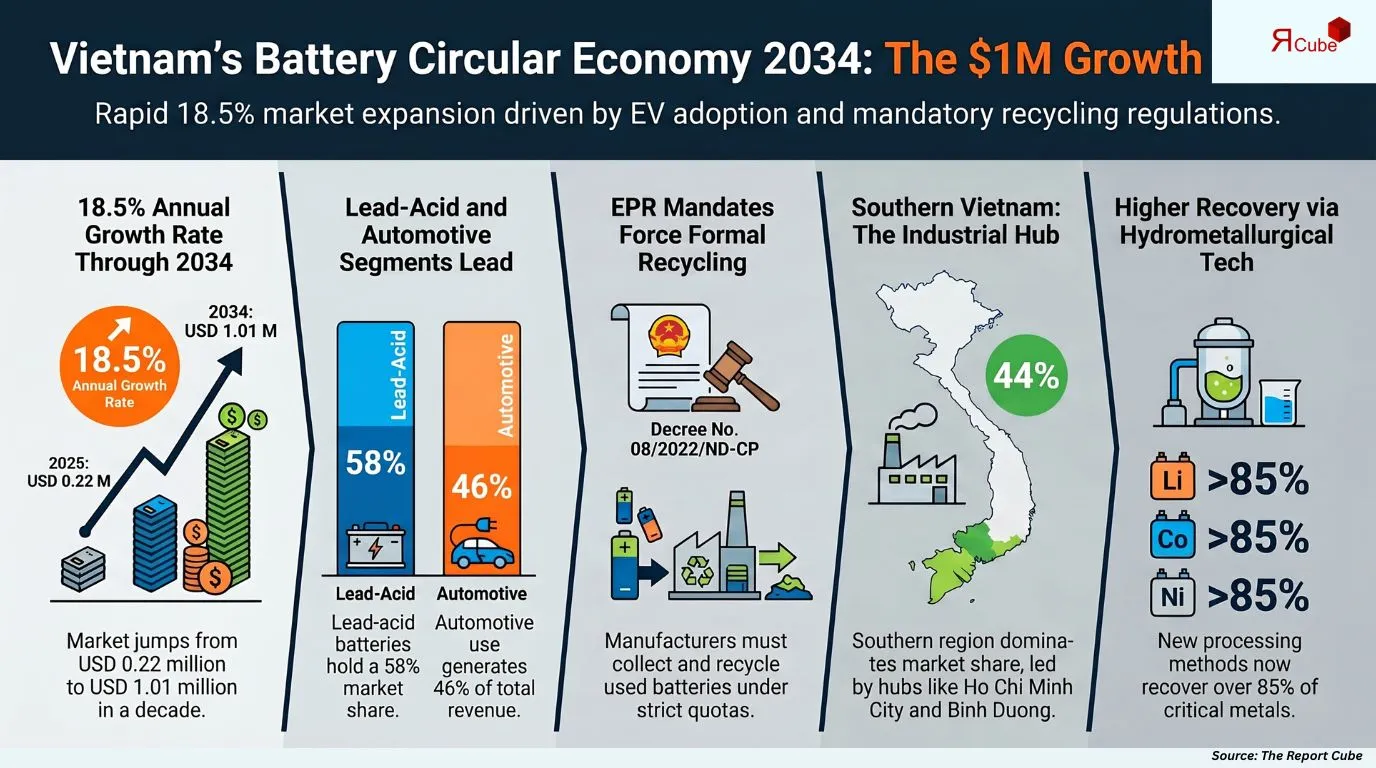
Lead-Acid Batteries segment leads the market, with around 58% share.
By End Use:
Automotive Batteries segment dominates the market, accounting for nearly 46% of total revenue.
Regional Outlook:
Southern region dominates the vietnam battery recycling & circularity market, with around 44% share.
Government Initiatives & Policies
- Vietnam National Strategy on Integrated Solid Waste Management (Decision No. 491/QD-TTg, updated 2025): Strengthens extended producer responsibility (EPR) for batteries and hazardous waste recovery targets.
- Decree No. 08/2022/ND-CP on Environmental Protection (EPR Implementation Roadmap, updated 2025 guidance): Mandates manufacturers and importers to collect and recycle used batteries under defined quotas.
Vietnam Battery Recycling & Circularity Market Insights & Analysis
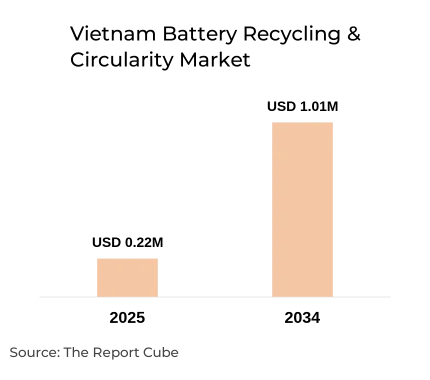
The Vietnam Battery Recycling & Circularity Market is anticipated to register a 18.5% during 2026-34. The market size was valued at USD 0.22 million in 2025 and is projected to reach USD 1.01 million by 2034. Rapid electrification in transport, expansion of renewable energy installations, and tightening environmental regulations are reshaping Vietnam’s battery lifecycle management landscape.
Vietnam’s accelerating electric vehicle adoption, supported by domestic manufacturing initiatives from companies such as VinES (Vingroup), is generating a parallel rise in end-of-life lithium-ion battery volumes. By 2025, EV registrations in Vietnam crossed an estimated 300,000 cumulative units, creating a visible pipeline for future recycling streams. At the same time, the country continues to generate over 200,000 tons of used lead-acid batteries annually from motorcycles, passenger vehicles, and industrial backup systems. Formal recycling capacity is expanding, yet a portion of battery waste still flows through informal channels, prompting regulatory tightening under EPR mandates.
Investment activity has intensified across southern industrial clusters such as Binh Duong and Ho Chi Minh City, where waste management firms including CITENCO, BIWASE, and Vietnam Waste Solutions are scaling hazardous waste treatment and material recovery infrastructure. Hydrometallurgical recovery technologies are gaining attention for lithium-ion battery processing due to their ability to extract cobalt, nickel, and lithium with recovery efficiencies exceeding 85%. This shift aligns with Vietnam’s ambition to localize battery material supply chains and reduce reliance on imported refined metals.
Moreover, circularity principles are moving beyond recycling toward second-life applications. Energy storage systems repurposing retired EV batteries are being piloted for commercial solar installations and telecom towers. Industry estimates suggest that by 2030, up to 20% of retired EV batteries in Vietnam could be redeployed into stationary storage before final material recovery. These structural shifts, backed by policy enforcement and private capital inflows, are positioning Vietnam as a high-growth emerging market in Southeast Asia’s battery circular economy ecosystem.
Vietnam Battery Recycling & Circularity Market Dynamics
Key Driver: Expansion of Electric Vehicles and Energy Storage Installations
Vietnam’s EV manufacturing push and rising renewable energy capacity are primary growth catalysts. Solar capacity in Vietnam surpassed 20 GW installed base, increasing demand for battery storage and eventual recycling pathways. Domestic EV production targets are projected to exceed 1 million units annually by 2030, significantly expanding future lithium-ion waste volumes. Automotive battery replacements already account for nearly half of annual collected battery waste. Additionally, stricter enforcement of EPR regulations requires OEMs and importers to finance collection and recycling, creating structured demand for licensed recyclers. As collection efficiency improves from an estimated 45% in 2025 toward a targeted 70% by 2030, formal sector volumes are expected to surge, directly supporting double-digit market growth.
Book your FREE 30-minute expert consultation today
Contact UsIndustry Trends: Transition Toward Hydrometallurgical Recovery and Closed-Loop Models
Technology upgrades are transforming processing efficiency and environmental performance. Traditional pyrometallurgical methods remain relevant for lead-acid batteries; however, lithium-ion recycling is shifting toward hydrometallurgical systems capable of recovering high-purity lithium carbonate and nickel sulfate. Recovery rates above 90% for cobalt and nickel are becoming commercially viable. Strategic collaborations between battery manufacturers and recyclers are enabling closed-loop supply chains, where recovered metals are reintroduced into domestic cell production. Digital tracking of battery lifecycles using QR-based identification systems is also emerging, improving traceability from collection to final recovery. These developments enhance transparency, reduce leakage into informal recycling channels, and strengthen investor confidence in scalable circular infrastructure.
Major Challenge: Informal Recycling Sector and Collection Inefficiencies
A considerable portion of used lead-acid batteries is still processed through informal operators lacking environmental safeguards. Industry observers estimate that up to 30% of battery waste may bypass licensed facilities, leading to material losses and environmental risks. Informal smelting practices can result in lead emissions exceeding regulated thresholds, creating public health concerns. Collection logistics also remain fragmented, particularly in rural provinces where structured take-back programs are limited. High transportation costs for hazardous materials and insufficient dismantling infrastructure constrain operational margins. While regulatory enforcement is strengthening, achieving nationwide compliance requires significant investment in awareness campaigns, monitoring systems, and licensed facility expansion.
Opportunity: Development of Second-Life Battery Applications and Localized Material Refining
Second-life battery deployment presents a compelling revenue stream. Retired EV batteries typically retain 70-80% of their original capacity, making them suitable for stationary storage. Telecom operators and commercial solar farms are piloting these systems to reduce energy costs. Additionally, localized refining of recovered lithium, cobalt, and nickel offers import substitution benefits. Vietnam currently imports a substantial share of processed cathode materials; integrating recycling outputs into domestic battery manufacturing could reduce raw material import dependence by an estimated 15-20% by 2034. Investors are increasingly exploring modular recycling plants in industrial parks to shorten logistics chains and improve economic viability.
Vietnam Battery Recycling & Circularity Market Segment-wise Analysis
By Battery Chemistry:
- Lead-Acid Batteries
- Lithium-Ion Batteries
- Nickel-Based Batteries
- Others
Lead-acid batteries hold approximately 58% of total recycled volume in 2025, driven by Vietnam’s large motorcycle fleet exceeding 65 million units. Replacement cycles averaging 18-24 months ensure a steady waste stream. Automotive workshops and independent collectors form the backbone of collection networks. Recovery efficiency for lead can surpass 95%, making the segment economically stable. Industrial backup systems and UPS installations further contribute to volume consistency. Although lithium-ion growth is accelerating, lead-acid remains dominant due to established processing facilities and mature supply chains, particularly in southern provinces where industrial density supports economies of scale.
By End Use:
- Automotive Batteries
- Industrial Batteries
- Consumer Batteries
- Energy Storage Systems
Automotive batteries account for nearly 46% of total market revenue, reflecting strong vehicle ownership growth and EV adoption momentum. Passenger vehicles, electric scooters, and commercial fleets generate predictable replacement demand. OEM take-back programs are expanding under EPR compliance frameworks, improving formal collection rates. Industrial batteries used in manufacturing plants and telecom towers follow closely, supported by Vietnam’s export-oriented industrial expansion. Consumer electronics batteries contribute smaller volumes but require advanced sorting and dismantling systems. Automotive dominance is expected to continue as EV penetration increases, elevating lithium-ion recycling volumes within this segment.
Regional Projection of Vietnam Battery Recycling & Circularity Industry
- Southern
- Northern
- Central
- Others
The Southern region leads with around 44% market share, anchored by industrial hubs in Binh Duong, Dong Nai, and Ho Chi Minh City. Concentration of manufacturing facilities, EV assembly plants, and waste management infrastructure strengthens collection density. BIWASE and Vietnam Waste Solutions operate advanced treatment plants within this region, enabling integrated hazardous waste handling. Northern Vietnam, including Hanoi, follows due to urban density and expanding electronics manufacturing clusters. Central provinces are gradually developing formal recycling capacity but remain dependent on inter-regional transport for advanced processing. Regional industrialization patterns directly influence battery waste generation and recycling economics.
Vietnam Battery Recycling & Circularity Market Recent Developments
- 2025: BIWASE announced a VND 1,150 billion (about USD 45 million) investment to develop a 12 MW waste-to-energy facility in Binh Duong, processing 500 tons per day, strengthening circular waste infrastructure integration with battery material recovery initiatives.
- 2025: VinES (Vingroup) confirmed a strategic partnership with Li-Cycle, designating the company as a preferred lithium-ion recycler to support closed-loop battery supply chain development within Vietnam’s growing EV ecosystem.
- 2025: GS Battery Vietnam was honored among the Top 20 National Green ESG Enterprises 2025, highlighting structured battery collection programs and strengthened distributor-linked recycling networks across major provinces.
- 2025: PINACO detailed expanded battery waste collection programs and financial contributions to Vietnam Environmental Protection Fund, reinforcing formal recycling channel expansion under national EPR compliance.
Need insights for a specific region within this market?
Request Regional DataWhy Choose This Report?
- Provides a comprehensive overview of the overall market analysis, encompassing key trends, consumer behavior analysis, and risk assessment to support strategic decision-making.
- Provides accurate, up-to-date insights into market size, segmentation, and emerging opportunities, helping to minimize risk & capitalizing on growth.
- Gives deep understanding of target audience preferences, investment habits, and communication channels for enhanced product development & marketing effectiveness.
- Delivers competitive analysis & benchmarking, uncovering the strengths & weaknesses of market competitors to guide strategies.
- Consolidate comprehensive market intelligence, reducing reasoning & streamlining research efforts.
- Facilitates customized market segmentation & risk mitigation strategies, fine-tuned to the business objectives.
- Aids in identifying both market challenges & untapped opportunities within the industry to drive long-term business growth.
- Provides valuable information based on actual customer data & search trends.
Table of Contents
- Introduction
- Objective of the Study
- Product and Category Definition
- Market Segmentation
- Study Variables
- Research Methodology
- Secondary Data Points
- Breakdown of Secondary Sources
- Primary Data Points
- Breakdown of Primary Interviews
- Secondary Data Points
- Executive Summary
- Market Dynamics
- Drivers
- Challenges
- Opportunity Assessment
- Recent Trends and Developments
- Regulatory and Policy Landscape
- Vietnam Battery Recycling & Circularity Market Overview (2021-2034)
- Market Size, By Value (USD Million)
- Market Share, By Battery Chemistry
- Lead-Acid Batteries
- Lithium-Ion Batteries
- Nickel-Based Batteries
- Others
- Market Share, By End Use
- Automotive Batteries
- Industrial Batteries
- Consumer Batteries
- Energy Storage Systems
- Market Share, By Process
- Collection & Logistics
- Dismantling & Sorting
- Mechanical Processing
- Pyrometallurgical Recovery
- Hydrometallurgical Recovery
- Second-Life Applications
- Market Share, By Source
- OEM Take-Back Programs
- Independent Collectors
- Municipal Waste Streams
- Industrial Scrap Streams
- Market Share, By Region
- Northern
- Central
- Southern
- Others
- Market Share, By Company
- Revenue Shares & Analysis
- Competitive Landscape
- Northern Vietnam Battery Recycling & Circularity Market
- Market Size, By Value (USD Million)
- Market Share, By Battery Chemistry
- Market Share, By End Use
- Market Share, By Process
- Market Share, By Source
- Central Vietnam Battery Recycling & Circularity Market
- Market Size, By Value (USD Million)
- Market Share, By Battery Chemistry
- Market Share, By End Use
- Market Share, By Process
- Market Share, By Source
- Southern Vietnam Battery Recycling & Circularity Market
- Market Size, By Value (USD Million)
- Market Share, By Battery Chemistry
- Market Share, By End Use
- Market Share, By Process
- Market Share, By Source
- Competitive Outlook and Company Profiles
- VinES (Vingroup)
- Company Overview
- Product Portfolio
- Strategic Alliances/Partnerships
- Recent Developments
- INSEE Ecocycle
- Company Overview
- Product Portfolio
- Strategic Alliances/Partnerships
- Recent Developments
- Vietnam Recycles (RLG)
- Company Overview
- Product Portfolio
- Strategic Alliances/Partnerships
- Recent Developments
- CITENCO
- Company Overview
- Product Portfolio
- Strategic Alliances/Partnerships
- Recent Developments
- URENCO Hanoi
- Company Overview
- Product Portfolio
- Strategic Alliances/Partnerships
- Recent Developments
- PINACO
- Company Overview
- Product Portfolio
- Strategic Alliances/Partnerships
- Recent Developments
- GS Battery Vietnam
- Company Overview
- Product Portfolio
- Strategic Alliances/Partnerships
- Recent Developments
- EcoCycle Vietnam
- Company Overview
- Product Portfolio
- Strategic Alliances/Partnerships
- Recent Developments
- Thuan Thanh Env.
- Company Overview
- Product Portfolio
- Strategic Alliances/Partnerships
- Recent Developments
- Green Star Co.
- Company Overview
- Product Portfolio
- Strategic Alliances/Partnerships
- Recent Developments
- Hanoi Eco-Recycling
- Company Overview
- Product Portfolio
- Strategic Alliances/Partnerships
- Recent Developments
- Vietnam Waste Solutions
- Company Overview
- Product Portfolio
- Strategic Alliances/Partnerships
- Recent Developments
- Vision Group
- Company Overview
- Product Portfolio
- Strategic Alliances/Partnerships
- Recent Developments
- BIWASE
- Company Overview
- Product Portfolio
- Strategic Alliances/Partnerships
- Recent Developments
- Tan Thien Nhien JSC
- Company Overview
- Product Portfolio
- Strategic Alliances/Partnerships
- Recent Developments
- Vietstar Environment
- Company Overview
- Product Portfolio
- Strategic Alliances/Partnerships
- Recent Developments
- Others
- VinES (Vingroup)
- Contact Us and Disclaimer
Top Key Players & Market Share Outlook
- VinES (Vingroup)
- INSEE Ecocycle
- Vietnam Recycles (RLG)
- CITENCO
- URENCO Hanoi
- PINACO
- GS Battery Vietnam
- EcoCycle Vietnam
- Thuan Thanh Env.
- Green Star Co.
- Hanoi Eco-Recycling
- Vietnam Waste Solutions
- Vision Group (Vietnam)
- BIWASE
- Tan Thien Nhien JSC
- Vietstar Environment
- Others
Frequently Asked Questions






