



Build Your Custom Market Intelligence Report
Customize Your ReportPhilippines Green Finance & Carbon Market Key Highlights
By Green Finance Instrument:
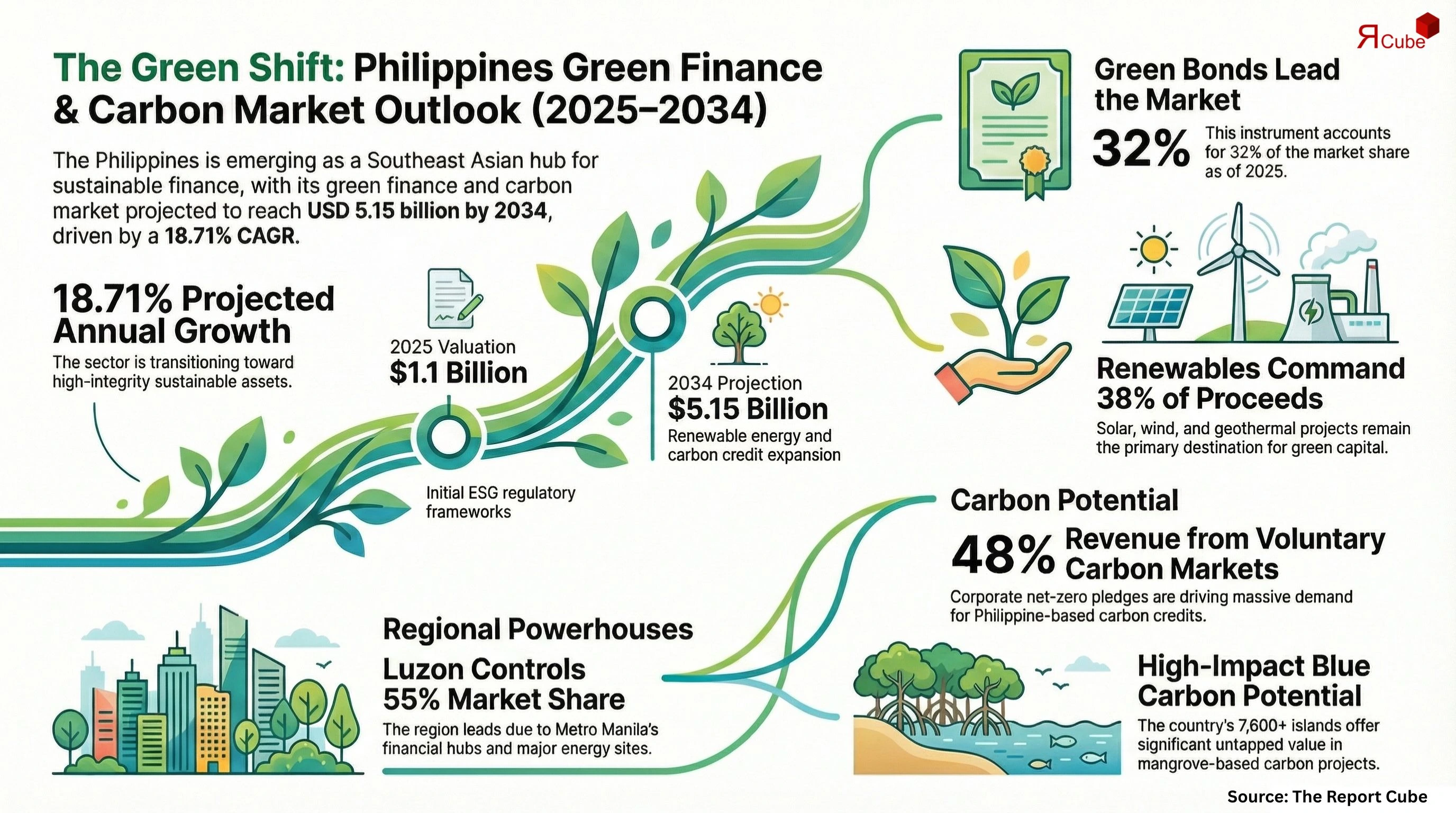
Green Bonds segment leads the market, with around 32% share.
By Use of Proceeds:
Renewable Energy segment dominates the market, accounting for nearly 38% of total proceeds.
Regional Outlook:
Luzon region dominates the philippines green finance & carbon markets market, with around 55% share.
Government Initiatives & Policies
- Republic Act No. 11285 - Energy Efficiency and Conservation Act (Updated 2025 Implementation Roadmap): Mandates energy efficiency standards and reporting, driving demand for sustainability-linked loans and green bonds.
- Philippine Sustainable Finance Framework (Bangko Sentral ng Pilipinas, Updated 2025 Guidance): Requires banks to integrate environmental and social risk management in lending, accelerating green finance growth.
Philippines Green Finance & Carbon Market Insights & Analysis
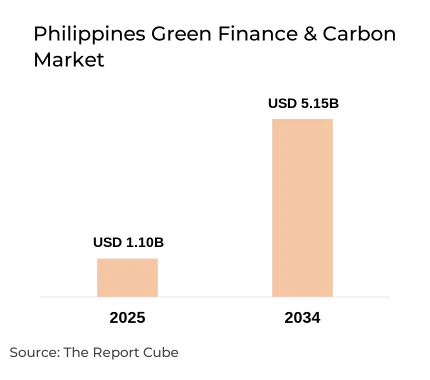
The Philippines Green Finance & Carbon Markets Market is anticipated to register a CAGR of 18.71% during 2026-34. The market size was valued at USD 1.1 billion in 2025 and is projected to reach USD 5.15 billion by 2034. The Philippines is rapidly positioning itself as a regional hub for sustainable finance and voluntary carbon market development, supported by regulatory reforms, renewable energy expansion, and rising investor appetite for ESG-aligned assets.
Green bond issuances from commercial banks and corporate energy developers have gained strong traction. By mid-2025, cumulative sustainable bond issuances exceeded USD 4.5 billion, reflecting increased alignment with ASEAN Green Bond Standards. Financial institutions such as BDO Unibank and BPI are integrating sustainability-linked financing frameworks that tie borrowing costs to emissions reduction and renewable energy capacity targets. This structural shift is creating deeper capital pools for climate-resilient infrastructure.
On the carbon market side, the Philippines is emerging as a competitive voluntary carbon credit supplier. Forest conservation, reforestation, and renewable energy projects are generating high-quality credits aligned with Verra and Gold Standard methodologies. The country’s archipelagic geography and extensive mangrove ecosystems create significant blue carbon potential. Estimates suggest that Philippine-based carbon projects could generate over 20 million tonnes of CO₂ equivalent credits annually by 2030, particularly from forest and land-use programs in Mindanao and Luzon.
International capital flows are strengthening project pipelines. Multilateral agencies and development finance institutions are expanding blended finance structures that de-risk early-stage renewable and adaptation projects. At the same time, local banks are issuing green loans to small and medium enterprises for rooftop solar, energy-efficient equipment, and waste management solutions. These trends collectively reinforce a diversified and rapidly maturing green finance ecosystem across the Philippines.
Philippines Green Finance & Carbon Market Dynamics
Key Driver: Renewable Energy Expansion and Sustainable Infrastructure Demand
The Philippines targets a 35% renewable energy share in the power mix by 2030, increasing to 50% by 2040. This ambition requires substantial capital deployment into solar, wind, geothermal, and hydro projects. Renewable auctions have stimulated pipeline development exceeding 10 GW in approved capacity. Financing these projects demands innovative instruments such as green bonds and sustainability-linked loans. Corporate issuers including ACEN Corporation and First Gen Corporation are leveraging green finance to refinance fossil assets and expand renewable portfolios. As climate vulnerability intensifies, adaptation investments in flood control, resilient infrastructure, and water management are also drawing sustainable capital inflows. This combination of mitigation and adaptation financing is the primary engine behind market expansion.
Book your FREE 30-minute expert consultation today
Contact UsIndustry Trends: Growth of Transition Credits and Digital Carbon Trading Platforms
Carbon market innovation is accelerating. Transition credits, designed to finance early coal retirement, are gaining policy and investor attention. Digital carbon exchanges such as AirCarbon Exchange (ACX) are enhancing transparency and liquidity by tokenizing carbon credits. Blockchain-enabled registries reduce double counting risks and improve transaction traceability. Corporate buyers in Asia-Pacific are increasingly sourcing credits from Philippine forestry and renewable projects to meet net-zero pledges. Additionally, sustainability-linked bonds with performance-based coupon adjustments are becoming mainstream among commercial banks. These structural trends are modernizing both capital markets and carbon trading infrastructure within the country.
Major Challenge: Regulatory Alignment and Carbon Market Integrity Risks
The absence of a fully operational national compliance carbon market creates uncertainty for long-term investors. While voluntary markets are expanding, pricing volatility and verification complexities pose operational challenges. Carbon credit prices in Southeast Asia have fluctuated between USD 4 and USD 15 per tonne, affecting revenue predictability for project developers. Monitoring, reporting, and verification (MRV) capacity remains uneven across regions. Additionally, greenwashing risks require stricter disclosure standards and third-party validation. Strengthening regulatory clarity and harmonizing carbon accounting frameworks will be essential to sustain investor confidence and international participation.
Opportunity: Blended Finance and Nature-Based Carbon Projects
Blended finance structures combining concessional capital with private investment present strong growth potential. Development banks such as Land Bank of the Philippines and DBP are structuring risk-sharing facilities for renewable energy and climate adaptation. Nature-based carbon projects in mangroves, peatlands, and forest conservation represent significant untapped value. The Philippines has over 7,600 islands with extensive coastal ecosystems suitable for blue carbon initiatives. Estimates indicate that blue carbon credits could command price premiums of 20-30% compared to standard forestry credits. Expanding advisory, brokerage, and verification services further enhances value chain integration across carbon markets.
Philippines Green Finance & Carbon Market Segment-wise Analysis
By Green Finance Instrument:
- Green Bonds
- Sustainability Bonds
- Sustainability-Linked Loans
- Green Loans
- Transition Finance Instruments
- Blended Finance and Development Finance
Green Bonds hold approximately 32% of the total market share in 2025, driven by large-scale renewable energy refinancing and infrastructure funding. Corporate issuers and commercial banks are increasingly tapping domestic and offshore bond markets. Coupon rates linked to sustainability performance metrics enhance investor engagement. Institutional investors allocate a growing portion of fixed-income portfolios to labeled green securities. This instrument’s standardized reporting framework and alignment with ASEAN taxonomy strengthen its dominance within the Philippines green finance ecosystem.
By Carbon Market Segment:
- Compliance Carbon Market
- Voluntary Carbon Market
- Carbon Credit Project Development
- Carbon Trading and Brokerage
- Carbon Advisory and Verification Services
The Voluntary Carbon Market accounts for nearly 48% of carbon-related revenue, supported by corporate net-zero commitments and international credit buyers. Forestry and renewable energy credits dominate issuance volumes. Digital exchanges and brokerage platforms facilitate cross-border transactions. Advisory and verification services are expanding as project developers seek third-party certification. As global buyers prioritize high-integrity credits, Philippine projects aligned with recognized standards are attracting premium pricing and long-term offtake agreements.
Regional Projection of Philippines Green Finance & Carbon Industry
- Luzon
- Visayas
- Mindanao
Luzon leads the market with approximately 55% share, anchored by Metro Manila’s financial institutions and major renewable project sites in Ilocos and Central Luzon. Most commercial banks and corporate issuers are headquartered in Luzon, driving capital mobilization. Mindanao follows due to extensive forest and land-use carbon project potential, particularly in Caraga and Davao regions. Visayas contributes through geothermal and wind developments. Regional diversification strengthens resilience while expanding both mitigation and adaptation project pipelines nationwide.
Philippines Green Finance & Carbon Market Recent Developments
- 2025: BDO Unibank announced its sustainable financing portfolio surpassed ₱1.04 trillion, supporting renewable energy, green buildings, water, and transport projects, reinforcing its leadership in mobilizing large-scale domestic climate capital.
- 2025: ACEN Corporation advanced its Coal to Clean Credit Initiative under Verra, pioneering transition credits designed to retire coal assets early and replace them with renewable capacity.
- 2025: Vena Energy Philippines secured cross-border financing for its 300 MW Opus Solar Energy Project in Ilocos Norte, expected to offset 349,000 tonnes of greenhouse gas emissions annually.
Need insights for a specific region within this market?
Request Regional DataWhy Choose This Report?
- Provides a comprehensive overview of the overall market analysis, encompassing key trends, consumer behavior analysis, and risk assessment to support strategic decision-making.
- Provides accurate, up-to-date insights into market size, segmentation, and emerging opportunities, helping to minimize risk & capitalizing on growth.
- Gives deep understanding of target audience preferences, investment habits, and communication channels for enhanced product development & marketing effectiveness.
- Delivers competitive analysis & benchmarking, uncovering the strengths & weaknesses of market competitors to guide strategies.
- Consolidate comprehensive market intelligence, reducing reasoning & streamlining research efforts.
- Facilitates customized market segmentation & risk mitigation strategies, fine-tuned to the business objectives.
- Aids in identifying both market challenges & untapped opportunities within the industry to drive long-term business growth.
- Provides valuable information based on actual customer data & search trends.
Table of Contents
- Introduction
- Objective of the Study
- Product and Category Definition
- Scope of Green Finance & Carbon Market
- Market Segmentation
- Study Variables and Assumptions
- Research Methodology
- Secondary Data Points
- Breakdown of Secondary Sources
- Primary Data Points
- Breakdown of Primary Interviews
- Market Size Estimation and Forecast Approach
- Data Triangulation and Validation
- Secondary Data Points
- Executive Summary
- Market Dynamics
- Drivers
- Challenges
- Opportunity Assessment
- Risk Factors and Barriers
- Recent Trends and Developments
- Regulatory and Policy Landscape
- Philippine Sustainable Finance Roadmap
- Philippine Taxonomy for Sustainable Finance
- Philippine Energy and Climate Policies
- Carbon Pricing and Carbon Trading Initiatives
- Disclosure and Reporting Requirements
- Philippines Green Finance & Carbon Market Overview (2021-2034)
- Market Size, By Value (USD Billion)
- Market Share, By Green Finance Instrument
- Green Bonds
- Sustainability Bonds
- Sustainability-Linked Loans
- Green Loans
- Transition Finance Instruments
- Blended Finance and Development Finance
- Market Share, By Use of Proceeds
- Renewable Energy
- Energy Efficiency
- Clean Transportation
- Green Buildings
- Sustainable Water and Wastewater Management
- Climate Change Adaptation
- Sustainable Agriculture and Forestry
- Waste Management and Circular Economy
- Market Share, By Issuer Type
- Commercial Banks
- Development Banks
- Corporate Issuers
- Energy Utilities and Project Developers
- Government and Government-Linked Entities
- Market Share, By Investor Type
- Domestic Institutional Investors
- International Institutional Investors
- Multilateral and Development Finance Institutions
- High-Net-Worth and Retail Investors
- Market Share, By Carbon Market Segment
- Compliance Carbon Market
- Voluntary Carbon Market
- Carbon Credit Project Development
- Carbon Trading and Brokerage
- Carbon Advisory and Verification Services
- Market Share, By Carbon Project Type
- Renewable Energy Carbon Projects
- Energy Efficiency Carbon Projects
- Forest and Land Use Carbon Projects
- Waste Management and Methane Capture Projects
- Blue Carbon and Coastal Ecosystem Projects
- Others
- Market Share, By Region
- Luzon
- Visayas
- Mindanao
- Market Share, By Company
- Revenue Shares & Analysis
- Competitive Landscape
- Luzon Green Finance & Carbon Market
- Market Size, By Value (USD Billion/Million)
- Market Share, By Green Finance Instrument
- Market Share, By Use of Proceeds
- Market Share, By Issuer Type
- Market Share, By Investor Type
- Market Share, By Carbon Market Segment
- Market Share, By Carbon Project Type
- Visayas Green Finance & Carbon Market
- Market Size, By Value (USD Billion/Million)
- Market Share, By Green Finance Instrument
- Market Share, By Use of Proceeds
- Market Share, By Issuer Type
- Market Share, By Investor Type
- Market Share, By Carbon Market Segment
- Market Share, By Carbon Project Type
- Mindanao Green Finance & Carbon Market
- Market Size, By Value (USD Billion/Million)
- Market Share, By Green Finance Instrument
- Market Share, By Use of Proceeds
- Market Share, By Issuer Type
- Market Share, By Investor Type
- Market Share, By Carbon Market Segment
- Market Share, By Carbon Project Type
- Competitive Outlook and Company Profiles
- ACEN Corporation
- Company Overview
- Product Portfolio
- Strategic Alliances/Partnerships
- Recent Developments
- BDO Unibank
- Company Overview
- Product Portfolio
- Strategic Alliances/Partnerships
- Recent Developments
- Energy Development Corporation (EDC)
- Company Overview
- Product Portfolio
- Strategic Alliances/Partnerships
- Recent Developments
- Bank of the Philippine Islands (BPI)
- Company Overview
- Product Portfolio
- Strategic Alliances/Partnerships
- Recent Developments
- Aboitiz Power
- Company Overview
- Product Portfolio
- Strategic Alliances/Partnerships
- Recent Developments
- Land Bank of the Philippines
- Company Overview
- Product Portfolio
- Strategic Alliances/Partnerships
- Recent Developments
- AirCarbon Exchange (ACX)
- Company Overview
- Product Portfolio
- Strategic Alliances/Partnerships
- Recent Developments
- First Gen Corporation
- Company Overview
- Product Portfolio
- Strategic Alliances/Partnerships
- Recent Developments
- Plastic Credit Exchange (PCX)
- Company Overview
- Product Portfolio
- Strategic Alliances/Partnerships
- Recent Developments
- Development Bank of the Philippines (DBP)
- Company Overview
- Product Portfolio
- Strategic Alliances/Partnerships
- Recent Developments
- Anthesis Philippines
- Company Overview
- Product Portfolio
- Strategic Alliances/Partnerships
- Recent Developments
- Citicore Renewable Energy
- Company Overview
- Product Portfolio
- Strategic Alliances/Partnerships
- Recent Developments
- Meralco Energy (MServ)
- Company Overview
- Product Portfolio
- Strategic Alliances/Partnerships
- Recent Developments
- Vena Energy Philippines
- Company Overview
- Product Portfolio
- Strategic Alliances/Partnerships
- Recent Developments
- Caraga Carbon Development
- Company Overview
- Product Portfolio
- Strategic Alliances/Partnerships
- Recent Developments
- Engie Services Philippines
- Company Overview
- Product Portfolio
- Strategic Alliances/Partnerships
- Recent Developments
- Blueleaf Energy
- Company Overview
- Product Portfolio
- Strategic Alliances/Partnerships
- Recent Developments
- Others
- ACEN Corporation
- Contact Us and Disclaimer
Top Key Players & Market Share Outlook
- ACEN Corporation
- BDO Unibank
- Energy Development Corporation (EDC)
- Bank of the Philippine Islands (BPI)
- Aboitiz Power
- Land Bank of the Philippines
- AirCarbon Exchange (ACX)
- First Gen Corporation
- Plastic Credit Exchange (PCX)
- Development Bank of the Philippines (DBP)
- Anthesis Philippines
- Citicore Renewable Energy
- Meralco Energy (MServ)
- Vena Energy Philippines
- Caraga Carbon Development
- Engie Services Philippines
- Blueleaf Energy
Frequently Asked Questions






