



Build Your Custom Market Intelligence Report
Customize Your ReportPhilippines Industrial Automation for Semiconductor Fabs Market Key Highlights
By Equipment Type:
Test & Measurement segment leads the market, with around 24% share.
By Fab Type:
Assembly & Test Fabs segment dominates the market, accounting for nearly 52% of total revenue.
Regional Outlook:
Luzon region dominates the philippines industrial automation for semiconductor fabs market, with around 63% share.
Government Initiatives & Policies
- Philippine Semiconductor & Electronics Industry Roadmap 2025-2030 (DTI-BOI): Targets higher-value semiconductor manufacturing, automation upgrades, and Industry 4.0 adoption across Luzon economic zones.
- CREATE Act Incentives (Republic Act No. 11534, enhanced 2025 implementation): Provides tax incentives and capital equipment import benefits to semiconductor fabs investing in automation and digital systems.
Philippines Industrial Automation for Semiconductor Fabs Market Insights & Analysis
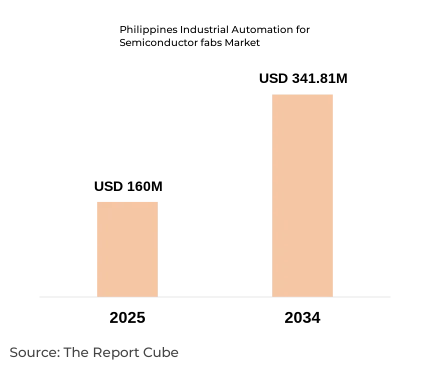
The Philippines Industrial Automation for Semiconductor Fabs Market is anticipated to register a CAGR: 8.8% during 2026-34. The market size was valued at USD 160 million in 2025 and is projected to reach USD 341.81 million by 2034. Strong export demand, global supply chain diversification, and increasing complexity of semiconductor packaging are driving automation investments across Philippine fabrication and assembly facilities.
The Philippines ranks among Southeast Asia’s major semiconductor assembly and test hubs, contributing more than 55% of the country’s total electronics exports. With rising demand for AI accelerators, automotive chips, and power management devices, fabs are scaling backend automation, robotics integration, and advanced inspection systems. Assembly and test operations, concentrated in economic zones in Laguna, Cavite, and Cebu, are modernizing to meet sub-micron accuracy requirements and shorter production cycles.
Automation intensity per fab is increasing as chip packaging transitions toward system-in-package (SiP), advanced wafer-level packaging, and heterogeneous integration. These processes require precise wafer handling systems, automated optical inspection, and real-time process control platforms. Industry estimates indicate that automation spending per new backend line increased by nearly 18% between 2023 and 2025, reflecting tighter yield control requirements. Industrial robotics deployment in semiconductor assembly lines has also expanded, with robot density in electronics manufacturing exceeding 150 units per 10,000 workers in leading facilities.
Government-backed incentives under the CREATE Act are reducing capital expenditure burdens for automation equipment imports, encouraging multinational firms to expand production lines locally. Furthermore, fab operators are integrating automation software and industrial networks to support predictive maintenance, reducing unplanned downtime by an estimated 12-15%. As semiconductor nodes shrink globally and packaging complexity rises, automation remains essential for maintaining yield rates above 98% in high-volume production environments.
Philippines Industrial Automation for Semiconductor Fabs Market Dynamics
Key Driver: Rising Backend Semiconductor Complexity and Export Growth
Assembly and test fabs in the Philippines are transitioning toward high-density packaging formats that demand advanced motion control, inspection, and test systems. Backend automation reduces defect rates, ensures traceability, and accelerates throughput. Semiconductor exports exceeded USD 45 billion in recent years, reinforcing the need for high-efficiency automated systems. Automated test equipment (ATE) adoption is rising as chips for AI, automotive electronics, and 5G applications require more extensive validation cycles. Companies are deploying programmable logic controllers, robotics, and AI-based defect detection systems to enhance line efficiency. Yield optimization through automated process control has become critical, particularly for advanced packaging lines where micron-level precision is mandatory.
Book your FREE 30-minute expert consultation today
Contact UsIndustry Trends: Integration of Robotics, Smart Sensors, and Digital Twins
Industrial robotics integration is accelerating in wafer handling and die bonding operations. Collaborative robots are increasingly used for precision material transfer in cleanroom environments. Smart sensors and machine vision systems now support real-time defect detection with sub-micron resolution. Digital twin technology is gaining traction, allowing fabs to simulate process flows and predict equipment failure before disruption occurs. Automation software platforms integrating SCADA and distributed control systems are enabling centralized monitoring of utilities and cleanroom conditions. Energy management systems are also being automated, reducing facility energy consumption by up to 10% annually. These technological upgrades are enhancing overall equipment effectiveness (OEE) and supporting sustainable fab operations.
Major Challenge: High Capital Intensity and Skilled Workforce Gaps
Automation deployment in semiconductor fabs requires significant upfront capital, particularly for advanced inspection and metrology tools. Test & measurement equipment can account for nearly 30% of automation investment in new lines. Smaller local fabs may face constraints in upgrading legacy systems. Additionally, operating sophisticated control systems requires specialized engineering talent. While the Philippines has a strong electronics workforce base, advanced robotics programming and automation software expertise remain limited. Training investments and partnerships with automation vendors are essential to bridge these capability gaps and sustain competitive positioning within regional semiconductor manufacturing.
Opportunity: Localization of High-Value Packaging and Smart Factory Expansion
Global semiconductor supply chain realignment is creating opportunities for the Philippines to capture higher-value backend operations. As advanced packaging demand grows, fabs are upgrading to fully automated die attach, wire bonding, and inspection platforms. Industrial networks and automation software integration enable real-time production analytics, improving responsiveness to global customers. Smart factory initiatives incorporating AI-driven yield analytics and predictive maintenance systems are projected to increase productivity by over 15% in upgraded facilities. These modernization efforts position the Philippines as a competitive alternative to larger semiconductor hubs while strengthening resilience in global chip supply chains.
Philippines Industrial Automation for Semiconductor Fabs Market Segment-wise Analysis
By Equipment Type:
- Wafer Handling Systems
- Material Handling Systems
- Process Control Systems
- Inspection & Metrology
- Test & Measurement
- Cleanroom Automation
- Others
Test & Measurement holds approximately 24% of the market share, driven by increasing validation complexity for AI and automotive chips. Automated test equipment ensures performance reliability across temperature ranges and voltage thresholds. Backend fabs rely on high-throughput testers capable of handling thousands of units per hour. As chip architectures grow more sophisticated, multi-site testing capabilities are expanding. Inspection & metrology tools follow closely, supporting precision verification in advanced packaging. Continuous yield monitoring through automated systems enables defect detection rates above 99%, reducing rework costs and enhancing export competitiveness.
By Fab Type:
- Wafer Fabrication Fabs
- Assembly & Test Fabs
- Specialty Semiconductor Fabs
Assembly & Test Fabs dominate with nearly 52% revenue share, reflecting the Philippines’ strong backend manufacturing footprint. These facilities require extensive automation across die bonding, encapsulation, inspection, and final testing. Automation integration improves cycle time efficiency and minimizes contamination risks within cleanroom environments. Specialty semiconductor fabs, including power and analog device production, are gradually increasing automation intensity to support automotive and renewable energy applications. Wafer fabrication remains limited compared to backend operations, but incremental investments in process control systems are enhancing local value addition.
Regional Projection of Philippines Industrial Automation for Semiconductor Fabs Industry
- Luzon
- Visayas
- Mindanao
Luzon leads with around 63% share, supported by semiconductor clusters in Laguna, Cavite, and Batangas. The presence of major multinational assembly and test operations drives automation investments. Economic zones offer infrastructure advantages and logistics connectivity for export-oriented production. Visayas, particularly Cebu, is expanding backend capacity, highlighted by Teradyne’s facility expansion in 2025. Mindanao remains emerging but shows potential as infrastructure development progresses. Regional growth patterns align closely with industrial park expansion and government-supported investment incentives.
Philippines Industrial Automation for Semiconductor Fabs Market Recent Developments
- 2025: Teradyne Philippines completed the acquisition of a 290,000-square-foot facility in Cebu to expand semiconductor test production, strengthening automated test capacity supporting AI-driven semiconductor applications.
- 2025: Siemens Philippines highlighted expanded automation and digitalization investments across Asia, reinforcing deployment of advanced industrial control and digital twin solutions into semiconductor manufacturing facilities.
- 2025: Omron Automation announced the launch of 22 new sensor and controller models in fiscal 2025, enhancing precision control systems targeted at semiconductor manufacturing environments.
- 2025: ASM Pacific Technology (ASMPT) maintained global leadership in semiconductor assembly equipment, supporting backend automation expansion and advanced packaging capabilities in markets including the Philippines.
Need insights for a specific region within this market?
Request Regional DataWhy Choose This Report?
- Provides a comprehensive overview of the overall market analysis, encompassing key trends, consumer behavior analysis, and risk assessment to support strategic decision-making.
- Provides accurate, up-to-date insights into market size, segmentation, and emerging opportunities, helping to minimize risk & capitalizing on growth.
- Gives deep understanding of target audience preferences, investment habits, and communication channels for enhanced product development & marketing effectiveness.
- Delivers competitive analysis & benchmarking, uncovering the strengths & weaknesses of market competitors to guide strategies.
- Consolidate comprehensive market intelligence, reducing reasoning & streamlining research efforts.
- Facilitates customized market segmentation & risk mitigation strategies, fine-tuned to the business objectives.
- Aids in identifying both market challenges & untapped opportunities within the industry to drive long-term business growth.
- Provides valuable information based on actual customer data & search trends.
Table of Contents
- Introduction
- Objective of the Study
- Product and Category Definition
- Market Segmentation
- Study Variables
- Research Methodology
- Secondary Data Points
- Breakdown of Secondary Sources
- Primary Data Points
- Breakdown of Primary Interviews
- Secondary Data Points
- Executive Summary
- Market Dynamics
- Drivers
- Challenges
- Opportunity Assessment
- Recent Trends and Developments
- Regulatory and Policy Landscape
- Philippines Industrial Automation for Semiconductor Fabs Market Overview (2021-2034)
- Market Size, By Value (USD Million)
- Market Share, By Equipment Type
- Wafer Handling Systems
- Material Handling Systems
- Process Control Systems
- Inspection & Metrology
- Test & Measurement
- Cleanroom Automation
- Others
- Market Share, By Control System
- Programmable Logic Controllers
- Distributed Control Systems
- Supervisory Control and Data Acquisition
- Industrial Robotics
- Industrial Sensors
- Industrial Networks
- Automation Software
- Market Share, By Fab Type
- Wafer Fabrication Fabs
- Assembly & Test Fabs
- Specialty Semiconductor Fabs
- Market Share, By Application
- Front End Processes
- Back End Processes
- Utilities & Facilities
- Market Share, By Node Size
- More than 65nm Nodes
- 45nm to 65nm Nodes
- 22nm to 45nm Nodes
- Below 22nm Nodes
- Market Share, By Region
- Luzon
- Visayas
- Mindanao
- Market Share, By Company
- Revenue Shares & Analysis
- Competitive Landscape
- Luzon Industrial Automation for Semiconductor Fabs Market
- Market Size, By Value (USD Million)
- Market Share, By Equipment Type
- Market Share, By Control System
- Market Share, By Fab Type
- Market Share, By Application
- Market Share, By Node Size
- Visayas Industrial Automation for Semiconductor Fabs Market
- Market Size, By Value (USD Million)
- Market Share, By Equipment Type
- Market Share, By Control System
- Market Share, By Fab Type
- Market Share, By Application
- Market Share, By Node Size
- Mindanao Industrial Automation for Semiconductor Fabs Market
- Market Size, By Value (USD Million)
- Market Share, By Equipment Type
- Market Share, By Control System
- Market Share, By Fab Type
- Market Share, By Application
- Market Share, By Node Size
- Competitive Outlook and Company Profiles
- Mitsubishi Electric (MELCO)
- Company Overview
- Product Portfolio
- Strategic Alliances/Partnerships
- Recent Developments
- Omron Automation
- Company Overview
- Product Portfolio
- Strategic Alliances/Partnerships
- Recent Developments
- Siemens Philippines
- Company Overview
- Product Portfolio
- Strategic Alliances/Partnerships
- Recent Developments
- ASM Pacific Technology (ASMPT)
- Company Overview
- Product Portfolio
- Strategic Alliances/Partnerships
- Recent Developments
- Teradyne Philippines
- Company Overview
- Product Portfolio
- Strategic Alliances/Partnerships
- Recent Developments
- Festo Philippines
- Company Overview
- Product Portfolio
- Strategic Alliances/Partnerships
- Recent Developments
- Schneider Electric
- Company Overview
- Product Portfolio
- Strategic Alliances/Partnerships
- Recent Developments
- SMC Pneumatics Phils.
- Company Overview
- Product Portfolio
- Strategic Alliances/Partnerships
- Recent Developments
- Rockwell Automation
- Company Overview
- Product Portfolio
- Strategic Alliances/Partnerships
- Recent Developments
- ABB Philippines
- Company Overview
- Product Portfolio
- Strategic Alliances/Partnerships
- Recent Developments
- Keyence Philippines
- Company Overview
- Product Portfolio
- Strategic Alliances/Partnerships
- Recent Developments
- Mtech Industrial Automation
- Company Overview
- Product Portfolio
- Strategic Alliances/Partnerships
- Recent Developments
- Unseen Era
- Company Overview
- Product Portfolio
- Strategic Alliances/Partnerships
- Recent Developments
- Controtek Solutions
- Company Overview
- Product Portfolio
- Strategic Alliances/Partnerships
- Recent Developments
- AMG Systemtechnik
- Company Overview
- Product Portfolio
- Strategic Alliances/Partnerships
- Recent Developments
- VTech Automation Corp.
- Company Overview
- Product Portfolio
- Strategic Alliances/Partnerships
- Recent Developments
- Air Liquide Philippines
- Company Overview
- Product Portfolio
- Strategic Alliances/Partnerships
- Recent Developments
- Others
- Mitsubishi Electric (MELCO)
- Contact Us and Disclaimer
Top Key Players & Market Share Outlook
- Mitsubishi Electric (MELCO)
- Omron Automation
- Siemens Philippines
- ASM Pacific Technology (ASMPT)
- Teradyne Philippines
- Festo Philippines
- Schneider Electric
- SMC Pneumatics Phils.
- Rockwell Automation
- ABB Philippines
- Keyence Philippines
- Mtech Industrial Automation
- Unseen Era
- Controtek Solutions
- AMG Systemtechnik
- VTech Automation Corp.
- Air Liquide Philippines
- Others
Frequently Asked Questions






